Join Our Wine Journey – Sign Up for the Newsletter 🍷
The Mascot: Finding Its Place
Share
Deel op X (twitter)
LinkedIn
WhatsApp
The Mascot: Finding Its Place.
Drawing on younger vines from Harlan Estate, BOND and Promontory, The Mascot occupies an unusual position within the Harlan family Domain. For Will Harlan, its significance is also deeply personal: this was the wine that served as his first step into the family business.
The Harlan family endeavors explored in our earlier stories each offer a different perspective on Napa Valley. Harlan Estate is rooted in continuity and the long view, shaped by Bill Harlan’s ambition to create one of the world’s great wine estates and ultimately by a 200-year vision extending far beyond the generation that conceived it. Promontory is a story of discovery, of encountering a territory sufficiently different that experience accumulated elsewhere could not simply be transplanted there. BOND looks outward across Napa Valley, using five carefully selected hillside vineyards to explore the individuality of place through Cabernet Sauvignon.
The Mascot follows none of these models exactly. It brings parts of all three worlds together, yet began without the intention of becoming an official part of the Domain. Its origins lie with younger vines that had not yet reached the stage at which they could contribute to their respective parent wines, and with a young Will Harlan who was not yet certain that his own future would lie within the family business. The two would develop alongside each other, gradually finding their place within a structure already defined by exacting standards and unusually long horizons.
An Unnamed Wine
“It was certainly an important one for me because it represented my first step into the family business, unintentionally,” Will explains. Growing up around Harlan Estate naturally exposed him to wine, but there was no assumption that he would simply move into the family business. His interests initially took him elsewhere, first to university and eventually towards San Francisco and the technology sector, even if wine remained something he wanted to understand more deeply.
During university breaks, Will would return to Napa Valley and occasionally sit in on blending sessions, often held around Christmas and early January. He was there primarily to observe his father and the winemaking team, to taste alongside them and ask questions. It was during these sessions that he became interested in certain lots not being selected for the parent wines. Their exclusion, critically, was not a reflection of insufficient quality. Many came from younger vines capable of producing excellent fruit, but which had not yet reached the stage where the team believed they could consistently communicate the character of their individual sites with sufficient depth and transparency.
For Will, those components presented an opportunity to learn. He asked his father, the family and winemaker Cory Empting whether he might use some of them to create a blend of his own, not as a wine to be brought to market, but as an exercise in understanding how different component wines worked together. “I wanted to learn more,” he recalls. “And I thought it would be an interesting way to learn—to be putting together my own blend.”
The resulting wine had neither a name nor a label, because at that stage it needed neither. Will shared it with friends and it gradually became a regular presence around the Harlan family dinner table. As he points out, the family was not routinely drinking Harlan Estate, for instance, at home; production was too limited for that. His unnamed blend served another purpose, becoming something that could be opened freely and enjoyed without ceremony.
After university, Will moved to San Francisco, where much of his attention was directed towards the technology world. He worked building websites, explored various company ideas and took bottles of his still-unnamed wine to gatherings with other young people pursuing similar ventures. The bottles were effectively “shiners,” without labels or any suggestion of a brand behind them. Before long, Will found himself confronting an amusing reality: the young, aspiring entrepreneurs around him appeared rather more taken by the wine than the tech-related ventures he was focused on.
He returned to his family with the suggestion that there might be an audience for it beyond friends and the family table. For Bill Harlan and the family, releasing a new wine was not without risk. Harlan Estate, for instance, had been built around a very different model, and there was understandable concern about a wine at a fraction of its price becoming immediately associated with the Harlan name.
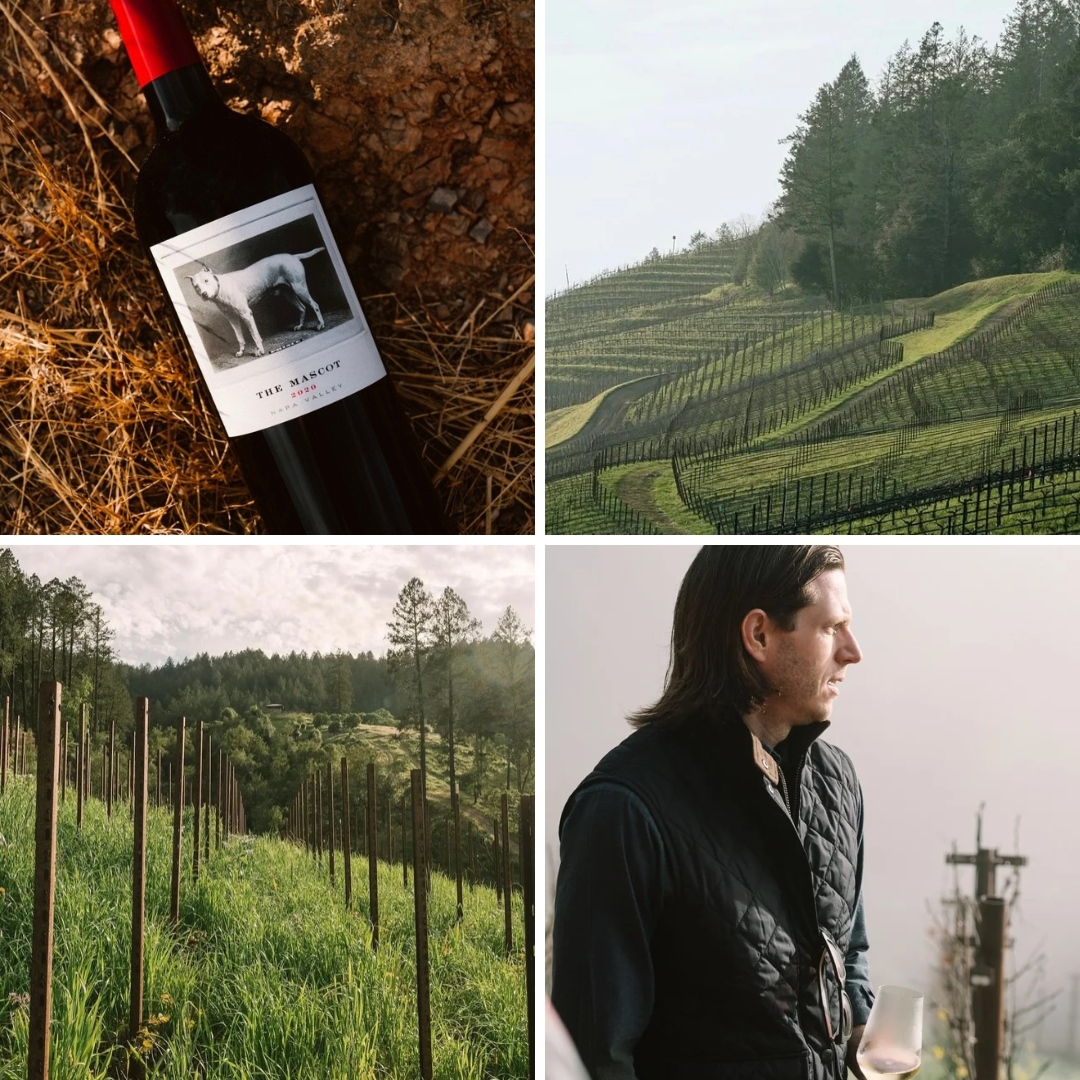
Will Harlan turned a project for close friends and family into a successful part of the portfolio of Domain HWH.
The eventual agreement came with strict conditions. Neither Will’s name nor Harlan could appear on the label or packaging, he could not use the Domain’s existing distribution relationships, and the established private-client lists of the family’s wineries were off limits. If there was an audience for the wine, Will would have to find it himself.
Those restrictions gave Will a certain freedom, but little shelter. Rather than receiving a ready-made position within the family portfolio, he had to build a following independently. The first official vintage, 2008, therefore marked both the beginning of The Mascot, as well as Will’s first practical experience of founding a wine project of his own.
Looking back, he believes his father understood that allowing him this freedom might serve a longer-term purpose. “I think he saw that there was a longer-term benefit of letting me do this, which was to hopefully bring me back to the wine business, to the family business.”
It did. The Mascot preceded Will’s involvement in the formative years of Promontory and the broader responsibilities that followed. He is careful not to overstate its position today—after years of work, Promontory has become more foundational to him personally—but The Mascot remains the place where he first “got to cut my teeth and learn and experiment a whole lot.”
Young Vines, Pedigree and Promise
Understanding what The Mascot became requires returning to those vineyard lots that first caught Will’s attention at the blending table. Describing them simply as young-vine material is accurate, although the terminology can easily create the wrong impression. Within the Harlan Family Domain, a vineyard is generally around seven years old before its fruit is even considered for The Mascot, while Will estimates that contributing vines average closer to twelve years, broadly ranging between seven and fifteen. By most definitions in the wine world, these are already established vines.
The distinction the team makes is not simply one of quality, but of the ability to translate place. Younger vines can produce remarkable wine, something the family’s own history demonstrates: when Harlan Estate’s 1994 vintage was produced, for instance, some vines were still only around seven years old. With greater maturity, however, the team looks for increasing resilience through the variations of individual seasons and, eventually, a deeper and more transparent expression of the vineyard itself. Once vines approach roughly fifteen years of age, depending on the site and block, they can begin to be considered for Harlan Estate, one of the five BOND wines, or Promontory respectively.
None of these transitions is automatic. Everything is tasted, and each vintage there are plenty of remaining blending components that do not meet the required standard for inclusion within The Mascot. The result is that The Mascot becomes a deliberate selection from a particular phase of vineyard development.
The Mascot is sourced from a diversity of the Domain WHW vineyards.
That phase is a permanent part of the Domain. The family currently works on the assumption that its vineyards may have a productive lifecycle of approximately fifty years, implying that, on average, around two percent of the vineyard area must be replanted annually. There will consequently always be sections of Harlan Estate, BOND and Promontory progressing through the years between establishment and the maturity expected of their respective parent wines.
The Mascot itself needed time to assume a formal place within that cycle. During the early years, Will describes it as more of a byproduct, assembled around the requirements of the parent wines. After five or six years, however, the family began to understand both the quality it could achieve and the role it might play in building a new audience for the family domain, who might not already be conversant with Harlan Estate, BOND, or Promontory. By around the 2016 vintage, it had become a fully intentional part of the program, with cellar capacity, vessels, and personnel planned accordingly.
Will describes the vineyards behind the wine through two ideas: pedigree and promise. Pedigree traces the connection to the land, the same hillside properties responsible for Harlan Estate, Promontory, and the five BOND wine, while promise establishes the connection to the future: these young vines will be aspiring, someday, to inclusion within their parent wines.
Young vines are used for the Mascot, with ‘young’ being a relative term here.
Each time a new block of vineyard is replanted, the team has an opportunity to apply their accumulated experience and wisdom to the establishment of the vines from the outset. Vine-training architecture, orientation, spacing, pruning, can all reflect what has been learned since the previous generation went into the ground; Will points, for instance, to the increasing movement towards head-trained vines rather than trellising. The younger vineyards are therefore not simply less mature versions of what preceded them, but also the first to embody the Domain’s yet deeper understanding of its sites.
“The Mascot is going to be the first beneficiary of that learning,” Will says. Blocks contributing to The Mascot today will eventually earn into consideration for Harlan Estate, BOND or Promontory, giving the wine an intriguing position between the established pedigree of those properties and their continuing evolution.
Seven Places, One Expression
There is another peculiarity to the project. Harlan Estate, BOND, and Promontory devote considerable effort to understanding and preserving differences between places. Harlan Estate is rooted in one estate, BOND deliberately keeps five vineyards separate, while Promontory has developed a winegrowing language shaped by a single territory fundamentally different from the family’s other holdings. The Mascot ultimately brings material from all seven sites into a single wine.
For most of its life in the cellar, however, that wine does not yet exist. “The Mascot doesn’t become The Mascot until the final blending,” Will explains.
Younger-vine fruit from Harlan Estate is harvested, vinified and matured at Harlan Estate according to the approach developed there. The BOND components follow their path at the BOND winery, while the Promontory material is produced at Promontory and undergoes élevage according to the methods established for that property, including its Austrian oak vessels. Each component therefore reaches the final blend carrying both the character of its vineyard and the interpretation developed specifically for that place.
The proportions can vary with every vintage. Nature determines what each vineyard provides, while different replanting schedules mean that the availability of suitable fruit fluctuates between the seven sites. Cabernet Sauvignon overwhelmingly dominates the finished wine, generally accounting for around 95 to 96 percent of the blend, with small quantities of the other Bordeaux varieties potentially entering from Harlan Estate.
Speaking of the blending table, Will admits that identifying the character of all seven sites in the finished wine would be unrealistic, though at the same time that is not the objective. “The beauty of The Mascot is when they come together.”
There is something counterintuitive about this within a fine-wine world that tends to move towards ever greater specificity. Region becomes appellation, appellation becomes vineyard and eventually attention turns towards individual parcels. Harlan Estate, BOND, and Promontory pursue that specificity in their own way, but each ultimately seeks the point where quality can be transcended by the character of a particular place.
When we ask Will how he understands the identity of The Mascot, his answer is strikingly simple: “The Mascot can just become this wonderful example of our region as a whole.”
Using vineyards from the different estates creates a representation of both Napa Valley and Domain WHW.
That broader perspective is what separates it most clearly from the parent wines. BOND explores Napa Valley through the diversity among its five vineyards; The Mascot provides a lens into those places as woven together with Harlan Estate and Promontory. Will also believes that, without a single site dominating, something of the common philosophy or culture behind the properties becomes more visible—the shared approach of the people interpreting these very different places.
This is also why comparisons with a conventional “second wine” only go so far. The Domain already has wines serving that function within its individual estates, including The Maiden at Harlan Estate, and Matriarch at BOND, while Penultimate at Promontory follows a somewhat different progression related more directly to vine age. The Mascot sits outside those hierarchies. Its components remain within the winemaking regimes of their parent estates until the final blending; what changes is not the ambition behind them, but what the finished wine is being asked to express.
The Freedom to Be Enjoyed
That difference leads back to the reason Will began making the wine in the first place. He wanted to learn about blending, but he also wanted something he could open with friends rather than a bottle that demanded overt fanfare. Working across seven sites gives the team enough flexibility to bring varying structures, textures, and aromatic profiles together into a wine that can become inviting relatively early without abandoning the substance required for further development.
When asked whether The Mascot is therefore allowed to have more fun than the other wines, Will answers without hesitation. “For sure.” He describes a bottle that should become a natural part of a gathering rather than requiring the occasion to organize itself around the wine. “It didn’t need to steal the spotlight,” he says. “It was just a really wonderful way to bring folks together.”
Nothing about the viticulture or winemaking is casual, yet the intended relationship between the wine and the person drinking it is less ceremonial. Within a collection associated with some of Napa Valley’s most collected and scrutinized bottles, The Mascot has retained something of the unnamed wine that once appeared around the Harlan family table.
For this article, we tasted the 2020 vintage, awarding it 94 points on the DWA scale.
2020 The Mascot, Napa Valley | 94/100 DWA Score
The 2020 is a wine of considerable depth, but one that carries its concentration with relative ease. The fruit profile is predominantly dark, moving through black cherry, blackberry and plum, with a more savoury register gradually emerging around cedar, graphite, dried herbs and tobacco. There is richness, but also sufficient freshness and aromatic lift to prevent the wine from becoming heavy or overly polished.
The palate follows much the same line, with substance and density through the center framed by fresh acidity and fine-grained but persistent tannins. The structure suggests considerable development ahead, yet the wine is already approachable with sufficient air. It does not require the same patience one would instinctively grant Harlan Estate, Promontory or one of the individual BOND wines, although neither does it feel designed primarily for early consumption.
What convinces most is the composition. There is no reason to search here for the singular identity of one vineyard; instead, the 2020 succeeds through balance and layering, with the different elements coming together without making the wine feel constructed. It combines the seriousness of its origins with a more immediate and convivial character.
2020 The Mascot – 94/100 DWA score.
Prince and The Mascot
That conviviality extends beyond the character of the wine itself. When the unnamed project eventually needed an identity, Will found one in an image whose story seemed unexpectedly close to what The Mascot had already become.
The dog on the label is often assumed to have been a Harlan family pet, although its history reaches much further back. Like the historic engravings used elsewhere within the Domain, the image was discovered in the archives of the American Bank Note Company and dates from the late nineteenth century, when it was commissioned for the Farmers Deposit National Bank of Pittsburgh.
His name was Prince. The offspring of a prize-winning show dog and an ordinary street dog, he eventually found his home at the bank, where he became part of everyday life, greeting customers and developing a particular affinity with the farmers who did business there. Prince became sufficiently identified with the institution that his likeness was eventually engraved onto its securities.
Prince, the original role model for the Mascot.
Will was drawn both to the unusual subject of the engraving and to Prince’s expression, which he saw as inquisitive and characterful rather than conventionally sentimental. More important was what the dog had come to represent. Prince became associated with loyalty, friendship and the relationship between the bank and its customers, serving as an emblem of its values without ever having been intended for that role.
Will recognized something of his own wine in the story. The Mascot, too, had begun without a formal position to occupy and gradually assumed one through the relationships it created. Prince had become the mascot of the bank; this wine could play a similar role for the Harlan family Domain.
Finding Its Place
The four endeavors we have explored ultimately reveal different expressions of the Harlan family’s conviction in Napa Valley. Will speaks about opportunities to pursue projects elsewhere in California, elsewhere in the United States and internationally, but the family has repeatedly chosen to deepen its commitment to the region it believes in most deeply. Napa Valley, in his view, remains young enough that much of its ultimate potential has yet to be understood, which explains the desire to “double and triple down” rather than look elsewhere.
Within that picture, The Mascot occupies a position of its own. Harlan Estate is grounded in continuity of evolution, Promontory in discovery, and BOND in the individuality of five distinct vineyards. The Mascot draws from all of them, exchanging the singularity of an individual site for a broader view of the region’s hillsides, and the shared culture of the family and team.
The Mascot was and is a wine for the center of the table, to be shared and enjoyed.
It is also what makes The Mascot an appropriate place to conclude these four stories. What began as Will’s curiosity about a few younger-vine lots became his first independent project within the family business, and eventually an established part of the Domain. His father may not have conceived a wine like The Mascot himself, as Will acknowledges, but he gave his son enough independence to discover whether the idea had merit. Bill Harlan, meanwhile, is known to drink more bottles of The Mascot than any of the family’s other wines.
The Mascot was never conceived as a statement about succession. Yet its beginnings now seem quietly prescient: a wine drawn from vines still developing their identity became the project through which the next generation first began to develop its own.
This article is written by our own Niels Aarts. We would like to thank Will Harlan for his time and openness, as well as our partner Colaris in the Netherlands, who distributes and sells the wine and provided us with a tasting sample. Picture credits: The Mascot and Domain HWH.
Join our insiders’ list and get exclusive early access to new articles, expert tips, and fresh reviews delivered straight to your inbox. Subscribe now and be the first to discover!