Join Our Wine Journey – Sign Up for the Newsletter 🍷
Cascina Penna-Currado, Writing on a White Paper
Share
Deel op X (twitter)
LinkedIn
WhatsApp
Cascina Penna-Currado, Writing on a White Paper.
It is late June in the Langhe, and Elena Penna is on the phone while Luca Currado Vietti is in the vineyard. The heat has been relentless – weeks above 35 degrees, humidity that makes the afternoons almost unworkable. Elena mentions, almost in passing, that the Timorasso harvest is expected to begin around the 20th of August. A harvest date that, a generation ago, would have been unthinkable for a variety grown at altitude in the Colli Tortonesi. The calendar has shifted that much.
It is a small detail that says everything about why Cascina Penna-Currado exists the way it does. For Luca and Elena, climate change is not a threat to be managed – it is the organizing principle of every decision they have made since leaving Vietti in January 2023. Which vineyards to choose. How to farm them. What the wines should taste like. And, perhaps most importantly, what Barolo might become in the decades ahead.
Our own Onno Deumer spoke with Elena Penna about a project built not on nostalgia, but on the freedom of a blank page.
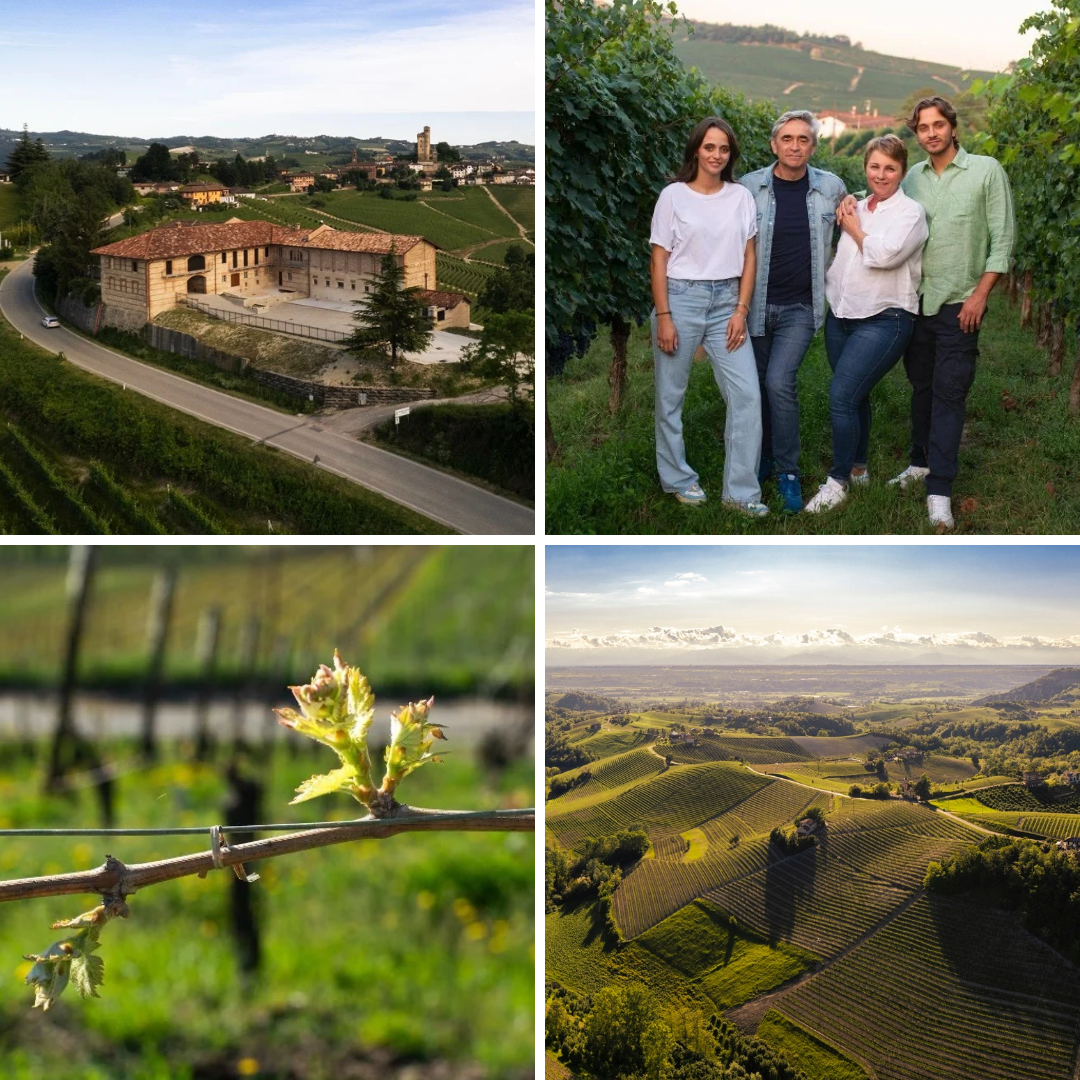
Giulia, Luca, Elena and Michele – the family behind Cascina Penna-Currado, in the vineyards above Serralunga d’Alba.
The House They Built
To understand Cascina Penna-Currado, you must understand Vietti – because one is impossible without the other.
Vietti is a family name as much as a winery name. The estate passed to Luca Currado Vietti through his mother, Luciana Vietti, who married Alfredo Currado – a winemaker who proved to be one of Barolo’s great pioneers: among the first to bottle single-cru Barolo, to produce commercial Arneis, and to introduce artist-designed labels that became part of the house’s identity. Luca inherited that world and expanded it, training at Opus One and Mouton-Rothschild before returning to build one of the most diverse MGA portfolios in the appellation. Elena came later, shaping the commercial identity of the house and championing Timorasso as a serious white wine before almost anyone else in the Barolo world was paying attention. That project was, from the beginning, hers.
Luca Currado Vietti at harvest – decades of building one of Barolo’s most celebrated portfolios, and still carrying the crates himself.
In 2016, Vietti was sold to an American multinational. The decision involved other members of the family, whose interests had diverged from Luca and Elena’s. It was not straightforward. What followed was nearly seven more years of stewardship: they stayed on to manage the estate, build the team, and ensure that the quality and positioning they had spent a lifetime creating would survive the transition intact.
Those years were productive – new crus, a stronger team, growing international recognition. But somewhere in that period, the space between what Luca and Elena wanted to do and what the situation allowed began to narrow. Elena is careful with how she describes this. No bitterness, no pointed criticism. The vision, over time, was no longer the same. For her, that was reason enough to go.
What turned that ending into a beginning was their children. Luca and Elena had never pushed Michele and Giulia toward the family trade – they had always believed that kind of commitment had to come from within. When both said they wanted to be part of whatever came next, the decision shifted in nature entirely. Leaving Vietti was no longer just about stepping away. It was about building something together, from the beginning. In January 2023, they left.
The White Paper
The physical foundation had been secured years before the project existed. Cascina Santa Giulia – known today as Cascina Lazzarito – is a farmhouse built in 1554, once part of the Opera Pia Barolo charity, where grapes from across Serralunga were vinified for generations. Luca had admired it since childhood. They bought it in stages from 2018 onwards and spent much of 2023 making it workable. For Elena, the choice needed no explanation: no better place to begin than one where wine had been made for 500 years.
Cascina Lazzarito, built in 1554, with the village of Serralunga d’Alba visible on the hill behind. The estate Luca had admired since childhood – and that became the physical heart of the new project.
What they did not have, when they walked out of Vietti in January 2023, was anything else. No vineyards. No cellar equipment. No plan. Elena describes it simply: they looked at each other and agreed they were too young to stop. They had 37 harvests of experience behind them and a clear sense of what they wanted to build – the shape of it, however, was still undefined.
What happened next was, by their own account, unexpected. People came to them. Growers they had worked alongside for decades, colleague’s vignerons who had watched them build Vietti from the inside, reached out with vineyard offers and practical help. Friends lent or sold used barrels – good casks, already broken in – so the first wines could begin aging while new oak was being sourced and prepared. It was, as Elena puts it, a project built on karma: “These are all people that maybe in our life we helped, without expecting anything from them. And when we had the need, they came back.”
The freedom that came with starting from nothing was also, paradoxically, an advantage. Without existing vineyards to maintain or a cellar identity to preserve, Luca and Elena could ask a question that most established producers never get to ask cleanly: what would we choose, today, knowing what we know now? They had the answer ready. They had been working on it for years.
A Vision Built for Fifty Years
At its core, that philosophy is a clear preference for a different kind of Barolo: one that leads with elegance and freshness rather than concentration and extraction. Not a lighter wine, but a more precise one – unmistakably Barolo, yet with less weight and more aromatic definition than much of what the region currently produces. In practice, this means seeking out cooler vineyard sites, harvesting earlier than most of their neighbors, using large neutral vessels rather than small oak, and intervening as little as possible in both vineyard and cellar. The result, intended, is wine with lower alcohol and more aromatic clarity – not as a stylistic statement, but as the honest expression of what the Langhe can produce when it is not pushed.
The full range of Cascina Penna-Currado, each wine a different expression of the same conviction: freshness, precision, and restraint.
Climate change reinforces this thinking but does not define it. What it does is make certain choices more urgent. Sites that were considered marginal a generation ago – too cool, too late-ripening, too exposed to mountain air – are now among the most interesting in the region. Cascina Penna-Currado has built its portfolio around exactly those places.
That awareness also shapes how they think about the full range of wines they make. Barolo is the destination, but the Langhe was always more than Nebbiolo. Dolcetto and Barbera sustained these farms for generations, keeping families afloat while Nebbiolo took its time. Elena is emphatic: they deserve serious attention, not a footnote. “The world has been changing so much in the last 30 years,” she says. At Cascina Penna-Currado, the answer to that change begins not only in cooler sites, but in what was always grown there.
The hills around Monforte d’Alba, with San Sebastiano’s vineyards, forest and natural lake visible from above – a landscape chosen not for its reputation, but for what it offers in a warming climate.
San Sebastiano – The Vineyard That Saw It Coming
Of all the choices Luca and Elena made in assembling Cascina Penna-Currado’s vineyard portfolio, none is more revealing than San Sebastiano.
The story of how it came to them is as much about the people as the land. A farming family in Monforte d’Alba, with no children to inherit their life’s work, reached out when they heard Luca and Elena were starting something new. The man who made the call had been driving tractors in those vineyards since he was eight years old, his feet barely reaching the pedals. He had spent more than fifty years building what he had. And he wanted to know it would be in the right hands – not just good hands, but hands that would commit to it for the long term. “For me and Luca,” Elena says, “we were not thinking one second.”
San Sebastiano sits at 470 to 480 metres above sea level, open to the north and east, facing the mountains. It lies just outside the official Barolo border – and there is a reason for that. When the Barolo appellation was drawn in 1966, the rules required Nebbiolo to reach a defined level of ripeness. In San Sebastiano, the climate was simply too cool, the harvest too late – sometimes stretching into November – to reliably achieve it. As Elena puts it: “Farmers in their minds said: if we are in the Barolo region and we have to make that quality of Nebbiolo for the Barolo, we might be able to do this one year on six, seven.” For most, it made no economic sense. Dolcetto and Barbera paid the bills far more reliably. San Sebastiano stayed outside the border.
San Sebastiano, with the Alps clearly visible on the horizon. The mountain air that once made ripening unreliable is now precisely what makes the site valuable.
Today, that same altitude and exposure are precisely what makes the site valuable. The wind from the mountains keeps the air cooler than the valley floor. The health of the grapes is consistently better, because that wind dries the clusters after rain. Harvest runs later than at the estates around it – a natural buffer against premature ripening. The biodiversity is remarkable too: vineyards bordered by hazelnut orchards, forest, a natural lake – a living ecosystem that moderates temperature and keeps the grapes healthier than anything viticultural intervention alone could achieve.
The wine San Sebastiano produces today – as Nebbiolo d’Alba, the small appellation that has always included this area – shows what the site already is. Elena is careful not to overstate what may eventually happen to the appellation’s borders, but she does not hide what she thinks of the quality: “It has such stunning Nebbiolo that for sure, probably, it will be included one day. But this will never happen.” The contradiction, delivered without irony, says it all.
Cascina Penna-Currado San Sebastiano Nebbiolo d’Alba Superiore 2023 | 94/100 DWA score
The nose is delicate and aromatic, with red fruit, dried flowers and a faint herbal edge – the kind of restraint that comes from a site that never rushes ripening. On the palate, the wine reveals unexpected depth and grip, with tannins that are firm but finely woven and an acidity that keeps the line taut from start to finish. The finish is long and mineral, with a cool persistence that lingers well beyond expectation.
The same logic guided the choice of Monvigliero in Verduno for one of the single-vineyard Barolos. Here it is not altitude but the Tanaro River that moderates temperature, keeping the site fresher than its southerly exposure might suggest. Cascina Penna-Currado also holds parcels in Monforte and Novello – the precise MGA sites deliberately unconfirmed ahead of the 2027 releases.
In the Cellar – Restraint as Technique
The same principle that shaped the vineyard choices runs through every decision in the cellar: preserve what the site gives and resist the temptation to add.
For the red wines, the dominant vessel is the traditional large-format botti – Garbellotto casks of 10 hectolitres. Small barriques exist but are reserved for what Elena calls “the spare wines.” The reasoning is direct: “The traditional cask, the more neutral wood, can give less concentration in the wines and keep much more the freshness, the crunchiness and the fragrance of the fruit.” The freshness that San Sebastiano and Monvigliero offer in the vineyard must be transmitted, not competed with. A more extractive vessel would work against everything those sites provide.
The cellar at Cascina Penna-Currado: Garbellotto botti of 10 hectolitres, chosen not for tradition’s sake but for what they allow the vineyard to express.
The cellar at Cascina Penna-Currado: Garbellotto botti of 10 hectolitres, chosen not for tradition’s sake but for what they allow the vineyard to express.
Spontaneous, whole-bunch fermentation is used for the Dolcetto – entirely – and for Monvigliero. The choice of vessel, like the choice of vineyard, is always made in relation to the wine’s intended character: Luca selects the oak format that will best preserve what each site expresses, rather than imposing a house signature. The target alcohol across the red range is deliberately low – pursued not only through site selection but through earlier harvesting than the regional norm, shaving roughly 0.5 to 0.7 degrees compared to conventional approaches. The results are already visible in the wines Cascina Penna-Currado makes today.
Cascina Penna-Currado Dolcetto d’Alba Bricco Lago 2024 | 92/100 DWA score
Dark cherry and wild berry on the nose, with an earthy, rustic undertone that speaks of the grape’s working-class roots. The palate is fresh and direct, with firm tannins and a lively acidity that give it more backbone than Dolcetto typically promises. Whole-bunch fermentation adds depth and grip without weighing it down. A serious take on a variety too long underestimated.
The Barbera follows the same logic – a variety historically sidelined, here given the attention it deserves.
Cascina Penna-Currado Barbera d’Alba Carrà 2023 | 93/100 DWA score
Blackberry and wild herbs lead the nose, with violet and an earthy, mineral undercurrent that gives the wine an almost Nebbiolo-like seriousness. The palate is full and layered, with a crunchy acidity that keeps the richness in check and drives the wine toward a long, focused finish. Old vines from 1965, aged in large botti – the result is a Barbera with the structure and ambition of something far more exalted.
The Langhe Nebbiolo completes the picture. Where the Dolcetto and Barbera speak of the Langhe’s history, this is where the focus shifts entirely to Nebbiolo – and to what the variety can do when it is not pushed toward Barolo’s weight and structure.
Cascina Penna-Currado Langhe Nebbiolo Bricco Lago 2024 | 92/100 DWA score
Savoury and restrained on the nose, with red cherry, violet and wild herbs over an earthy, mineral core. The palate is cool-toned and structured, with fine-grained tannins and a bright seam of acidity that carries through to a focused, persistent finish. For a Langhe Nebbiolo, the depth here is unexpected. For a wine from this team, it is entirely logical.
Elena and the Timorasso
The Timorasso illustrates something that runs through the whole of Cascina Penna-Currado: the willingness to hold a conviction before the world has caught up with it. Elena championed this grape when it was still marginal. She developed a technique for it that sets the E.P. apart from the dominant style in the category. And she has a clear view of where the variety should go, even as the appellation is still working out what it wants to be. In that sense, the Timorasso is not a footnote to the project. It is a distillation of it.
Her connection to the variety predates the boom that has made it fashionable. The Timorasso project at Vietti – launched in 2018 – was her initiative, driven by a conviction she had held long before the category attracted attention: that this grape, from the Colli Tortonesi hills east of Alba, could produce white wine of genuine international importance. The quality, she says, was always there. What it lacked was reach.
Early budbreak in the Langhe – the beginning of a growing season that will only reveal its character months later. Elena’s approach to Timorasso follows the same logic: patience first, complexity in time.
The technique she now uses at Cascina Penna-Currado has its origins in a tasting she still recalls clearly. Some fifteen years ago, in Liguria, she and Luca tasted a Vermentino that showed the texture and body of skin contact without the oxidative notes that usually accompany it. The producer explained the method: a submerged cap, in which the skins are held beneath the fermenting must, extracting structure through infusion rather than open-air maceration. She and Luca were struck by what they tasted. When the time came to make her own Timorasso, she applied the same logic. By 2024, fifty percent of the volume was handled this way – which she considers the ceiling. “Not because something is working you need to apply it in a higher volume. Because maybe then it loses the elegance.”
The wine she has in mind starts fresh and earns its complexity over time – citrus and floral precision in youth, depth with age. It deliberately resists the fuller, more oxidative style that has come to define much of the Derthona category. Timorasso, as Elena sees it, is still finding its common language. Cascina Penna-Currado’s answer is clear: freshness, precision, and the patience to let complexity arrive on its own terms.
Cascina Penna-Currado Derthona E.P. Timorasso 2024 | 93/100 DWA score
Citrus blossom, white peach and chamomile on the nose, with a stony mineral edge underneath. The palate is fresh and precise, carried by bright acidity and a saline thread that runs through to a long, layered finish. Texture without weight – the hallmark of Elena’s submerged cap technique. A Timorasso built for time.
That same thinking extends to Elena Spirits, the vermouth project Elena and Luca founded before Cascina Penna-Currado. Using Timorasso as the base for the bianco and Barolo Lazzarito for the rosso, it applies the same logic as the wines: quality of base material, vintage-specific, no shortcuts.
Close Enough to Matter
At one point during our conversation, Elena is asked what she and Luca are doing differently now – compared to what they could have done at Vietti. She pauses, then says something simple: Their size today allows them to oversee every aspect of the work, from the vineyard to the cellar – something that, until not long ago, they sometimes had to delegate. In short, today they do everything their selves, together. They do the work. That is the difference scale makes, and the difference they chose.
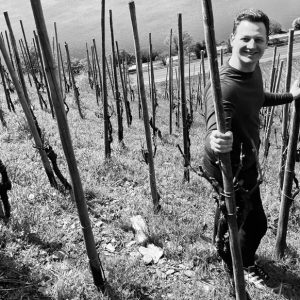
Elena and Luca at harvest – doing the work themselves. At Cascina Penna-Currado, that is not a romantic gesture. It is the whole point.
It is easy to frame Cascina Penna-Currado as a story about freedom – the blank page, the fresh start, the chance to do things right. And it is that. But listening to Elena, what comes through more clearly is not freedom but necessity. These are people who make wine because they cannot imagine not making wine. Who left one of the most respected estates in Barolo not out of dissatisfaction, but out of the need to feel the soil again. To make decisions with their own hands. To be close enough to the work that it matters every day.
That closeness is what the wines are about. The freshness they pursue, the restraint they practice, the sites they chose – all of it comes back to the same impulse: to make something honest, at a scale where honesty is still possible. Cascina Penna-Currado is, in that sense, less a new beginning than an arrival. The place where the work finally matches the conviction.
This article is written by our own Onno Deumer. With sincere thanks to Elena Penna of Cascina Penna-Currado for her time, openness and generosity during our conversation. Our gratitude also goes to our partner Wijnkooperij de Lange for facilitating access to Cascina Penna-Currado and for their continued support of Dutch Wine Apprentice.
Join our insiders’ list and get exclusive early access to new articles, expert tips, and fresh reviews delivered straight to your inbox. Subscribe now and be the first to discover!