Join Our Wine Journey – Sign Up for the Newsletter 🍷
Opus One — A Legacy Without Borders
Share
Deel op X (twitter)
LinkedIn
WhatsApp
Opus One — A Legacy Without Borders.
As Michael Silacci prepares to conclude a quarter-century at Opus One, we reflect with him on the people, decisions and encounters that have shaped one of Napa Valley’s most internationally recognized estates. From the ambitions of Robert Mondavi and Baron Philippe de Rothschild to the evolution of Overture, our conversation explores a winery whose story continues to unfold.
A Quarter-Century at Opus One
When we speak with Michael Silacci in early November, he has just completed his final harvest at Opus One. After more than a quarter of a century and twenty-six vintages at the Oakville estate, he is preparing to depart in the summer of 2027, although the winery’s calendar leaves little room for reflection just yet. The 2026 wines still require blending and barrel ageing, while the 2025 vintage is approaching its final preparations for bottling. For now, Michael remains immersed in the work that has defined much of his professional life.
When we ask how he feels about leaving, he acknowledges that there are responsibilities he will miss and others he will be less reluctant to relinquish. His answer becomes more personal when the conversation turns to his colleagues. “Mostly I’ll miss the people,” he tells us. It is a revealing observation from someone whose career has been devoted to understanding vineyards and refining one of Napa Valley’s most prestigious wines. Throughout our conversation, Michael consistently approaches winemaking as a collective endeavour, shaped by the experience and judgement of those who work with the vines and interpret their character.
Michael Silacci signs off as head winemaker after 25 years and 26 vintages.
His perspective seems particularly appropriate for Opus One, an estate founded on the collaboration between two remarkable personalities. Robert Mondavi and Baron Philippe de Rothschild brought together different wine cultures and ambitions, creating a winery whose influence would eventually extend far beyond California. Michael joined that story in 2001, becoming part of an organisation already recognized internationally but still evolving in its approach to viticulture, winemaking and distribution.
Over the following quarter-century, Opus One strengthened its position in the global fine-wine market, while Overture, the estate’s other wine, gradually developed an identity of its own. Michael has been closely involved in these developments, making his approaching departure an opportunity to revisit the people and decisions that shaped the estate and consider what might come next.
Two Visionaries, One Ambition
The partnership between Robert Mondavi and Baron Philippe de Rothschild has become an integral part of the Opus One story. Their ambition to create an exceptional Bordeaux-inspired wine in Napa Valley was unprecedented in many respects, although Michael believes the personalities behind that ambition are equally important to understanding the estate.
When we ask what each founder contributed, he begins with Baron Philippe and the Rothschild family’s long-term perspective. He describes a culture in which decisions are considered across generations, combined with an appreciation for creativity and a willingness to challenge convention. Baron Philippe embodied those characteristics through his involvement with Château Mouton Rothschild, his interests in literature, art and motorsport, and his decision to commission artists to create the château’s labels. Michael observes that French wine culture can be deeply conservative despite the country’s extraordinary achievements in other creative fields, making Baron Philippe’s willingness to challenge established traditions particularly significant.
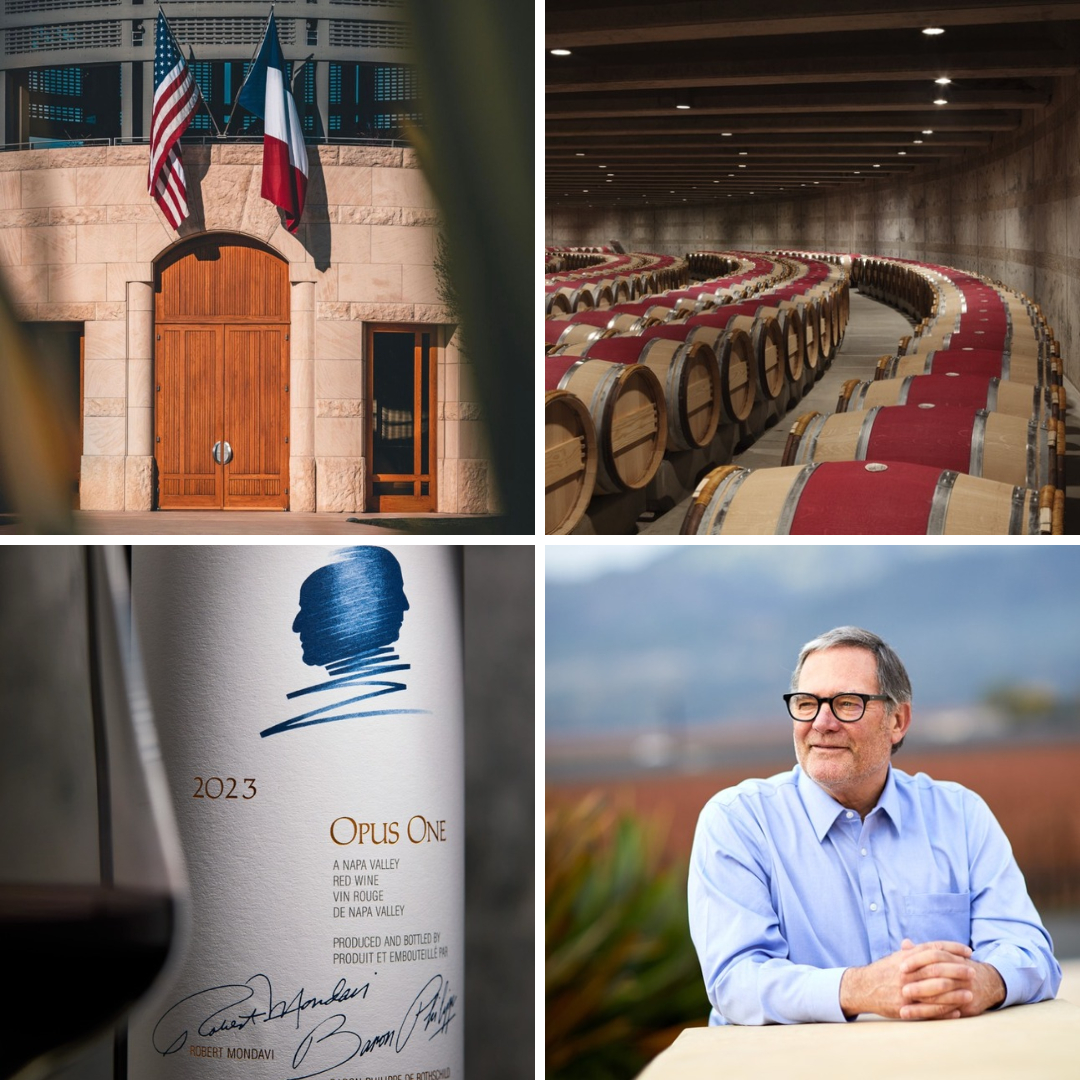
Baron Philippe de Rothschild and Robert Mondavi at Opus One Estate.
Robert Mondavi brought a different energy. Michael remembers him as an entrepreneur whose curiosity extended beyond his own winery and who took a genuine interest in helping talented people develop their ideas. He illustrates this with a story about a young German printer travelling through the United States who met Mondavi through an introduction connected to the creation of the Opus One label. Fascinated by the printer’s knowledge, Mondavi asked whether he could produce labels for the winery. When the young man explained that he had neither the equipment nor plans to establish a business, Mondavi asked what it would cost to purchase the necessary machinery.
According to Michael, Mondavi subsequently offered to finance the venture, allowing the printer to repay him through the labels he would produce. The story reflects the entrepreneurial spirit that helped shape modern Napa Valley, where Mondavi recognized that supporting talented individuals could create opportunities extending well beyond his own business.
Michael also points to the many influential winemakers who developed their careers at Robert Mondavi Winery before establishing reputations elsewhere. Warren Winiarski, Mike Grgich, Zelma Long and Paul Hobbs are among the names he mentions, illustrating Mondavi’s willingness to encourage talent even when it eventually pursued opportunities beyond his organisation.
The Opus One estate in Oakville, Napa Valley, surrounded by its vineyards and framed by the Vaca Mountains in the background.
The contrast between the founders was considerable. Baron Philippe brought the perspective of generations of European wine culture, while Mondavi represented the confidence and entrepreneurial freedom of California. Both valued creativity, although combining their approaches was not always straightforward. Michael recalls stories about the discussions surrounding the winery’s name, when suggestions from one side occasionally carried unintended meanings for the other. Eventually, Baron Philippe proposed Opus, referring to a work of art, before returning with Opus One, a name that would represent the first creation of their partnership.
Opus One, A Bridge between the United States and France.
Their differences extended beyond language and naming conventions. Working methods, expectations and personalities had to be reconciled, sometimes creating tensions that Michael compares to those found within families. Yet those contrasts became essential to the estate’s identity. Opus One was never intended to reproduce Bordeaux in California, but to bring two traditions together in a wine that could develop its own character.
Becoming Part of the Story
Michael joined Opus One in 2001 as Director of Viticulture and Enology, following an unusually thorough recruitment process involving multiple interviews, written questions and an essay explaining his suitability for the position. He also travelled to France to meet Patrick Léon, an encounter he remembers warmly because Léon was anticipating the birth of his first grandchild and was in exceptionally good spirits.
The final decision came during a meeting involving Tim Mondavi and Peter Ventura. When Tim asked how they should proceed, Ventura explained that three of the four decisionmakers had already agreed on Michael. Tim then extended his hand and welcomed him to Opus One, beginning a professional relationship that would last twenty-five years.
Having previously worked with influential figures including André Tchelistcheff and Warren Winiarski, Michael arrived with considerable experience. Nevertheless, Opus One presented a different challenge. He was joining a winery whose identity was already established, with the influence of two families and their respective philosophies remaining central to its operation. He describes his early position as a bridge between those traditions, working alongside Tim Mondavi and Patrick Léon while contributing his own understanding of viticulture and winemaking.
One of his first priorities was establishing a dedicated vineyard team. Michael wanted people who would work with the same vines year after year, developing an intimate understanding of individual parcels and their responses to changing growing conditions. Rather than assembling the entire team himself, he appointed a vineyard manager and entrusted that person with selecting colleagues, establishing an approach to leadership based on responsibility and mutual confidence.
Many improvements have been made in the vineyards by Michael and his team in the past 25 years.
Over the following years, the team experimented with irrigation, root development and different farming practices, including biodynamics. Not every initiative proved successful. Michael speaks openly about the decision to discontinue biodynamic farming after the results failed to meet expectations, although he wonders whether a longer period of experimentation might have produced a different outcome. His reflections reveal a willingness to acknowledge uncertainty rather than present every decision as an achievement.
That openness also encouraged less conventional ideas. Michael recalls an experiment proposed by research team member Alaina Velasquez, who wanted to investigate whether music might influence fermentation. Different tanks were exposed to Michael’s playlist, classical music at 432 Hz or no music, with the project subsequently attracting the interest of a visiting composer. Michael recounts the experience with amusement, although he makes no claim that music improves fermentation. What matters to him is that someone felt comfortable proposing an unusual experiment and was given the opportunity to explore it.
The experiment has since found a place within a broader cultural collaboration. Through its Composer in Residence programme, developed in partnership with the Fontainebleau Schools of Music & Fine Arts in France, Opus One brings young composers into the world of winemaking, creating opportunities for artistic and scientific curiosity to meet. In 2026, composer Nora Popescu is working alongside Alaina Velasquez on the project, extending an idea that began with music played to fermenting wines into a dialogue between two seemingly distant disciplines. It is a fitting reflection of the culture Michael has sought to cultivate at Opus One, where experimentation is not necessarily measured by its immediate results, but also by the possibilities it opens for the people involved.
The Barrel Cellar at Opus One Estate.
This willingness to question established approaches has accompanied the evolution of Opus One itself. During his early years, Michael occasionally encountered criticism that the wines lacked stylistic consistency because successive vintages could differ noticeably. He considered that criticism to misunderstand the estate’s ambitions. A warm growing season will inevitably produce different characteristics from a cooler one, and he believes those distinctions should remain visible rather than be concealed in pursuit of a uniform style.
His objective is for the wines to communicate their origins with increasing precision, allowing someone tasting Opus One to recognize California, Napa Valley, Oakville and eventually the estate itself. Michael believes the wines have gradually become more transparent expressions of their vineyards, reflecting changes in farming practices and the accumulated experience of the people responsible for making them.
Opus One Beyond Napa Valley
Although Opus One was conceived through an international partnership, its global distribution developed considerably during Michael’s tenure. When he arrived, exports represented a relatively modest proportion of sales. The introduction of Opus One through La Place de Bordeaux, beginning with the 2001 vintage, marked an important step in expanding its international presence.
Michael recalls Philippine de Rothschild inviting a group of Bordeaux négociants to spend several days at the estate. Some were initially uncertain about working with a Californian wine, accustomed as they were to the established traditions of Bordeaux. Their visit to Oakville introduced them to a different approach to fine wine, combining a commitment to quality with a willingness to experiment. The relationships established during that visit developed over subsequent decades, allowing Opus One to reach an increasingly international audience. Michael estimates that the estate’s wines have been distributed in approximately ninety countries, sometimes approaching one hundred, depending on market conditions.
Interestingly, he believes that international recognition also influenced the estate’s reputation in the United States. At home, he had encountered people who dismissed Opus One as an expensive marketing exercise, sometimes basing their opinions on wines tasted many years earlier. Abroad, consumers and wine professionals often approached the estate with fewer preconceived ideas, judging the wines according to their quality rather than their reputation.
Their positive reception gradually encouraged some American observers to reconsider earlier assumptions. Michael particularly enjoys meeting people who have not tasted Opus One for ten or fifteen years and arrive with firmly established opinions. Revisiting the wines together can lead to conversations about how the estate has evolved, offering an opportunity to assess its present direction rather than relying on memories of earlier vintages.
Opus One has had a strong focus on hospitality ever since its opening.
International recognition has also brought visitors from across the world to Oakville, many of whom have developed a personal connection to Opus One long before seeing the estate. Michael recalls encountering four visitors from Texas in the parking lot who had always wanted to visit but arrived without a reservation. Rather than disappoint them, he decided to show them around himself.
The anecdote illustrates something important about his approach to hospitality. Opus One’s reputation may attract visitors, but their lasting impression depends equally on the people they encounter. For Michael, welcoming guests and sharing the estate’s story are responsibilities that extend beyond the hospitality team, reflecting the generosity he associates with Robert Mondavi.
Overture — An Identity of Its Own
While Opus One has long defined the estate’s reputation, Overture provides an interesting perspective on how its philosophy has developed. Created in 1993, Overture began as a multi-vintage wine, allowing the winemaking team greater flexibility when selecting components from the estate’s vineyards.
Michael explains that producing a single wine places considerable pressure on blending decisions. Every component must contribute to a particular expression, leaving fewer opportunities for wines that may be excellent individually but do not fit the intended composition. Overture offered another possibility, with its multi-vintage character allowing wines from different growing seasons to contribute complementary qualities.
Michael enjoyed the creative challenge. An older component might introduce maturity and roundness, while a younger wine could contribute freshness and energy. Achieving harmony was not necessarily easier than producing a single-vintage wine, however, because the components had developed under different conditions and needed to work together both immediately and over time.
The concept also created confusion among consumers. People frequently asked about the proportions of grape varieties and vintages, while Michael occasionally encountered restaurant wine lists presenting detailed compositions that had no apparent factual basis. As Overture’s international audience grew, the question of how best to communicate its identity became increasingly relevant.
Overture has become very much its own expression of the Opus One Estate.
Discussions about producing a vintage-designated Overture had been taking place within the estate for some time, although opinions differed. One concern was that consumers might compare Opus One and Overture from the same vintage and occasionally prefer the latter. Michael sees little reason why that should be problematic, since wine appreciation is personal and the two wines are intended to offer different experiences.
He is therefore reluctant to describe Overture simply as a second wine, preferring to consider it another expression of the estate. The introduction of vintage-designated Overture in 2021 helped clarify that identity, accompanied by a more deliberate understanding of which vineyard parcels were particularly suited to each wine.
These decisions remain flexible. A parcel generally associated with Overture may produce a component that contributes particularly well to Opus One, while the reverse can also occur. The objective is not necessarily to establish a hierarchy between vineyard blocks, but to understand how each contributes to the finished blend.
The transition to vintage designation also allows Overture to communicate the character of individual growing seasons more directly. Its first three releases, 2021, 2022 and 2023, illustrate that opportunity particularly well, moving from the dry conditions of 2021 through the intense heat of 2022 to the cooler, more measured growing season of 2023.
Together with Opus One 2018, 2022 and 2023, these wines provide an opportunity to explore how the estate interprets different vintages through two distinct expressions.
Six Wines, Two Expressions of Opus One
The six wines selected for this feature illustrate the relationship between vintage character and the identity of Opus One’s vineyards. The three vintage-designated Overture releases reveal the development of a wine with a newly defined relationship to individual growing seasons, while Opus One 2018, 2022 and 2023 offer contrasting interpretations of the estate’s flagship blend.
Comparing the two wines from 2022 and 2023 is particularly revealing, as it allows us to consider how different compositions and stylistic objectives respond to the same climatic conditions.
Overture 2021, A New Beginning | 92/100 DWA score
Overture 2021 marks the beginning of a new chapter, becoming the first vintage-designated expression of a wine previously built around multiple growing seasons. The year was exceptionally dry, with rainfall among the lowest recorded in the estate’s history, although the absence of prolonged extreme heat allowed the grapes to develop concentration while retaining freshness.
The wine’s aromatic profile reflects that balance, with blackcurrants, ripe blackberries and dark cherries accompanied by plum, dried rose petals and delicate earthy nuances. As it develops, suggestions of forest floor, coffee and dark chocolate contribute complexity without overwhelming the fruit.
The palate combines a rounded, velvety texture with a more substantial structure than its accessible aromatics initially suggest. Fine, powdery tannins provide definition around the concentrated fruit, while freshness maintains balance and carries the wine towards a finish marked by dark berries and subtle savoury notes.
What makes this inaugural vintage particularly interesting is its ability to express the conditions of a specific year while retaining the generosity associated with Oakville. Overture 2021 appears approachable in its youth, although its concentration and structure suggest that several years of bottle development should reveal additional complexity.
Overture 2022, Generosity and Resilience | 93/100 DWA score
The second vintage-designated Overture emerged from a demanding growing season, culminating in extreme temperatures around harvest. Careful vineyard management and selective picking were essential in preserving balance, and the resulting wine reflects both the warmth of the year and the estate’s efforts to maintain freshness.
Its Cabernet Sauvignon-driven character is evident in an expressive combination of ripe blackberries, blueberries and dark cherries, complemented by violets, anise, toasted almonds and gentle spice. The fruit is generous and mouth-filling, yet sufficient acidity provides direction and prevents the wine from becoming excessively rich.
Rounded tannins contribute a supple texture, while notes of mocha, black tea and restrained toast introduce complexity towards the finish. Compared with the more measured 2021, Overture 2022 appears broader and more immediately expressive, with the warmth of the vintage reflected in its depth of fruit.
Nevertheless, the wine retains a recognisable sense of balance. Rather than attempting to disguise the growing season, Overture 2022 interprets its generosity through polished texture and sufficient freshness to maintain a composed finish, offering an accessible expression of the estate under challenging conditions.
Overture 2023, Elegance and Definition | 94/100 DWA score
The 2023 growing season provided a welcome contrast to the previous year. Substantial winter rainfall replenished the vineyards, while cooler summer temperatures allowed the grapes to ripen gradually, creating favorable conditions for aromatic development and balance.
Overture 2023 offers a particularly elegant interpretation of the estate’s vineyards, combining blackcurrants, blueberries and blackberries with brighter notes of cherries, raspberries and red plums. Floral nuances and delicate cedar contribute refinement, while subtle caramel notes introduce warmth without dominating the aromatic profile.
On the palate, the wine appears medium-bodied, with supple, finely integrated tannins and lively acidity that provide clarity and direction. Rather than relying on concentration, its character emerges through the relationship between fresh fruit, texture and restraint. The influence of oak remains carefully integrated, supporting the wine’s structure without drawing attention away from its fruit.
Among the first three vintage-designated Overture releases, the 2023 appears particularly successful in communicating an increasingly distinct identity. It combines the generosity expected from Oakville with freshness and precision, suggesting both immediate appeal and the capacity to develop further complexity in bottle.
The Opus One selection on our tasting table.
Opus One 2018, Refinement and Harmony | 99/100 DWA score
The 2018 growing season was remarkably favorable, with relatively mild temperatures and a prolonged ripening period allowing the grapes to develop concentration without sacrificing freshness. Opus One 2018 reflects those conditions through a combination of aromatic complexity, structural refinement and balance.
Blackcurrants, blackberries and ripe dark cherries form the foundation, accompanied by violets, lavender and rose petals. Beneath the fruit, graphite, cedar, fresh herbs and earthy nuances contribute depth, while time in the glass reveals suggestions of tea, gentle spice and more savoury characteristics.
The palate is concentrated yet remarkably polished, with fine-grained tannins providing structure without overwhelming the fruit. Fresh acidity maintains definition, while subtle mineral and savoury elements contribute complexity and length. Rather than presenting itself through sheer power, the wine derives much of its appeal from the harmony between concentration and restraint.
Now eight years from the vintage, the 2018 is approaching a stage where its primary fruit can gradually develop more mature aromatic characteristics. Its balance suggests that it should already offer considerable pleasure with appropriate preparation, although the quality of its structure indicates substantial ageing potential.
Within the estate’s recent history, Opus One 2018 stands as an expression of a growing season in which concentration and refinement developed together, resulting in a wine distinguished as much by its elegance as by its depth.
Opus One 2022, Character in a Challenging Vintage | 94/100 DWA score
The 2022 growing season demanded considerable vigilance, particularly during the intense heat experienced around harvest. Careful decisions concerning fruit selection and picking dates were essential, and the resulting Opus One reflects the generosity and structural challenges associated with those conditions.
Dark cherries, blackcurrants and ripe plums dominate the aromatic profile, accompanied by graphite, tobacco, dried herbs and cedar. Cocoa, coffee and warm spice contribute additional complexity, giving the wine a broader, more expressive character than that of some cooler vintages.
The palate is substantial and fruit-driven, with considerable concentration and a relatively expansive texture. Freshness provides balance, although the tannins appear more assertive than those of the 2018 or 2023, creating a firmer impression in the wine’s youth.
Compared with the more harmonious character of those vintages, the 2022 offers a different expression of Opus One. Its fruit has depth, while the combination of structure, savoury complexity and oak influence suggests that additional bottle age may help the different elements become more closely integrated.
The wine should therefore be approached with an appreciation of its growing season rather than an expectation that it will resemble other releases. Its generous fruit and youthful firmness provide a distinctive interpretation of Oakville under demanding conditions, with further development likely to bring greater harmony.
Opus One 2023, Precision and Classical Elegance | 98+/100 DWA score
Following the demanding conditions of 2022, the 2023 vintage benefited from abundant winter rainfall, cooler summer temperatures and an extended ripening period. These conditions allowed the grapes to develop aromatic complexity while preserving freshness and fine tannin structure.
Opus One 2023 presents a nuanced aromatic profile, combining cassis, black cherries and dark berries with red fruit, cherry blossom and dried violets. Graphite, tobacco, forest floor and subtle herbal notes introduce a savoury dimension, while restrained vanilla and spice contribute further complexity.
The palate combines concentration with carefully proportioned structure. Fine, silky tannins provide definition without interrupting the progression of the fruit, while fresh acidity introduces energy and allows notes of red plum, black pepper and orange peel to emerge towards the finish.
What distinguishes the 2023 is its balance between depth and restraint. The wine possesses the concentration expected from an exceptional Napa Valley Cabernet Sauvignon-based blend, yet its character develops through aromatic detail and refined texture rather than sheer intensity.
Compared with the more generous and assertive 2022, Opus One 2023 appears more classical in its proportions, with an elegance that should become increasingly apparent as it matures. Its youthful freshness and finely integrated structure suggest considerable ageing potential, while the overall harmony already offers an indication of its quality.
The 2023 provides a compelling example of the estate’s pursuit of a transparent expression of Oakville, demonstrating how depth and concentration can coexist with precision and elegance.
Two Wines, One Estate
Considering these six wines together reveals how Opus One and Overture interpret the same vineyards through different objectives. The first three vintage-designated Overture releases demonstrate the possibilities of a wine increasingly defined by individual growing seasons, while Opus One 2018, 2022 and 2023 illustrate the estate’s response to contrasting conditions through its flagship blend.
The comparison also reinforces Michael’s reluctance to describe Overture simply as a lesser version of Opus One. Both wines originate from the same place, but their different compositions and intended expressions allow them to communicate distinct characteristics. The result is an increasingly interesting relationship between two wines whose identities are connected without being interchangeable.
Opus One 2023, one of the vintages nearing perfection.
The Next Chapter
As our conversation turns towards the future, Michael seems less interested in discussing what his departure will mean for Opus One than in considering how the estate will continue to develop. He speaks about recognizing the strengths of individuals, encouraging different perspectives and allowing colleagues to contribute beyond their formal responsibilities.
His philosophy of leadership is illustrated by an unusual organizational chart he once created. Rather than arranging employees in a conventional hierarchy, Michael asked his assistant to purchase a large exercise ball, onto which they placed the names of colleagues representing the different functions within the winery. He could then bounce the ball, look at whichever name appeared at the top and identify something that person did better than anyone else in the organisation.
The exercise reflected his belief that expertise exists throughout an organisation and that leadership depends on recognizing the abilities of others. When we ask what advice he would offer his successor, Michael emphasises the importance of assembling a team whose strengths complement one’s own weaknesses, encouraging collaboration while accepting that some decisions ultimately require individual responsibility.
The estate itself faces challenges that will shape its next chapter. Red blotch disease is creating the need to redevelop certain vineyard areas, while changing environmental conditions require further consideration of farming practices and long-term resilience. Michael views these developments as opportunities to reconsider how vineyards should be planted and managed, with decisions increasingly shaped by the needs of future generations.
Towards the end of our conversation, we ask what the founders might think if they could see Opus One today. Michael believes they would appreciate the creativity and collaboration that continue to characterize the estate. He also returns to their original ambition of producing a wine that people would want to share with friends and family, rather than merely collect, and of creating a place that successive generations would seek to leave in better condition than they found it.
Michael is leaving the estate in capable hands, with healthy vineyards and a strong team.
As he prepares to conclude his tenure, those ideas appear to matter more to him than any individual achievement. Opus One has changed considerably since Michael joined in 2001, expanding its international presence, refining its approach to viticulture and developing a clearer identity for Overture. The next generation will inevitably bring different experiences and perspectives, just as Michael did when he arrived.
His contribution has been substantial, although he remains reluctant to associate the identity of Opus One too closely with any individual. He would rather the wines express their origins than the fingerprints of those who made them, a perspective that seems particularly fitting for an estate whose history has always depended on collaboration between different people and traditions.
The Opus One that Michael prepares to leave is not the same winery he joined twenty-five years ago, nor should it be. Its identity has developed through experience, experimentation and the willingness to reconsider established ideas. As he approaches his final months, Michael leaves behind a philosophy of stewardship and shared responsibility that connects the ambitions of Mondavi and Rothschild with the people who will determine the estate’s future.
The next chapter of Opus One will belong to them.
This article is written by our own Niels Aarts. We would like to thank the Opus One winery, and Michael Silacci in particular, for their support, time and the wines provided. Opus One can be purchased through selected retailers, such as Colaris in the Netherlands, and is features globally on wine lists at most respected restaurants and wine bars.
Join our insiders’ list and get exclusive early access to new articles, expert tips, and fresh reviews delivered straight to your inbox. Subscribe now and be the first to discover!