Join Our Wine Journey – Sign Up for the Newsletter 🍷
Tollius × Domburg — When Great Wines Meet a Kitchen Unafraid of Flavour
Share
Deel op X (twitter)
LinkedIn
WhatsApp
Tollius × Domburg — When Great Wines Meet a Kitchen Unafraid of Flavour.
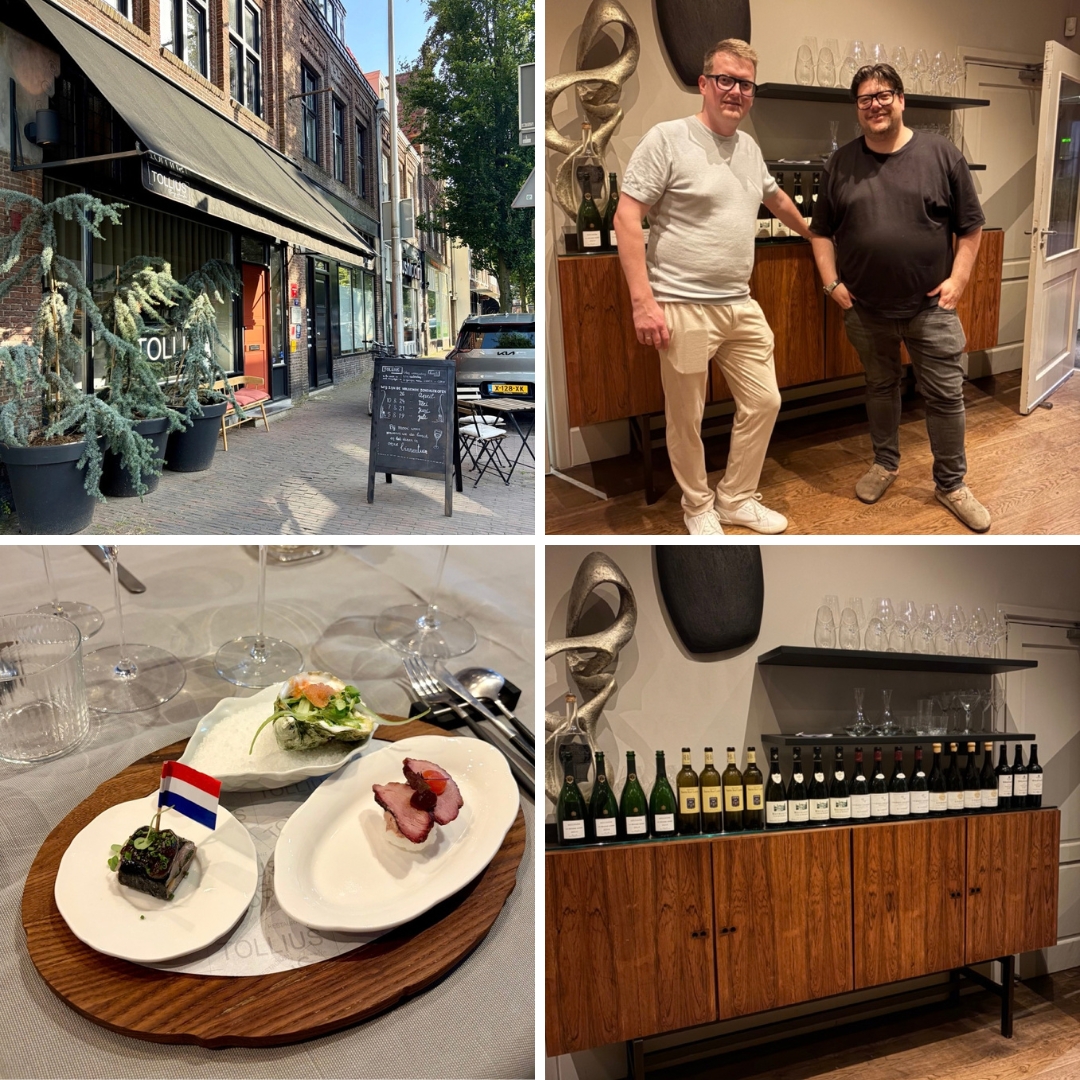
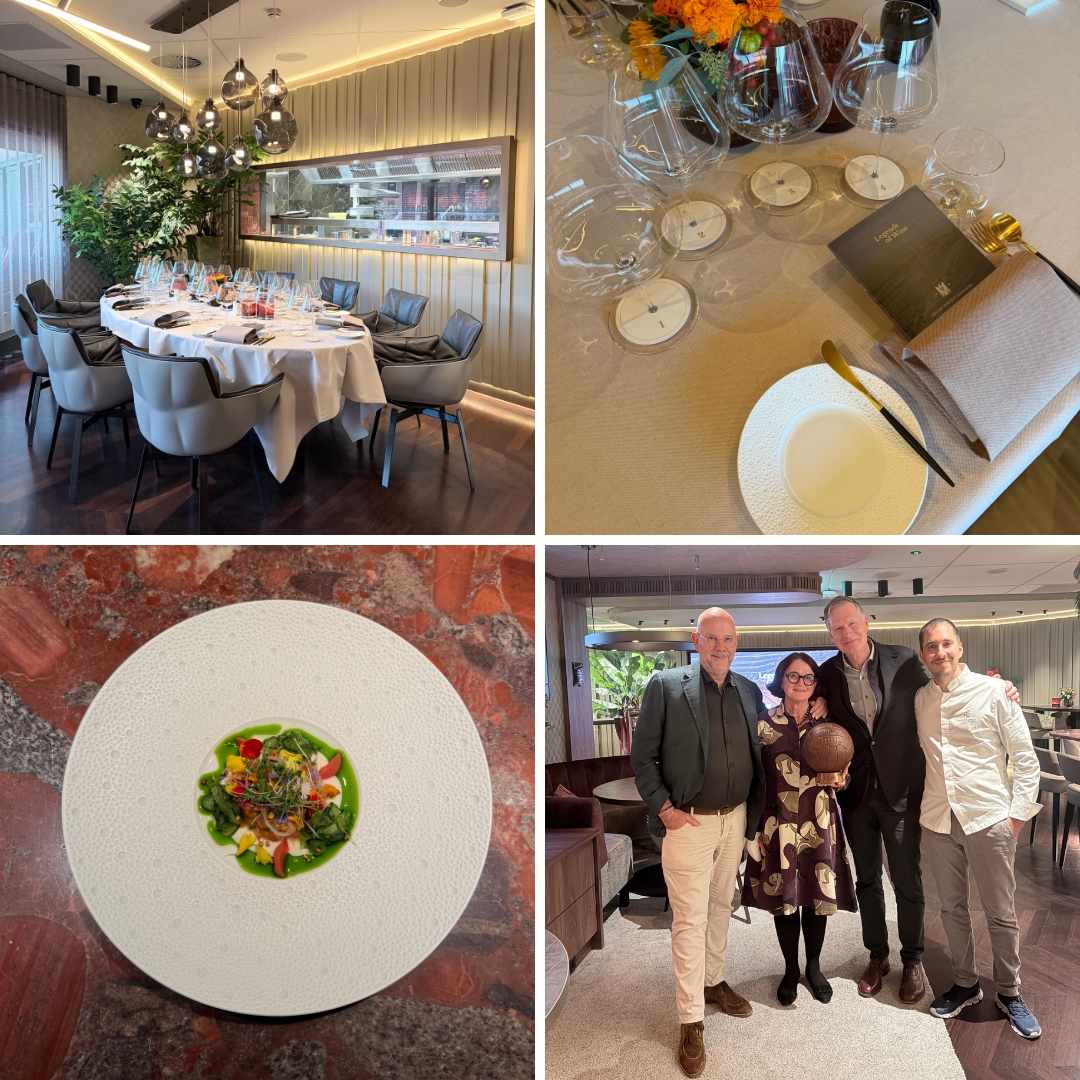
Some wine dinners are built around a theme: a single region, producer or vintage. Others are more interesting precisely because they resist such boundaries. The latest dinner organized by Domburg Putten belonged firmly to the latter category. Following our previous encounter with Domburg at Restaurant Le Havre in Elburg, this edition brought us to Tollius in Amersfoort, where chef and owner Barry Hamstra created a menu around a formidable sequence of wines selected by Domburg.
Our previous dinner had already demonstrated the philosophy behind these evenings. At Le Havre, Domburg’s Erik Stoffelsen (@wijnvanerik) constructed a line-up in which established benchmarks were combined with less predictable choices, with the wines intended not simply to accompany the food but to shape the progression of the evening. At Tollius, that approach returned, although in a rather different setting and with an even more ambitious vinous trajectory.
Tollius is situated at the foot of the Amersfoortse Berg and has been under the direction of chef Barry Hamstra for many years. His cooking draws on classical foundations while readily incorporating Asian flavours and ingredients, something clearly visible in this particular menu. The restaurant itself describes its cooking as seasonal, bold and strongly flavored, while Gault&Millau similarly points towards Hamstra’s ability to reinterpret classical cuisine through more contemporary combinations.
That made Tollius a compelling partner for Domburg. The wines on this occasion were anything but modest: Bollinger La Grande Année, Smith Haut Lafitte Blanc, Meursault from Jacques Prieur, Charmes-Chambertin Grand Cru, Chapoutier’s monumental L’Ermite and, finally, mature Vintage Port from Graham’s. On paper, it was an impressive list. Around the table, however, the more interesting question was how such distinctive wines would respond to a kitchen willing to work with wasabi, unagi, ginger beer and Campari alongside foie gras, caviar and truffle.
An Opening in Champagne
The evening began with three small dishes, each approaching the accompanying Champagne from a different direction.
The first was Dutch-style sushi with soy, ginger, shiso and chives, followed by a Special Gaey oyster with Negroni, burrata, fennel, basil and Campari. The final bite was perhaps the richest: Peking duck nigiri with hoisin, cucumber, red pepper and foie gras.
Three appetizers full of flavour to start the night.
It was quite a range of flavours to ask one wine to negotiate, but the choice was suitably serious.
Bollinger La Grande Année 2014 | DWA score: 95/100
La Grande Année 2014 immediately established the level of the evening. The wine combined Bollinger’s familiar generosity with the considerable tension of the vintage: ripe orchard fruit and citrus were joined by brioche, toasted nuts and subtle spice, carried by a fine mousse and persistent acidity.
What made it particularly successful here was its versatility. With the sushi, its freshness worked against soy and ginger; with the oyster, acidity and autolytic complexity had enough presence to deal with the unusual bitter-sweet accents of Negroni and Campari. Yet it was alongside the Peking duck and foie gras that the Champagne showed another dimension. Its vinous breadth met the richness of the dish, while the acidity prevented the combination from becoming heavy.
Rather than simply providing a ceremonial opening, La Grande Année functioned as a gastronomic wine throughout the three amuses.
Sea Bass & Lobster — Looking to Bordeaux
The first composed course brought together sea bass and lobster with avocado, wasabi, soy and piment. It is a combination that frequently appears on Tollius’ menu, illustrating Hamstra’s tendency to combine French technique with Asian seasoning.
The plate moved between sweetness, richness, salinity and heat. Lobster provided natural sweetness and texture, while avocado broadened the mouthfeel. Wasabi and piment introduced a sharper edge, with soy bringing the necessary umami and saltiness.
Sea Bass & Lobster.
Château Smith Haut Lafitte Blanc 2018 | Pessac-Léognan Grand Cru Classé | DWA score: 94/100
White Bordeaux was an intelligent direction to take. The 2018 Smith Haut Lafitte Blanc showed considerable concentration, with ripe citrus, white peach and exotic fruit alongside herbs, smoke and a restrained oak-derived complexity. Despite its richness, there was enough freshness and mineral tension to keep the wine energetic.
The pairing worked largely through contrast. The wine had sufficient body for the lobster and avocado, yet its acidity provided relief from the dish’s richer components. Its aromatic intensity was equally important: a more neutral white could easily have disappeared alongside wasabi, soy and piment.
Château Smith Haut Lafitte Blanc 2018.
It was an expressive pairing, but also one that showed why serious white Bordeaux deserves a place at the gastronomic table far beyond more conventional seafood preparations.
Smoked Salmon — Burgundy Takes Over
From Bordeaux, the dinner moved naturally towards Burgundy. Smoked salmon was served with asparagus, quail egg, wild mushrooms, chives and caviar, a dish that assembled several ingredients capable of complicating a wine pairing.
Smoke, egg, asparagus and caviar each pull a wine in a different direction. Here, however, the earthy mushrooms and richness of the quail egg also created a bridge towards Chardonnay.
Smoked salmon served with asparagus, quail egg, wild mushrooms, chives and caviar.
Domaine Jacques Prieur Clos de Mazeray Meursault 2020 | DWA score: 93/100
There was an interesting continuity here with our previous Domburg dinner at Le Havre, where Jacques Prieur’s 2023 Beaune Clos de la Féguine Premier Cru accompanied roasted langoustine. That wine impressed with its combination of stone fruit, citrus and integrated oak.
The 2020 Clos de Mazeray offered a broader Meursault expression. Ripe orchard and stone fruit were accompanied by citrus, hazelnut and gentle toast, with the vintage giving the wine generosity without entirely sacrificing freshness.
The pairing found its strongest connection through texture. The Chardonnay had enough breadth for the salmon and quail egg, while its savoury, nutty character connected naturally with the mushrooms. Caviar introduced a saline counterpoint that helped sharpen the overall combination.
At 93/100, it was perhaps not the most profound wine of an exceptional evening, but it fulfilled its gastronomic role convincingly.
Sweetbread, Smoked Eel and Charmes-Chambertin
Then came one of the evening’s most intriguing combinations: sweetbread with smoked eel, unagi, ginger beer, chicory and apple.
This is very much Tollius territory. Gault&Millau specifically singles out Hamstra’s combination of crisp sweetbread with smoked eel, ginger beer, apple and chicory, and it is easy to understand why. There is richness from the sweetbread, fat and smoke from the eel, sweetness and umami from the unagi, bitterness from chicory and freshness from apple. Ginger beer introduces another aromatic dimension.
Pairing Pinot Noir with this spectrum of flavours might appear risky. Domburg went considerably further and poured mature Grand Cru Burgundy.
Domaine Tortochot Charmes-Chambertin Grand Cru 2013 | DWA score: 94/100
At more than a decade of age, the Charmes-Chambertin had moved beyond primary fruit. Red cherry and darker berries remained, but the wine increasingly spoke through forest floor, dried herbs, spice and subtle earthy notes. The tannins had softened considerably, allowing the aromatic complexity to come forward.
Domaine Tortochot Charmes-Chambertin Grand Cru 2013.
This was less a pairing based on matching individual flavours than one based on the character of the entire plate. The earthiness of mature Burgundy found common ground with the sweetbread, while the wine’s savoury development worked particularly well with the smoked eel. Apple and ginger beer, meanwhile, provided enough freshness to stop the combination from becoming too dark or heavy.
The pairing also demonstrated something important about mature Burgundy. Grand Cru does not necessarily require the grandest or most classical dish. Sometimes its complexity becomes more interesting when confronted with flavours that force different elements of the wine to emerge.
Rossini Meets Hermitage
If the previous courses played with contrast and aromatic complexity, the main course returned to something altogether more classical: Beef Rossini with puff pastry, Australian winter truffle, croutons and jus.
It was a dish built around depth and richness, with beef and truffle at its center. After the relative delicacy of mature Pinot Noir, the progression demanded a wine with considerably more authority.
Domburg answered with one of the great expressions of Syrah.
M. Chapoutier Ermitage L’Ermite 2014 | DWA score: 96/100
L’Ermite immediately changed the scale of the evening.
The 2014 was intense yet controlled, combining dark fruit with blackberry, graphite, black olive, pepper, smoke and an unmistakable mineral character. There was power, certainly, but the wine’s appeal lay in how that power was channeled. Its structure remained imposing, yet there was sufficient evolution for the underlying complexity to become increasingly apparent in the glass.
Rossini Meets Hermitage.
Against the beef, the Syrah’s density felt entirely natural. Truffle amplified the wine’s earthy and mineral dimensions, while the concentrated jus provided the intensity required to stand alongside it.
It was also a reminder that the greatest food-and-wine combinations are not always the most complicated. After several dishes built around intricate interactions of spice, sweetness, smoke and umami, beef, truffle and mature Hermitage relied on something much more fundamental: depth meeting depth.
At 96/100, L’Ermite was one of the wines of the evening, and one of those bottles that encouraged increasingly slow drinking as it continued to develop.
The Wine-Up for this Special Night.
A Domburg Conclusion
A dinner organized by Domburg could hardly conclude without cheese.
The Domburg cheese selection, accompanied by apricot, walnuts, blackberries and apple syrup, brought the evening back explicitly to one of the store’s core specialties. It also created a natural transition from the dry wines towards the final bottle.
At our previous dinner, Domburg’s cheese selection was paired with Quinta do Vesuvio 1989 Vintage Port, a matured but powerful wine whose blackberry, plum and cacao character worked particularly well with the stronger cheeses.
This time, Erik Stoffelsen reached considerably further into the cellar.
Graham’s Vintage Port 1994 | DWA score: 96/100
Few vintages need much introduction among Port enthusiasts, and after more than three decades the Graham’s 1994 was entering a particularly compelling stage of its development.
There was still ample fruit — blackberry, plum and dark cherry — but maturity had added layers of dried fruit, cacao, spice and tobacco. The sweetness remained generous without overwhelming the wine’s structure, while the long finish showed why great Vintage Port rewards patience.
With the cheese, the combination was reassuringly classical after some of the more adventurous pairings earlier in the evening. Nuts and fruit on the plate echoed the Port’s developed aromatic spectrum, while mature cheese provided the salt and savoury intensity required to counter its sweetness.
At 96/100, it provided a fitting counterpart to L’Ermite and ensured that the evening ended at the same level at which its final chapters had begun.
More Than a Collection of Great Bottles
Looking back at the dinner, what stands out is not simply the pedigree of the wines. One could easily construct an impressive tasting by assembling Champagne, classified-growth white Bordeaux, Meursault, Grand Cru Burgundy, Hermitage and Vintage Port. Turning such bottles into a coherent dinner is more difficult.
That was also what impressed us during the earlier Le Havre collaboration. There, the dinner progressed from Chablis Grand Cru and white Burgundy through Paleo Rosso and Vega Sicilia before finishing with Vintage Port, with each wine occupying a clear place within the evening.
At Tollius, the contrasts were greater.
Erik Stoffelsen and Barry Hamster created another memorable evening.
Barry Hamstra’s cooking does not shy away from ingredients that sommeliers traditionally approach with caution. Wasabi, soy, smoked eel, unagi, ginger beer, chicory and Campari all appeared during the evening. His cuisine has classical foundations, but it is willing to move freely between French and Asian references, something also recognized in the restaurant’s current positioning.
That gave Erik Stoffelsen’s wine selection something to push against. Not every pairing sought seamless harmony. Some worked through texture, others through contrast, and occasionally the interest lay precisely in the tension between plate and glass. This made the dinner more engaging than a succession of prestigious labels could ever have been.
There was also a thoughtful escalation in maturity and intensity. Bollinger’s La Grande Année 2014 provided energy and breadth at the beginning. Smith Haut Lafitte Blanc and Jacques Prieur explored two very different expressions of serious white wine. Charmes-Chambertin introduced maturity and delicacy before L’Ermite dramatically increased the scale. Graham’s 1994 then offered a final change of register rather than merely extending the power of the Hermitage.
Final Thoughts
Domburg’s second collaborative dinner we attended confirmed something that was already apparent after the evening at Le Havre: Erik Stoffelsen approaches these events not simply as opportunities to open important bottles, but as complete gastronomic experiences.
At Tollius, he also found an appropriate counterpart in Barry Hamstra. The chef’s cooking is confident enough to challenge serious wines rather than treating them with excessive reverence. The sweetbread with smoked eel, unagi, ginger beer, chicory and apple perhaps illustrated this best. It is not a dish conceived to make wine pairing easy, yet alongside mature Charmes-Chambertin it became one of the evening’s most thought-provoking combinations.
And then there were the bottles themselves. Bollinger La Grande Année 2014 at 95 points, Smith Haut Lafitte Blanc 2018 at 94, Jacques Prieur Clos de Mazeray 2020 at 93, Tortochot Charmes-Chambertin 2013 at 94, followed by two 96-point wines in Chapoutier’s L’Ermite 2014 and Graham’s Vintage Port 1994. It was an exceptional line-up, but importantly, the dinner never felt like a tasting with food added around it.
Instead, Tollius and Domburg allowed the two disciplines to meet on equal terms. Hamstra supplied bold, technically grounded cooking; Stoffelsen responded with wines that had sufficient identity to engage with it. Sometimes they mirrored each other, sometimes they contrasted, but throughout the evening there was a conversation between plate and glass.
For us at Dutch Wine Apprentice, that ultimately remains the attraction of dinners such as these. Great bottles can be tasted anywhere. What stays with us is the moment when the context changes how we understand them — when a mature Burgundy finds an unexpected companion in smoked eel, when Hermitage and truffle seem almost inevitable together, or when a thirty-two-year-old Vintage Port quietly brings an ambitious evening to its conclusion.
Following Elburg and Le Havre, Domburg’s journey took us to Amersfoort and Tollius. Different restaurant, different cooking and a different collection of wines, but the underlying philosophy remained intact: choose wines with personality, put them alongside food with personality, and allow the interaction between the two to tell the story.
This article is written by our own Niels Aarts for Dutch Wine Apprentice. We would like to thank Domburg Putten and Restaurant Tollius for the invitation and hospitality.
Join our insiders’ list and get exclusive early access to new articles, expert tips, and fresh reviews delivered straight to your inbox. Subscribe now and be the first to discover!