Join Our Wine Journey – Sign Up for the Newsletter 🍷
A Seat at the Table: Ciel Bleu – The Art of Personal Luxury
Share
Deel op X (twitter)
LinkedIn
WhatsApp
A Seat at the Table: Ciel Bleu – The Art of Personal Luxury.
For the second chapter of A Seat at the Table, we travel to Hotel Okura Amsterdam, where Ciel Bleu brings together two-Michelin-starred cooking, an ambitious wine programme and an approach to hospitality shaped by an unusually international clientele. Following the experience from the table into the kitchen and back again, we discover how food, wine and service come together — and how many people it takes to make the exceptional appear effortless.
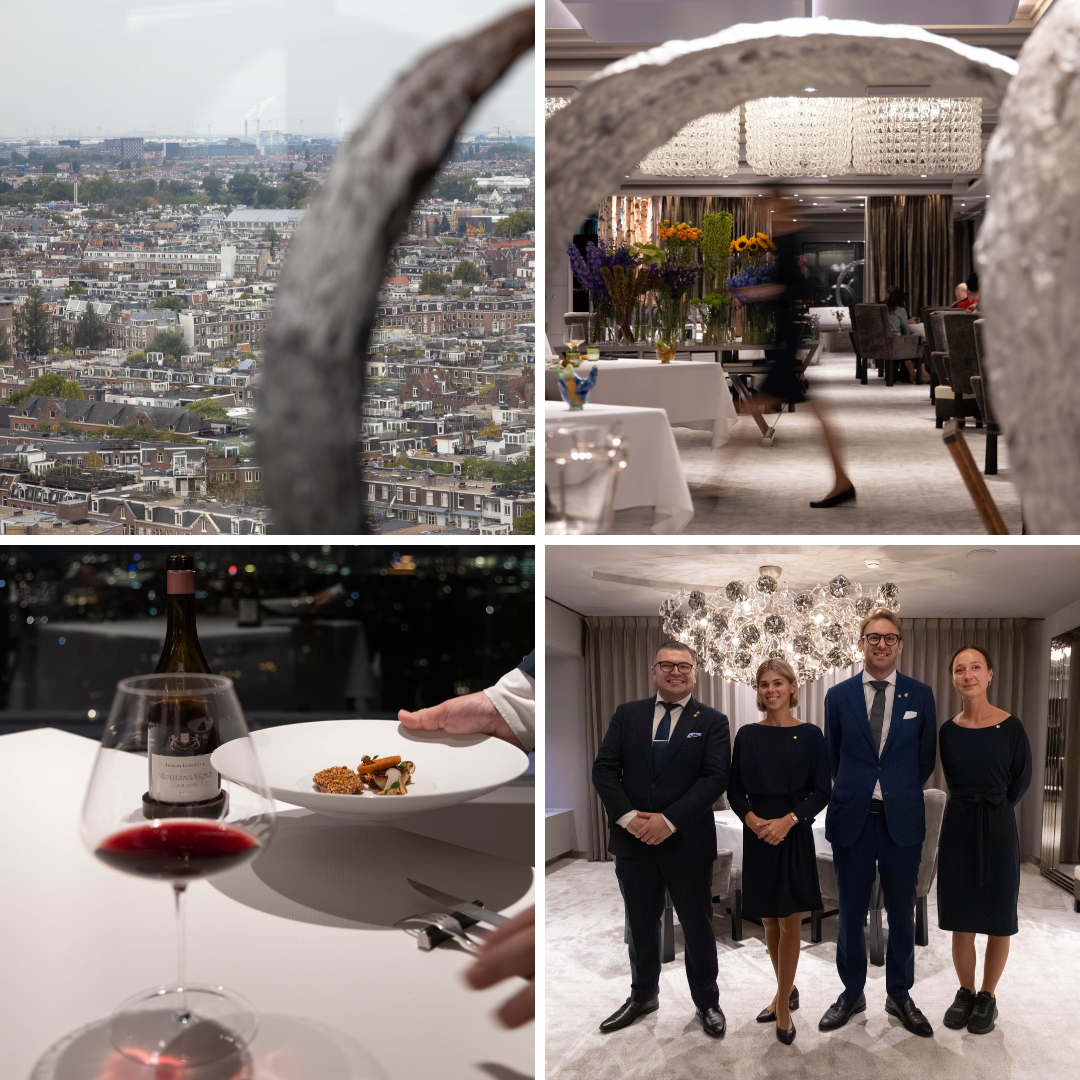
There is an inevitable sense of transition when making your way to Ciel Bleu. Amsterdam gradually disappears beneath you as the elevator climbs through Hotel Okura, until the city that moments earlier surrounded you becomes a panorama beyond the windows. Once inside the restaurant, it becomes clear that this remarkable view is an integral part of the experience. The tables are deliberately positioned towards the windows, drawing guests’ attention to the city stretching out below. Whether in daylight or after dark, Amsterdam provides an ever-changing backdrop to the evening, adding another dimension to the restaurant’s atmosphere.
It is an appropriate setting for a restaurant that has occupied a distinctive place in Dutch gastronomy for many years. Holding two Michelin stars since 2008, Ciel Bleu is deeply embedded within the international environment of Hotel Okura, yet over time it has developed an identity very much of its own.
Front row seats along the Amsterdam skyline at Ciel Bleu.
Reading the Guest
That international environment matters. On some evenings, the dining room can welcome guests from as many as seventeen different nationalities, each potentially bringing a different expectation of what fine dining should be. Some want an extensive evening in which dinner itself is the destination, while others prefer a faster pace. For Ciel Bleu, service therefore cannot simply be a fixed sequence reproduced table after table. It requires observation and adaptation.
We begin to notice that almost immediately after taking our seats. There is no rush to begin: water is poured, the first small bites arrive and the people looking after us introduce themselves, but there is also time simply to settle into the room. A guest may have travelled for hours, come directly from a meeting or navigated Amsterdam traffic before stepping into the restaurant. The menu does not need to be the first thing demanding their attention. Before serving the table, you first have to understand the people sitting at it.
Wine knowledge is widely represented in Ciel Bleu’s service team.
That responsibility extends well beyond the restaurant’s most visible names. Executive Chef Arjan Speelman shapes the culinary direction together with Chef de Cuisine Mike Klaassen, while Maître-Sommelier Francesco Simonelli has responsibility across both wine and service. Around them is a much larger kitchen and front-of-house team, welcoming guests, preparing tables, serving dishes, changing glassware, presenting wines and continuously reading the rhythm of the room. As the evening progresses, the importance of that collective effort becomes increasingly apparent.
Product, Wine and Generosity
Our introduction comes with Roger Coulon Héri-Hodie Grande Tradition Premier Cru Brut; a Blanc de Noirs built around a réserve perpétuelle whose oldest component dates back to 1995. Its structured, gastronomic style makes it particularly suited to the richer flavours of the amuse-bouches and the signature preparation that follows: Bluefin Tuna.
The raw tuna is marinated in aged soy and paired with konbu, yuzu and Dauricus caviar from Maison Kaviari, then served inside a hollowed-out section of a large bluefin tuna spine bone. The presentation is striking without losing sight of the ingredient itself; indeed, the fish literally becomes part of it. Aged soy and konbu deepen the savoury character, yuzu provides freshness and the caviar brings richness and salinity. The Champagne, meanwhile, has sufficient freshness to provide contrast and enough structure to remain present alongside those pronounced flavours.
The dish introduces us to something fundamental in Speelman’s cooking. His starting point remains the product: first the principal ingredient, then its preparation, followed by the sauce and supporting components. It is essentially a classical order of thought, even when the flavours surrounding it travel considerably further. Craftsmanship — salt crusts, open fire, barbecue, proper sauces — remains important, while above all the food should remain recognisable. An exceptional ingredient should not disappear beneath the technique used to prepare it.
Bluefin Tuna, one of Ciel Bleu’s Signature Dishes.
Generosity is part of that philosophy too. At Ciel Bleu, luxury is not simply about placing expensive ingredients on the plate. If caviar is used, it should have a meaningful presence rather than become a symbolic garnish; if a guest commits to an extensive menu, it should ultimately still feel like a meal. Product, generosity and pleasure are closely connected.
Wine follows much the same logic. Both Francesco Simonelli and Sommelier Gioele Di Gianni present wines during our dinner, part of a four-sommelier team available to the restaurant. Yet wine service is never separated from the wider experience on the floor. Simonelli’s position as Maître-Sommelier is particularly relevant here: wine forms an important part of his responsibility, but so does service as a whole.
Maître-Sommelier Francesco Simonelli.
The cellar has evolved accordingly. In recent years, the programme has been critically reassessed, asking not simply which wines the team admires but which bottles genuinely belong at Ciel Bleu and remain relevant to its guests. The list has developed from roughly 400 references towards 600, with established strengths such as Bordeaux and Burgundy joined by categories where demand has grown, including the Super Tuscans. At the same time, preservation systems have helped expand the by-the-glass programme, allowing the sommeliers greater freedom to respond to individual preferences.
Underlying it is a straightforward principle: a pairing wine should not merely be technically correct, but enjoyable in its own right. We drink before a dish arrives and often continue after it has disappeared; if the wine only makes sense during one particular bite, something has been lost.
That becomes tangible with Fruits de Mer, where uni, caviar and saline vegetables are brought together around a uni panna cotta. Two wines offer different interpretations. Pietracupa Fiano di Avellino 2022 uses texture, fruit, acidity and minerality to connect with the creaminess of the preparation, while Domaine de Bellevue Clos de la Bouquinardière Muscadet 2022 pulls the dish towards freshness, precision and salinity. Neither needs to win. What matters is how differently the same plate can be experienced depending on what is in the glass.
Fruits de Mer.
The Lobster, accompanied by cucumber, blood orange and kabosu, presents another challenge. Simply adding a dry, high-acid wine to a citrus-driven dish risks making the combination increasingly sharp and accentuating bitterness. Dr. Hermann Erdener Treppchen Riesling Kabinett 2025 instead combines acidity with residual sugar, softening the interaction with the citrus while remaining sufficiently delicate for the lobster. It is a useful demonstration of why pairing is rarely about one flavour matching another; acidity, sweetness, bitterness, texture and intensity are all part of the equation.
Lobster with Dr. Hermann Erdener Treppchen Riesling Kabinett.
Behind the Pass
From our table, all of this arrives with apparent ease. Plates appear, wines are poured, glassware changes and conversation continues. Then, between courses, we leave the dining room and see what is happening on the other side.
Walking into the kitchen changes the perspective completely. Many people are working simultaneously: plates wait in sequence as components are added, different hands attend to different details and preparations converge at precisely the moment they are needed. There is considerable activity, but remarkably little disorder.
Executive Chef Arjan Speelman at work in the Kitchen.
For guests who want to experience this side of Ciel Bleu more closely, the restaurant also offers a Chef’s Table. Situated within the open kitchen environment, it provides the possibility of private dining while offering a direct view of the culinary team at work. Rather than experiencing only the finished dishes, guests can follow the activity behind their creation, witnessing the precision and coordination that normally remain out of sight in the main dining room.
Watching the brigade at work, the comparison with an orchestra feels natural. Not because the work is theatrical, but because everyone appears to understand when their contribution is required. No single movement creates the finished plate; it is the coordination between them that matters.
Finishing touches for the Fruit de Mer.
What we witness during service is only the final stage of a process that can begin weeks earlier. Ideas are discussed, preparations tested, flavours adjusted and dishes tasted repeatedly. When a composition is roughly seventy or eighty percent complete, the wine conversation becomes more concrete, allowing the sommeliers to explore possibilities while the kitchen still has room to make final adjustments. Food and wine can therefore influence one another before the dish reaches the menu.
Then comes the harder challenge: consistency. At Michelin level, this means reproducing that work throughout an evening, regardless of what else is happening in the kitchen. This is where Chef de Cuisine Mike Klaassen and the wider brigade become essential. An idea only becomes a restaurant experience when a team can translate it into plate after plate under the timing and pressure of live service.
The same principle applies on the other side of the doors. The people serving food, presenting wines, clearing tables and monitoring the rhythm of dinner form another part of that orchestra. Kitchen and dining room perform different roles, but neither can create the complete experience independently.
Back at the Table
We return with a different appreciation of the apparent ease with which the next course arrives. Madai, combined with cabbage and vadouvan, is paired with Nikolaihof Grüner Veltliner Federspiel Aus den Gärten 2020. Maturation in large old oak and time on the lees bring roundness, while freshness and minerality provide a counterpoint to the richer character of the fish. The wine’s herbal spectrum connects naturally with cabbage and kale, while its aromatic character has enough personality to engage with the vadouvan.
Madai paired with Nikolaihof’s Grüner Veltliner Federspiel Aus den Gärten.
The course also illustrates the international language of Ciel Bleu’s kitchen. Rather than defining the cuisine through one dominant foreign influence, individual dishes are allowed to travel: Scandinavian ideas might appear in one course, Spanish or Japanese references in another. They function as accents rather than declarations of fusion. Here, vadouvan changes the direction of the composition without displacing the Madai as its protagonist.
With the Sea Bass, accompanied by celeriac and spruce tips, restraint becomes particularly important. Domaine de Bellivière Les Rosiers 2020, a Chenin Blanc from a warm vintage, brings ripe nuances alongside freshness and a mineral backbone, while its sec-tendre character provides a subtle degree of sweetness. Acidity cuts through the richer elements of the dish, while that touch of sweetness supports the spruce-tip component.
There is a parallel here with the cooking itself. Technique is present, but recognisability matters; surprise should come through flavour rather than by obscuring the ingredient at the center of the plate. Ciel Bleu is aware of how fine dining changes, but does not appear interested in following every trend simply because it exists. Part of maintaining an identity is knowing which developments matter and which can pass by.
Mieral Pigeon paired with Thibault Liger-Belair’s Moulin-à-Vent La Roche.
The progression towards deeper flavours arrives with Mieral Pigeon, served with mushroom and shallot and accompanied by Thibault Liger-Belair Moulin-à-Vent La Roche 2020. Its tannic backbone has enough structure for the iron-rich, gamey character of pigeon, while the earthier side of mature Gamay connects with mushroom and porcini. Dark cherry and blackberry provide contrast to the sweetness of the shallot.
It is also the kind of selection that can gently challenge expectations without turning wine service into an exercise in provocation. Throughout dinner, Francesco and Gioele explain why particular wines have been chosen while leaving room for preference and conversation. The objective is not simply to tell us what is in the glass, but to provide another way into the dish.
Around them, the wider front-of-house team maintains the rhythm of the evening. Courses appear and disappear, glassware changes and the table is reset, while the team remains attentive to the smallest details, observing when conversation should be left uninterrupted and when there is an opportunity for interaction. This approach reflects Omotenashi, the Japanese philosophy of hospitality that is deeply rooted in Hotel Okura’s identity.
Ciel Bleu’s service team works like a well-oiled machine, but one with a high level of personal attention.
At its heart lies the ability to anticipate a guest’s needs before they become apparent, offering thoughtful attention without making the service feel intrusive. Even when one guest temporarily leaves the table, a short conversation with the person remaining can be more hospitable than leaving them to retreat to their phone. It is this combination of observation, anticipation and genuine human connection that makes the service at Ciel Bleu feel personal rather than rehearsed.
A Personal Interpretation of Luxury
The transition towards dessert begins with Peach, combined with olive oil and shiso, moving us away from the deeper flavours of pigeon without immediately introducing the full sweetness of the final course. By now another characteristic of Ciel Bleu has become clear: despite the complexity behind the experience, relatively little feels imposed upon the guest.
That is particularly relevant at a time when many ambitious restaurants have gravitated towards a single fixed tasting menu. Ciel Bleu deliberately retains more flexibility through different menu lengths, additions and the ability to respond to changing dining habits, including guests who increasingly prefer fish or eat less meat. The wine programme follows the same principle, combining complete pairings with a substantial selection by the glass.
Our wine selection for the night.
Choice, in this context, becomes part of luxury. Not because everything must always be available, but because the restaurant has sufficient depth to respond to the individual sitting at the table. It brings us back to our arrival: allowing guests to settle, observing them and understanding what kind of evening they actually want.
The final course centres on Rice, joined by jasmine and sake kasu, with Liliac & Kracher Eiswein 2024 alongside. Refreshing acidity keeps the sweetness of the wine from becoming heavy, while stone and tropical fruit together with floral nuances connect with the jasmine. It completes a sequence in which every wine has been asked to perform a particular role — sometimes through contrast, sometimes texture, acidity or sweetness, and sometimes simply by offering another perspective on the plate.
The same philosophy extends beyond wine. For guests who choose not to drink alcohol, Ciel Bleu is exploring ways to create an equally engaging pairing experience, with drinks that complement the cuisine and bring their own character to the table. Working with mixology expertise elsewhere within Hotel Okura, the team is developing original combinations tailored to the flavours and textures of individual dishes. Experiments involving ingredients such as celery and apple illustrate this approach, where the objective is not simply to replace wine, but to offer a distinctive experience that adds genuine value to the evening.
That relationship with Hotel Okura is significant. Its international character is reflected not only in the diversity of its guests and its approach to hospitality, but also in the culinary expertise found throughout the property. With restaurants such as Yamazato, Sazanka and Serre, each recognized by Michelin, Ciel Bleu operates within an environment where different culinary traditions and disciplines come together.
This creates opportunities for exchanging knowledge and drawing inspiration beyond its own kitchen. Yet while Ciel Bleu benefits from being part of Hotel Okura’s broader culinary environment, it has developed a distinctive identity of its own, built on honest cooking, craftsmanship and a constant pursuit of quality. These principles have guided the restaurant for many years, even as the expectations of fine dining continue to evolve.
By the end of the evening, it becomes clear that Ciel Bleu’s identity cannot be captured by its most visible attributes alone. Two Michelin stars, panoramic views over Amsterdam, exceptional ingredients and an extensive wine cellar certainly contribute to its appeal, but our visit behind the pass reveals what truly sustains the experience. Every dish is the result of careful development, experimentation and refinement before the brigade must reproduce it consistently throughout service. In the dining room, that same dedication takes another form, as the team coordinates food, wine and hospitality while continuously adapting to the rhythm and preferences of each table.
Mike Klaassen, Arjan Speelman and Francesco Simonelli.
Speelman and Klaassen provide leadership in the kitchen, just as Simonelli connects wine and the wider service experience on the floor, with Gioele and the rest of the sommelier team contributing their expertise. But Ciel Bleu is ultimately the work of considerably more people than those whose names appear most prominently.
That is why the image of the orchestra remains with us. At this level, the difference between good and exceptional rarely comes down to one grand gesture. It lies in bringing hundreds of smaller decisions together repeatedly, while ensuring that the guest never feels the machinery behind them.
For all the sophistication surrounding it, Ciel Bleu ultimately returns to something refreshingly straightforward: it still wants to cook. To work with exceptional ingredients, apply craftsmanship, make proper sauces, use fire and send food into the dining room that people genuinely want to eat. At the same time, the people serving it need to recognize who is sitting in front of them rather than simply execute a predetermined programme.
From our Seat at the Table, that balance between precision and pleasure may be the clearest expression of Ciel Bleu. We see the precision behind the pass and experience the pleasure in the dining room; between the two is an entire team making an extraordinary amount of preparation, coordination and expertise feel almost effortless.
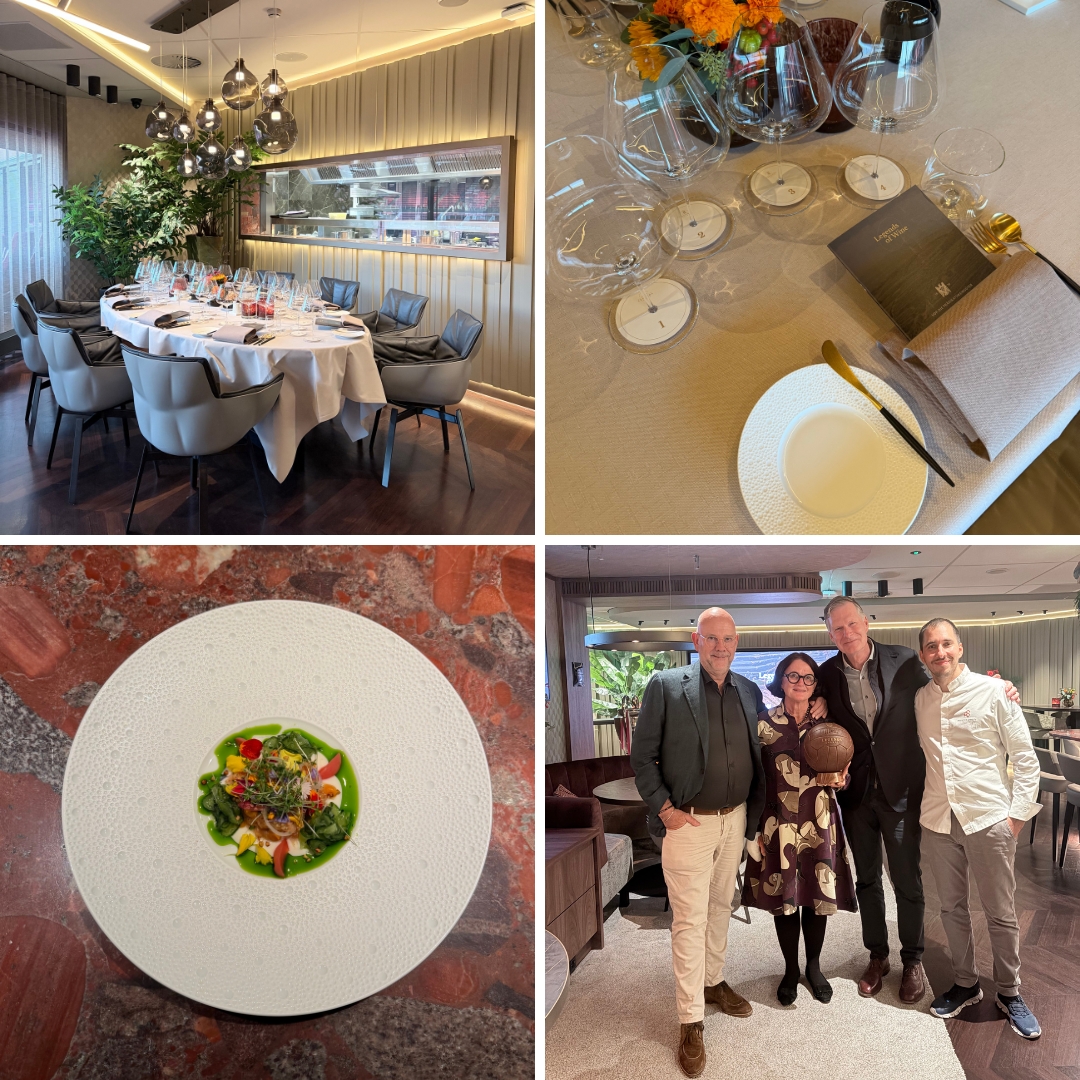
Ciel Bleu delivered another Magical Chapter for our Book ‘A Seat at the Table’.
This article is written by our own Niels Aarts. Photography by Marianne van Velzen, MAVE Photography. We would like to thank Arjan Speelman, Francesco Simonelli, Mike Klaassen, Gioele Di Gianni and the entire Ciel Bleu and Hotel Okura Amsterdam teams for sharing their philosophy and welcoming us to their restaurant.
Join our insiders’ list and get exclusive early access to new articles, expert tips, and fresh reviews delivered straight to your inbox. Subscribe now and be the first to discover!