Join Our Wine Journey – Sign Up for the Newsletter 🍷
Ramey Wine Cellars: Understanding California Through Place
Share
Deel op X (twitter)
LinkedIn
WhatsApp
Ramey Wine Cellars: Understanding California Through Place.
California has long been celebrated for the diversity of its vineyards, yet few wineries have dedicated themselves to exploring that diversity as completely as Ramey Wine Cellars. Since its founding in 1996, the Sonoma-based estate has quietly established itself among the state’s benchmark producers of Chardonnay, Cabernet Sauvignon and Pinot Noir—not by pursuing a recognisable house style, but by allowing each vineyard to speak with its own voice.
That philosophy has guided the winery from the beginning. David and Carla Ramey founded the estate with a conviction that great wine is shaped first and foremost in the vineyard. Precision in the cellar matters, but only insofar as it allows a site to express itself with greater clarity. Nearly three decades later, Alan and Claire Ramey are carrying that philosophy into a new generation, ensuring that the winery continues to evolve without losing sight of the principles on which it was built.
The Ramey Family.
California had already proven that it could produce world-class wines, but many of its leading producers were still defining what a distinctly Californian identity should look like.
Comparisons with Burgundy and Bordeaux remained inevitable, yet Ramey’s ambition was never to imitate Europe’s great wines. Instead, the estate sought to interpret California with the same seriousness and respect for terroir that have long defined the world’s most celebrated wine regions.
Before establishing his own winery, David Ramey helped shape the modern identity of several influential Californian estates, including Matanzas Creek, Chalk Hill, Dominus Estate and Rudd Estate. Those years reinforced a philosophy centred on balance, freshness and vineyard expression, while encouragement from Christian Moueix ultimately gave him the confidence to establish an independent label bearing the family name.
From the outset, however, Ramey Wine Cellars was conceived as far more than the project of a gifted winemaker. While David guided the wines, Carla laid the commercial foundations of the business, helping to build a family estate that expanded steadily without sacrificing its independence or culture. That long-term perspective remains evident today—not only in the continuity between two generations of the Ramey family, but also in the remarkable stability of the winery’s team and its enduring partnerships with growers across Sonoma and Napa.
Making the first Ramey wine.
Those relationships are fundamental to understanding the estate. Unlike many of Europe’s historic domaines, whose identities are inseparable from vineyards they own, Ramey has deliberately built its portfolio through collaborations with growers who know their sites intimately. The objective has never been to assemble an impressive collection of vineyard names, but to cultivate partnerships that allow individual vineyards to be interpreted over decades rather than vintages. In that respect, ownership has always been less important than shared purpose.
Alan Ramey’s experiences abroad reinforced that conviction. Like many young Californian winemakers, he travelled to Chile and Burgundy expecting to encounter fundamentally different philosophies of fine wine. Instead, the experience strengthened his appreciation for what had already been achieved at home.
“I expected to find something fundamentally different in Europe,” he reflects. “Instead, I realised how far California had already come.”
The lesson was not that California should emulate Europe’s great wine regions, but that it possessed both the confidence and the extraordinary diversity of vineyards to define excellence on its own terms.
Ultimately, that has become the defining thread running through Ramey Wine Cellars. The estate has never sought to prove that California can rival the world’s great wine regions—that argument has long since been won. Its ambition has been quieter, and perhaps more enduring: to understand California more completely, one vineyard at a time.
Understanding California Through Place
If Ramey Wine Cellars has a defining strength, it is the ability to reveal California not as a single wine region, but as a collection of remarkably distinct landscapes. The differences between its vineyards are not treated as variations on a theme, but as individual expressions worthy of being explored on their own terms.
That philosophy is reflected in the winery’s long-standing partnerships with some of California’s most celebrated growers. Hyde Vineyard in Carneros, Rochioli and Martinelli in the Russian River Valley, and the Charles Ranch vineyard in Fort Ross-Seaview, on the Sonoma Coast, each offer a different interpretation of Chardonnay or Pinot Noir, shaped by their own combination of climate, elevation, soils and exposure. Rather than seeking prestige through famous vineyard names, Ramey has built relationships that allow these sites to be studied over decades, with each vintage adding another layer of insight.
The Rochioli vineyard.
Those collaborations challenge one of the traditional assumptions of fine wine: that ownership is the ultimate expression of commitment to terroir. While many of Europe’s historic domaines derive their identity from vineyards that have remained in the same family for generations, Ramey has demonstrated that equally profound knowledge can emerge through long-term partnership. The relationship between grower and winery is not transactional but collaborative, built on shared decisions in the vineyard and a mutual commitment to revealing each site’s individual character.
That approach becomes particularly compelling in Sonoma, where the Pacific Ocean shapes the landscape with extraordinary subtlety. A vineyard perched on the ridges of Fort Ross-Seaview may spend much of the growing season above the morning fog, exposed to persistent ocean winds and cool afternoon temperatures. Further inland, in the Russian River Valley, the maritime influence remains evident but expresses itself differently, creating conditions that favor wines of greater breadth without sacrificing freshness. Even within relatively short distances, changes in elevation, exposure and airflow can alter ripening patterns enough to produce markedly different expressions of the same variety.
Charles Ranch vineyard in Fort Ross-Seaview.
These distinctions have become central to the winery’s philosophy. Rather than pursuing a recognisable “Ramey style”, the cellar is tasked with preserving the individuality of each vineyard. Fermentation, oak maturation and élevage are carefully considered, yet they remain tools rather than signatures. The objective is never for every Chardonnay to taste unmistakably like Ramey, but for Hyde to remain unmistakably Hyde, Fort Ross-Seaview unmistakably Fort Ross-Seaview, and Woolsey Road unmistakably Woolsey Road.
Alan Ramey’s harvests in Chile and Burgundy offered an illuminating perspective on that philosophy. The world’s most respected producers, he discovered, were united less by a particular style than by a shared commitment to knowing their vineyards intimately over time. Returning to Sonoma, he saw California with fresh eyes—not as a region still searching for validation, but as one whose extraordinary diversity deserved even greater attention.
Ultimately, the wines make the argument more convincingly than words ever could. Two Chardonnays produced by the same winery, using broadly similar methods, can display strikingly different personalities simply because they originate from different places. Ramey’s pursuit has never been consistency of flavour, but consistency of interpretation: creating wines that speak with clarity about where they come from.
Curiosity as a House Philosophy
If the vineyard defines the questions, the cellar is where Ramey Wine Cellars searches for the answers.
Curiosity has always been woven into the estate’s identity, though rarely in the form of dramatic innovation. New techniques are not embraced because they are fashionable or because they promise to distinguish the winery from its peers. Instead, they are examined patiently, often by altering a single variable while leaving every other aspect of production unchanged. Whether evaluating fermentation, lees ageing or oak selection, the objective remains remarkably consistent: to determine whether each decision allows a vineyard to express itself with greater clarity.
That measured approach reflects an important distinction. At Ramey, winemaking is viewed not as an opportunity to impose style, but as a process of removing unnecessary influence. Every intervention carries the risk of obscuring origin; every refinement is intended to make the connection between vineyard and glass more transparent.
The same mindset extends beyond the cellar. Alongside his work at the winery, Alan Ramey created the book Pressing Matters, a series of conversations bringing together scientists, philosophers, psychologists and wine professionals to explore how people perceive taste, quality and authenticity. Although the discussions reach far beyond practical winemaking, they are united by a simple conviction: certainty is rarely the beginning of understanding. Asking better questions often proves more valuable than claiming definitive answers.
That philosophy has also encouraged a healthy skepticism towards fashion. California has experienced successive waves of stylistic preference, from richly extracted wines shaped by generous oak to more recent trends favoring increasingly reductive techniques and minimalist intervention. Ramey has never ignored those developments, but neither has it been defined by them. Decisions in the cellar are ultimately judged by a far simpler measure: do they produce wines that are more transparent, more balanced and, above all, more compelling to drink?
Ultimately, the answer is found not in theory, but in the glass.
Place in the Glass
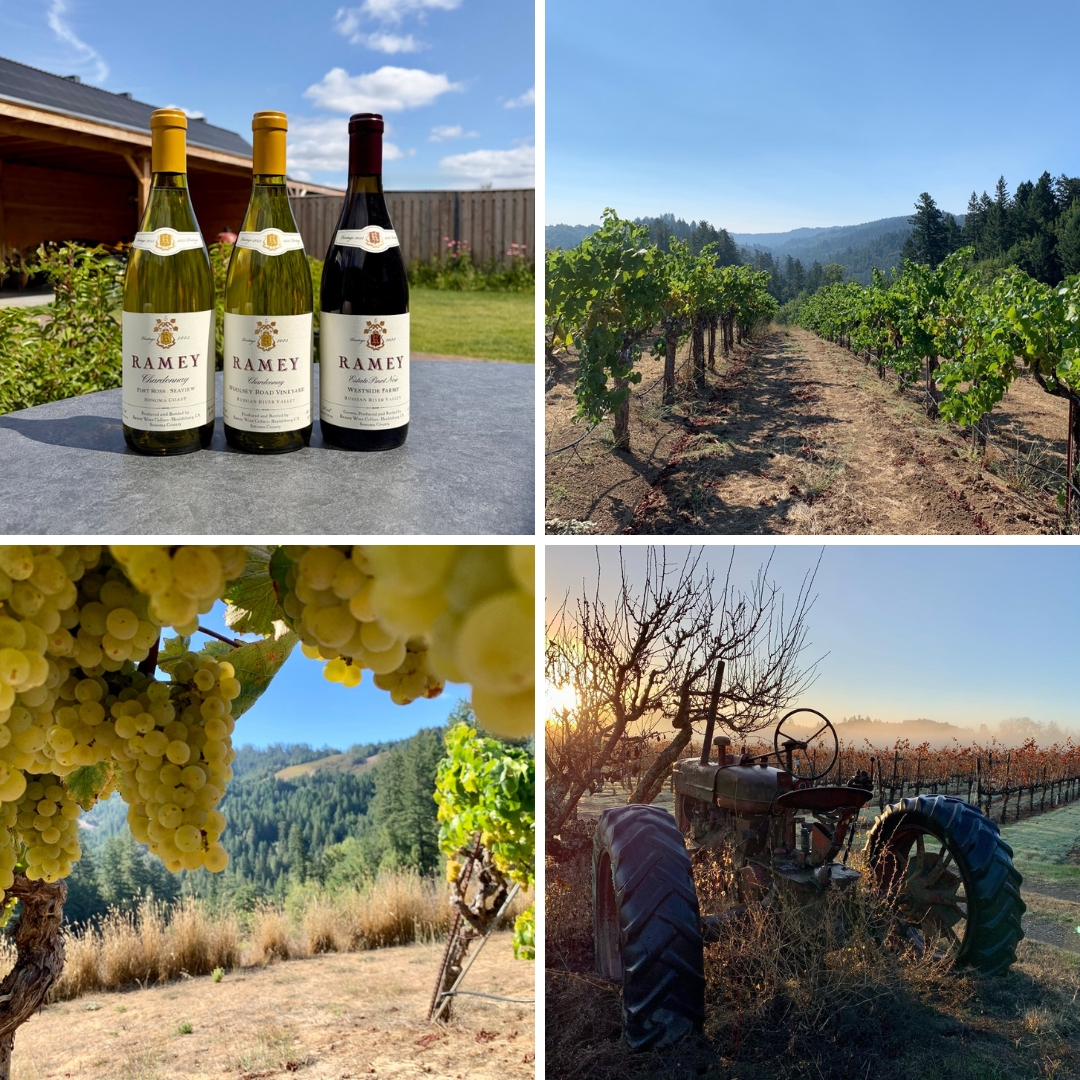
As part of our interview with Alan Ramey we tasted a selection of three wines, recent vintages, produced by the estate. Two Chardonnay’s from different sites, and an expression through a different grape, a Pinot Noir.
The Ramey Wines on our tasting table.
The 2023 Fort Ross-Seaview Chardonnay is a study in tension rather than power. Initially restrained, the wine gradually unfolds to reveal layers of citrus peel, white nectarine and subtle maritime notes, with discreet hints of toasted hazelnut emerging as it opens in the glass. The palate is defined by precision: concentrated without weight, driven by vibrant acidity and a persistent saline thread that carries effortlessly through the finish. Its greatest strength lies not in intensity but in composure, demonstrating how the cool Sonoma Coast can produce Chardonnay of remarkable energy and finesse.
DWA Score: 94/100
The 2023 Woolsey Road Vineyard Chardonnay presents a compelling counterpoint. While equally precise, it expresses the Russian River Valley through greater breadth and textural generosity. Ripe orchard fruit, preserved citrus and delicate white blossom unfold across a palate that feels layered rather than expansive, supported by seamlessly integrated oak and finely judged acidity. There is quiet confidence here: a wine that achieves richness without excess and complexity without sacrificing definition. It is a compelling demonstration that elegance and generosity need not exist in opposition.
DWA Score: 95/100
The 2022 Westside Farms Pinot Noir completes the picture. Fragrant rather than forceful, it opens with vivid red cherry, wild strawberry and crushed raspberry before developing floral notes, sweet spice and a subtle earthy complexity. The palate combines silken tannins with impressive purity of fruit, its bright acidity lending freshness and persistence rather than angularity. What lingers most, however, is not any single aroma or flavour, but the wine’s transparency—a Pinot Noir that communicates its origin with remarkable clarity while maintaining the poise and restraint that have become hallmarks of the estate.
DWA Score: 93/100
Tasted together, the three wines reinforce the philosophy that has guided Ramey Wine Cellars since its earliest vintages. They are not united by a signature flavour or a recognisable stylistic imprint, but by a shared commitment to precision and authenticity. Each wine reflects a distinct vineyard, while the hand of the winemaker remains deliberately understated. The strongest statement Ramey makes is also its quietest: when a vineyard is truly understood, it has remarkably little need for embellishment.
Stewardship Without Standing Still
For many family wineries, succession is defined by continuity. At Ramey Wine Cellars, it is equally defined by curiosity.
As David and Carla gradually hand greater responsibility to Alan and Claire, the transition has unfolded without dramatic reinvention. The philosophy that shaped the winery in 1996 remains intact, yet it continues to evolve through fresh perspectives, new questions and an enduring willingness to learn. That balance between continuity and renewal has become one of the estate’s greatest strengths.
That willingness to explore new possibilities is perhaps most evident in Curious Ground, a new wine project developed by Alan and Claire Ramey. While Ramey Wine Cellars has built its reputation on interpreting individual vineyards, Curious Ground approaches Sonoma from a broader perspective, questioning whether the region’s extraordinary diversity of climates, soils and grape varieties might give rise to an identity not yet fully explored. Rather than accepting established appellations and varietal conventions as definitive, the project investigates how different vineyard sources and varieties might be brought together to create a more unified expression of Sonoma.
It is an ambitious undertaking, shaped by a distinctly long-term perspective. As Alan suggested during our conversation, the question is not simply what Sonoma produces today, but what it might become in a thousand years. Curious Ground therefore represents less a departure from the family’s philosophy than an extension of its most fundamental principle: that great wine begins with curiosity about place.
Westside Farms, the Ramey Estate Vineyard in Russian River Valley.
The challenges facing California today are very different from those that confronted David Ramey three decades ago. Climate change, shifting growing seasons and increasing pressure on natural resources demand constant adaptation, while a new generation of wine drinkers places greater emphasis on transparency, sustainability and authenticity. Yet these developments only reinforce the values on which the winery was built: careful observation, close collaboration with growers and the conviction that every vintage offers another opportunity to deepen the understanding of a vineyard.
In an era when wine is often discussed in terms of trends and innovation, Ramey Wine Cellars offers a quieter perspective. Its story is not one of constant reinvention, but of continuous refinement. Every vineyard partnership, every vintage and every carefully considered decision in the cellar contributes to a deeper understanding of California’s remarkable vineyard landscape.
The Ramey Crest remains recognisable ever since the first vintage, as are the wines.
Ultimately, the question that has shaped Ramey Wine Cellars has remained remarkably consistent. It has never simply been whether California can produce world-class wines—that question was answered long ago. Instead, the estate has spent nearly three decades asking a more enduring one: how faithfully can a vineyard be translated into a glass of wine?
It is the question that has shaped every bottle bearing the Ramey name. Judging by the wines tasted, it is one the winery has become remarkably adept at answering—even as it continues to ask it anew with every harvest.
This article is written by our own Niels Aarts. We would like to thank Alan Ramey for his time and openness, sharing his personal and family’s story. Additionally, we would like to thank Dan Buckler for the introduction. Ramey wines are exported to numerous countries, and available in the Netherlands through Best of Wines, who kindly provided the wines for tasting purposes.
Join our insiders’ list and get exclusive early access to new articles, expert tips, and fresh reviews delivered straight to your inbox. Subscribe now and be the first to discover!