Join Our Wine Journey – Sign Up for the Newsletter 🍷
Chefs & Cellars – Dining at Restaurant Azurite, Delft
Share
Deel op X (twitter)
LinkedIn
WhatsApp
Chefs & Cellars – Dining at Restaurant Azurite, Delft.
How Decades of Experience Came Together in Delft.
Delft is not usually the first city that comes to mind when discussing the Netherlands’ leading gastronomic destinations. Visitors arrive for Vermeer, the city’s historic canals and its centuries-old porcelain tradition rather than for Michelin stars. Yet placed inside Huis van Delft, only a short walk from the medieval heart of the city, Mario Ridder has quietly created one of the country’s most ambitious dining destinations.
At first glance, Azurite may appear to be another addition to an already impressive career. Spend some time with Mario, however, and a different picture begins to emerge. During our conversation for Episode 4 of Season 2 of Chefs & Cellars, and later during a return visit to experience the restaurant ourselves, it became increasingly clear that Azurite represents something far more personal.
Some restaurants mark a new chapter.
Azurite feels like the place where decades of experience finally come together.
A Lifetime Leading to Delft
Few chefs have left as profound a mark on modern Dutch gastronomy as Mario. His professional journey has taken him through some of the country’s most influential kitchens, beginning at Parkheuvel in Rotterdam under Cees Helder before continuing through De Zwethheul, Joelia and several other successful ventures. Along the way he earned recognition, accolades and the respect of peers throughout the industry.
For many chefs, a career of that length eventually leads towards consolidation. Restaurants become businesses, systems become established and the appetite for large-scale risks naturally diminishes. Experience often encourages caution.
Yet listening to Mario describe the origins of Azurite, one senses that the project emerged from precisely the opposite impulse.
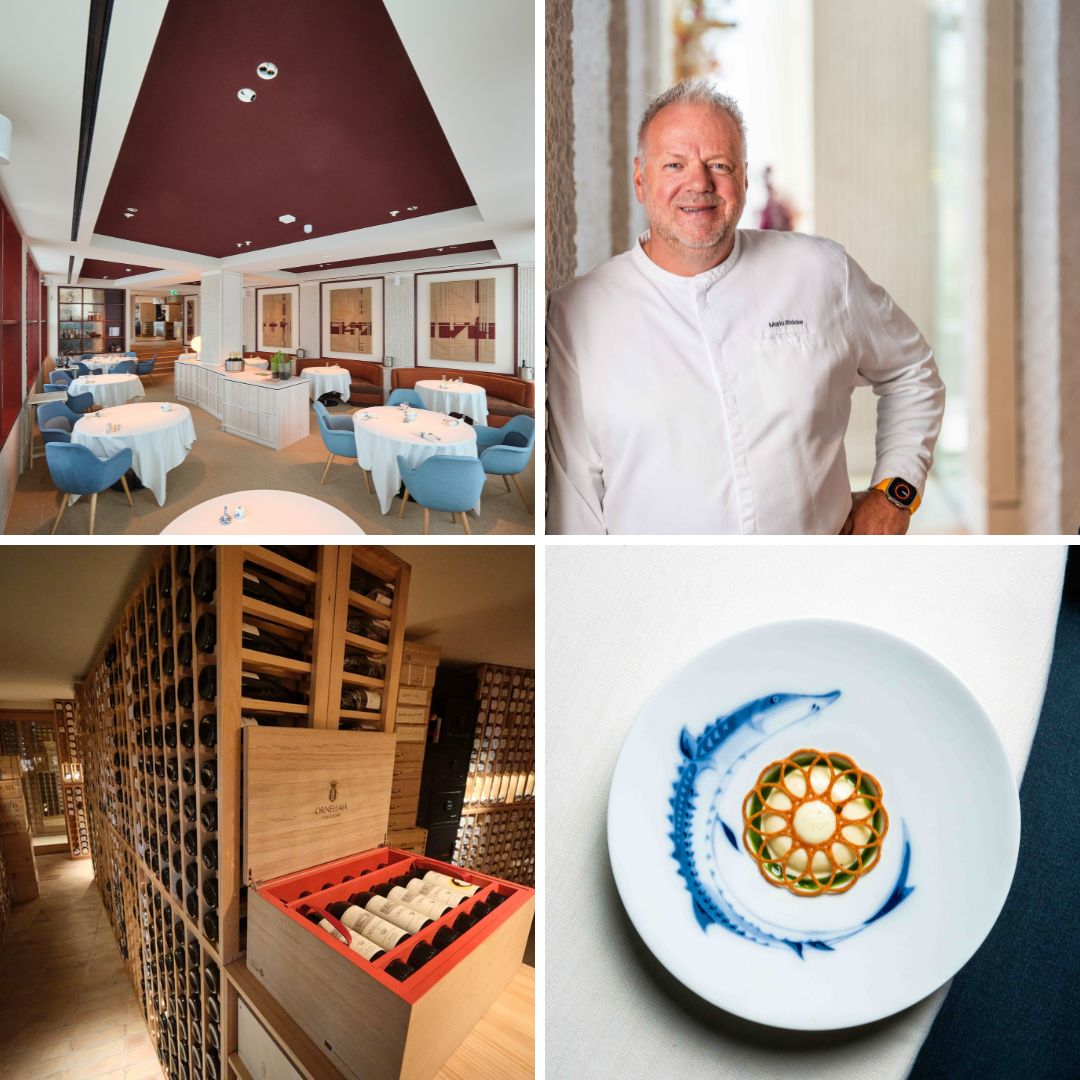
Mario Ridder – Azurite.
The story began not with a desire to open another restaurant, but with an invitation to help shape the hospitality concept within Huis van Delft. Initially, Mario’s role was limited to offering advice. What type of restaurant would suit the building? How could hospitality contribute to the broader vision? What would make sense in Delft?
His answer was straightforward. If the building was going to house a restaurant, it should be a serious one.
As plans evolved and conversations deepened, the possibility emerged that he might become more than an advisor. Gradually, the project transformed from an interesting concept into an opportunity that became increasingly difficult to ignore.
Looking back on that period, Mario described a feeling that surprised even him.
“Everything I lost in the last ten years came back together again.”
The remark stayed with us long after it was spoken. It was not the comment of somebody searching for a new challenge or attempting to recreate past successes. Instead, it felt like the reflection of someone rediscovering the passion that first drew him into hospitality.
That renewed energy can be felt throughout Azurite.
Building Without Compromise
Restaurants often reveal their priorities before a single dish reaches the table.
Azurite certainly does.
Occupying approximately 700 square metres while accommodating relatively few guests, the restaurant prioritizes comfort, atmosphere and experience over efficiency. The dining room feels spacious in a way that has become increasingly rare. High ceilings, generous spacing and carefully considered sightlines create an immediate sense of calm, while the restrained design allows attention to remain where Mario believes it belongs.
“The plates should create the music.”
The phrase surfaced several times during our conversations and provides perhaps the clearest insight into the restaurant’s design philosophy. The room itself is intentionally understated, acting as a frame through which the experience unfolds rather than becoming the experience itself.
The Dining Room at Azurite.
The same thinking extends to the restaurant’s connection with Delft.
Originally, Mario planned to furnish the restaurant using work from a celebrated German ceramic artist. Shortly before opening, however, he encountered another restaurant built around a remarkably similar aesthetic. Rather than continue down that path, he changed direction and embraced the city around him. Delft Blue porcelain now forms part of the guest experience, creating a connection to the city’s heritage that feels authentic rather than decorative.
It is a small detail, but an important one.
Throughout our time at Azurite, we were struck by how often decisions had been made not because they were fashionable, but because they felt right.
Hospitality Beyond the Table
That philosophy becomes particularly evident once service begins.
Guests do not simply arrive, sit down and remain in one place throughout the evening. Instead, the experience unfolds gradually through a series of spaces that reveal different aspects of the restaurant. The evening begins at the bar before moving into the dining room, while later visits to the kitchen and cellar provide additional layers of context.
The Restaurant Bar.
What could easily feel choreographed instead feels natural.
The progression creates a sense of movement without ever becoming theatrical. Guests gain insight into the people and processes behind the restaurant while remaining firmly anchored in the experience of dining itself.
Listening to Mario discuss hospitality, one quickly realizes that he sees restaurants not as places where food is served, but as places where memories are created. The meal matters, of course, but it exists within a much broader experience.
That perspective perhaps explains why wine occupies such an important role at Azurite.
Wine Is Made to Make Memories
At one point during our conversation, Mario offered a phrase that neatly summarized his relationship with wine.
“Wine is made to make memories.”
The simplicity of the statement belies its significance.
Throughout our discussion, wine rarely appeared as a collectible object or status symbol. Instead, Mario spoke about bottles in relation to the people, meals and moments surrounding them. A wine became memorable not because it was rare, but because it was experienced at precisely the right moment.
That philosophy has shaped one of the most impressive restaurant cellars in the Netherlands.
Housing approximately 12,000 bottles and 5,000 references, Azurite’s collection reflects decades of curiosity and exploration. Burgundy remains particularly close to Mario’s heart, and our conversation drifted naturally towards producers such as Armand Rousseau and Domaine d’Auvenay. Yet what proved most interesting was not the names themselves, but the stories attached to them.
Azurite’s impressive Wine Cellar.
One anecdote centred on an Aligoté from Domaine d’Auvenay that left a more lasting impression than several celebrated grand cru wines served alongside it. The lesson was clear. Great wine has an extraordinary capacity to surprise.
The same curiosity explains Mario’s fascination with white Bordeaux. Years ago, a bottle of Domaine de Chevalier Blanc 1982 fundamentally changed his perception of what the category could achieve. Decades later, he still remembers how the wine evolved throughout the meal, revealing new dimensions with each course.
Listening to him describe these experiences, it became clear that the cellar within Azurite is not simply a collection of bottles. It is a collection of memories.
A Shared Bottle
That philosophy was perhaps best illustrated by the wine Mario chose to open during our recording. Faced with thousands of possibilities, he selected Petit Cheval Blanc 2021.
The choice felt entirely appropriate.
The 2021 Petit Cheval Blanc.
As our conversation unfolded, so too did the wine. Initially, the nose presented freshness and restraint, offering citrus blossom, lemon zest and white peach. Yet with time in the glass, a second personality emerged. The texture broadened, revealing layers of stone fruit, subtle oak spice and a gently waxy quality that added complexity without diminishing the wine’s precision.
What impressed us most was the sense of evolution.
Every return to the glass seemed to reveal something different. At one moment the wine emphasized freshness and minerality; moments later it displayed a richer and more textured character. Rather than moving in a straight line, it oscillated between these expressions while maintaining remarkable balance.
The experience immediately brought to mind what Mario had been describing all afternoon. Great wines are not static. They evolve. They interact with food, conversation and time itself. Petit Cheval Blanc seemed to embody exactly that idea.
Petit Cheval Blanc 2021 | Dutch Wine Apprentice Rating: 93/100
Bright aromas of citrus blossom, white peach and lemon zest evolve into layers of stone fruit, subtle oak spice and a gently waxy texture. The palate combines precision with depth, supported by vibrant acidity and a long mineral finish. Already highly expressive, yet clearly built for long-term development.
Returning to Azurite
Several weeks after recording the podcast, we returned to Delft to experience Azurite as guests. During our earlier conversation, many of the themes that define the restaurant had surfaced repeatedly: simplicity over complexity, hospitality as experience and wine as a vehicle for memory. Returning for dinner provided an opportunity to discover whether those ideas remained theoretical or whether they had found genuine expression around the plate.
The answer became apparent from the opening moments.
Our visit followed Azurite’s menu Van Streek tot Signatuur—from region to signature—a title that neatly captures Mario’s culinary philosophy. The journey begins with recognisable Dutch references before gradually moving towards dishes that feel increasingly personal and reflective of his own culinary identity.
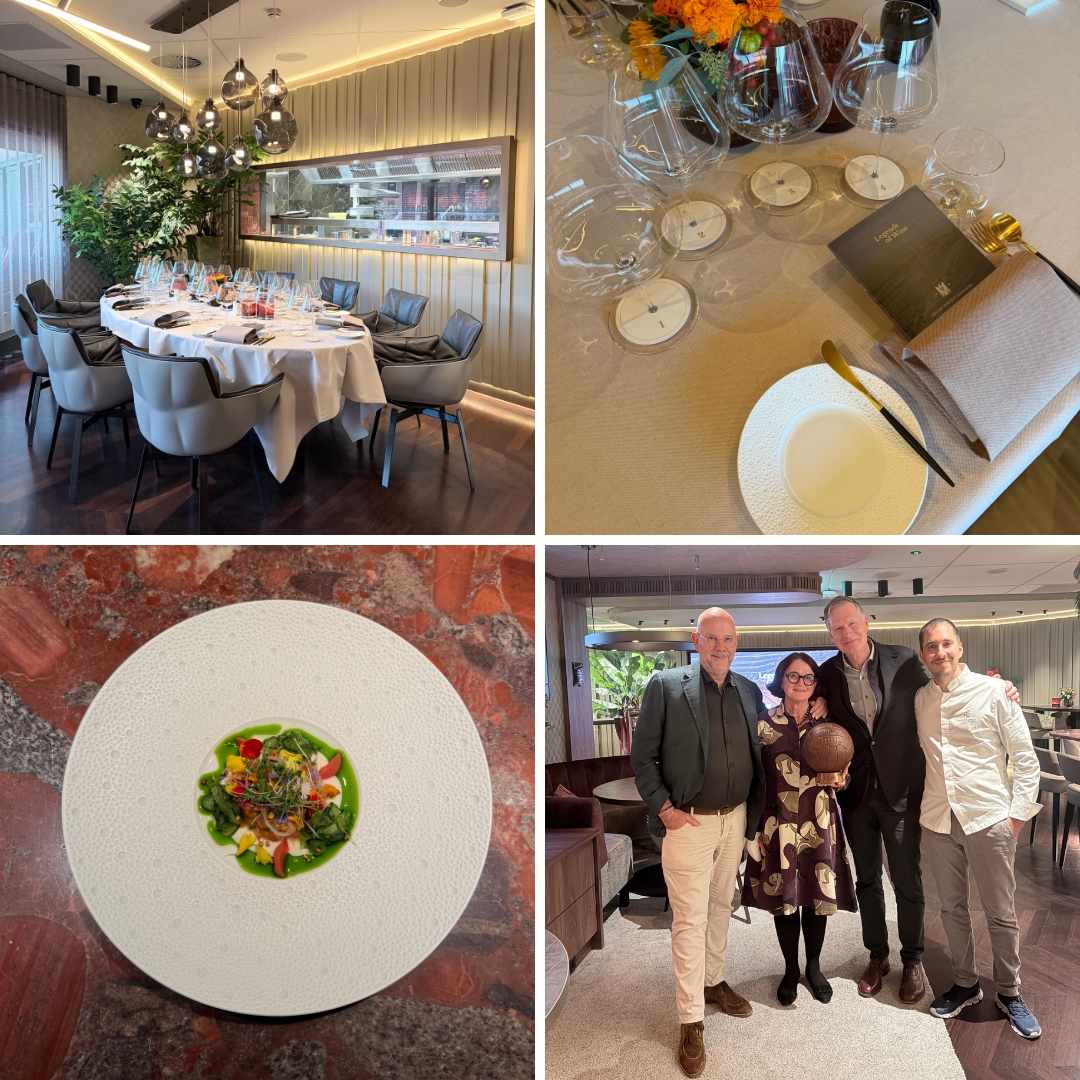
Our return to Azurite for Dinner.
Amuse Bouches
An opening sequence inspired by Dutch culinary heritage reimagines ingredients and flavours that many guests will recognize immediately. IJsselmeer eel appears alongside caviar, while hutspot and Calvé peanut sauce are transformed through the lens of fine dining. The dishes establish a sense of place while simultaneously signaling that nostalgia is not the objective. Instead, familiar references become a foundation for something new.
Accompanying these opening bites was Leclaire-Thiefaine’s Terre Blanche, whose freshness and mineral profile provided a natural counterpoint to the richness of the seafood-focused opening sequence.
1st Course: De Steur van Hering | Caviar | Comté | Potato
The first seated course arrived under the title De Steur van Hering. The name refers not to the ingredients on the plate, but to the distinctive porcelain on which the dish is served. During our earlier conversation, Mario spoke about his admiration for the work of German ceramic artist Stefanie Hering and the role her porcelain plays within the restaurant. The course therefore felt like a subtle continuation of that story, linking the dining experience to the broader design philosophy behind Azurite.
On the plate, Caviar, Comté and Potato formed a deceptively simple composition that perfectly reflected Mario’s preference for clarity over complexity. Each ingredient remained clearly recognisable, yet together they created a dish that balanced richness, salinity and texture with remarkable precision. The savoury depth of the Comté provided a natural counterpoint to the freshness of the Caviar, while the Potato grounded the dish and brought the components together.
Served alongside Domaine Bernadeau’s Les Onglés 2021, the pairing immediately demonstrated why the wine had been selected to accompany multiple courses. Its freshness cut effortlessly through the richness of the cheese, while its textural depth allowed it to engage with the dish on equal terms. Rather than dominating the flavours, the wine seemed to expand them, revealing new dimensions with every sip.
The course provided an elegant transition into the seafood-focused chapter of the menu that followed.
1st Course: De Steur van Hering | Caviar | Comté | Potato.
2nd Course: Tandoori | North Sea Crab | Langoustine
The Second Course shifted the focus firmly towards the North Sea. Under the title Tandoori, Crab and Langoustine were paired with the warm, aromatic spice profile more commonly associated with Indian cuisine. It was an intriguing combination that demonstrated Mario’s willingness to look beyond traditional European flavour combinations while remaining firmly anchored in exceptional ingredients.
The sweetness of the shellfish provided an ideal canvas for the spice blend, which added complexity and depth without overwhelming the delicate character of either the crab or the langoustine. The dish managed to feel both familiar and unexpected, balancing richness, freshness and spice with considerable precision.
2nd Course: Tandoori | North Sea Crab | Langoustine.
Alongside it, Domaine Bernadeau’s Les Onglés 2021 continued to reveal new dimensions. The wine’s freshness provided lift, while its textural depth allowed it to engage comfortably with the more aromatic character of the dish. Orchard fruit and citrus notes remained at the forefront, but subtle herbal nuances began to emerge as the wine opened further in the glass.
3rd Course: Du Modeste au Noble | Kingfish | Mackerel | Caviar
The menu’s seafood chapter continued with Du Modeste au Noble, a dish built around Kingfish, Mackerel and Caviar. The title itself hints at the concept behind the course, putting together ingredients often perceived as modest with one of gastronomy’s most celebrated luxuries.
Rather than allowing the Caviar to dominate, the dish sought balance. The richness and salinity of the Caviar elevated the composition as a whole, while the Kingfish and Mackerel retained their individual character. The result was a thoughtful exploration of contrast, demonstrating how luxury in cuisine is often as much about context and execution as it is about ingredients.
Here, Les Onglés felt entirely at home. The wine’s mineral tension provided a natural counterpoint to the richness of the Caviar, while its freshness complemented the purity of the fish. By this stage of the meal, the wine had become a perfect illustration of something Mario had discussed earlier: the pleasure of a wine that evolves alongside multiple courses, revealing different aspects of its personality as the evening progresses.
4th Course: Hollands Trots | Asparagus | Lobster | Rhubarb
One of the evening’s most complete pairings arrived with Hollands Trots, a dish built around Asparagus, Lobster and Rhubarb.
4th Course: Hollands Trots | Asparagus | Lobster | Rhubarb.
The accompanying Meursault 1er Cru Perrières 2020 from Domaine Albert Grivault demonstrated precisely why the vineyard remains one of Burgundy’s most admired sites. Notes of citrus oil, white peach, hazelnut and crushed stone unfolded naturally throughout the course, while a finely tuned mineral backbone provided both structure and tension.
The interaction between wine and dish felt seamless. The sweetness of the Lobster amplified the wine’s generosity, while the Asparagus highlighted its mineral precision. Neither sought dominance. Instead, both elevated the other.
It was one of the defining pairings of the evening and a reminder of how powerful simplicity can be when both product and execution are of the highest level.
The main course centred around Lozère Lamb prepared on the bone and finished over charcoal, a dish that reflected many of the ideas Mario had discussed during the podcast. Earlier, he had spoken passionately about the importance of preserving character in cooking, arguing that too much modern technique can prioritise consistency over flavour. Cooking Lamb on the bone and over charcoal inevitably introduces greater variation, but it also produces a depth of flavour that cannot easily be replicated.
Experiencing the dish later in the dining room, it became clear why he feels so strongly about the subject. The Lamb possessed both elegance and intensity, allowing the quality of the product itself to remain unmistakably visible.
5th Course: Lozère Viungo | Lozère Lamb.
The accompanying wines created one of the evening’s most fascinating moments.
Rather than presenting a single pairing, Azurite offered Château Palmer 2012 and Château Lynch-Bages 2014 side by side. Both wines originating from Bordeaux. Both occupied broadly similar stages of development. Yet their personalities could hardly have been more different.
Château Palmer and Château Lynch-Bages side-by-side.
The Palmer displayed all the elegance associated with maturing Margaux. Aromas of violets, cedar, graphite and dark berries emerged gradually from the glass, while beautifully integrated tannins created a sense of harmony that felt almost effortless. With the Lamb, the wine emphasized refinement and detail, drawing attention to texture and nuance.
Château Palmer 2012 | Dutch Wine Apprentice Rating: 96/100
The Lynch-Bages approached the dish from a different perspective. More structured and muscular, it emphasized cassis, tobacco and graphite while bringing additional depth and intensity to the pairing. Where the Palmer highlighted finesse, the Lynch-Bages amplified power.
Experiencing both wines alongside the same dish provided a fascinating lesson in Bordeaux. Neither was inherently superior. Instead, each illuminated different aspects of the Lamb and demonstrated how dramatically style can influence a pairing.
Château Lynch-Bages 2014 | Dutch Wine Apprentice Rating: 94/100
6th Course: ‘Delfts Blauw Tegeltje’ | White Chocolate | Lime
Following the Lamb, the menu returned to Delft itself.
Delfts Blauw Tegeltje served as the first dessert and felt entirely in keeping with the restaurant’s broader identity. White Chocolate and Lime formed the foundation of the dish, creating a balance between richness and freshness that echoed the restrained elegance found throughout the meal. The reference to Delft Blue was more than a name; it served as another reminder of the city’s influence on the restaurant and its experience.
Accompanying the course was Thanisch’s Riesling Auslese 1994. More than three decades after harvest, the wine retained remarkable freshness while offering layers of honey, dried apricot and candied citrus. The combination worked particularly well with the citrus elements of the dessert, allowing the wine’s acidity to provide lift while its maturity added depth and complexity.
The final plated course, Beekers Berries, shifted the focus towards fruit and freshness. Built around Strawberry, Fennel and Basil, it provided a lighter and more vibrant conclusion to the menu. The combination demonstrated considerable restraint, relying on purity of flavour rather than richness to make its impression.
The mature Riesling revealed yet another facet of its personality alongside the dish. The Strawberry highlighted the wine’s fruit profile, while the Fennel and Basil introduced subtle herbal notes that created an unexpected dialogue with the wine’s evolved aromatics. By this stage of the evening, the pairing felt less like a conventional dessert wine match and more like a continuation of the conversation between food and wine that had characterized the entire meal.
Rather than ending on a dramatic flourish, the menu concluded with elegance and balance, allowing both the cuisine and the wine to fade gradually rather than abruptly.
There is something unusual about Azurite’s current position within Dutch gastronomy.
Restaurants operating at this level rarely remain undiscovered for long, particularly when they are led by a chef with Mario’s track record. Yet there remains a sense that the restaurant is still being discovered, perhaps because it opened too late in the Michelin evaluation cycle to feature prominently in the most recent guide, or perhaps because Delft is not yet viewed internationally as one of the country’s leading gastronomic destinations.
Whatever the reason, the situation feels temporary.
For now, Azurite occupies a fascinating position. The restaurant already displays the confidence and maturity typically associated with far more established destinations while still retaining the feeling of a discovery. Guests arriving today have the opportunity to experience a restaurant operating at an exceptionally high level before the broader spotlight inevitably arrives.
Everything Coming Together
As we left Delft that evening, it was difficult not to think back to something Mario had said earlier in our conversastions.
“Everything I lost in the last ten years came back together again.”
After spending time in the restaurant, sharing a bottle together and returning to experience the menu for ourselves, the remark made perfect sense.
Azurite does not feel like the beginning of something.
It feels like everything that came before finally finding its place.
The cooking reflects decades of refinement. The wine cellar reflects decades of curiosity. The guest experience reflects decades of understanding how hospitality can create memories that endure long after the final course has been served.
Perhaps that is why the restaurant feels so complete despite its relative youth. It is not searching for its identity because its identity has already been shaped by a lifetime of experience.
In an era when many restaurants are built around concepts, trends or carefully crafted narratives, Azurite stands apart because its story feels entirely genuine. It is the work of a chef who has spent a career pursuing excellence and who has chosen, at this stage of that journey, to invest everything he has learned into one deeply personal project.
For now, Azurite remains one of the most compelling dining experiences in the Netherlands and, perhaps more importantly, one of the most rewarding. If this is indeed Mario’s pièce de résistance, it is difficult to imagine a more fitting culmination of an extraordinary career.
Azurite, Mario’s pièce de résistance.
Chefs & Cellars
For Episode 4 of Season 2 of Chefs & Cellars, we sat down with Mario Ridder of Restaurant Azurite in Delft. In a conversation shaped by craftsmanship, hospitality, wine and the pursuit of excellence, we explored the experiences that have defined one of the Netherlands’ most respected chefs and the philosophy behind his most personal restaurant to date. This episode of Chefs and Cellars will be online soon.
This article is written by Niels Aarts for Dutch Wine Apprentice. We thank Azurite for their hospitality and the excellent dinner. Picture credits: Restaurant Azurite, Sophie Slurink Photography and Dutch Wine Apprentice.
Join our insiders’ list and get exclusive early access to new articles, expert tips, and fresh reviews delivered straight to your inbox. Subscribe now and be the first to discover!