Join Our Wine Journey – Sign Up for the Newsletter 🍷
A New Chapter at F.X. Pichler: The Long Road to Wachauer Pinot Noir
Share
Deel op X (twitter)
LinkedIn
WhatsApp
A New Chapter at F.X. Pichler: The Long Road to Wachauer Pinot Noir.
When visitors arrive at Weingut F.X. Pichler in Oberloiben today, they encounter one of Austria’s most celebrated wine estates. The winery’s Rieslings and Grüner Veltliners have become benchmarks not only for the Wachau, but for Austrian wine as a whole. From Kellerberg and Loibenberg to the celebrated Unendlich bottlings, the estate has spent decades helping define what both varieties can achieve at the highest level, earning a place among the world’s most respected producers of dry white wine.
Which is precisely why the appearance of a Pinot Noir bearing the F.X. Pichler label came as such a surprise.
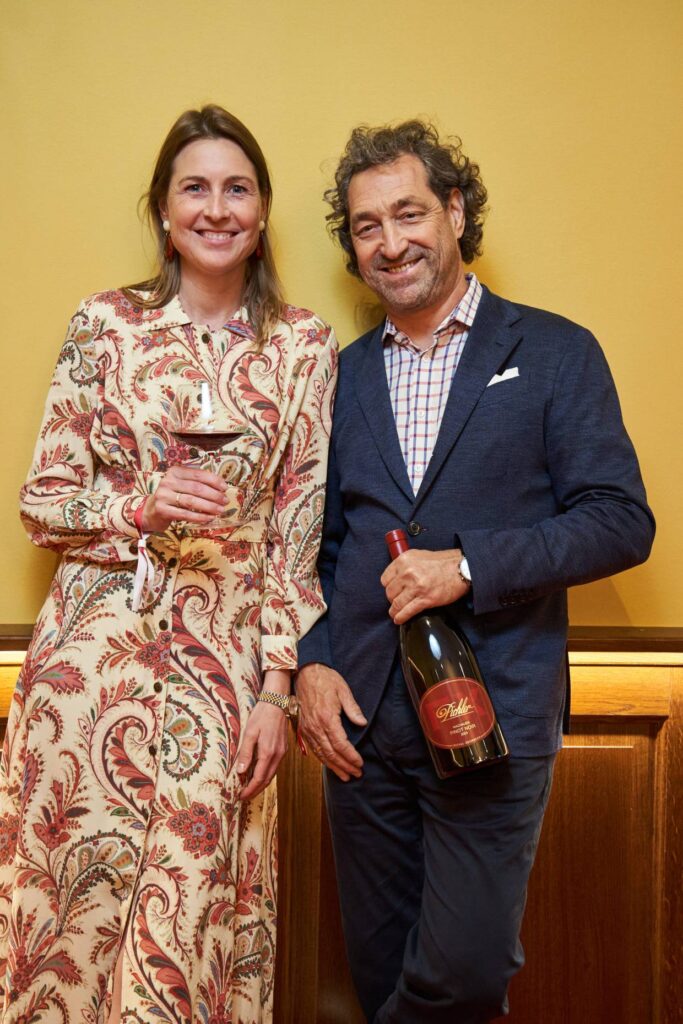
Johanna and Lucas F. Pichler Launching a Novum, their Wachauer Pinot Noir.
At VieVinum in Vienna earlier this year, Lucas and Johanna Pichler unveiled the estate’s first-ever red wine: Wachauer Pinot Noir. The project had remained largely hidden from public view for years. Even within the close-knit community of Wachau producers, few knew the full extent of what was happening behind the scenes. The unveiling immediately sparked curiosity. Why would one of Austria’s most successful white wine producers enter a category where it had no history, no reputation and, perhaps most importantly, no commercial necessity?
The answer lies in a story that stretches back more than a decade and, in some ways, much further than that.
A Family of Pioneers
Before discussing Pinot Noir, it is worth remembering that F.X. Pichler itself began as something of an outsider story. Seven generations ago, the family arrived in the Wachau from neighbouring Kremstal and settled in what was then a fisherman’s house in Oberloiben. Unlike several other well-known Pichler families in the region, there is no direct family connection. The family’s roots were elsewhere, and for much of its history the property resembled countless other rural farms throughout Austria.
When Lucas’ grandfather ran the estate, it was still a mixed agricultural business with animals, crops and only around two hectares of vineyards. The transformation began when Franz Xaver Pichler took over in 1971. At the time there were several wineries in the region carrying the name Franz Pichler, prompting him to adopt his second name, Xaver, and create the identity that would eventually become famous around the world: F.X. Pichler.
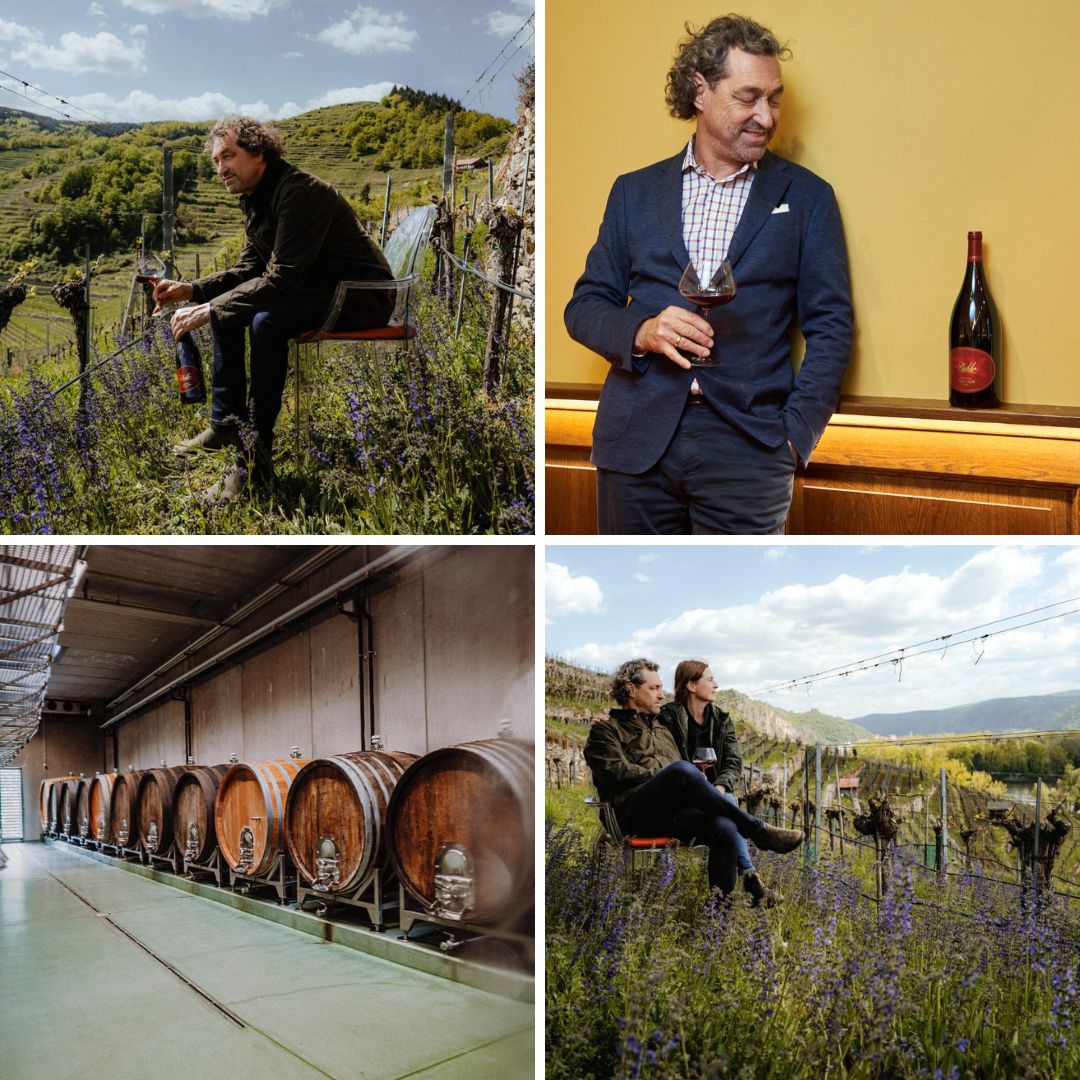
Lucas F. Pichler, now leading the estate, overlooking the family vineyards high above the Donau.
Over the following decades, Franz Xaver steadily expanded the vineyard holdings while relentlessly pursuing quality. Yet the story of F.X. Pichler was never solely about tradition. There was also a willingness to challenge convention. Long before Austrian wine became internationally fashionable, Franz Xaver planted Sauvignon Blanc in the Wachau, inspired by the wines of the Loire Valley. Later, driven by a fascination with Bordeaux, he even experimented with Cabernet Sauvignon.
The Cabernet project lasted only a single vintage. The wine failed to convince him, and the vines disappeared as quickly as they had arrived. Yet the episode would prove surprisingly important decades later. When Lucas first approached his father with the idea of planting Pinot Noir, Franz Xaver immediately recognized the risks involved.
“Don’t make the same mistake I did,” he warned.
The irony is difficult to miss. The father who had once challenged convention became the cautious voice of experience, while the son inherited the instinct to explore new possibilities. More than ten years ago, Lucas began talking seriously about Pinot Noir. His father remained unconvinced. Great vineyard land in the Wachau is scarce, and every hectare devoted to Pinot Noir is a hectare that could have been planted to Riesling. From a commercial perspective, the proposal made little sense.
Yet Lucas could not let the idea go. Part of that persistence came from his own relationship with wine. While his father had long admired Bordeaux, Lucas increasingly found himself drawn towards Burgundy. The attraction was not merely stylistic but philosophical.
“We love Riesling,” he says. “Pinot Noir is the red Riesling.”
For Lucas, the attraction lies in Pinot Noir’s ability to communicate place with remarkable clarity. Rather than relying on concentration or power, the variety reveals subtle differences in soil, climate and exposure, rewarding patience and careful observation in much the same way as the world’s great terroir-driven wines.
Learning from Burgundy, Finding a Voice in the Wachau
The Wachauer Pinot Noir did not emerge from a sudden decision. It was the result of years spent tasting, observing and learning. Through a close friend in Vienna, Lucas gained access to some of the most extraordinary Pinot Noir tastings imaginable. Over more than a decade he attended private tastings featuring many of Burgundy’s most celebrated wines, including extensive verticals from some of the region’s most revered producers.
What fascinated him was not simply the quality of the wines, but the questions they raised. Why did one wine possess greater tension than another? Why did neighbouring vineyards produce such distinct expressions? What role did stem inclusion, extraction techniques or barrel regimes play in communicating terroir? These tastings became a form of ongoing research, helping him understand Pinot Noir long before planting a single vine.
At the same time, Lucas understood that imitation would be a mistake. Burgundy already existed and possessed centuries of accumulated knowledge. The objective was never to recreate Chambolle-Musigny in Austria, nor to prove that the Wachau could produce a Burgundian lookalike.
“I wanted to have both,” he explains. “The idea of Burgundy, but also to have our own style of what Pinot Noir from the Wachau could be.”
Over time, that distinction became increasingly important. The question was no longer whether Pinot Noir could be planted successfully in the Wachau, but whether the variety could reveal something distinctive about the region itself. Could a region celebrated for precision and transparency in white wine discover a similarly compelling voice through Pinot Noir? That challenge gradually became more interesting to Lucas than the idea of reproducing a Burgundian model.
The Wachau and its Donau, giving unique character to the terroir.
Finding the Right Sites
The first step was securing the right plant material. Rather than relying on modern commercial clones, Lucas sought out older Burgundian selections preserved at Weingut Juris in Burgenland. Decades earlier, the Stiegelmar family had imported Pinot Noir material directly from Burgundy and maintained these historic selections. In 2019, Lucas travelled to Burgenland and personally collected cuttings, which would become the foundation of the project.
At the same time, another chapter at F.X. Pichler was drawing to a close. Sauvignon Blanc, once considered pioneering in the Wachau, had become increasingly difficult to position in a global market flooded with examples from every major wine-producing country. The final vintage was produced in 2019, creating an opportunity to graft Pinot Noir onto existing rootstocks.
The choice of vineyard sites proved equally important. The Wachauer Pinot Noir is assembled from five vineyards on the left bank of the Danube. Lucas is convinced that Pinot Noir does not belong on the steep primary rock terraces that have made the Wachau famous for Riesling. Instead, he believes the variety performs best on lower slopes, closer to the river, where humidity, airflow and soil composition create a different environment.
Prime locations were selected for the Pinot Noir vineyards.
One vineyard stands out in particular. Liebenberg, situated between Dürnstein and Weißenkirchen, contains a rare combination of limestone and slate. In a region largely defined by primary rock, the presence of limestone immediately caught Lucas’ attention. For Pinot Noir, it felt promising.
The Liebenberg Vineyard.
The project remained remarkably small. Even today, total plantings amount to little more than half a hectare. This was never intended as a large-scale commercial venture. The limited scale offered freedom. If the experiment failed, it would not threaten the future of the estate. Yet the reputation of F.X. Pichler ensured there would be no freedom from scrutiny.
Making Pinot Noir in the Wachau
Growing Pinot Noir was one challenge. Learning to make it was another entirely.
Lucas openly admits that red winemaking represented unfamiliar territory. After decades of producing world-class white wines, he suddenly found himself navigating a completely different process. Picking decisions became more complex, particularly as different clones ripened at different speeds. Finding physiological ripeness without sacrificing freshness required a level of precision that felt entirely different from working with Riesling.
Then came an unexpected stroke of luck. In 2020, the winery hired a new cellar master named Wolfgang, who had spent thirteen years working at Fred Loimer in the Kamptal, and had extensive experience with Pinot Noir. The timing proved invaluable.
“It was very helpful for me, getting to know Wolfgang, both professionally and personally” Lucas admits.
The project remained his vision, but Wolfgang’s practical experience accelerated the learning curve dramatically. The collaboration reflects one of the most appealing aspects of this story. Rather than pretending to know everything, Lucas approached Pinot Noir with curiosity and humility.
The Wachauer Pinot Noir.
The resulting winemaking philosophy reflects both Burgundy and the Wachau. The fruit undergoes a week of cold maceration before fermentation. Around thirty percent whole bunches are included, while extraction relies entirely on pigeage rather than pump-overs. The wine matures in oak for approximately two years, with around 70% new barrels. After blending, it spends a further six months in stainless steel tanks before being bottled unfiltered.
Throughout our conversation, Lucas repeatedly returns to one point: he dislikes overly fruity Pinot Noir. Instead, he admires wines built on texture, structure and complexity. Referring to Chambolle-Musigny, he describes the greatest examples as “wines with great inner balance”—a description that feels particularly apt for what he is trying to achieve in the Wachau.
A Wine for Modern Gastronomy
The project also reflects broader changes in contemporary gastronomy. For decades, fine dining often revolved around rich sauces, substantial meat dishes and concentrated wines. Today’s restaurant culture increasingly favours vegetables, seafood, Nordic influences and Asian flavours. Alcohol levels are more closely scrutinized, and versatility at the table has become increasingly important.
For Lucas, this evolution matters. F.X. Pichler exports to around fifty countries, with restaurants remaining a central focus. Pinot Noir, with its freshness, moderate alcohol and adaptability, fits naturally into this changing landscape. In many respects, the thinking behind the project mirrors developments that have already shaped the estate’s white wines. The pursuit of balance, freshness and gastronomic versatility has become increasingly important across the portfolio, from Riesling to Grüner Veltliner. Pinot Noir therefore represents not only a fascination with Burgundy, but also a response to the way people eat and drink today.
Tasting the First Chapters
The release of the 2022 and 2023 vintages offers a rare opportunity to taste not only a new wine, but also the evolution of an idea. Both wines clearly belong to the same family, yet the differences between the two vintages are equally revealing, demonstrating how quickly the project has developed in its early years.
The inaugural Wachauer Pinot Noir 2022 immediately conveys the seriousness of the undertaking while remaining remarkably approachable for such a young wine. Aromatically, it combines bright red cherry fruit with delicate floral notes and subtle hints of nougat and sweet spice, the oak already well integrated into the overall composition. There is a lifted quality to the bouquet that reflects the wine’s emphasis on elegance rather than concentration.
On the palate, the wine is defined by balance and finesse. Ripe cherries and red berry fruit form the core, supported by a subtle mineral framework and a gentle touch of spice. What stands out most is the sense of harmony already present at this early stage. The texture remains light-footed and refined, yet the wine carries itself with impressive persistence. A chalky, saline note emerges towards the finish, adding freshness and length while reinforcing the connection to its Wachau origins. Although already enjoyable today, the wine possesses sufficient structure and detail to suggest considerable ageing potential.
F.X. Pichler Wachauer Pinot Noir 2022 | 94/100 DWA score
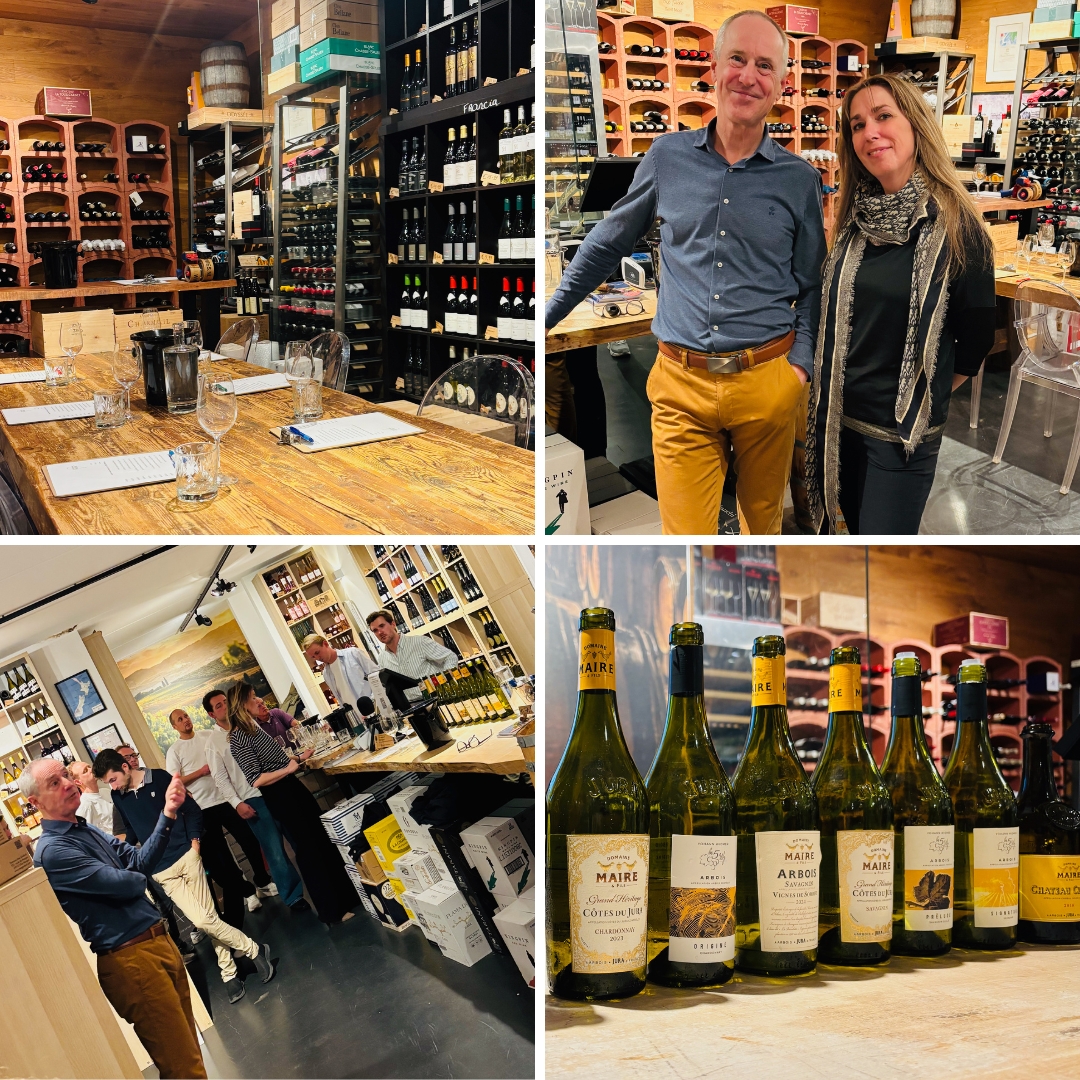
Both Pinot Noir’s (2023 and 2022) on our tasting table.
The 2023 vintage takes the same philosophy in a slightly more ambitious direction. The nose is immediately more expressive, opening with aromas of wild strawberry, red cherry and darker cherry fruit, accompanied by delicate hints of clove, spice and a subtle suggestion of nougat. While the wine remains unmistakably elegant, there is greater depth and concentration compared with the inaugural vintage.
The palate reveals a firmer structure and a more pronounced mineral backbone. Dark cherry fruit is layered with savoury spice and finely integrated oak, while the texture combines silkiness with a sense of underlying power. The saline character that appears in the 2022 is even more evident here, carrying the wine through a long, persistent finish that lingers on mineral and spice-driven notes. Despite its accessibility, the 2023 remains very youthful and still appears to be in the early stages of its development. The balance between fruit, texture and freshness is impressive, and the wine’s combination of concentration and precision suggests a long future ahead.
F.X. Pichler Wachauer Pinot Noir 2023 | 95/100 DWA score
What is perhaps most impressive about these first releases is not that F.X. Pichler has succeeded in producing a convincing Pinot Noir. It is that the wines already possess a distinct identity. They do not attempt to imitate Burgundy, nor do they follow the richer, more fruit-driven styles increasingly encountered elsewhere in the world. Instead, they reveal a style that combines Burgundian inspiration with a distinctly Wachau sense of precision.
The wines favor tension over weight, texture over exuberant fruit and persistence over immediate impact. They already feel less like an experiment and more like the beginning of a coherent new chapter for the estate. The 2022 demonstrates the elegance and drinkability that Pinot Noir can achieve in the Wachau, while the 2023 hints at the greater depth and complexity that may emerge as the project continues to evolve.
A Second Opinion
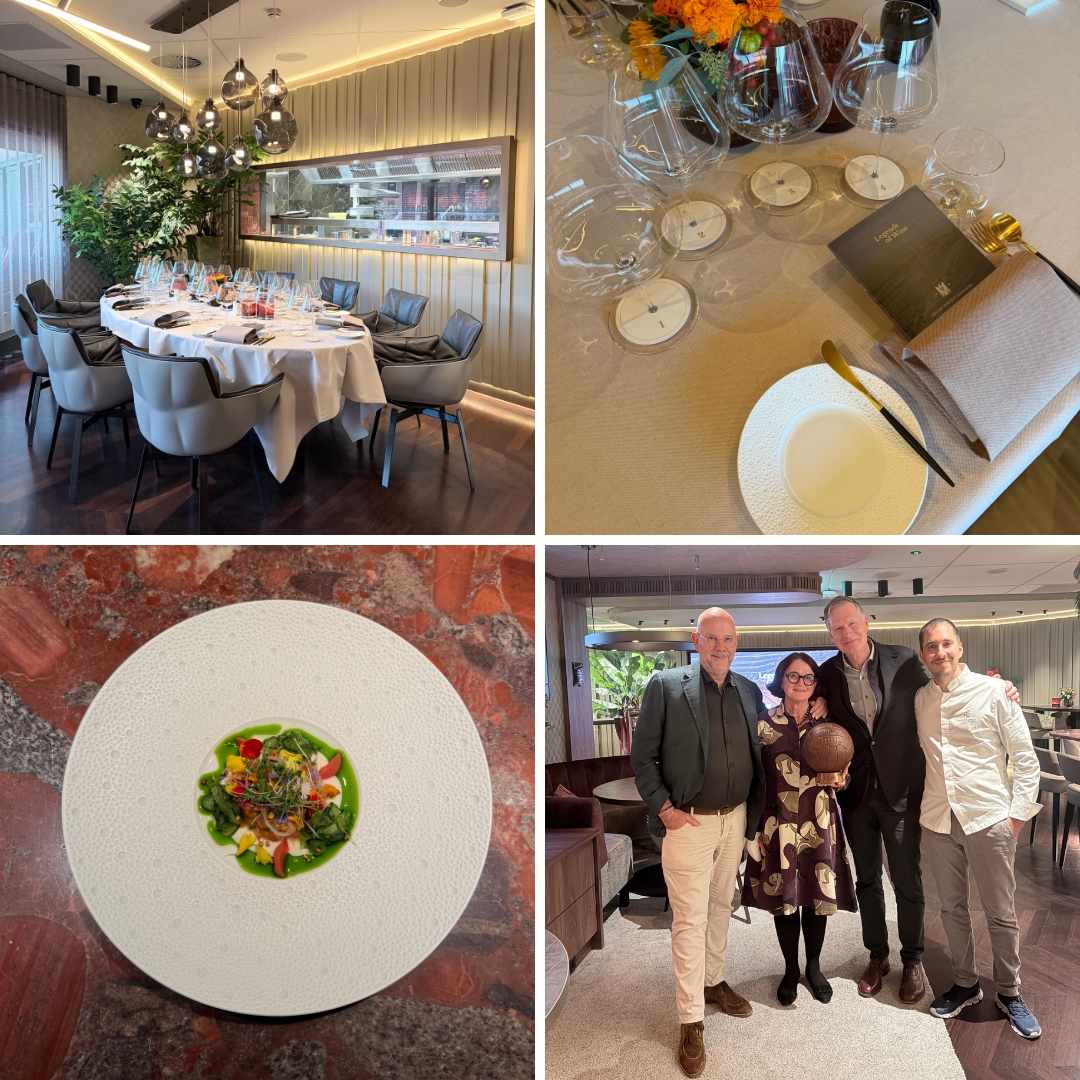
When looking for a second opinion on F.X. Pichler’s inaugural Pinot Noirs, we immediately thought of Axel Rosier, Head Sommelier at Restaurant Fred, the two-Michelin-starred restaurant in Rotterdam. F.X. Pichler’s Rieslings and Grüner Veltliners have long featured on the restaurant’s wine list, and over the years Axel has developed a deep appreciation for the estate’s unmistakable style—one defined by precision, freshness and longevity. That familiarity made his perspective on these first Pinot Noirs particularly valuable.
What surprised Axel was not simply that one of Austria’s most celebrated white wine producers had decided to make a red wine. Even more remarkable was that Pinot Noir had reached this level of quality in the Wachau—a region renowned almost exclusively for Riesling and Grüner Veltliner, where Pinot Noir is scarcely planted and has virtually no history as a serious category. In his view, these wines challenge long-held assumptions about what the Wachau is capable of producing, while remaining unmistakably true to the precision and elegance that define F.X. Pichler.
Rather than approaching the wines as curiosities, Axel evaluated them as he would any serious Pinot Noir destined for the fine-dining table. The 2022 immediately impressed him with its balance and composure. The nose initially opens with generous, almost jam-like fruit before gradually revealing a more restrained and layered expression. On the palate, it is exceptionally juicy, supported by very soft tannins, an elegant texture and remarkable length. Rather than relying on power or extraction, the wine achieves its depth through freshness, harmony and effortless drinkability.
Unsurprisingly, Axel’s thoughts quickly turned to food. Although the 2022 is elegant and relatively low in tannin, he would not necessarily pair it with an equally delicate dish. Instead, he looks for preparations with enough richness and savoury intensity to reveal the wine’s underlying depth. His first thought was grilled lobster, whose sweet, succulent flesh and subtle smoky notes would complement the wine’s generous fruit while matching its concentration without overwhelming its finesse. Aged Parmesan would add another layer of umami, while a touch of chorizo introduces savoury depth and gentle spice. Together, these elements create the balance of richness, freshness and complexity that, in his view, allows the wine to perform at its highest level.
For Axel, these combinations illustrate what makes the 2022 so compelling from a gastronomic perspective. Its vibrant acidity refreshes the palate, its supple tannins never dominate the dish, and its concentration allows it to accompany ingredients with genuine flavour intensity. Rather than demanding a classic Pinot Noir pairing, the wine lends itself to a contemporary style of cuisine in which sweetness, umami, smoke and subtle spice exist in careful balance.
The 2023 reveals a different personality. Initially more reserved on the nose, it requires patience, gradually unfolding as it develops in the glass. Axel believes the wine’s true character is still emerging and expects significantly greater complexity with bottle age. While he considers the 2022 ready to enjoy today, he recommends cellaring the 2023 for at least another five years before revisiting it.
He also experimented with different glassware during the tasting. While a universal glass immediately made the wine more expressive, he ultimately preferred a classic Burgundy bowl, which allowed it to evolve more gradually while preserving its focus and tension. In his view, this is not a Pinot Noir intended for casual drinking, but one that rewards time, attention and contemplation.
Asked whether the wines reminded him of another region, Axel was reluctant to draw direct comparisons. Every wine region, he argued, possesses its own identity, and these Pinot Noirs should ultimately be appreciated on their own terms. If pressed, he would look towards the southern Côte de Beaune as a broad stylistic reference, though only in the sense of elegance and balance rather than imitation. More importantly, he believes F.X. Pichler is already demonstrating that Pinot Noir can establish a distinctive identity in the Wachau.
What impressed Axel most was not simply that F.X. Pichler had succeeded in producing a convincing Pinot Noir. It was how complete these wines already feel. From the very first commercial release, they display the same precision, restraint and gastronomic focus that have long defined the estate’s celebrated Rieslings and Grüner Veltliners. They are not impressive because they are the winery’s first red wines—they are impressive because they stand comfortably alongside the benchmark wines that built F.X. Pichler’s international reputation.
Looking Beyond Tradition
By 2025, the first vintage was technically ready for release. Lucas chose to wait. The wine had spent two years in barrel and additional time in stainless steel, yet he felt the project deserved a stronger introduction. As he puts it, “You only have one chance.”
That chance arrived at VieVinum 2026. Rather than presenting a single wine, F.X. Pichler showed the 2022 and 2023 vintages together, alongside a barrel sample of the 2024. The decision immediately communicated seriousness. This was not a curiosity or a side project, but the beginning of a long-term commitment.
The Launch of the Pinot Noir’s at VieVinum 2026.
Whether Pinot Noir becomes an important part of the Wachau’s future remains uncertain. Lucas is careful not to make grand predictions, yet he clearly sees potential. Climate change is altering assumptions throughout the wine world. Sites once considered marginal increasingly produce outstanding fruit, while historic classifications are being reconsidered. Even Burgundy faces questions about what constitutes a great vineyard in a warmer future.
The Wachau is no exception. For Lucas, Pinot Noir represents another lens through which to explore the Wachau. It does not compete with Riesling or Grüner Veltliner, nor does it seek to redefine the region. Instead, it expands the conversation about what certain sites may be capable of producing in the decades ahead. The project is already expanding modestly through additional plantings at Liebenberg, and production is expected to increase slightly over the coming years. Quantities will remain small, but the ambition remains considerable.
As our conversation draws to a close, Lucas reflects on the broader significance of the project. He never speaks about market share, sales targets or commercial opportunities. Instead, he talks about possibility, curiosity and the desire to discover something new. At one point he pauses and smiles.
“Maybe I start a new history.”
The remark is delivered lightly, almost jokingly, yet it captures something important. The significance of F.X. Pichler’s Pinot Noir does not lie in the 2,000 bottles produced from the first vintages. It lies in the fact that one of Austria’s most respected producers was willing to ask a question that many others had not. What if the Wachau could be known for something more?
The first answer now rests in the bottle.
This article is written by our own Niels Aarts. Picture credits: Weingut F.X. Pichler and their respective owners. We thank Lucas Pichler of Weingut F.X. Pichler and our partner Wine+Partners. The wines of F.X. Pichler are distributed and sold in the Netherlands through Anfors Imperial.
Join our insiders’ list and get exclusive early access to new articles, expert tips, and fresh reviews delivered straight to your inbox. Subscribe now and be the first to discover!