Join Our Wine Journey – Sign Up for the Newsletter 🍷
Chappellet: Guardians of Napa’s Grand Cru
Share
Deel op X (twitter)
LinkedIn
WhatsApp
Chappellet: Guardians of Napa’s Grand Cru.
How Chappellet shaped the legend of Pritchard Hill.
Long before Pritchard Hill became one of Napa Valley’s most coveted wine-growing sites, Donn and Molly Chappellet recognized the extraordinary potential of an unforgiving mountainside overlooking Lake Hennessey. Nearly sixty years later, their pioneering vision continues to define not only one of California’s most respected family wineries, but also the mountain that helped transform Napa Valley Cabernet Sauvignon.
The Mountain Before the Myth
Great wine begins with place. Before there is a winery, a winemaker or even a vineyard, there is a landscape capable of producing something extraordinary, waiting for someone to recognize its potential. Throughout the history of fine wine, the world’s greatest estates have rarely created exceptional terroir; they have simply understood it before anyone else.
Rising above the eastern shores of Lake Hennessey, Pritchard Hill has become one of California’s most revered wine-growing sites. Although it has never been recognized as an official American Viticultural Area, its reputation extends far beyond the legal framework of Napa Valley. Among collectors, critics and winemakers, it is regarded as one of the finest places in North America to grow Cabernet Sauvignon, producing wines distinguished not only by their concentration and longevity but also by a remarkable sense of balance that has become the mountain’s defining signature.
Yet landscapes are not born with reputations.
Every celebrated vineyard has a moment before the acclaim, before the critics and before the waiting lists, when its future depends entirely upon the vision of those prepared to invest in an uncertain idea. Long before Pritchard Hill acquired its almost mythical status, it was little more than a rugged mountainside whose steep slopes, volcanic soils and remote location discouraged all but the most determined growers.
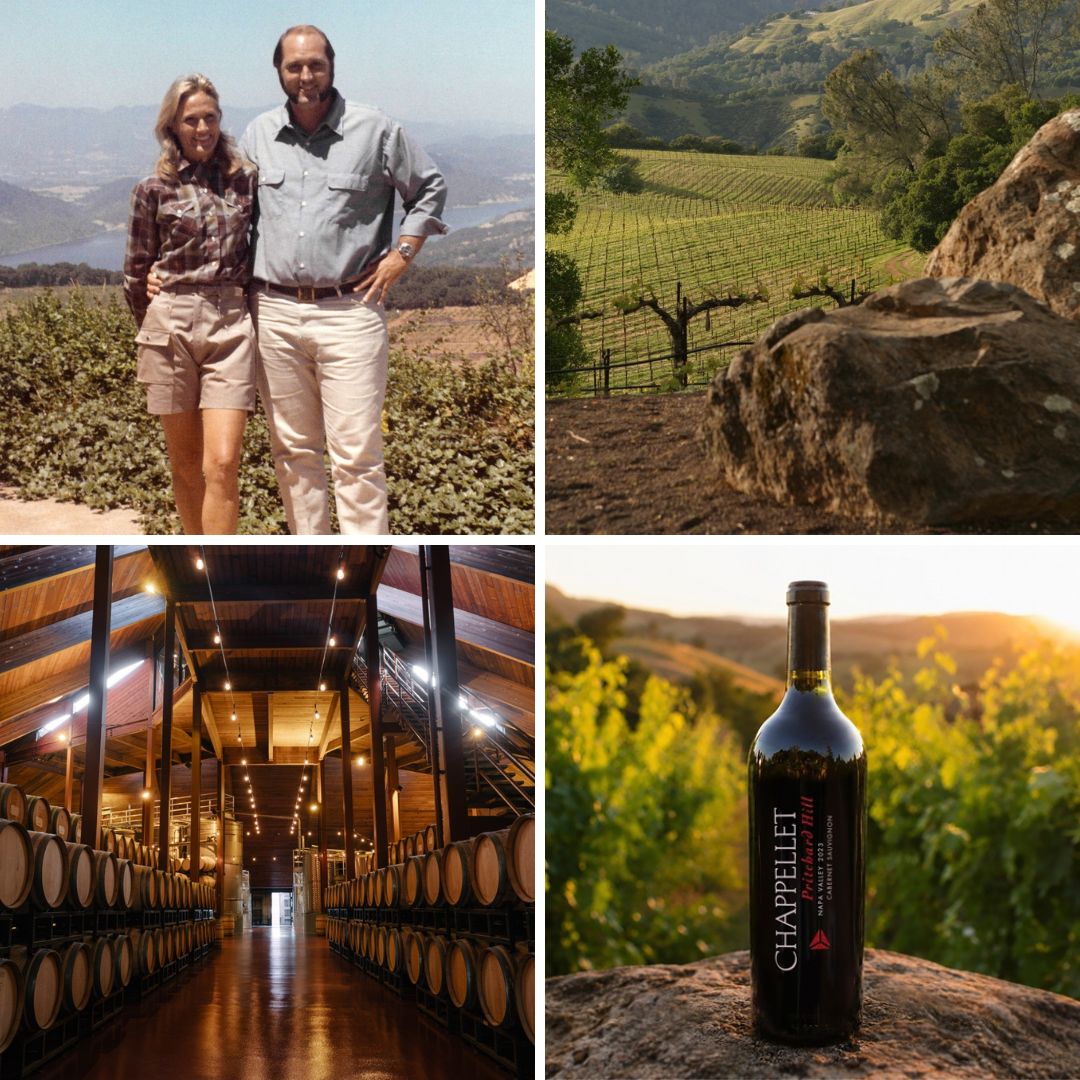
Donn and Molly Chappellet in the early days.
It was precisely those qualities that attracted Donn and Molly Chappellet.
When they purchased land on Pritchard Hill in 1967, Napa Valley itself was still searching for an identity. The famous Judgment of Paris lay almost a decade in the future, fewer than one hundred wineries operated throughout the valley and California Cabernet Sauvignon had yet to establish itself among the world’s great wines. Conventional wisdom favored the fertile valley floor, where gentler terrain promised reliable yields and easier farming. Choosing a steep mountain property instead appeared, to many, an unnecessary risk.
The Chappellets viewed the mountain differently. Rather than asking whether vines could survive under such demanding conditions, they were intrigued by what those conditions might offer in return. They believed that struggle could produce character, that poorer soils might yield greater complexity and that elevation could bring freshness to fruit ripened beneath the Californian sun. It was a conviction shaped as much by curiosity as by confidence, and one that would ultimately alter not only the future of their own family winery but also the reputation of Pritchard Hill itself.
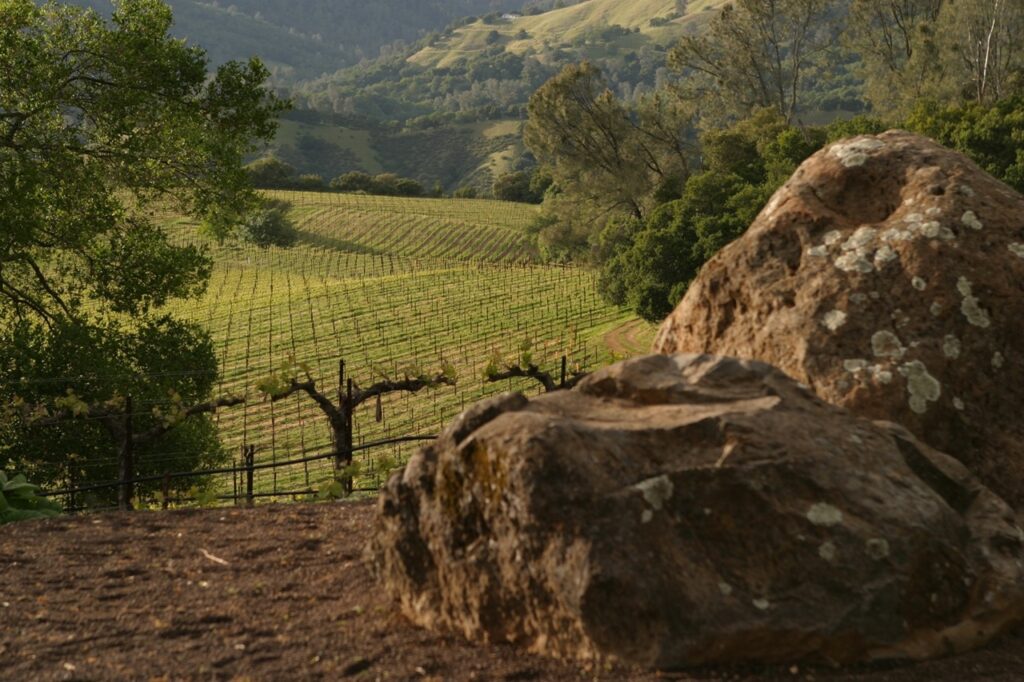
The Chappellet Vineyards on Pritchard Hill.
Nearly six decades later, Chappellet remains inseparable from the mountain that inspired its founders. It was the first winery established on Pritchard Hill and remains the only estate permitted to use the name on its labels, a distinction that reflects not merely geography but history. More importantly, the estate demonstrated, vintage after vintage, that Cabernet Sauvignon grown on these volcanic slopes possessed a character unlike anything being produced elsewhere in Napa Valley, encouraging a new generation of vintners to look beyond the valley floor and recognize the mountain’s extraordinary potential.
Today, President David Francke speaks less about preserving a legacy than about continuing a conversation that began when Donn and Molly first planted vines on Pritchard Hill. Every generation, he believes, inherits a deeper understanding of the mountain, adding its own experience to knowledge accumulated over decades rather than attempting to redefine the estate with each passing era. It is a philosophy rooted in patience, and one that perhaps explains Chappellet’s remarkable consistency across almost sixty years of winemaking.
To appreciate how visionary that original decision truly was, however, it is necessary to return to Napa Valley as Donn and Molly first encountered it: a region rich in ambition, short on certainty and still searching for the confidence that would eventually establish California among the world’s great wine-producing regions.
Betting on the Impossible
When Donn and Molly Chappellet arrived in Napa Valley, they entered a wine region that was still defining itself.
Today, it is difficult to imagine California without the prestige of Napa Valley. Its wines command international acclaim, vineyard land ranks among the most valuable in the world and names such as Mondavi, Heitz, Ridge, Stag’s Leap Wine Cellars and Chappellet have become woven into the history of American fine wine. In the late 1960s, however, that reputation was far from assured. Outside the United States, California was rarely spoken of in the same breath as Bordeaux or Burgundy, while within Napa Valley there remained genuine uncertainty about which grape varieties, vineyard sites and winemaking philosophies would ultimately define the region.
It was, however, a remarkably optimistic period. A new generation of producers believed California could create wines capable of standing alongside the world’s finest, and that shared ambition fostered an unusually collaborative spirit. Equipment was borrowed, advice exchanged freely and neighbors often helped one another through the practical challenges of establishing new estates. Success was viewed less as an individual achievement than as a collective effort to demonstrate that Napa Valley deserved a place on the global stage.
The Chappellets became part of that movement from the moment they arrived.
Donn’s ambition had never been to replicate the wines of Bordeaux, despite his admiration for them. His travels through Europe’s great wine regions had convinced him that California possessed every natural advantage required to produce wines of equal stature, provided growers were prepared to look beyond convention. He believed Cabernet Sauvignon would become Napa Valley’s defining variety, but only if planted in sites capable of expressing genuine character rather than simply delivering generous yields.
That conviction led him to seek the advice of André Tchelistcheff, whose influence on Californian wine can scarcely be overstated. Having transformed Beaulieu Vineyard into one of the state’s benchmark producers, Tchelistcheff had long advocated the potential of hillside vineyards, arguing that vines growing under more demanding conditions produced fruit of greater concentration, structure and longevity. His encouragement confirmed Donn’s instinct that Pritchard Hill was not a compromise born of ambition, but an opportunity unlike any other in Napa Valley.
Even with that confidence, establishing a winery on the mountain demanded an extraordinary leap of faith. Roads had to be improved before equipment could reach the property, vineyards planted on steep, rocky slopes and a winery constructed in a landscape where few considered serious viticulture possible. There was no guarantee that the mountain would reward the effort, only the belief that exceptional wine rarely emerged from easy places.
The Unique Terroir of Pritchard Hill, which was largely undeveloped when Donn and Molly arrived.
The first harvest offered an early reminder of both the challenges and the camaraderie that characterized Napa Valley at the time. With Chappellet’s winery still under construction, the 1968 vintage was produced at Robert Mondavi Winery before returning to its permanent home on Pritchard Hill. It is a story that has become part of Napa Valley folklore, illustrating the generosity that existed among many of the region’s pioneers. As David Francke observes, there was a shared understanding that every successful winery strengthened the reputation of California wine as a whole.
That spirit of collaboration would help shape the valley’s future, but for the Chappellets the greater challenge still lay ahead. Establishing a winery was only the first step. The real task was to understand the mountain they had chosen, not over the course of a single vintage, but over a lifetime.
For Donn and Molly, Pritchard Hill was never simply the site of an ambitious new winery. It was where they intended to build a home, raise their family and commit themselves to a landscape whose greatest lessons would reveal themselves only through time. It is this decision—perhaps even more than the wines that followed—that continues to distinguish Chappellet from many of its contemporaries, because from the very beginning the estate was conceived not as a project, but as a place where life and viticulture would become inseparable.
A Family and a Mountain
For Donn and Molly Chappellet, Pritchard Hill was never simply the location of a winery. From the outset, they envisioned something more enduring: a family home where the rhythms of daily life would be inseparable from those of the vineyard. Long before visitors arrived to admire the panoramic views across Lake Hennessey or taste Cabernet Sauvignon in the hillside tasting room, the estate was first and foremost the place where six children grew up, where family dinners marked the passing of the seasons and where the vineyards became as familiar as the surrounding oak forests and granite outcrops.
That sense of permanence has remained one of Chappellet’s defining characteristics. While many of Napa Valley’s most celebrated estates have changed ownership, expanded through acquisition or evolved into corporate enterprises, Chappellet has remained family-owned since its founding. Nearly six decades after Donn and Molly first arrived on Pritchard Hill, the second generation continues to guide the estate, preserving not only the family’s ownership but also the philosophy that shaped its earliest decisions.
David Francke believes that continuity has become one of the estate’s greatest strengths, not because it encourages tradition for tradition’s sake, but because it allows knowledge to accumulate over time. Every growing season reveals something new about the mountain, and every generation inherits not only the vineyards themselves but also decades of careful observation, practical experience and an intimate understanding of how each parcel responds to changing conditions.
That philosophy is reflected throughout the estate. Spread across approximately 40 hectares of vineyards, planted between 240 and more than 550 metres above sea level, Chappellet is far from uniform. Variations in elevation, aspect, soil depth and exposure create a mosaic of individual vineyard blocks, each ripening at its own pace and each contributing a different expression of Pritchard Hill. Rather than seeking consistency by treating the property as a single vineyard, the viticultural team embraces these differences, adapting pruning, canopy management, irrigation and harvest dates to the specific needs of each block.
The Winery as integral part of Pritchard Hill.
Such an approach demands patience as much as precision. Modern vineyard management provides an abundance of information, from detailed soil analysis and weather forecasting to satellite imagery and aerial mapping, yet none of these tools replaces the value of experience accumulated through decades of working the same slopes. Patterns begin to emerge only after successive vintages: how one parcel responds during a cooler growing season, why another retains freshness despite prolonged summer heat or how subtle changes in vine age gradually alter the character of the fruit.
“The mountain keeps teaching us,” says Francke. “Every vintage reinforces something you’ve learned before, but it also presents something entirely new. That’s one of the things that makes farming here so rewarding.”
This willingness to keep learning has characterized Chappellet from the beginning and extends well beyond the family itself. Over the years, the estate has benefited from the expertise of some of California’s most respected winemakers, each contributing to an evolving understanding of Pritchard Hill rather than attempting to redefine its identity. Philip Togni helped establish the structure and longevity for which the wines became known, Cathy Corison further refined the estate’s expression of mountain-grown Cabernet Sauvignon, and Phillip Corallo-Titus continued that pursuit of elegance and precision.
Phillip Corallo-Titus, winemaker at Chappellet.
Their individual contributions undoubtedly shaped the wines, yet the more remarkable story lies in the continuity between them. Rather than pursuing dramatic stylistic shifts with each new appointment, Chappellet has consistently favored evolution over reinvention, allowing every generation of winemakers to build upon the observations of those who came before. Over nearly sixty years, that cumulative knowledge has become one of the estate’s most valuable assets, enabling increasingly precise decisions both in the vineyard and in the cellar.
Chappellet’s Barrel Cellar.
It also reflects a broader truth about fine wine. Truly exceptional vineyards reveal themselves slowly. Understanding them requires far more than technical expertise or favorable vintages; it demands the patience to observe, to question and, above all, to listen. That process has defined Chappellet since its earliest days and continues to shape every bottle produced on Pritchard Hill.
The mountain, however, has always been the principal author of that story. The family’s achievement has not been to impose its will upon the landscape, but to understand what makes this remarkable site capable of producing wines unlike any other in Napa Valley.
Why Pritchard Hill Matters
Few vineyard sites earn their reputation through a single defining characteristic. More often, it is the convergence of geography, geology and climate that creates the conditions for truly exceptional wines. Pritchard Hill is no exception. Its elevation, volcanic soils and exposure to the Californian sun are each significant in their own right, but it is the interaction between these elements that gives the mountain its distinctive identity and explains why it has become one of the most sought-after sites for Cabernet Sauvignon in North America.
The landscape itself offers the first clues. Unlike the deeper, more fertile soils found across much of the Napa Valley floor, Pritchard Hill is characterized by fractured volcanic rock, weathered sandstone and shallow, well-drained soils that place the vine under constant, moderate stress. Water does not linger after winter rains, compelling roots to penetrate deep into the mountain in search of moisture and nutrients, while the naturally low fertility limits vigor and encourages the plant to focus its energy on producing a smaller crop of intensely flavored fruit. For growers, these conditions require careful management and a willingness to accept lower yields. For Cabernet Sauvignon, they provide an environment in which concentration develops naturally, without sacrificing balance.
Elevation plays an equally important role. Chappellet’s vineyards rise from approximately 240 to more than 550 metres above sea level, creating a markedly different growing environment from that of the valley floor. During the growing season, many vineyard blocks sit above the morning fog that settles across Napa Valley, allowing the vines to benefit from longer hours of sunlight while avoiding the excessive heat that can accumulate lower down. Warm afternoons encourage complete phenolic ripeness, yet the cooler nights slow the vines’ metabolism, preserving acidity and aromatic freshness. The resulting wines combine the depth and richness expected from California with a vibrancy and structure more commonly associated with cooler climates.
Those broad characteristics, however, tell only part of the story. What makes Pritchard Hill such a compelling place to farm is its remarkable diversity over relatively short distances. A slight variation in elevation may delay ripening by several days, while differences in aspect influence both sunlight exposure and afternoon temperatures. Some parcels retain just enough moisture to sustain the vines through the dry summer months, whereas others require a different approach to canopy management in order to achieve the desired balance between fruit development and freshness. Even neighbouring blocks planted to the same clone of Cabernet Sauvignon can produce fruit with noticeably different tannin profiles, aromatic expression and natural acidity.
It is this complexity that has shaped Chappellet’s approach to viticulture over the past six decades. Rather than pursuing uniformity across the estate, the objective has always been to understand the individual character of each vineyard block and to respond accordingly. Decisions about pruning, irrigation, harvest timing and vinification are made with the knowledge that every parcel contributes a different voice to the final blend, and that respecting those differences ultimately produces wines of greater precision and complexity.
As David Francke explains, that understanding can never be considered complete. “Every vintage teaches you something,” he says. “You begin to recognize patterns, but the mountain is always capable of surprising you. That’s what keeps the work interesting.”
His observation reflects a philosophy that has become deeply embedded in the culture of the estate. While advances in technology have transformed modern viticulture, providing detailed data on everything from soil composition to vine water status, they have complemented rather than replaced experience. The most valuable knowledge at Chappellet has been accumulated gradually through decades of observation, with each vintage adding another layer to the estate’s understanding of how Pritchard Hill responds to changing weather patterns, seasonal extremes and the slow evolution of mature vineyards.
David Francke, President of Chappellet.
Today, Pritchard Hill is home to many of California’s most celebrated producers, each drawing its own expression from the mountain’s volcanic slopes. Yet Chappellet occupies a distinctive place within that history. The estate was established before the mountain had earned its reputation, and its early success demonstrated that these challenging hillside vineyards were capable of producing Cabernet Sauvignon with a level of complexity and longevity few believed possible at the time. In doing so, it helped redefine perceptions not only of Pritchard Hill itself, but also of what Napa Valley could achieve on the world stage.
Nearly six decades after Donn and Molly Chappellet first stood on an unproven mountainside overlooking Lake Hennessey, the story comes full circle. Every decision made since—from vineyard planting and farming to harvest and élevage—has been guided by a belief that Pritchard Hill could produce wines unlike any other in Napa Valley. The clearest expression of that conviction is found not in the estate’s history, but in the wines themselves.
Tasting Chappellet
Every great estate ultimately has to justify its reputation in the glass. Chappellet is no exception. The history of Pritchard Hill, the pioneering vision of Donn and Molly Chappellet and nearly six decades of accumulated knowledge ultimately find their truest expression in the wines themselves.
Tasting the estate’s Cabernet Sauvignons side by side offers a fascinating insight into both place and philosophy. The Napa Valley bottlings showcase the generosity, balance and approachability that have long defined Chappellet’s house style, while the Pritchard Hill wines delve deeper into the estate’s identity, revealing an extraordinary combination of power, elegance and precision that only a great mountain vineyard can produce.
It is also worth noting that both Pritchard Hill Cabernet Sauvignons were tasted at an exceptionally early stage in their development. Even now, they display remarkable harmony and depth, yet they remain wines built for the long term. Collectors willing to cellar them for fifteen to twenty years are likely to be rewarded with even greater aromatic complexity and textural refinement, while those opening a bottle in the near future would do well to allow several hours of decanting. These are wines that reveal themselves patiently rather than immediately.
Chappellet’s Flagship Wine, the Pritchard Hill Cabernet Sauvignon.
Chappellet Napa Valley Signature Cabernet Sauvignon 2022 | 92/100 DWA
The 2022 Napa Valley Cabernet Sauvignon provides an inviting introduction to the Chappellet style, combining generosity with admirable restraint. Aromas of ripe blackberry, cassis and dark plum are accompanied by cedar, baking spices, tobacco leaf and a subtle hint of cocoa, creating a bouquet that is expressive without becoming overtly opulent.
The palate is supple and beautifully composed, offering layers of dark fruit supported by polished tannins and a welcome freshness that keeps the wine vibrant from beginning to end. Notes of graphite, dried herbs and dark chocolate gradually emerge with air, adding complexity without disturbing the wine’s effortless balance. Although approachable in its youth, it possesses sufficient structure to reward several years in bottle, making it an excellent ambassador for both the estate and the vintage.
Chappellet Napa Valley Signature Cabernet Sauvignon 2023 | 93/100 DWA score
The 2023 vintage builds confidently upon its predecessor, displaying greater aromatic lift and a little more precision throughout. Bright blackcurrant, blackberry and red cherry are framed by floral notes, fresh bay leaf, cedar and finely integrated oak, giving the wine an immediate sense of freshness and purity.
On the palate, the fruit is beautifully defined, carried by silky tannins and lively acidity that lend both energy and elegance. There is a subtle mineral thread running beneath the generous fruit profile, adding depth and complexity while preserving the wine’s accessibility. Slightly more linear and refined than the 2022, the 2023 demonstrates impressive harmony and should continue to develop positively over the coming decade.
Chappellet Napa Valley Signature Cabernet Sauvignon.
Chappellet Pritchard Hill Cabernet Sauvignon 2022 | 98/100 DWA score
The step from the Napa Valley Cabernet Sauvignon to the Pritchard Hill bottling is immediately apparent. The 2022 possesses greater depth, greater complexity and a heightened sense of precision, yet its defining quality is not power but composure. Aromas of blackcurrant, blackberry and damson unfold alongside graphite, cedar, dried sage, violets and finely judged oak, while subtle notes of espresso, dark chocolate and crushed volcanic stone continue to emerge with time in the glass.
The palate is beautifully structured, combining remarkable concentration with finely sculpted tannins that frame the fruit without ever dominating it. Beneath its richness lies a vibrant freshness that carries the wine effortlessly towards a long, mineral finish, where savoury herbs and dark fruit linger with impressive persistence. Already immensely rewarding, the 2022 nevertheless feels as though it still has another chapter to write. Over the next fifteen to twenty years, the tannins are likely to soften further while the aromatic profile gains additional nuance and complexity. Those unwilling to wait should allow the wine several hours in a decanter, where it gradually reveals increasing depth, elegance and detail.
Chappellet Pritchard Hill Cabernet Sauvignon 2023 | 99/100 DWA score
The 2023 Pritchard Hill Cabernet Sauvignon represents everything that makes this remarkable site so compelling. From the first pour, the wine displays extraordinary purity, opening with vibrant cassis, wild blackberry and black cherry, supported by delicate floral notes, graphite, cedar, crushed rock and fresh mountain herbs. Every aromatic component feels seamlessly integrated, creating a wine of striking precision and remarkable poise.
The palate is simply magnificent. Despite its concentration, the wine possesses an almost weightless quality, gliding across the palate on perfectly ripe fruit, vibrant acidity and tannins of exceptional refinement. Layer upon layer of dark berries, cocoa, pencil lead and subtle spice unfolds with remarkable clarity before giving way to a finish of extraordinary length, where freshness and minerality persist long after the fruit has faded. There is an effortless harmony to the 2023 that makes its complexity appear almost inevitable, suggesting a wine that is destined to evolve for decades while remaining beautifully balanced throughout its life. It is astonishingly complete at such an early stage, yet one cannot escape the feeling that its greatest years still lie ahead. If opened young, it deserves patience in the decanter every bit as much as it deserves patience in the cellar.
Some of Chappellet’s Historical Bottles.
Final Thoughts
Nearly six decades after Donn and Molly Chappellet first looked across an unproven mountainside and imagined what it might become, their belief continues to resonate in every bottle produced on Pritchard Hill. The estate’s story is not simply one of pioneering vision or remarkable wines, but of patience, continuity and an enduring commitment to understanding a singular place. In an era when ownership, styles and fashions often change with remarkable speed, Chappellet remains rooted in the principles upon which it was founded, demonstrating that the finest expressions of terroir are measured not only by the quality of a single vintage, but by consistency across generations.
This article is written by our own Niels Aarts. Dutch Wine Apprentice extends its sincere thanks to David Francke and the entire Chappellet team for their openness in sharing the estate’s history and philosophy, and for providing the opportunity to experience these exceptional wines. Their passion for Pritchard Hill is evident not only in the bottles that bear the Chappellet name, but also in the care with which they continue to steward one of Napa Valley’s most remarkable vineyard sites.Picture credits: Chappellet and their respective owners.
Join our insiders’ list and get exclusive early access to new articles, expert tips, and fresh reviews delivered straight to your inbox. Subscribe now and be the first to discover!