Join Our Wine Journey – Sign Up for the Newsletter 🍷
Domaine Evremond: A New Voice from Kent
Share
Deel op X (twitter)
LinkedIn
WhatsApp
Domaine Evremond: A New Voice from Kent.
Before a single bottle of Domaine Evremond had been poured, the tone for the afternoon had already been set.
Gathered at Restaurant Fred in Rotterdam, journalists and wine lovers had come to discover one of the most anticipated arrivals in the world of sparkling wine: the Dutch launch of Domaine Evremond, the English estate created by Champagne Taittinger and long-time UK importer Patrick McGrath MW. Yet from the very first conversations, it became clear that this would not be another presentation built around production figures, investment or market ambitions. Instead, the discussion repeatedly returned to the people behind the project.
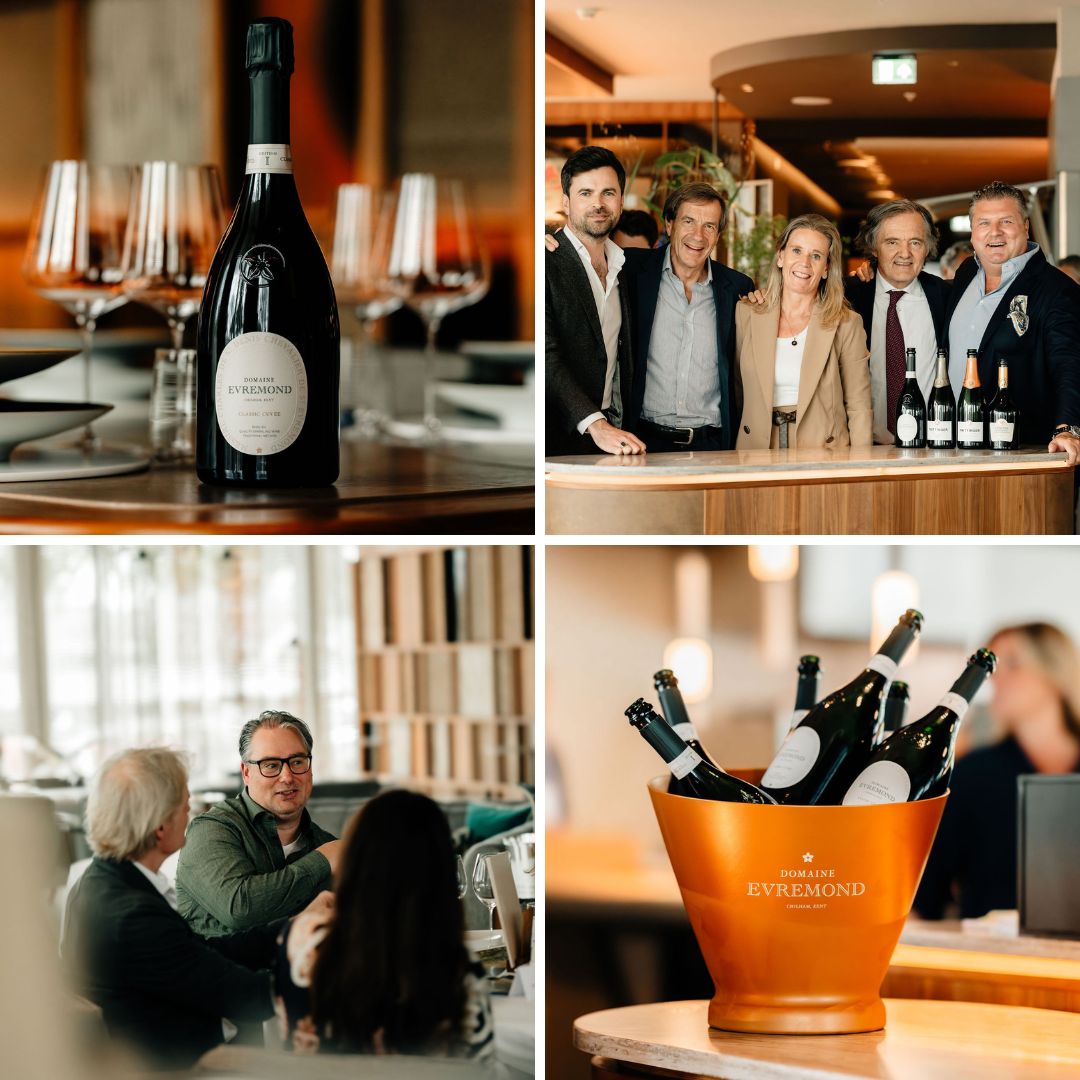
Bottles of Domaine Evremond’s Classic Cuvée Edition I being uncorked for the Dutch release.
That was hardly surprising given the two men at its center. Patrick McGrath and Pierre-Emmanuel Taittinger have worked together for nearly three decades, but what stood out throughout lunch was how naturally that professional relationship had evolved into genuine friendship. They interrupted one another’s stories, laughed at memories only they fully understood and seemed far more interested in recognizing the contributions of colleagues than talking about themselves. Watching them together, it became increasingly difficult to think of Domaine Evremond as simply another ambitious wine venture. It felt like the natural expression of a partnership built patiently over many years.
Restaurant Fred provided an appropriately understated setting. Chef Fred Mustert and his brigade had created a menu that allowed each wine to speak without distraction, while Head Sommelier Axel Rosier guided the pairings with the quiet confidence that has become synonymous with one of the Netherlands’ finest wine programmes. Together with the team from VINVIN Wines—Corinne Hofland, Frank Laurentius and Marcel Just de la Paisières—the afternoon unfolded less as a formal launch than as an invitation into the thinking behind the estate.
Patrick McGrath MW and Pierre-Emmanuel Taittinger with the VINVIN team
What proved striking was not the scale of the investment or the ambition of the project, but the way both McGrath and Taittinger consistently shifted the spotlight away from themselves. Vineyard managers, winemakers, growers and family members all became essential characters in the story, reinforcing the impression that the wine was ultimately the product of those relationships rather than the reason they existed.
A Partnership that Predates the Vineyard
Patrick McGrath has played a defining role in shaping the fine wine landscape in the United Kingdom. When he founded Hatch Mansfield in 1994, his ambition was not simply to establish another importer, but to represent family-owned producers whose philosophies reflected his own long-term outlook. Champagne Taittinger joined the portfolio in 1998, creating what would become one of the maison’s most important export partnerships and helping the United Kingdom grow into its largest international market.
Years of working together gradually transformed that commercial relationship into something much deeper. They travelled extensively, shared countless lunches and dinners and, perhaps most importantly, spent years tasting wine together. As English sparkling wine evolved from curiosity into genuine international contender, those tastings increasingly included bottles from producers across southern England.
Neither McGrath nor Taittinger suggested that England’s potential revealed itself overnight. Confidence grew slowly, vintage after vintage, as producers consistently demonstrated what the country’s chalk soils and cool maritime climate could achieve. Eventually, Pierre-Emmanuel posed a question that would alter both their futures.
Rather than watching English sparkling wine develop from the sidelines, why not become part of its story?
Looking back, the idea now feels almost inevitable. At the time, however, it represented a bold step. Champagne Taittinger had already shown through Domaine Carneros that it was willing to invest beyond Champagne, yet England presented an entirely different challenge. This would not be an overseas extension of an established house style, but the opportunity to create something entirely new while remaining faithful to the principles that had guided the family for generations.
Patrick McGrath at the Evremond Launch in Restaurant Fred, Rotterdam.
Patrick McGrath summed up those early conversations with characteristic simplicity. “It’s a project that’s really based on friendship.”
By the end of the afternoon, that understated remark had quietly become the thread connecting every chapter of Domaine Evremond’s story.
Pierre-Emmanuel Taittinger offered another perspective on the estate’s origins, revealing that the project began with something even rarer than commercial ambition.
Pierre-Emmanuel Taittinger, Honorary President of Champagne Taittinger and Co-Founder of Domaine Evremond.
When the Taittinger family regained ownership of the maison in 2006, buying the company back demanded enormous commitment from everyone involved. Patrick McGrath remained one of Champagne Taittinger’s closest international partners throughout that period, supporting the brand in one of its most important export markets while helping strengthen its position in the United Kingdom.
Looking back on those years, Pierre-Emmanuel explained that the original idea behind Domaine Evremond did not begin with a vineyard in Kent. “The first idea,” he told us, “was really to say thank you to Patrick.”
Few wineries can trace their origins to gratitude rather than opportunity.
Of course, both men believed England possessed exceptional potential for sparkling wine. They had followed the country’s progress for years and recognized the possibilities offered by Kent’s chalk soils and increasingly favorable growing conditions. Yet listening to Pierre-Emmanuel, it became clear that respect came first; the vineyard followed afterwards.
That same sentiment resurfaced when he reflected on wine itself. “If we are here today, it is not only to drink, to eat or to make business, but to share moments of happiness.”
It was not delivered as a rehearsed line. Looking around Restaurant Fred, where conversations flowed as naturally as the wines being poured, it felt like a genuine reflection of the atmosphere in the room.
Searching for the Right Place
Turning a shared ambition into reality proved considerably more complicated than deciding to pursue it.
Patrick McGrath explained that the search revolved around a handful of uncompromising requirements. The vineyard needed chalk soils, south-facing slopes and sufficient shelter to maximize ripening in England’s still marginal climate. Several promising sites were explored before ultimately being rejected, including one where the chalk lay beneath a layer of clay too thick to provide the conditions they were seeking.
Eventually, the search led them to a fruit farm near the village of Chilham, west of Canterbury, owned by Mark Gaskain. Finding the vineyard, however, proved only half the challenge.
Meeting Gaskain was equally important. Having farmed the land for decades, he possessed an intimate understanding of its soils, drainage and seasonal rhythms. Rather than selling the property and stepping aside, he became an integral part of the estate and continues to oversee the vineyard alongside Christelle Rinville, Taittinger’s Vineyard Director.
Pierre-Emmanuel Taittinger, co-founder of Domaine Evremond and Fred’s Head Sommelier Axel Rosier at Evremond’s Dutch Debut.
Listening to McGrath describe that partnership, it became clear that Domaine Evremond was never conceived as a French project transplanted onto English soil. From the outset, the ambition was to combine generations of Champagne expertise with the knowledge of those who had spent their lives working this particular landscape.
That same philosophy extended into the winery. Chef de Cave Alexandre Ponnavoy and Rinville were given the rare opportunity to build an estate from the ground up rather than inherit one. For two people whose careers had been shaped by one of Champagne’s great houses, the chance to discover a new terroir from its earliest days represented an opportunity as exciting as it was unfamiliar.
Domaine Evremond, one of England’s most exciting new sparkling wine projects.
McGrath believes that process has only just begun. “It will take us ten years to really understand the terroir.”
It was not offered as a disclaimer, but as an acknowledgement that great vineyards reveal themselves gradually. Domaine Evremond is still learning its own language, and those behind it appear entirely comfortable allowing that process to unfold at the vineyard’s pace.
A Name that Bridges Two Countries
The vineyard may have found its home in Chilham, but its identity reaches much further back in history.
Rather than naming the estate after the village or inventing an entirely new brand, McGrath and Taittinger chose to honour Charles de Saint-Évremond, the seventeenth-century French soldier, philosopher and writer who spent much of his later life in England after falling from favor at the court of Louis XIV.
During his years in London, Saint-Évremond became one of Champagne’s earliest ambassadors, introducing the wines to the English aristocracy and helping establish their reputation at the court of Charles II. Today, he remains the only Frenchman buried in Westminster Abbey’s Poets’ Corner—a remarkable symbol of the cultural ties that have long connected England and France.
For Pierre-Emmanuel Taittinger, that symbolism carried particular significance. Domaine Evremond was announced in 2015, at a moment when relations between the United Kingdom and continental Europe were increasingly shaped by political uncertainty. As Brexit began to dominate public debate, he chose instead to focus on a story that reminded people how deeply connected the two countries had always been.
During his address, he reflected on the role wine has played in building those connections over centuries. Politics may shift with each generation, he suggested, but wine, gastronomy and friendship have always crossed borders more easily.
Saint-Évremond therefore became more than the estate’s namesake. He embodied the spirit of a project built on exchange rather than division.
Letting Kent Speak
That philosophy extends naturally into the wine itself.
Whenever comparisons with Champagne arose during our conversation, Patrick McGrath gently steered them in another direction. Although Domaine Evremond shares many of Champagne’s natural advantages—not least its chalk soils and traditional grape varieties—he was adamant that reproducing Champagne had never been the ambition. “We’re not making Taittinger in the UK,” he said. “We’re making a wine that reflects Chilham.”
It is a distinction that defines the entire project.
The chalk provides a familiar foundation, yet Kent’s maritime climate brings cooler summers, stronger coastal influences and growing conditions that differ noticeably from those across the Channel. Flint also plays a far greater role in the vineyard than many visitors might expect, something that immediately fascinated Alexandre Ponnavoy. Rather than trying to minimize those differences, the team chose to embrace them, convinced they would ultimately become part of Domaine Evremond’s own identity.
Domaine Evremond, the Winery in Kent.
That approach demands patience. Despite decades of experience in Champagne, neither Ponnavoy nor Rinville arrived in Kent believing they already possessed all the answers. Instead, both viewed the estate as a rare opportunity to begin again and discover how an entirely new landscape might express itself over time.
Evremond’s first classic cuvee, Edition I, should therefore be seen as the beginning of a conversation with the vineyard rather than its conclusion. Rosé and Blanc de Blancs have already been bottled and continue to mature quietly in the cellar, while further wines—including a possible Blanc de Noirs and future vintage releases—will only appear when the team believes the vineyard itself is ready.
It is a remarkably restrained philosophy at a time when many new wineries feel pressure to expand quickly. Domaine Evremond seems content to let the vineyard dictate the pace.
A Lunch that Reflected the Journey
As the conversations gradually gave way to lunch, the philosophy behind Domaine Evremond continued to unfold on the table.
Chef Fred Mustert had created a menu that never sought to compete with the wines. Instead, each dish revealed a different facet of the afternoon’s story, while Axel Rosier guided the pairings with the effortless precision that has become synonymous with Restaurant Fred’s wine programme. Beginning in Kent before returning to Champagne, the sequence felt less like a comparison than a journey through the shared history that Patrick McGrath and Pierre-Emmanuel Taittinger had spent the afternoon describing.
It was fitting that Domaine Evremond’s Classic Cuvée Edition I stood alone as the opening wine. Before attention shifted towards the familiarity of Champagne Taittinger, the estate’s inaugural release was given every opportunity to introduce itself on its own terms.
Patrick McGrath admitted that no wine had ever made him more nervous.
Domaine Evremond’s Classic Cuvée Edition I.
After a decade spent searching for the right vineyard, planting the first vines and waiting patiently for the estate to mature, this bottle would inevitably shape the world’s first impression of Domaine Evremond. It carried not only the expectations surrounding England’s newest prestige sparkling wine, but also the weight of ten years of quiet anticipation.
Composed of 55% Pinot Noir, 35% Chardonnay and 10% Pinot Meunier, based on the 2020 vintage with reserve wines from 2019 and finished with a dosage of 7 g/L, Edition I already displays remarkable confidence. Bright citrus and crisp orchard fruit are layered with subtle brioche, while a finely textured mousse carries through to a saline, flinty finish that leaves little doubt about its Kentish origin. We awarded the wine 93 points—not only for the quality of the debut, but for the clarity with which it expresses its sense of place.
The first step back across the Channel came with Taittinger’s Brut Millésimé 2018, paired with Crab, Noilly Prat and aged Balsamic. Its generosity of fruit was balanced by remarkable freshness and precision, earning 94 points and illustrating the elegance that has long defined the maison’s vintage style.
Taittinger’s Champagnes poured besides those of Domaine Evremond.
With Langoustine, Melon and Coconut, Folies de la Marquetterie revealed a broader, more vinous personality. Produced exclusively from the vineyards surrounding Château de la Marquetterie, it combined richness with impressive tension, deserving its 95-point score.
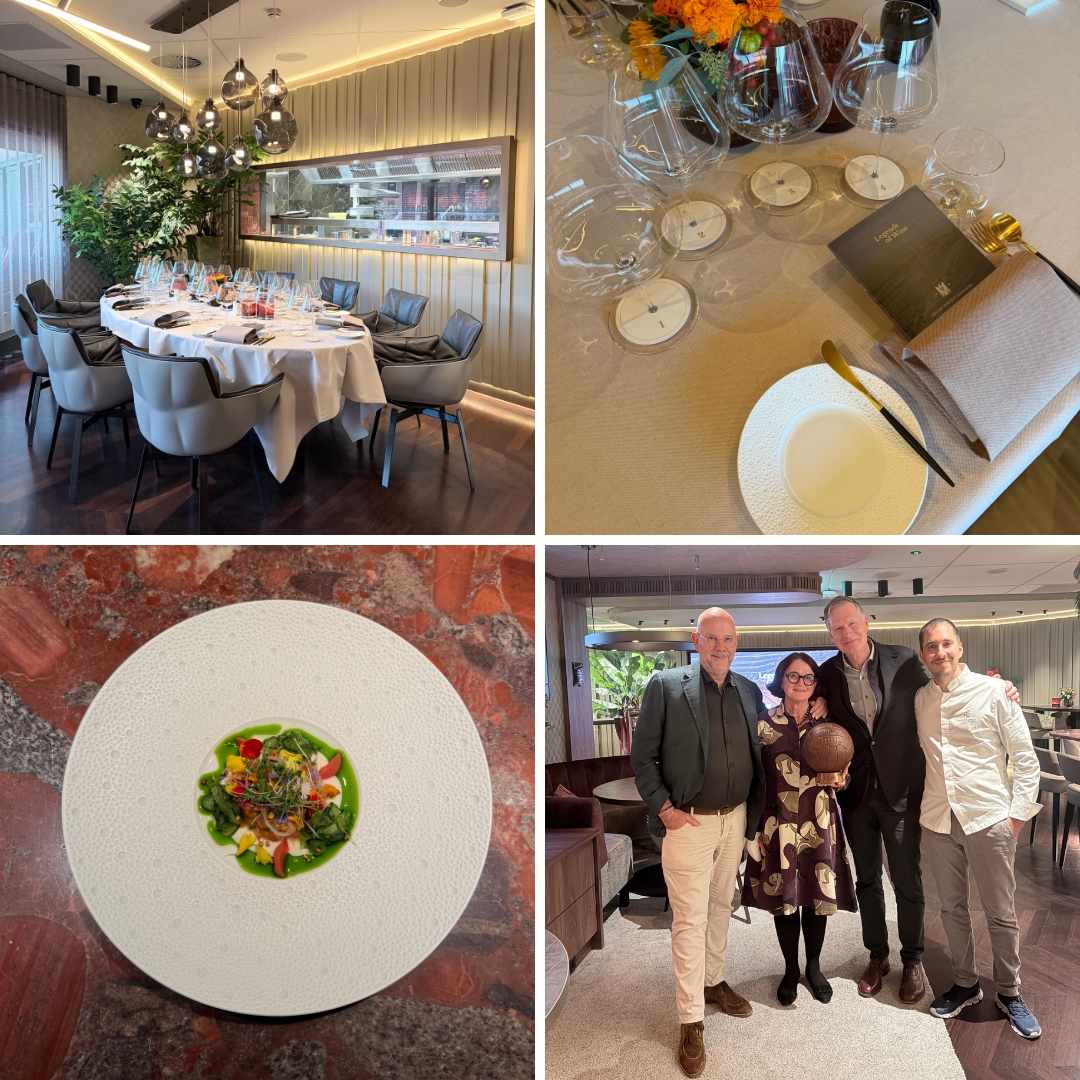
Fred’s Culinary Masterpieces formed a beautiful pairing with the wines.
The final pairing brought together Turbot, Asparagus and Lardo with Comtes de Champagne Blanc de Blancs 2014. Long regarded as one of Champagne’s benchmark expressions of Chardonnay, it demonstrated extraordinary purity, finesse and length. Awarded 97 points, it was the highest-scoring wine of the afternoon, yet somehow never overshadowed the bottle that had opened the lunch.
That, perhaps, was the most revealing aspect of the tasting.
At no point did the progression invite guests to decide whether Domaine Evremond was better than Champagne, or vice versa. Instead, the wines illustrated continuity. The Champagnes reflected generations of accumulated experience, while Domaine Evremond offered the first glimpse of how those same values might evolve in an entirely different landscape.
Domaine Evremond’s Classic Cuvée amongst the Selection of Taittinger Cuvée’s.
By the end of the meal, the conversation no longer centred on whether England could produce world-class sparkling wine. That question had quietly been answered long before dessert arrived. Instead, what lingered was a deeper appreciation of the patience required to build a great estate—one vintage, and one generation, at a time.
More than another English Sparkling Wine
As lunch drew to a close, it became clear that the story of Domaine Evremond had never really been about England or Champagne.
Throughout the afternoon, Patrick McGrath and Pierre-Emmanuel Taittinger had spoken remarkably little about production volumes, market share or commercial ambitions. Instead, they repeatedly turned the conversation towards the people who had shaped the estate:
Mark Gaskain’s intimate understanding of the Chilham vineyard, Christelle Rinville and Alexandre Ponnavoy embracing the challenge of building an estate from the ground up, and the next generation, represented by India McGrath and Vitalie Taittinger, who are already helping to guide the project into its next chapter.
Perhaps that explains why Domaine Evremond already feels different from so many ambitious new wine ventures.
The Vineyards in Front of the Winery.
Although it bears one of Champagne’s most respected family names and occupies exceptional chalk slopes in Kent, it has never been presented as an attempt to recreate Champagne on English soil. The vineyard is still finding its own voice, and those behind it seem entirely comfortable allowing that process to unfold in its own time.
Before we said our goodbyes, Patrick McGrath extended an invitation to visit the estate in Kent. It was a small gesture, but somehow an appropriate one. Throughout the day there had been remarkably little sense of a finished product. Instead, Domaine Evremond had been presented as a work in progress—an estate still learning, still evolving and still discovering what its vineyard is capable of expressing. Seeing that evolution firsthand suddenly felt like the natural next chapter of the story.
Pierre-Emmanuel Taittinger perhaps captured it best when he returned once more to the philosophy that had quietly underpinned the entire afternoon. “If we are here today, it is not only to drink, to eat or to make business, but to share moments of happiness.”
Axel Rosier, Fred’s Head Sommelier, guided us through a wonderful afternoon, highlighting the wines of Evremond and Taittinger, alongside Fred’s Culinary Excellence.
Looking back, that sentence explains Domaine Evremond better than any technical sheet or production statistic ever could.
Its first release is undoubtedly an impressive debut, but after spending an afternoon with the people behind it, we left Rotterdam convinced that the wine is only part of the achievement. Long before the first vines were planted in Kent, the foundations of Domaine Evremond had already been laid through trust, generosity and a shared willingness to think not in vintages, but in decades.
Edition I is not the conclusion of that story. It is simply where the rest of us are invited to join it.
This article was written by Dutch Wine Apprentice’s Niels Aarts. Picture credits: Phienne Photograph . We would like to thank Patrick McGrath MW of Hatch Mansfield and Pierre-Emmanuel Taittinger of Champagne Taittinger for their time, openness and generosity in sharing the story of Domaine Evremond with us.
Our sincere thanks also go to VINVIN Wines, the exclusive Dutch importer and distributor of Domaine Evremond and importer of Champagne Taittinger in the Netherlands, for the invitation, and to Restaurant Fred for its warm hospitality and exceptional lunch. If you would like to learn more about Domaine Evremond, Champagne Taittinger or their wines, please contact VINVIN Wines directly.
Join our insiders’ list and get exclusive early access to new articles, expert tips, and fresh reviews delivered straight to your inbox. Subscribe now and be the first to discover!