Join Our Wine Journey – Sign Up for the Newsletter 🍷
Understanding Bordeaux: Two Banks, Two Expressions
Share
Deel op X (twitter)
LinkedIn
WhatsApp
Understanding Bordeaux: Two Banks, Two Expressions.
A Region Shaped by Trade and Development.
Bordeaux is not a region that lends itself to simple definitions. Over centuries, it was shaped by trade, outside influence, and a constant search for balance. As early as Roman times, vineyards were planted around ancient Burdigala, present-day Bordeaux. What began as local production for Roman garrisons evolved into a region whose international reputation was built largely on trade. That commercial mentality still runs deep in Bordeaux today. It remains the only wine region in the world where merchants, the négociants, historically held greater influence than the winemakers themselves. Even now, that dynamic continues through the Place de Bordeaux system.
Yet the story of Bordeaux does not begin in the warehouses along the quays, but in the landscape itself. With around 95,000 hectares of vineyards (2023), more than three times the size of Burgundy, the region stretches seemingly without end. There are no steep Mosel slopes or dramatic Douro terraces here. Instead, endless rows of vines, interrupted by forests, villages, and château-lined driveways, dominate the landscape.
Bordeaux is facing a difficult moment. Demand for traditional red Bordeaux continues to fall, while younger consumers increasingly gravitate towards lighter wines or simply drink less alcohol. Oversupply became so severe that both the French government and the CIVB approved the uprooting of thousands of hectares of vineyards.
At the same time, growers across the region are dealing with warmer summers, earlier harvests, and mounting mildew pressure. Economic conditions are adding further strain. Exports to China have slowed, costs continue to rise, and smaller estates are particularly vulnerable.
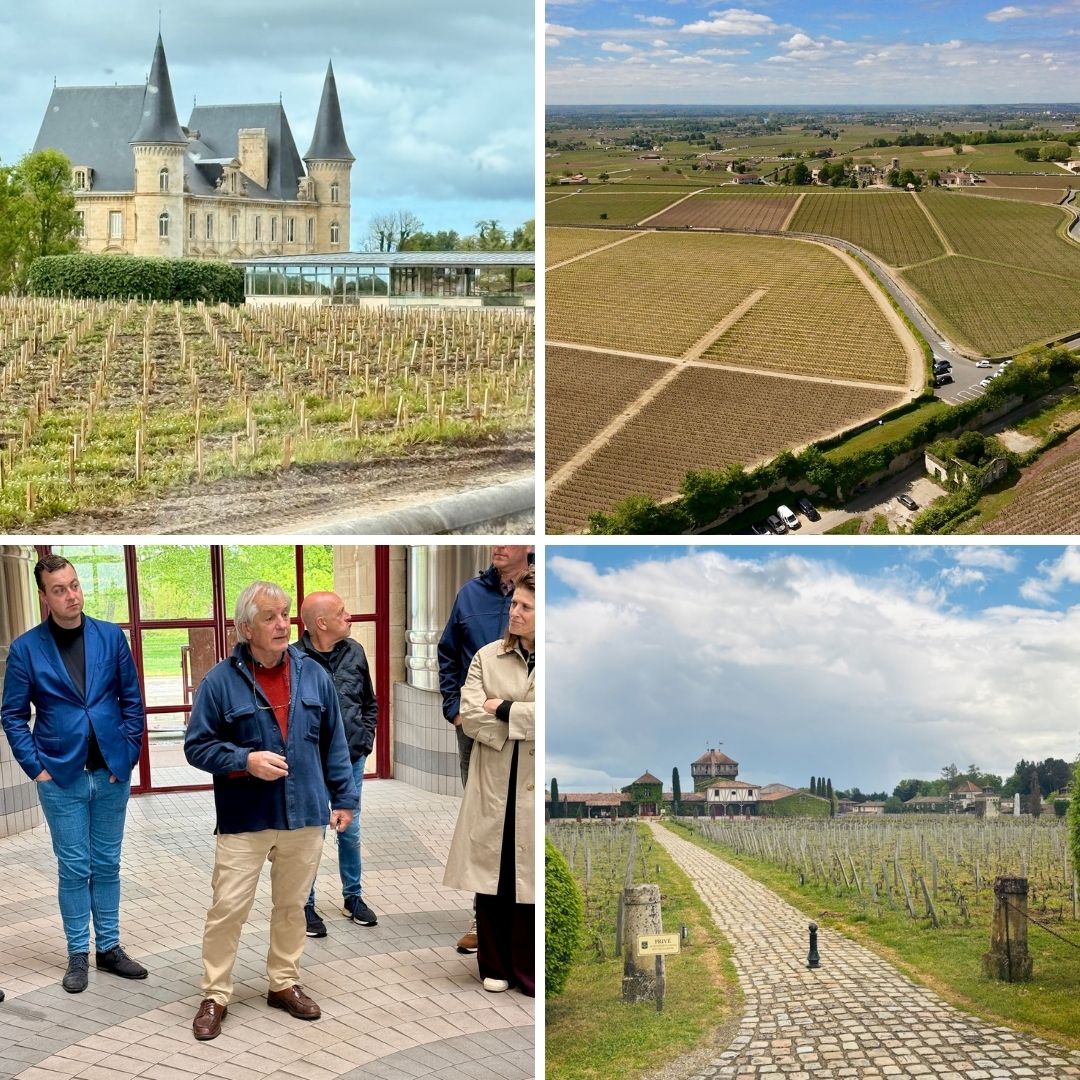
Vineyards in the Medoc.
Bordeaux is also struggling with its image. For many consumers, the region remains synonymous with prestige, high prices, and classic, sometimes inaccessible, wines, while much of Bordeaux continues to produce affordable wines that often remain overlooked.
Still, signs of change are becoming increasingly visible across the region. More than two-thirds of Bordeaux vineyards now operate under environmental certifications; biodiversity and regenerative practices are gaining ground. The way Bordeaux presents itself is shifting too. Tastings no longer revolve around weaker vintages. Instead, strong years are poured to reinforce the message that Bordeaux is still capable of producing high-quality wines.
At the heart of it all lies the central question: what truly makes this region unique? The answer lies not only in history or trade. To understand Bordeaux, you first need to understand the region’s geographical structure.
The Gironde as a Liquid Divide
In Bordeaux, water is defining. The Gironde, the largest estuary in Western Europe, formed by the confluence of the Garonne and the Dordogne, splits the region in two. West lies the Left Bank, home to the Médoc. East is the Right Bank, where the Libournais, including Saint-Émilion and Pomerol, forms the heart of the region. What looks like a map line is, in practice, the beginning of two distinct wine identities shaped by grape choices, soils, and viticultural approach.
The Left Bank is more open and orderly. In the Médoc, vineyards follow a steady pattern punctuated by famous châteauxlike Lafite Rothschild and Latour. Moving south toward Graves and Pessac‑Léognan, the scenery grows greener and more wooded. Vineyards sit more sheltered among the trees, contributing to a slightly warmer microclimate.
Across the river, the picture immediately changes character. The Right Bank is smaller in scale and gently hilly. In the Libournais, vineyards and villages alternate more rapidly, with names like Cheval Blanc, Pétrus, and Ausone scattered throughout the landscape. Historical land division and diverse soil structures have also left parcels smaller and less contiguous.
Between the two banks lies Entre-Deux-Mers, literally “between two seas,” referring to the two rivers. The landscape here is more open, with vineyards interspersed with arable land and villages. The area feels less stately and less completely shaped by viticulture than either the Left or Right Bank.
The geography translates directly into how Bordeaux grows and tastes.
Terroir as a Foundation
In Bordeaux, everything comes back to terroir: the interaction between climate, soil, and human decisions.
Bordeaux has a warm temperate maritime climate, heavily influenced by the Atlantic Ocean and the Gulf Stream. Temperatures are generally mild, but humidity and rainfall remain constant factors throughout the growing season.
For decades, Bordeaux was associated with a wet climate. Annual rainfall averages between 800 and 900 millimeters, often during crucial moments in the vineyard cycle. In recent years, however, longer dry periods have become increasingly common (with 2024 a notable exception). Higher temperatures and increasing heat stress are adding further pressure in the vineyards. Hail, drought, heavy rainfall, and spring frost only add to the challenge. Growers across Bordeaux are constantly being forced to adapt.
Because the region is relatively flat, soils become critically important. On the Left Bank, gravel and pebble soils deposited by the rivers thousands of years ago dominate the landscape. These soils drain rainwater quickly while retaining heat, supporting the slow ripening of cabernet sauvignon (22.5%) and encouraging the development of ripe tannins.
The Vineyards of Chateau Giscours in the Margaux Appellation on Bordeaux’s Left Bank.
Across the river, the subsoil changes completely. Gravel gives way to denser clay and limestone soils. These cooler soils retain water more effectively during dry periods, allowing merlot (66%) to ripen more evenly and develop softer tannins.
White grapes also play an important role in Bordeaux, although they often receive less attention internationally. Dry Bordeaux Blanc is primarily based on sémillon (47%), sauvignon blanc (43%) and smaller amounts of muscadelle (5%). The same grapes underpin the famous sweet wines of Sauternes and Barsac, where misty mornings and sunny afternoons create ideal conditions for noble rot (Botrytis cinerea).
Nowhere is the influence of soil and climate more visible than on the two banks of the Gironde.
The Left Bank: Structure and Precision
Without Dutch intervention, the Left Bank as we know it today would not exist. Until the 17th century, much of the Médoc consisted of inaccessible marshland. Dutch engineers drained the swamps and regulated water management through a network of canals known as jalles. This exposed the gravel banks and made vineyard planting possible, laying the foundations for what would later become one of Bordeaux’s defining landscapes.
Travelling the Left Bank from north to south, the landscape gradually shifts. In the Haut‑Médoc, gravel terraces alternate with heavier clays. Around Saint-Estèphe, higher clay content produces firmer, more structured wines with a cooler profile. Closer to the Gironde, well‑drained gravels favour the slow ripening of cabernet sauvignon. In Pauillac and Saint-Julien, deep gravel layers often rest on sandy or limestone subsoils. The combination of heat retention and drainage produces wines that combine power with precision. Pauillac is known for structure and concentration, Saint-Julien for balance and consistency.
In Margaux, the gravel deposits become finer and sandier. The soils are lighter and better drained, resulting in more refined and elegant wines. Further inland, towards Listrac and Moulis, gravel becomes less dominant while clay and limestone increase. Here, cooler soils slow ripening, producing firmer yet juicy wines.
In Graves and Pessac-Léognan, soil composition becomes more complex again. Gravel, sand, and loam combine with iron-rich material over sandstone or limestone subsoils. In Pessac-Léognan especially, this creates a balance between ripeness, structure, and freshness. Further south, towards Sauternes, well-draining gravel and sandy soils again play a major role, although here the defining factor ultimately becomes the microclimate that enables the development of noble rot.
Domaine Chevalier in Pessac-Leognan on Bordeaux’s Left Bank.
Sustainability is visible in the vineyards. Estates such as Giscours and Domaine de Chevalier invest heavily in soil health and ecological balance. At Giscours, vineyards, woodlands, and ponds interlock. The vineyards no longer resemble the barren monoculture they were thirty years ago. Cover crops keep soils porous, improve water management, buffer heat, and reduce herbicide use.
In the wooded heart of Pessac‑Léognan, Domaine de Chevalier sits almost hidden among pines. As assistant manager Rémi Edange puts it, terroir here is not an isolated factor but the sum of soil, climate, vegetation, and human choices. Biodiversity and ecological vineyard management play a central role. Great wines, he argues, are not created solely in the cellar, but first and foremost in the vineyard itself.
Across the Dordogne, the emphasis shifts noticeably. Not only do the soils change, but also the dominant grape varieties and the profile of the wines.
The Right Bank: Softness and Nuance
Across the Dordogne, a different expression of Bordeaux emerges. Here, merlot is the dominant grape variety, complemented by cabernet franc (9.5%). Wines from the Right Bank are generally rounder, softer, and velvetier than those of the Left Bank.
Saint-Émilion and Pomerol form the heart of this area. In Saint-Émilion, the landscape is built around a limestone plateau, slopes, and lower-lying sections towards the Dordogne. On the limestone plateau, wines develop structure, fine tannins, and notable freshness. On the slopes, where clay and limestone soils dominate, the wines become firmer and more concentrated. In the sandier sections, the wines are lighter and more approachable.
The Vineyards in Saint-Emilion.
Pomerol forms a world of its own within this broader picture. The appellation is small and relatively flat, with soils largely lacking limestone. Instead, clay, sand, and gravel dominate, often underlain by an iron-rich layer known as crasse de fer. The most concentrated and complex wines are produced on the central plateau. Heavy clay soils ensure even ripening even in warmer vintages, allowing the wines to retain richness while maintaining softness and roundness in structure.
Sustainability and biodiversity are also playing an increasingly important role on the Right Bank. At Château Cheval Blanc, the estate has embraced an agroecological approach in which the vineyard is no longer viewed as a controlled monoculture, but as a living ecosystem. Vegetation between the vines, fruit trees, and other plant life are used to make the vineyards more resilient to climate change. During our visit, Juliette Combe, the estate’s agroecology manager, explained that this is no marketing veneer but a long‑term vision in which terroir, biodiversity, and sustainability are inseparable.
The Right Bank is less uniform than the Left. From the power of Pomerol to the plush, more elegant wines of Saint-Émilion’s limestone plateau, soil, exposition, and vineyard choices clearly shape what ends up in the glass.
Two Banks, One Bordeaux
The contrast between the banks is driven not only by grape varieties but by soils, climate, and vineyard management. On the Left Bank’s fast‑draining gravels, cabernet sauvignon can ripen slowly in a relatively cool maritime setting and build firm tannins. On the Right Bank’s cooler clays and limestone, merlot ripens more evenly and yields softer tannins. It is precisely this combination of geography, soil, and viticulture that explains why Bordeaux, despite all the changes it faces, remains one of the wine world’s enduring reference points.
This article is written by our own Brigitte Janssen, following a visit to the region and conversations with some of the leading producers, who are mentioned in this article.
Join our insiders’ list and get exclusive early access to new articles, expert tips, and fresh reviews delivered straight to your inbox. Subscribe now and be the first to discover!