Join Our Wine Journey – Sign Up for the Newsletter 🍷
Taurasi – Barolo of the South? Or a Legend in Its Own Right
Share
Deel op X (twitter)
LinkedIn
WhatsApp
Taurasi – Barolo of the South? Or a Legend in Its Own Right.
Taurasi is often introduced as “the Barolo of the South.” It is an understandable shorthand: a powerful, tannic and long-lived red wine, built around a late-ripening indigenous grape variety and capable of developing for decades. But after spending time in the region, walking its vineyards, meeting its producers and tasting extensively, one question kept returning: does Taurasi really need the comparison at all?
The answer begins to emerge before the first wine is poured. Join us as our own Janne van Lieshout reports on her visit to the region.
Into Irpinia
Taurasi lies in Campania, a region better known internationally for Naples, Pompeii, the Amalfi Coast and Salerno. Millions of visitors pass through this part of southern Italy every year, yet surprisingly few make the turn inland towards the Apennine Mountains and the green, elevated landscape of Irpinia.
From Naples, it is barely an hour’s drive into the hills, but the landscape changes quickly. Traffic gradually gives way to forests, the road begins to climb and the temperature falls with it. On the day of our arrival, we experienced 15°C in Naples and just 4°C in Taurasi. It was perhaps the simplest introduction possible to one of the defining characteristics of the region. Here, the mountains matter.
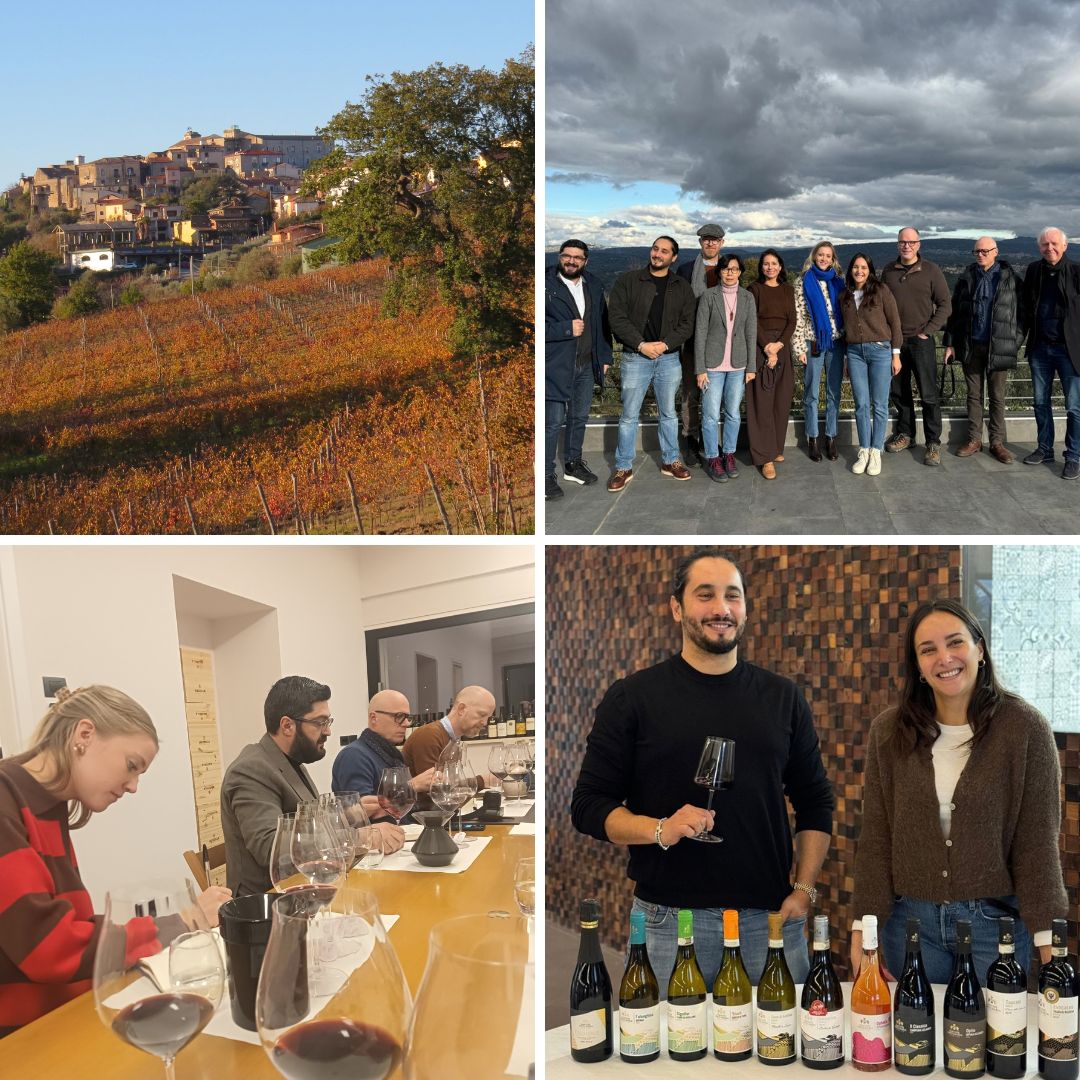
The hillsides of Taurasi with the Mountains in the background.
The Apennines provide cooling influences and pronounced differences between daytime and nighttime temperatures, important factors behind Taurasi’s combination of structure, freshness and ageing potential. The extensive forests surrounding the vineyards further moderate temperatures and support considerable biodiversity, creating a natural buffer against climatic extremes.
It is a landscape that feels removed from the Mediterranean image generally associated with Campania. Taurasi has a continental climate, with winters that can be harsh and snow far from uncommon, while summers remain relatively mild. The wide diurnal range helps preserve acidity and extends the ripening season — particularly significant for a grape variety as demanding and late-ripening as Aglianico.
Water is another important part of the picture. Irpinia holds one of southern Italy’s largest freshwater reserves, supplying water beyond Campania to regions including Puglia. At a time when drought and water stress are becoming increasingly important considerations throughout the Mediterranean, this represents a significant resource for the region.
Yet Taurasi’s relationship with its landscape extends much further back than today’s climatic challenges.
A History Rooted Deep in the Soil
Viticulture in Campania stretches back more than two millennia. The Greeks introduced vines along the Campanian coast as early as around 700 BC, although the modern identity of Taurasi began to emerge much later.
During the nineteenth century, families such as Mastroberardino played an important role in preserving Aglianico and establishing the wines of Irpinia beyond their regional borders. When phylloxera subsequently devastated vineyards across Europe, parts of Taurasi proved unusually resilient. Due to particular soil conditions and the relative isolation of some vineyards, certain vines escaped the devastation.
Taurasi as part of Campania has a rich wine making tradition.
A handful of very old vines remain today, some claimed locally to approach 300 years of age. Whatever their precise age, seeing these surviving vines in the landscape gives tangible form to the depth of viticultural history here.
Official recognition arrived much later. Taurasi became a DOC in 1970, before receiving DOCG status in 1993. But regulations and classifications explain only part of the region. To understand why Aglianico performs as it does here, it is necessary to look beneath the vines.
More Than Volcanic Soil
When people think of Campania, volcanic soils inevitably come to mind. Vesuvius dominates both the physical and popular imagination of the region, and volcanic influences do exist within Taurasi, including parcels where volcanic material forms part of the topsoil. Yet to describe Taurasi simply as volcanic is to overlook much of its geological character.
Many vineyards are rooted in deep, clay-rich soils, frequently combined with sand and limestone. In some areas, clay represents more than half of the soil profile. For Aglianico, this matters. Clay can retain water during dry periods while contributing to the long, gradual ripening cycle that allows acidity and phenolic maturity to develop over an extended growing season.
Young vines in Taurasi.
The soils are also rich in elements including potassium and magnesium. Together with altitude, exposure and the region’s climatic conditions, this complex geology contributes to the diversity encountered across the denomination.
That diversity becomes increasingly apparent when moving through Taurasi itself.
The Different Faces of Taurasi
Taurasi can broadly be understood through four geographical areas, with altitude providing one of the clearest threads connecting — and differentiating — them.
In the north, vineyards generally sit between 300 and 350 metres, making this the lowest part of the denomination. Ripening is consequently earlier, often reaching harvest by the middle of October, and the resulting wines tend towards a somewhat more moderate body.
Moving into the central zone, vineyards climb towards 400–450 metres around villages including Taurasi, Mirabella Eclano, Bonito, Fontanarosa, Luogosano and Sant’Angelo all’Esca. Here, deep clay-rich soils are interspersed with pockets of volcanic ash, while harvest commonly extends into late October or early November.
Further west, steeper slopes at around 400 metres give rise to wines that can combine structure with considerable elegance. But it is towards the southwest that the influence of altitude becomes most pronounced.
Here, vineyards rise to between 500 and 650 metres. Rainfall is higher, diurnal temperature differences become wider, and clay and limestone feature prominently in the soils. Villages such as Montemarano, Paternopoli, Castelfranci and Castelvetere occupy this cooler landscape. Harvest comes correspondingly late, sometimes extending well into November and occasionally taking place with snow already arriving in the vineyards. Montemarano, in particular, is often among the last places in the region to bring in its grapes.
Following that progression through the landscape makes one characteristic of Taurasi increasingly difficult to ignore: this is a wine region built around patience.
And no variety embodies that better than Aglianico.
Aglianico at the Core
Campania is home to an extraordinary diversity of grape varieties, with around 300 recorded across the region, but Taurasi is defined above all by Aglianico.
One of Italy’s ancient native varieties, its precise origins remain the subject of discussion. What is less ambiguous is its character in the vineyard. Aglianico ripens late and demands sunlight, patience and precision. Its thick skins bring abundant tannin and colour, while naturally high acidity gives the wines the structure required for prolonged ageing.
In Taurasi, these characteristics frequently translate into wines built around dark fruit, herbal and balsamic notes, considerable structure and, at their best, an elegance that becomes increasingly apparent with time.
Aglianco is at the core of the Taurasi DOCG.
Aglianico is not alone in Irpinia. The surrounding vineyards also contain white varieties including Fiano, Greco, Falanghina, Coda di Volpe, Malvasia and Trebbiano, while Piedirosso, Aglianicone and Sciascinoso contribute to the red-wine landscape. Even a rare red mutation of Coda di Volpe can be found. Coda di Volpe itself proved particularly interesting during the trip, capable of producing wines with mineral, floral and unexpectedly expressive characteristics.
For Taurasi DOCG, however, Aglianico must account for at least 85% of the blend. The wines require a minimum of three years’ ageing, including at least twelve months in wood, while Taurasi Riserva requires four years of ageing, of which eighteen months must be in wood.
Those regulations already indicate that Taurasi is not intended as a wine of immediate gratification. Yet it was only through tasting across vintages that the significance of time became fully apparent.
Seventy-One Taurasi: Understanding the Wines Through Time
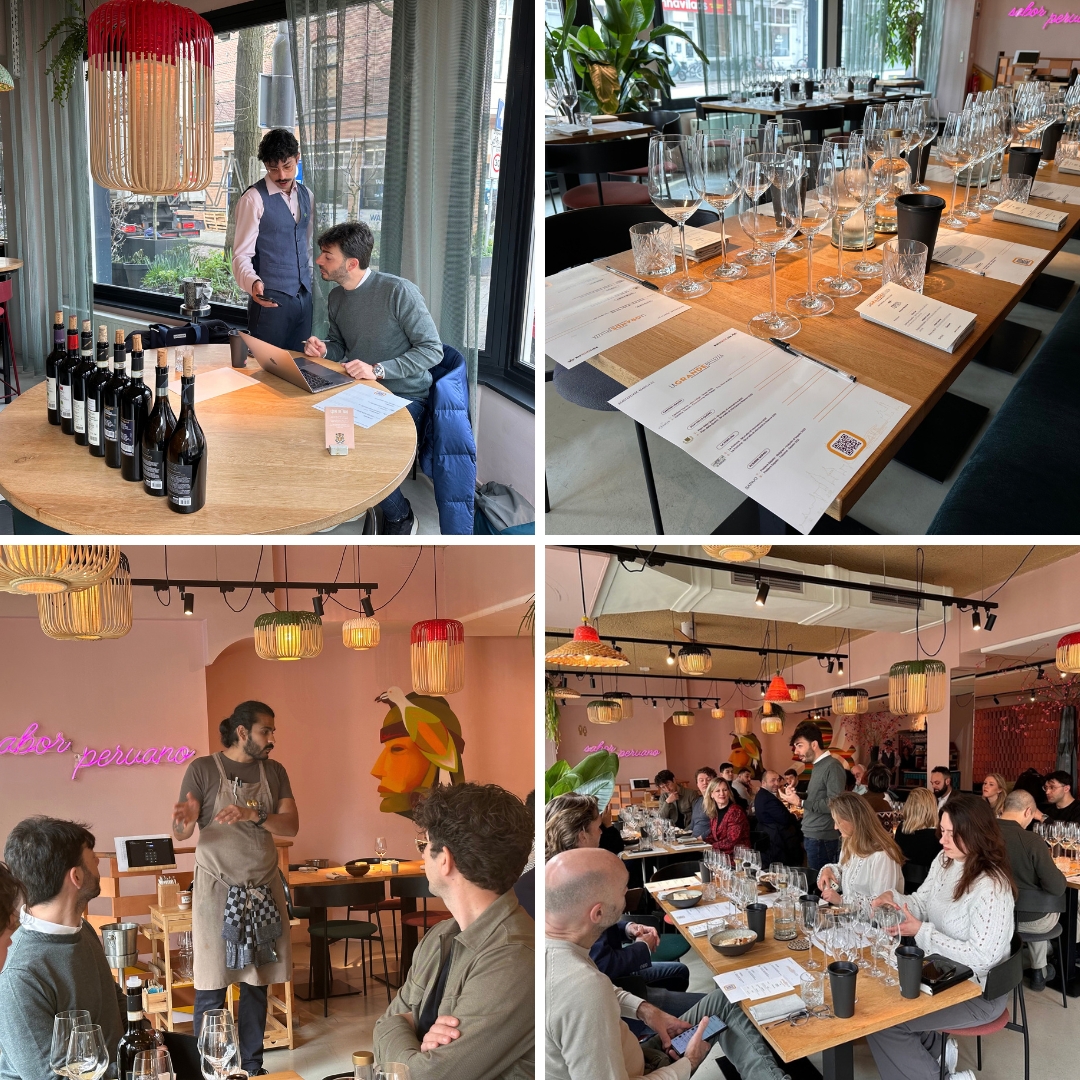
Over two mornings, we tasted 71 different Taurasi wines, offering an opportunity to move beyond the theory. If altitude, clay-rich soils, late harvests and Aglianico’s formidable tannic structure explain Taurasi on paper, tasting so broadly revealed how those elements translate into the glass — and, perhaps more importantly, what happens to them with age.
Young Taurasi can be uncompromising. Tannins are prominent, dark fruit and herbal notes dominate, and the structure can feel firm, occasionally even austere. These are not necessarily wines designed to charm immediately.
With bottle age, however, the picture changes. The tannins begin to soften and integrate, while the aromatic profile moves beyond primary fruit towards balsamic notes, leather, dried herbs and spice. Crucially, the acidity remains, giving mature wines energy and preventing their considerable structure from becoming heavy.
Tasting a wide variety of Taurasi wines with the group.
This was one of the clearest impressions to emerge from the tastings. Age does not simply make Taurasi softer; it reveals additional dimensions of the wine. Complexity develops without sacrificing freshness, demonstrating one of Aglianico’s greatest strengths and helping to explain why patience remains such a recurring theme throughout the region.
The same tension between tradition, patience and change could also be seen among the producers we visited.
Different Visions of Modern Taurasi
If there is a single contemporary model for Taurasi, it was difficult to identify one. The producers encountered during the trip instead offered different interpretations of the same landscape, ranging from highly focused, small-scale production to broader ambitions involving stylistic accessibility, hospitality and wine tourism.
Gian Luca Mazzella
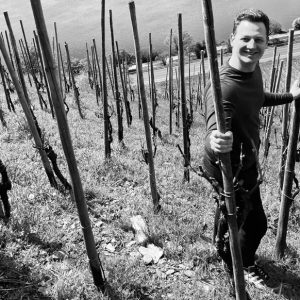
Gian Luca Mazzella represents perhaps the most tightly focused of these approaches. After gaining experience in prestigious wine regions including Barolo and the Langhe, he returned to Irpinia with a clear objective: to express Taurasi with precision and authenticity.
Certified organic, regenerative farming. Mazzella works with low yields and places considerable emphasis on soil health. His vineyard practices are deliberately demanding. Pruning in March alone reduces production by around 20%, intentionally slowing the vine’s biological cycle and limiting sugar accumulation. Fertilizers are avoided, while leaf removal remains minimal and selective, encouraging smaller clusters and natural competition between berries.
Gian Luca Mazzella during the cellar tour.
The same restrained philosophy continues in the cellar. Fermentations are spontaneous and can last three to four weeks in old barrels, while press wine is excluded. Maturation is deliberately long, ranging from three to five years and the wines are unfiltered.
The wines reflect that patience. Palerico 2020 combines fresh red berries, dried herbs and floral lift with elegant mint notes. Paterico 2021 moves towards black fruit, smooth texture, freshness and an herbal finish, while Q 2019 is intensely perfumed and balsamic, layered with black fruit and subtle oak integration.
If Mazzella represents a particularly focused interpretation of Taurasi, Macchie Santa Maria illustrates another aspect of the region’s development.
Macchie Santa Maria
Located in Montemiletto at around 500 metres above sea level, Macchie Santa Maria is a young and dynamic estate farming approximately 14 hectares, with a strong emphasis on Fiano di Avellino alongside Aglianico.
The soils are predominantly clay-rich, with volcanic influences from surrounding volcanic systems. Tufo stone also plays a practical role at the estate, being used in the cellar to help maintain stable temperatures.
Here, the philosophy extends towards accessibility and diversity. The range encompasses sparkling wines, fresh whites, lighter interpretations of Aglianico and more structured expressions. There is also a clear eye towards changing consumer preferences and climatic conditions, with fresher, lower-alcohol expressions of Aglianico sitting alongside more traditional interpretations.
Tasting the Wines of Macchie Santa Maria.
Equally significant is the estate’s investment in wine tourism. Its panoramic position overlooking the valley makes hospitality an increasingly important part of how Macchie Santa Maria presents both its wines and the wider landscape of Taurasi.
At Perillo, by contrast, the emphasis shifts towards old vines, family continuity and the slow accumulation of experience.
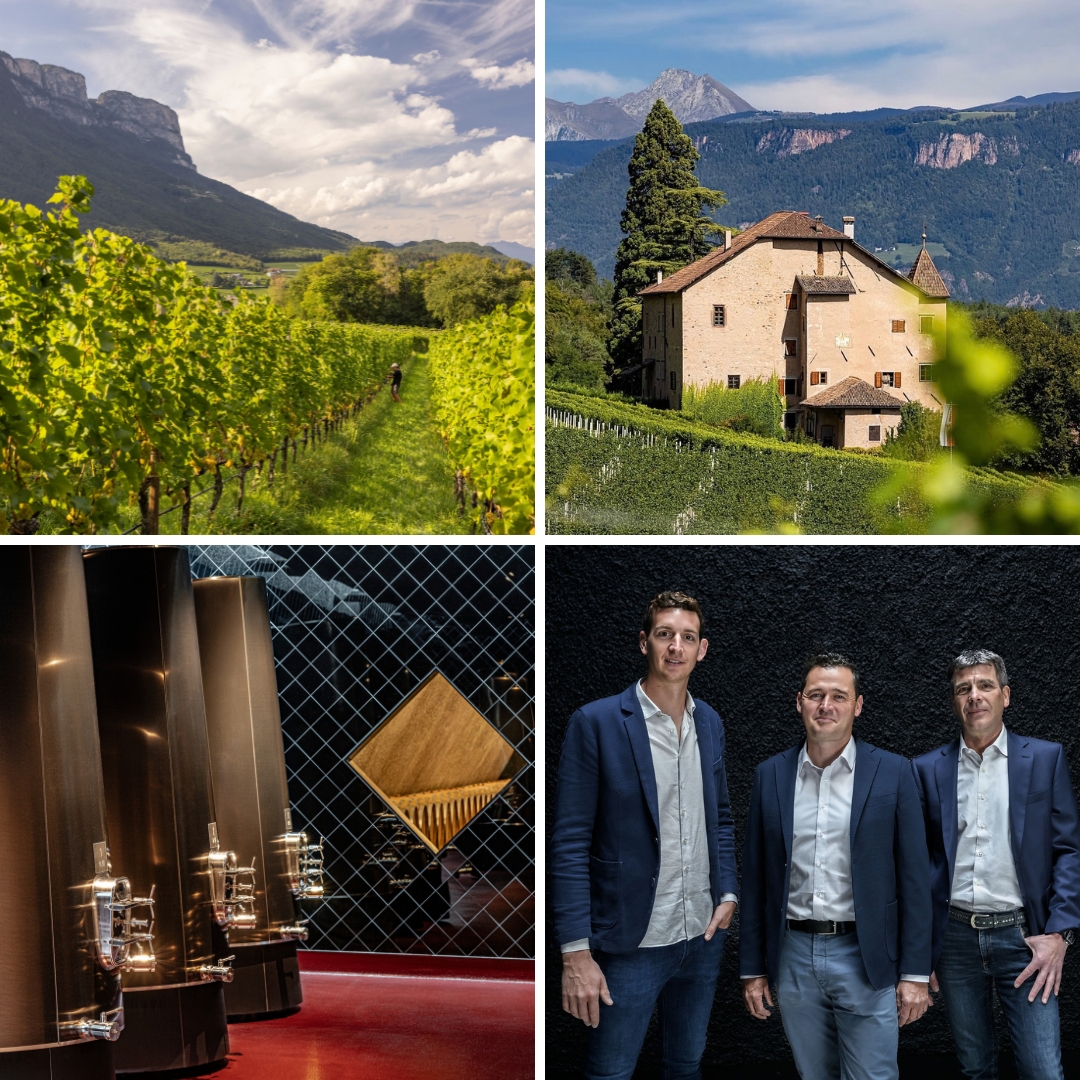
Cantina Perillo
Founded in 1999, Cantina Perillo remains a family-run estate, today managed by father and two sons. Its vineyards are situated in Castelfranci and Montemarano, predominantly on southwest-facing slopes.
Many of the vines were planted shortly after the Second World War, providing naturally low yields and concentration. The estate has also undertaken its own clonal selection, identifying and propagating material considered particularly well suited to its terroir.
The resulting wines emphasize balance, elegance and complexity. They possess the structure expected of Aglianico, but without excessive weight, and are clearly conceived with ageing in mind.
That relationship between wine, time and regional identity took another form at Tenuta Cavalier Pepe, where the ambitions of the estate extend beyond Taurasi itself.
Tenuta Cavalier Pepe
Tenuta Cavalier Pepe brings together family history, wine production and hospitality. The Pepe family has deep roots in Irpinia, with the estate now under the leadership of Milena Pepe.
Its philosophy centres on respect for nature, typicity and balance, while wine tourism has become an integral part of the estate. Vineyard visits, tastings, gastronomy and hospitality are treated not simply as additions to wine production but as ways of introducing visitors to Irpinia as a whole.
The breadth of the range also provided an opportunity to look beyond Aglianico. Mature whites proved particularly revealing: Coda di Volpe 2016, Fiano di Avellino 2014 and Greco 2013 remained fresh, layered and complex, underlining the ageing potential that exists beyond the region’s celebrated reds.
Among those reds, Appio 2018 — produced in limited quantities and partially aged in amphora — showed smoky and herbal characteristics while retaining vibrancy. Taurasi “Opera Mia” 2017 combined mint and balsamic notes with red fruit following maturation in large barrels and barrique, while Taurasi Riserva “La Loggia” 2016, aged in cement, delivered intense fruit, oregano and herbal character with notable clarity.
Across these different estates, approaches vary considerably, but certain themes recur: respect for Aglianico’s long growing cycle, increasing attention to soil health and biodiversity, and a search for balance rather than sheer power.
Taurasi in Its Own Right
Which brings us back to the comparison with which we began.
Taurasi is not trying to be Barolo, and that may ultimately be one of its strengths. This is a region shaped by altitude, forests, water, clay-rich soils and a grape variety that rewards patience above almost everything else. Aglianico does not rush, and neither does Taurasi. Time is not an obstacle here; it is part of the identity of the wine.
As climate change continues to reshape viticulture, some characteristics that historically made Taurasi challenging may increasingly prove advantageous. Its elevated vineyards, significant diurnal temperature ranges, long growing season and important water resources provide growers with tools that are becoming increasingly valuable in warmer Mediterranean regions.
Our Tour through the Taurasi DOCG has soon us the richness and variety of one of Italy’s most understated regions.
At the same time, Taurasi itself is changing. A new generation of producers is interpreting tradition with increasing precision, focusing on soil health, biodiversity and balanced ripeness. Sustainability is becoming less an abstract concept than a practical necessity, while investment in wine tourism is gradually opening Irpinia to visitors looking beyond Campania’s familiar coastal destinations.
Perhaps the most compelling aspect of Taurasi lies in these contrasts: power accompanied by freshness, history alongside innovation, and formidable structure capable of developing into elegance.
After travelling through Irpinia, walking its vineyards, tasting 71 Taurasi wines and seeing the different ways producers are approaching its future, the familiar comparison with Barolo begins to feel less necessary. Not because Taurasi needs to prove itself greater or lesser, but because the landscape, the grape and the wines increasingly make the case on their own.
Taurasi’s identity is already there. It simply requires the same thing as Aglianico itself: time.
This article is written by our own Janne van Lieshout and based on a press trip to the Taurasi DOCG region, organized by Paul Balke in collaboration with a group of communes of the region.
We would like to thank the organization for their invitation and hospitality, and the producers for their openness, insights and the wines provided. Picture credits: Paul Balke and Dutch Wine Apprentice.
Join our insiders’ list and get exclusive early access to new articles, expert tips, and fresh reviews delivered straight to your inbox. Subscribe now and be the first to discover!