Join Our Wine Journey – Sign Up for the Newsletter 🍷
Sebastián Zuccardi: The Future Is in the Place
Share
Deel op X (twitter)
LinkedIn
WhatsApp
Sebastián Zuccardi: The Future Is in the Place.
José Alberto Zuccardi helped take Argentine wine to the world. His son Sebastián is now looking in the opposite direction: deeper into the vineyards, soils and individual parcels that are reshaping the identity of the Uco Valley.
In October 2025, at De Wereldse Wijndagen, organized by Delta Wines, we sat down with Sebastián Zuccardi of Zuccardi Wines for a conversation that inevitably picked up where an earlier one had ended. Previously, we had spoken with his father, José Alberto. This time the family, the Andes, the Uco Valley and Malbec remained familiar reference points, but the scale of the conversation had changed. Where José had spoken about building a family winery and helping Argentine wine find an international audience, Sebastián increasingly brought us underground: to stones, calcium carbonate, soils and differences between individual parcels.
Our earlier conversation with José had taken us through a family history closely intertwined with the development of modern Argentine wine. His father Alberto was an engineer whose experiments with irrigation led to the family’s first vineyard in Mendoza in 1963. José joined the company in 1976 and would eventually take its wines abroad at a time when Argentina, despite being one of the world’s major wine-producing countries, had little international presence. Malbec helped change that. José described it to us as a variety that came “from the vineyard to the market”, rather than something conceived as a marketing proposition: it performed particularly well in Argentina, growers recognized that, and eventually consumers did too.
José and Sebastián Zuccardi.
By the time of our conversation with Sebastián, that argument had largely been won. Malbec no longer needs much introduction, and neither does Zuccardi. The more interesting question is what happens when the grape that established an identity for Argentina also begins to limit how that identity is understood. Sebastián has little interest in searching for its successor. His ambition is to look more closely at what is already there.
“The future is in the place.”
Over the course of our conversation, that thought connects much of what follows, from the increasingly detailed study of the Uco Valley to Argentina’s renewed interest in white varieties. For Sebastián, the country’s next stage will depend less on promoting a grape than on communicating the origins behind it.
The Freedom to Begin Again
Sebastián does not talk about the third generation as if its primary responsibility were preservation. Wine and vineyards naturally surrounded him growing up, but joining the family company was a choice rather than an obligation, and the same freedom was extended to his siblings. His brother developed an activity the family had not previously pursued and became a leading producer of olive oil in Argentina, while his sister Julia became closely involved with hospitality, tourism and the family foundation.
Sebastián chose wine, but not simply to continue where José had left off. He talks about the freedom his father gave him to change direction and, in that sense, considers himself something more than a successor: a founder, as his grandfather and father had been before him.
Seen across three generations, the history of Zuccardi becomes one of successive reinvention. Alberto brought an engineer’s mind to viticulture; José built markets and helped introduce Argentine wine internationally; Sebastián became absorbed by the Uco Valley and by understanding why vineyards, and eventually parcels within vineyards, behaved differently. Each generation inherited something substantial, but also the freedom to question it.
That perspective extends to Sebastián’s view of family ownership. Family companies, he argues, can take decisions over a longer horizon because not every choice needs to be justified by its immediate financial return. The family lives there, and another generation may do so after them; the responsibility of the company therefore extends beyond its own profitability to the long-term conditions of the place in which it operates.
The Zuccardi Family has put together an impressive collection of wines in the last decades.
The same long view is evident in the vineyards. Sebastián recognizes what Malbec has done for Argentina, but believes its success also produced an image that became too narrow. “I think Argentina did a good introduction to the market,” he says, “but we’re very focused on Malbec and we’re very focused on one style of Malbec.” For a country whose vineyards extend along the Andes through dramatically different climates, elevations and soils, that singular image increasingly conceals as much as it reveals.
When Sebastián is asked what comes after Malbec, his answer is essentially “More Malbec, but communicated through its places”. He even describes the established image of Malbec as a form of competition: the assumption that consumers already know what Argentine Malbec is supposed to taste like. His work in the Uco Valley has increasingly been concerned with challenging that assumption by showing how differently the variety can behave over relatively short distances.
Reading the Landscape Through Wine
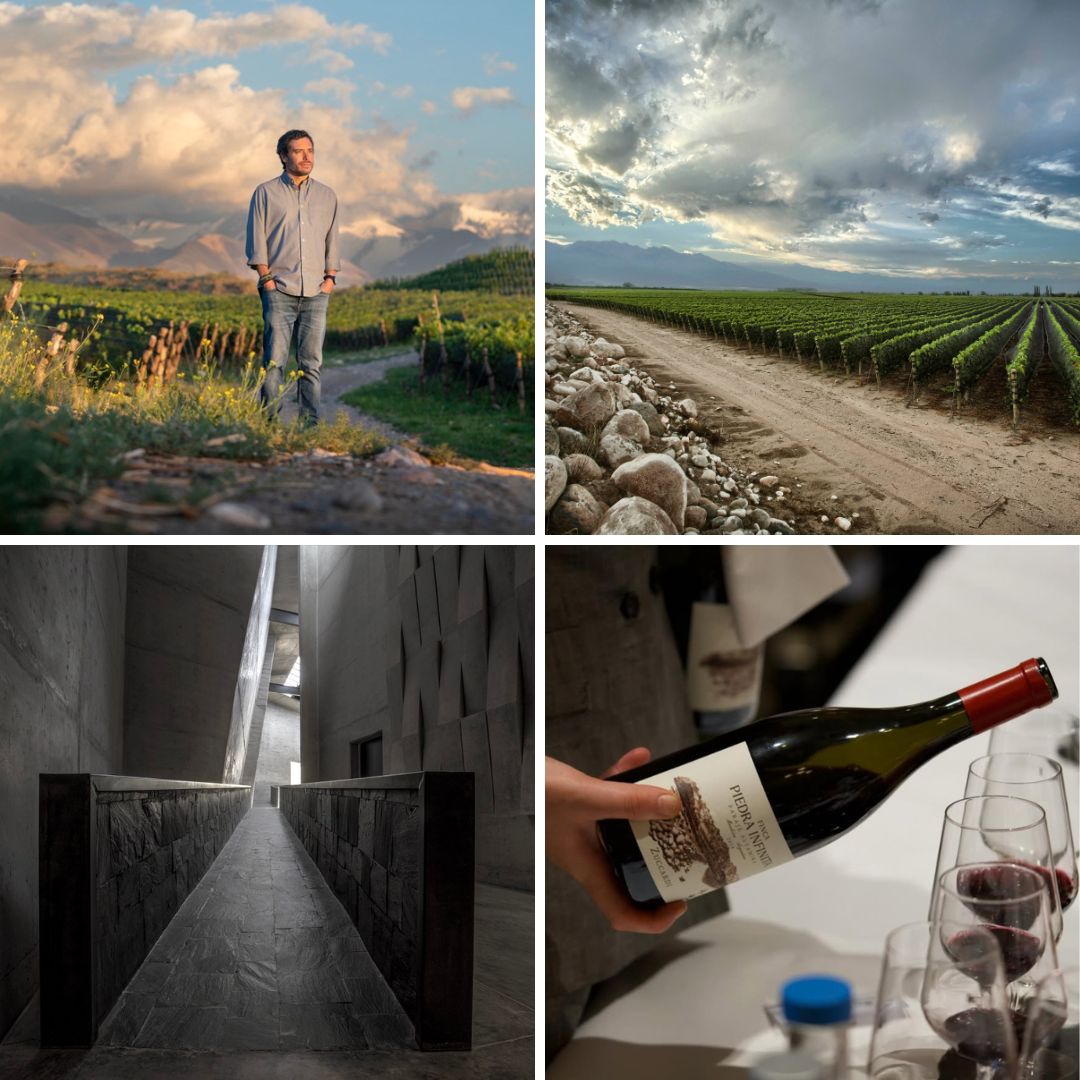
Few places illustrate this more clearly than Piedra Infinita in Paraje Altamira. Sebastián’s fascination with soils has led Zuccardi towards an increasingly detailed reading of a vineyard that, viewed from above, might appear more uniform than it does once the ground is opened. Beneath the surface are variations in the size and composition of stones, the depth of alluvial material and the presence of calcium carbonate, differences significant enough to influence vineyard management, harvesting and vinification.
Piedra Infinita in Paraje Altamira.
The progression is one of continually narrowing scale: Argentina gives way to Mendoza, Mendoza to the Uco Valley, then to Paraje Altamira and eventually to individual vineyards and parcels. At some point even the vineyard ceases to be sufficiently precise as a unit of definition.
During the masterclass at De Wereldse Wijndagen, that idea became tangible through Finca Piedra Infinita Gravascal 2020 and Finca Piedra Infinita Supercal 2018, two Malbecs originating within the same broader vineyard but from distinctly different parcels. We rated them 97/100 DWA Points and 98/100 DWA Points respectively, although the more interesting observation was how differently the two wines behaved.
Piedra Infinita poured at the Wereldse Wijndagen.
Gravascal carried its concentration with considerable energy, moving between dark and red fruit, floral and herbal nuances and a distinctly chalky structure. There was depth without heaviness, with freshness and finely drawn tannins giving the wine direction. Supercal was more austere, its fruit held within a more pronounced mineral framework, accompanied by an almost ferrous character and persistent, tactile tannins. Where Gravascal felt energetic and finely structured, Supercal was more severe and uncompromising.
Sebastián Zuccardi during his Masterclass at De Wereldse Wijndagen.
Sitting with Sebastián as he explained what lay beneath the vines, their differences mattered more than their similarities. They offered a persuasive illustration of how far Zuccardi has moved beyond the idea of Malbec as a single expression. Here, the grape becomes a means of making differences within the landscape perceptible in the glass.
Sebastián’s approach to old vines shows the same reluctance to rely on easy markers of quality. Argentina possesses an important patrimony of mature vineyards, particularly as repositories of genetic material, but he is wary of assuming that age itself confers greatness. Place comes first, followed by how the vineyard has been managed, and only then its age. A well-managed old vineyard in a great location may provide greater balance, but longevity cannot compensate for an unsuitable site.
Rediscovering Argentina in White
Sebastián sees what is happening with white wine as nothing short of a revolution in Argentina. For decades, the country became so focused on reds that some of its white-wine potential—and part of its viticultural history—slipped into the background. Renewed confidence in altitude, cooler sites and the soils along the Andes is now bringing those possibilities back into focus.
Three varieties stand out in his thinking. Torrontés carries an identity that no international grape can reproduce; Sebastián describes it as Argentina’s native variety and sees considerable potential in more precise contemporary interpretations. Sémillon reaches further into the country’s viticultural past. Argentina had around 6,000 hectares in the 1950s, he tells us, compared with only around 700 today, after the industry turned increasingly towards reds during the 1990s. Its renewed relevance therefore feels less like discovery than recovery.
Chardonnay occupies a different position. Sebastián describes it as a grape that is not particularly “talkative”, something he regards as an advantage in the higher parts of the Uco Valley. Particularly on calcareous soils, he sees Chardonnay as a transparent translator of site, capable of expressing those soils through texture without imposing too much varietal character of its own.
Zuccardi’s work in San Pablo puts that interest into practice. At around 1,400 metres, close to the Andes and exposed to considerable frost risk, the family has been developing new vineyard land focused on white varieties. José had already pointed us in this direction during our earlier interview, predicting that the quality of Argentina’s whites could become another source of international recognition.
Sebastián Zuccardi sees a bright future for white wines in Argentina.
The timing inevitably raises a commercial question. White wine is attracting greater international demand at precisely the moment Zuccardi is investing further in it, something Sebastián readily acknowledges. Yet he draws a clear distinction between recognizing a market and allowing it to determine what happens in the vineyard.
“My obsession is that we have to make wine looking at our place and our philosophy. And then we go to the market to deliver,” he explains.
Profitability matters because without it there is no ability to plant vineyards, improve viticulture or continue exploring, but it is a condition for continuing the work rather than its purpose. “The market is a place where we deliver, not where we look for inspiration.”
In practice, conviction and commercial opportunity need not be entirely separate. Zuccardi’s exploration of high-altitude whites may begin in the vineyard, but it is developing at a moment when the market is increasingly receptive to precisely those wines. In this instance, the two happen to be travelling in the same direction.
The broader question is how Argentina communicates such developments internationally. No matter how successful an individual estate becomes, Sebastián recognizes that one producer cannot create an understanding of an entire wine region. “Nobody can put the place on the map alone,” he says. His summary of the relationship between Argentina’s producers is equally concise: “We share and then we compete.”
José had made a similar observation when we spoke with him, noting the greater exchange of knowledge among Argentina’s younger generation of winemakers and viticulturists. That cooperation matters because the next story Argentina needs to tell is more complicated than the one Malbec told so successfully. A grape and a country offered consumers something immediately understandable; individual regions, alluvial landscapes, vineyards and parcels demand more attention.
Bodega Zuccardi in Valle de Uco leads the way for Argentinean fine wine.
The comparison with established fine-wine regions is tempting, but useful only to a point. Burgundy has taught generations of drinkers to consider differences between vineyards; Barolo has developed its own language of communes and individual sites. Argentina does not need to reproduce those hierarchies. Its geography is fundamentally different, shaped by altitude, alluvial fans, ancient river deposits, stones and calcium carbonate against the Andes. The challenge is to make those differences intelligible without forcing them into a model borrowed from somewhere else.
By the end of our conversation, the scale of Sebastián’s argument had become considerably smaller than the scale on which Argentine wine is usually discussed. We had started with a country and the grape that introduced it to much of the world; we ended with two wines from individual parcels within the same vineyard, their differences traced back to what lay beneath the vines.
That progression also describes something of the Zuccardi family itself. Alberto learned how to cultivate this arid landscape; José helped take its wines beyond Argentina; Sebastián has inherited the freedom to look more closely at what previous generations built. His task is no longer simply to demonstrate that the Uco Valley can produce great wine, but to understand why one part of it does not taste quite like another.
Perhaps that is what he means when he says the future is in the place: not that Zuccardi has arrived at a final understanding of its vineyards, but almost the opposite. The closer Sebastián looks, the more there appears to be left to discover.
Earlier in the Zuccardi story:
Before sitting down with Sebastián, we spoke with his father, José Alberto Zuccardi, about the origins of the family winery, the rise of Malbec and Argentina’s emergence on the international wine stage. You can read our full feature on José Alberto and the Zuccardi family story, or listen to our conversation with him in Grape Masters S02E02 — Zuccardi Wines, Argentina, where we explore the family’s history and the evolution of Argentine wine in greater depth.
This article is written by our own Niels Aarts. We would like to thank Sebastián Zuccardi for his time and openness, and Delta Wines for working with us on this article. Zuccardi Wines are imported and distributed in the Netherlands by Pallas Wines, and available at selected partners or direct sale for professionals. Picture credits: Delta Wines and Zuccardi.
Join our insiders’ list and get exclusive early access to new articles, expert tips, and fresh reviews delivered straight to your inbox. Subscribe now and be the first to discover!