Join Our Wine Journey – Sign Up for the Newsletter 🍷
Dalla Valle Vineyards: A Legacy of Deliberate Decisions
Share
Deel op X (twitter)
LinkedIn
WhatsApp
Dalla Valle Vineyards: A Legacy of Deliberate Decisions.
Great wine estates are rarely the product of chance. Dalla Valle Vineyards is the result of four decades of deliberate decisions.
For nearly four decades, Dalla Valle Vineyards has occupied a singular place in Napa Valley. Located on the eastern hillsides of Oakville, the estate has earned an international reputation for producing Cabernet wines that combine power with remarkable elegance. While many Napa wineries have pursued growth and scale, Dalla Valle has remained deliberately focused on a single estate, allowing its vineyard to define every bottle it produces.
The story behind the winery is as distinctive as its wines. Founded by Gustav and Naoko Dalla Valle in the late 1980s, the estate was never intended to become one of California’s most celebrated producers. What began as an entirely different ambition gradually evolved into one of Napa Valley’s great success stories, built on meticulous vineyard work, uncompromising standards and an unwavering belief in the potential of a remarkable hillside site.
Today, that legacy continues under the guidance of second-generation winemaker Maya Dalla Valle. Having gained experience in Napa Valley and Europe before returning home, she now leads the estate into its next chapter.
A Vineyard Instead of a Hotel
Long before the first vintage was bottled, Gustav and Naoko Dalla Valle arrived in Napa Valley with a very different plan. Their ambition was not to establish a winery, but to develop a hotel and restaurant that reflected their love of food, wine and hospitality. Everything changed when they discovered a property on the eastern slopes of Oakville.
The site already contained a small planting of vines, but it was the landscape itself that captured their imagination. Rising above the valley floor at around 150 meters, the hillside offered sweeping views across Napa Valley and a distinctive combination of iron-rich, rocky soils. For Gustav, whose Italian roots had fostered an appreciation for hillside vineyards, the property immediately felt different.
As Maya recalls, the decision to become wine producers was far from predetermined.
“They originally came to Napa Valley with the intent of starting a hotel and restaurant. Then the idea shifted when they bought this property. My father was very much the bon vivant personality, never afraid to try things. He just believed, ‘We can do this.'”
Although neither Gustav nor Naoko had formal winemaking training, they approached the new venture with a clear objective. Rather than simply producing Napa Cabernet, they wanted to create wines capable of standing alongside the world’s finest. That ambition shaped every decision that followed, from vineyard planting to winery design and, perhaps most importantly, the decision to remain an estate producer instead of sourcing fruit from elsewhere.
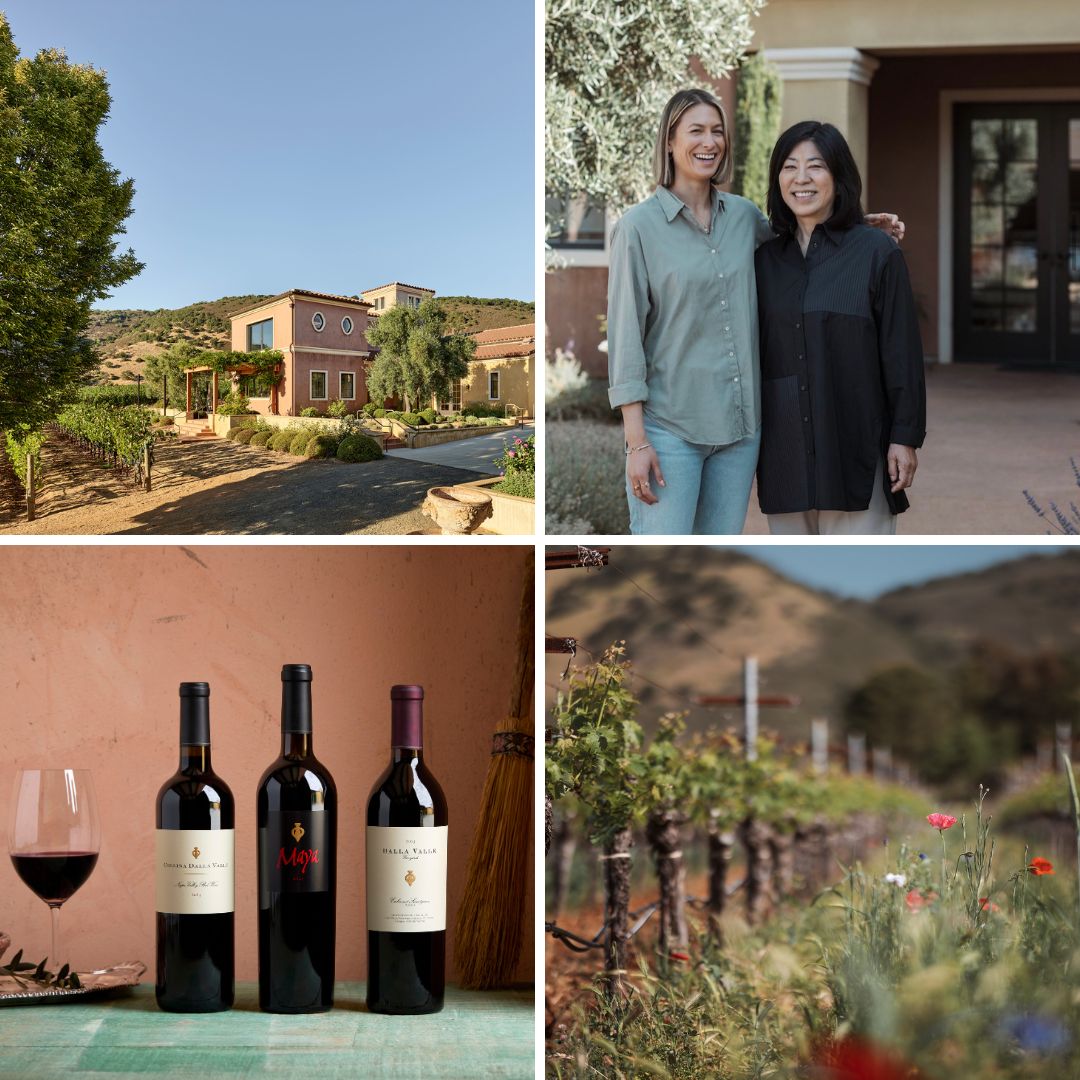
Pollinator rows at Dalla Valle Vineyards.
From the outset, they believed that great wines begin in the vineyard. Every vine would be farmed by the estate itself, allowing complete control over quality while ensuring each wine expressed the character of a single place. It was an approach inspired as much by Europe’s great wine estates as by the pioneering spirit that defined Napa Valley during the 1980s.
Looking back, Maya believes her parents’ greatest strength was the clarity of their vision.
Once they committed to wine, they knew exactly what they wanted Dalla Valle to become: not necessarily the best winery in the world, but one recognized among the world’s great wine estates.
Building an Estate
The vineyard became the foundation of that vision. At a time when Cabernet Sauvignon dominated Napa Valley, Gustav and Naoko also chose to plant a significant proportion of Cabernet Franc, reflecting their admiration for the great wines of Bordeaux and their belief that blending would give the estate’s wines greater complexity and balance. That philosophy has remained unchanged ever since.
“We’ve always made all of our wines as some type of blend because we feel that really brings together the sense of the property and what the vineyard has to offer in terms of its personality. Cabernet Franc adds freshness, lifts the wines and gives more complexity.”
Equally important was the decision to remain entirely estate-driven. From the beginning, every aspect of the vineyard has been managed by Dalla Valle itself, reflecting a philosophy more commonly associated with Europe’s historic wine estates than with the rapidly expanding Napa Valley of the time.
As Maya explains, the family always believed in an estate model, growing and vinifying their own fruit in one location so that every bottle would express the character of the vineyard itself. The focus was never on producing large quantities of wine, but on creating wines with a clear sense of place.
Dalla Valle Estate in Oakville.
That philosophy also explains why Dalla Valle has remained remarkably small. While many Napa wineries expanded as their reputations grew, the family deliberately resisted that temptation. Following Gustav’s passing in 1995, Naoko chose to preserve a scale she could oversee personally while raising Maya and guiding the estate into its next chapter.
Maya believes that decision proved instrumental in shaping the winery’s identity. Rather than pursuing growth for its own sake, her mother focused on caring for the vineyard, investing in the people around her and maintaining complete control over every aspect of the estate. It is an approach that continues to define Dalla Valle today.
Nearly forty years after its founding, the estate remains a rarity in Napa Valley: a family-owned winery where the vineyard still determines every important decision, and where each generation has chosen to refine the vision instead of reinventing it.
Finding Her Own Path
Growing up among some of Napa Valley’s most respected vineyards did not automatically mean Maya Dalla Valle envisioned a future at the family winery. In fact, for much of her youth, she deliberately looked elsewhere. “Growing up, it wasn’t my intent. I thought it was too obvious of a choice.”
Rather than following a predetermined path, she pursued opportunities outside the family business. She studied economics and gained experience in marketing before working for a wine importer, where she developed a broader understanding of the commercial side of the industry. During that period, she also spent time in the blending room at Dalla Valle, becoming increasingly familiar with the wines from a different perspective.
It was only after working a harvest at Nyers Vineyards in Napa Valley that her ambitions began to change. Experiencing harvest firsthand revealed the complexity of winemaking and the connection between vineyard and cellar. For the first time, she realised that her future might indeed lie in wine.
When Maya shared her decision with her mother, Naoko’s response was immediate. “She said, ‘If you want to come back, you have to earn it.'”
There would be no shortcut into the family business. Naoko insisted that her daughter first complete a formal education in viticulture and enology and gain experience beyond Dalla Valle before returning home. It was a philosophy that reflected the standards she had always maintained for the estate: family ties alone would never be enough.
Maya and her mother Naoko in the Estate Vineyards.
Maya embraced the challenge. She enrolled at Cornell University, one of the world’s leading institutions for viticulture and enology, while continuing to build practical experience through internships and harvest work. Instead of preparing to inherit an established winery, she was laying the foundations for her own career.
Looking back, Maya sees her mother’s insistence on independence as one of the greatest gifts she could have received. By earning her place elsewhere first, she returned to Dalla Valle with confidence, experience and the perspective needed to contribute on her own terms. That continuity is evident.
Looking Beyond Napa
Maya’s education as a winemaker was deliberately international. Rather than moving directly from her studies into the family estate, she sought experience in wine regions with different climates, traditions and approaches to viticulture, beginning in Tuscany at Ornellaia, working with Axel Heinz.
From Italy, her journey took her to Argentina, adding a very different perspective to her practical education. Working across these contrasting regions allowed her to experience winemaking beyond the environment in which she had grown up, while reinforcing the importance of understanding a vineyard on its own terms rather than approaching every site with the same methods or assumptions.
The most formative period came in Bordeaux, where Maya spent three years and worked at two estates that offered very different expressions of the region: Château Pétrus in Pomerol and Château Latour in Pauillac. At Pétrus, the focus on a singular vineyard and the extraordinary attention given to every detail provided an intimate view of how one of the world’s great estates interprets its site. Château Latour broadened that perspective further, exposing her to the workings of a larger historic estate whose identity had been built and refined across generations.
Maya brought home learnings from vineyards as well as cellars around the world.
Taken together, these experiences gave Maya something that could never have been learned by remaining in Napa Valley alone. Ornellaia, Argentina and Bordeaux each approached wine from different cultural, climatic and technical perspectives, yet the lesson she brought home was not that one region held the answers for another. Rather, great estates succeed by understanding what is distinctive about their own vineyards and continually refining the way that identity is expressed.
When Maya eventually returned to Oakville, she therefore did not arrive with the intention of applying a European model to Dalla Valle. Her years abroad had instead given her a broader frame of reference from which to understand what her parents had already created.
The experience would become particularly relevant as she began introducing her own refinements to the estate, from biodynamic farming to greater precision in the cellar, while preserving the vineyard-first philosophy that had defined Dalla Valle from the beginning.
Refining the Estate
By the time Maya officially joined Dalla Valle, the winery already possessed one of Napa Valley’s strongest reputations. The challenge was never to reinvent the estate, but to build thoughtfully upon the foundations established by her parents.
Reflecting on her role today, Maya describes her contribution not as a departure from the past, but as a continuation of the family’s long-term commitment to improvement.
“We’ve made the transition to biodynamic farming from my time working in Europe. Beyond that, with the winemaking, we’ve become that much more precise. We renovated the winery, I designed it, added concrete tanks, and really tried to pay back all the investments my mother made in my education and experience.”
The transition to biodynamic farming reflects an ongoing effort to deepen the understanding of each vineyard block while preserving the character of the Oakville hillside that defines Dalla Valle’s wines. Precision, rather than expansion, has become the guiding principle.
That same philosophy shaped the renovation of the winery. The project was not designed to increase production, but to provide greater flexibility during fermentation and vinification. The addition of concrete tanks alongside stainless steel allows individual vineyard parcels to be handled according to their specific characteristics, giving the winemaking team more options while preserving the identity of each block.
Despite these changes, Maya is quick to emphasize that continuity remains one of the estate’s greatest strengths. “Every winemaker who’s made wine here has respected the site. If you taste through the vintages, you don’t see dramatic stylistic shifts because everyone understood that the vineyard comes first.”
That philosophy has guided Dalla Valle through every chapter of its history. Techniques may evolve, new equipment may be introduced and farming practices may continue to improve, but the objective remains unchanged: to allow one exceptional vineyard to speak with clarity and consistency through every vintage.
In the Glass
The philosophy behind Dalla Valle ultimately finds its clearest expression in the glass.
Following our conversation with Maya Dalla Valle, we tasted four wines that together illustrate the remarkable consistency of the estate. While each occupies a different place within the portfolio, they all share the same defining characteristics: purity of fruit, freshness, precision and an unmistakable sense of place. Together they tell the story of an estate where every wine, regardless of level, is shaped by the same uncompromising philosophy.
The Dalla Valle Wines.
2023 Collina Dalla Valle | 94/100 DWA Score
As the most approachable wine in the Dalla Valle range, Collina offers an accessible introduction to the estate without compromising its identity. Produced from younger vines and selected parcels, it captures the freshness and vibrancy of Oakville while emphasizing elegance over sheer concentration.
The 2023 vintage immediately impresses with lifted aromas of black cherries, ripe plum, cassis and wild blackberry, complemented by hints of violets, graphite and subtle baking spices. With time in the glass, delicate notes of cedar, vanilla and a touch of mocha emerge, adding further complexity while preserving the wine’s vibrant fruit profile. On the palate, the wine is energetic and beautifully proportioned, balancing generous fruit with lively acidity and finely textured, velvety tannins. There is plenty of depth, yet the emphasis remains firmly on precision, freshness and drinkability.
While approachable in its youth, the wine possesses enough structure to reward several years in bottle. It is an excellent introduction to the Dalla Valle style and a convincing demonstration that the estate applies the same attention to detail across its entire portfolio.
2023 Dalla Valle Cabernet Sauvignon Estate | 96/100 DWA Score
The Estate Cabernet Sauvignon represents the heart of Dalla Valle. Drawn entirely from the Oakville vineyard, it captures the character of the site with remarkable clarity while demonstrating why the estate has become one of Napa Valley’s benchmarks for Cabernet Sauvignon.
The 2023 vintage combines impressive concentration with exceptional restraint. Aromas of cassis, blackberry, black cherry and blueberry unfold alongside cedar, pencil shavings, crushed rock and subtle floral notes. On the palate, the wine is layered and remarkably composed, delivering significant power without ever feeling heavy. Fine-grained, silky tannins provide impressive structure, while vibrant acidity lends remarkable energy and carries the wine towards a long, mineral-driven finish. Despite its youthful charm, this is unmistakably a wine built for long-term cellaring, promising to evolve beautifully over the coming decades. It is a Cabernet Sauvignon that speaks less of opulence than of precision, balance and an unwavering sense of place.
2015 Maya | 97/100 DWA Score
Tasted alongside the current release, the 2015 Maya offers a fascinating glimpse into the evolution of Dalla Valle’s special cuvee. Now entering a beautiful stage of maturity, it demonstrates how gracefully the estate’s wines develop over time while preserving the freshness and precision that define the vineyard.
The bouquet reveals layers of blackcurrant, dried blackberry and dark cherry, gradually unfolding towards cigar box, cedar, graphite, tobacco leaf and delicate savoury herbs. As the wine continues to open, subtle notes of cocoa, forest floor and dried flowers add further complexity. On the palate, richness is matched by remarkable finesse. The tannins have softened beautifully without sacrificing structure, allowing the fruit, mineral tension and aromatic complexity to work in complete harmony. The finish is exceptionally long, elegant and perfumed, illustrating why Maya continues to rank among Napa Valley’s truly great wines. More importantly, it offers tangible proof of the longevity Gustav and Naoko envisioned when they first planted this remarkable hillside vineyard.
2023 Maya | 99/100 DWA Score
If the Estate Cabernet Sauvignon expresses the vineyard, Maya represents its highest level of precision. Produced only from the finest parcels and built around the unique partnership between Cabernet Sauvignon and Cabernet Franc, it stands as the ultimate expression of Dalla Valle’s Oakville hillside.
The 2023 vintage is breathtaking from the very first impression. Intensely aromatic yet remarkably poised, it reveals an intricate interplay of cassis, black cherry, blueberry and violets, layered with graphite, crushed stone, cocoa, subtle spice and delicate floral lift. The palate is simultaneously powerful and weightless, revealing extraordinary concentration wrapped in effortless elegance. Every element feels seamlessly integrated, from the vibrant acidity to the finely sculpted tannins that carry the wine towards an extraordinarily persistent finish. Despite its immense concentration, the wine never feels heavy, instead combining vibrant freshness with impeccable balance and precision. Already captivating in its youth, it possesses the structure, harmony and depth to evolve gracefully over many decades. It is a profound wine and, in our view, one of the most complete young Napa Valley wines we have tasted in recent years.
Tasted together, these four wines reveal a striking consistency of purpose. While each occupies a distinct place within the portfolio, all are unmistakably Dalla Valle: wines defined not by excess, but by precision, freshness and an unwavering sense of place. It is a fitting reflection of the philosophy Maya Dalla Valle described throughout our conversation—a commitment to continuous refinement while remaining true to the identity of the estate.
Looking Ahead
Nearly four decades after Gustav and Naoko first arrived in Napa Valley, Dalla Valle remains remarkably faithful to the principles that shaped its beginnings. The estate has never sought to become larger, only better. Every investment—whether in the vineyard, the winery or the people who work there—has been guided by the same objective: allowing one exceptional site to express itself as clearly as possible.
For Maya, that process is far from complete.
“I never wanted to feel in a position where I’m comfortable. I’m always thinking down the road about how we can make it better.”
It is a philosophy that reflects both ambition and humility. Rather than viewing Dalla Valle’s reputation as something to preserve unchanged, she sees it as a responsibility to keep learning, refining and questioning every aspect of the estate. The pursuit of excellence, she suggests, is never a finished process.
That mindset also shapes her perspective on the wider wine world. Consumer preferences evolve, markets fluctuate and fashions inevitably come and go, yet she remains convinced that the foundations of great wine are remarkably constant.
“It’s important to continue to do the work and don’t listen to all the noise.”
Those few words perhaps capture the essence of Dalla Valle better than any technical discussion of vineyard practices or winemaking techniques. Throughout our conversation, Maya returned repeatedly to the importance of patience, consistency and allowing the vineyard itself to take centre stage. It is a philosophy rooted in the vision established by Gustav and Naoko, but one that continues to evolve through the next generation.
Dalla Valle has created and preserved its own identity over time, continuing to do so.
That continuity extends beyond the wines. Rather than chasing trends or expanding production, Dalla Valle remains focused on incremental improvements—from biodynamic farming to greater precision in the cellar. The goal has never been to redefine the estate, but to reveal its vineyard with ever greater clarity.
For anyone who has followed Napa Valley over the past four decades, Dalla Valle stands as a reminder that true greatness is rarely built overnight. It is the result of long-term vision, unwavering discipline and the confidence to remain true to one’s identity.
The wines in the glass tell that story with exceptional clarity. Behind them stands a family whose commitment to a single vineyard has never wavered, and a new generation determined not to rewrite that legacy, but to carry it forward with the same curiosity, dedication and relentless pursuit of excellence.
This article is written by our own Niels Aarts. We would like to thank Maya Dalla Valle of Dalla Valle Vineyards for her precious time and the wines provided, and François Vignaud for his support in writing this article. Dalla Valle’s wines are released upon allocation, and can be purchased directly through the estate, or at selected partners in a number of export markets. Picture credits: Dalla Valle Vineyards.
Join our insiders’ list and get exclusive early access to new articles, expert tips, and fresh reviews delivered straight to your inbox. Subscribe now and be the first to discover!