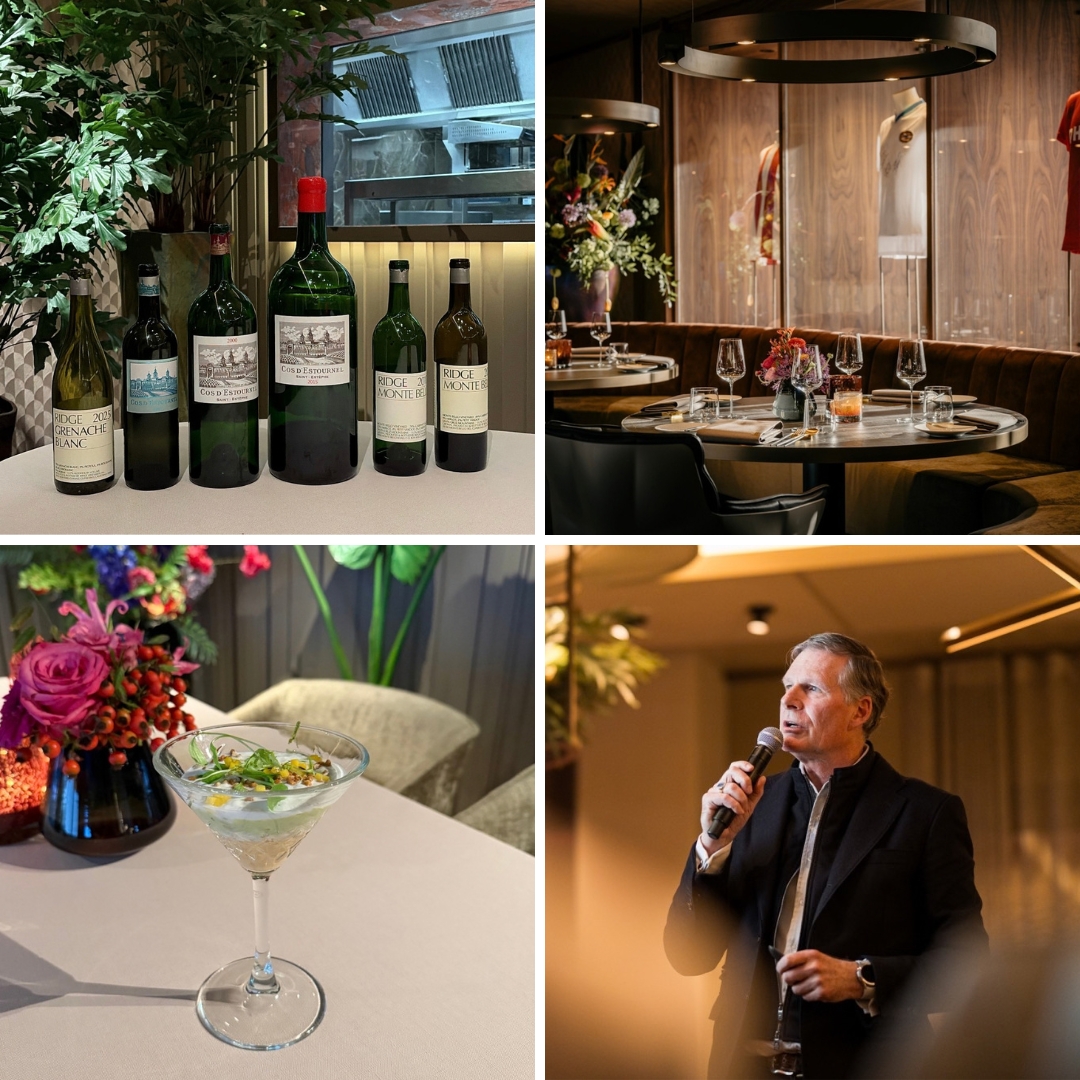
Guided by Clément Robert MS and Cees van Casteren MW, and accompanied by a menu from Erik van Loo of Restaurant Parkheuvel, the dinner explored how maritime influence, place and time shape Cabernet Sauvignon on opposite sides of the Atlantic.
A Dinner Shaped by Two Coasts
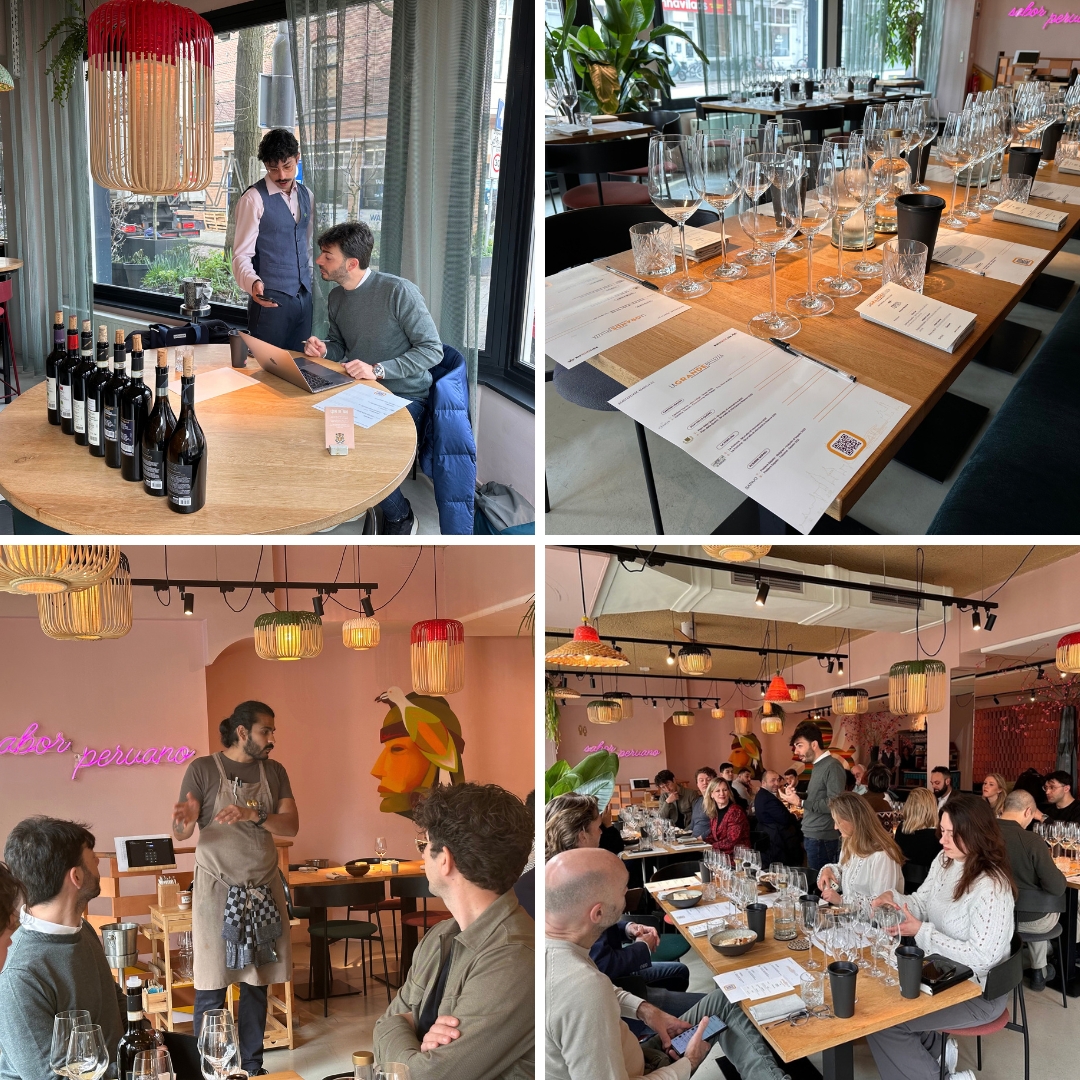
There is something unusual about tasting several of the world’s most distinguished Cabernet Sauvignon based wines while looking out over the pitch of a football stadium. Yet once dinner began in the Legends Lounge at Eindhoven’s Philips Stadion, the setting felt less like a novelty than an invitation to look at familiar wines from a different angle.
In front of us were Bordeaux and California, mature vintages and current releases, and a menu by Erik van Loo of the two Michelin starred Restaurant Parkheuvel. The evening would gradually reveal how much Château Cos d’Estournel and Ridge Vineyards share, and where their identities remain unmistakably their own.
Frank van Gool’s Legends of Wine series is built around this kind of encounter. The producers are present, the kitchen is given a serious role, and the conversation develops around the bottles rather than alongside them.
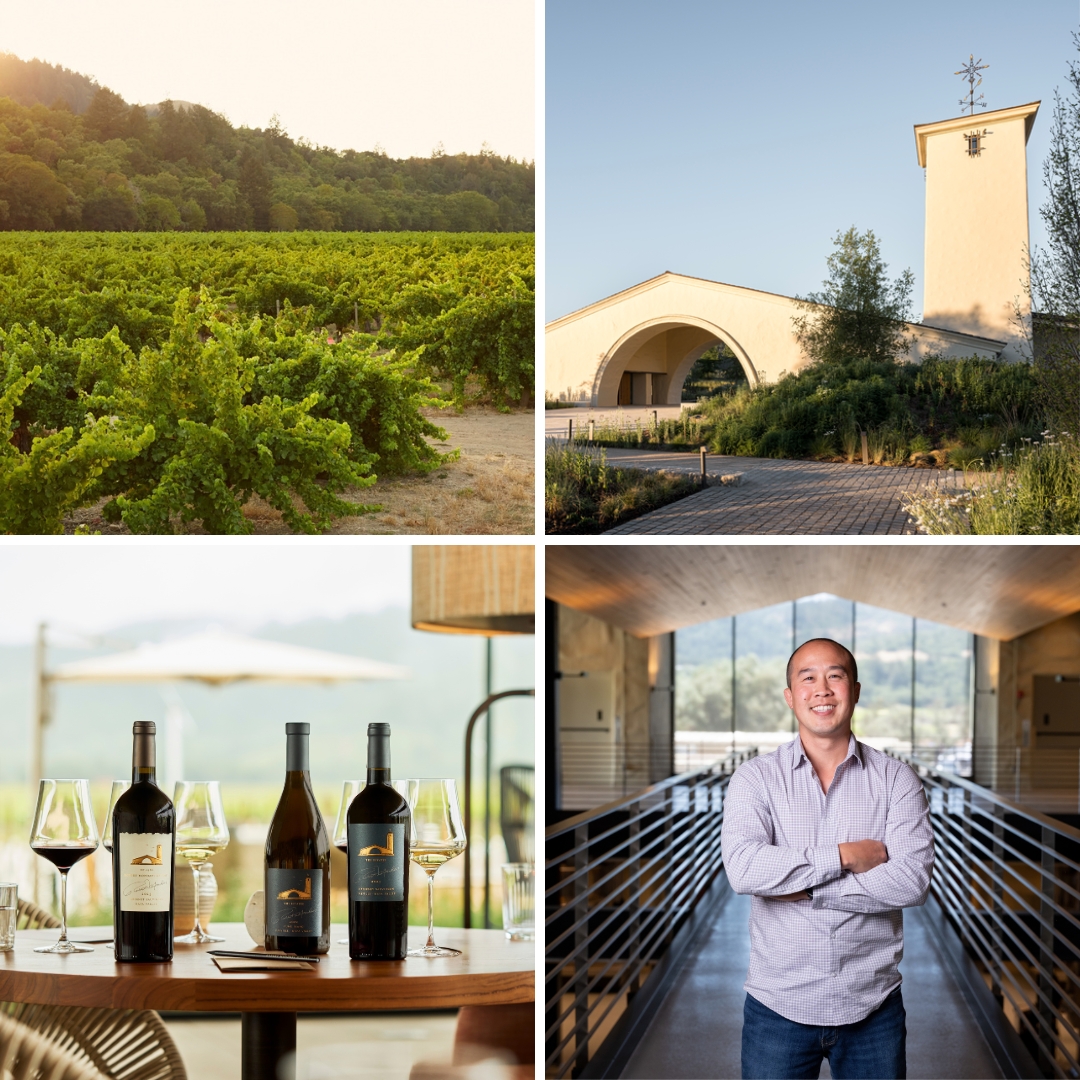
Ridge was represented by International Sales Director Katie Blakely, while Group Commercial Director Charles Thomas spoke for Cos d’Estournel. Master Sommelier Clément Robert and Cees van Casteren MW guided the evening, each bringing a different kind of perspective. Clément connected the histories, places and people around the table; Cees returned repeatedly to what the wines themselves revealed, particularly the different ways in which Bordeaux and California retain and transform fruit with age.
Two of the World’s Best Wine Producers Brought Together an Exceptional Selection of Wines.
Clément began with several connections that were easy to overlook. The name Cos refers to a hill in the local Bordeaux dialect, while Ridge is named for the mountainous terrain of its vineyards. Both estates lie roughly 30 kilometers from an ocean, although on opposite sides of the Atlantic, and maritime influence is central to the way their grapes ripen. Their principal vineyard holdings are also similar in scale. These parallels created a useful starting point, but the purpose of the evening was not to make the estates seem alike. It was to understand how comparable ambitions take shape in very different places.
The aperitif already widened that frame. Ridge Grenache Blanc 2025 (93/100 DWA score) came not from Monte Bello or Sonoma, but from the Adelaida District of Paso Robles. Katie presented it as part of a more exploratory chapter for a winery best known for Cabernet Sauvignon and Zinfandel. The blend of 79% Grenache Blanc, 9% Picpoul, 8% Roussanne and 4% Bourboulenc brought lemongrass, white flowers, pear and nectarine, with fresh citrus and a mineral edge. Its rounded texture never obscured the acidity, helped by the cool Pacific air entering the region through the Templeton Gap.
That balance between freedom and continuity is important at Ridge. Paul Draper joined in 1969 and remained the defining winemaking influence for almost half a century. Long before his retirement, he worked alongside John Olney to ensure that knowledge of the vineyards and the estate’s philosophy could pass naturally to another generation. Katie also drew our attention to Ridge’s labels, which state the composition of each blend. The details change because the wines are assembled by taste rather than according to a fixed recipe. The transparency is practical, but it also reflects a broader confidence in letting vineyard and vintage determine the final wine.
From the Northern Médoc to the First Course
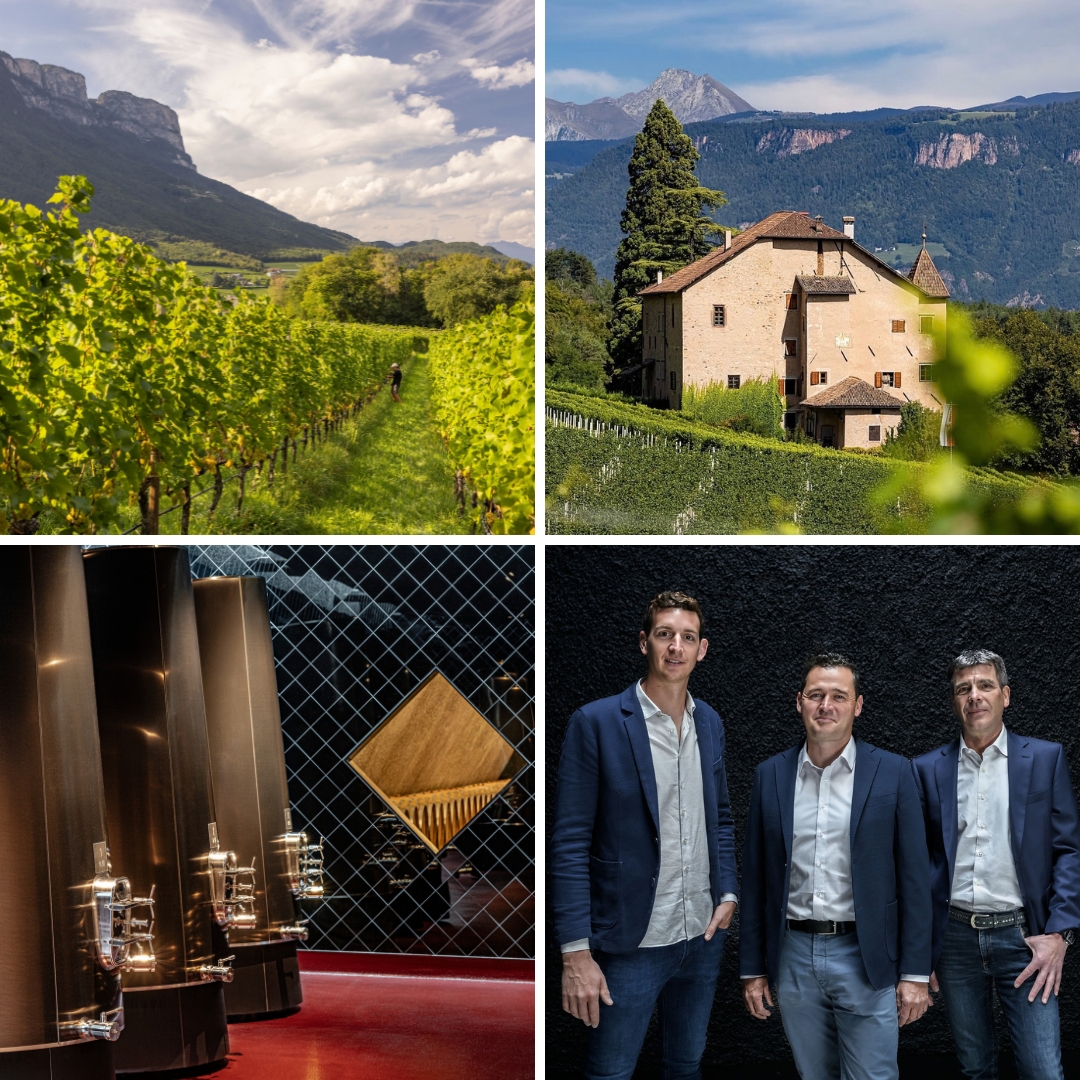
With Charles, the conversation moved from contemporary California to an estate whose outward appearance still bears the imagination of its nineteenth century founder. Louis-Gaspard d’Estournel began exporting wine to India and, on returning to Bordeaux, incorporated architectural references from the East into Cos d’Estournel. Charles’s own route to Saint-Estèphe added another layer to that history. Born in Dijon and raised in a Burgundian winegrowing family, he spent around a decade working in Asian wine markets before returning to France. His experience made him a particularly apt source for a property whose identity has long reached beyond Bordeaux.
The first course allowed us to encounter Cos through its less familiar colour. Tomato, Burrata and Quinoa was served with the Cos d’Estournel Blanc 2020 (94/100 DWA score), drawn from vineyards in the far north of the Médoc, much closer to the Atlantic than the château’s red wine parcels. Charles described a place exposed to almost constant wind, where cooler conditions and maritime influence help Sauvignon Blanc and Sémillon retain their freshness.
The White Cos was One of the Big Surprises for many of the Guests this Night.
The 2020 is a blend of 66% Sauvignon Blanc and 34% Sémillon. Citrus zest and ripe white peach appeared first, followed by mango, a gentle floral lift and a stony, saline quality. Sémillon gave the palate breadth, while Sauvignon Blanc provided a firmer line of acidity. The result had enough texture for the burrata, but the freshness required by the tomato. Quinoa added a mild nuttiness that drew out the wine’s more savoury side.
The pairing made a convincing case for white Bordeaux at the table. Its strength did not lie in aromatic volume alone, but in the way texture, acidity and salinity remained in balance. Charles explained that the wine is fermented and matured in barrel without relying on new oak, an approach intended to preserve the character of the fruit and its maritime origin. By the end of the course, the wine had become broader and more expressive, yet its finish remained clean and distinctly saline.
North Sea Crab with Citrus and Mango.
The Cos d’Estournel Blanc remained in our glasses for the North Sea Crab with Citrus and Mango. The second pairing revealed another side of the wine. Its ripe citrus and mango notes found a direct connection with the fruit in the dish, while the saline finish and lively acidity followed the sweetness of the crab without overwhelming its delicacy. Where the burrata had emphasized the wine’s breadth, the crab brought its maritime freshness and precision to the foreground.
Two Vintages of Cos d’Estournel
The transition to red Bordeaux came with Erik van Loo’s Poussin with Chanterelles and Truffle. Both grand vins were poured with the dish: Cos d’Estournel 2015 (97/100 DWA score) from a three-liter Jeroboam and Cos d’Estournel 2000 (98/100 DWA score) from magnum. This placed two vintages, separated by fifteen years and produced during different periods in the estate’s modern history, directly alongside one another.
The 2015 blend comprises 75% Cabernet Sauvignon, 23.5% Merlot and 1.5% Cabernet Franc. It was immediately generous, with blackcurrant, blackberry and dark cherry joined by cedar, graphite, tobacco and warm spice. The structure was substantial, but the tannins were finely drawn and the fruit retained considerable freshness. The Jeroboam had slowed its development, leaving the wine youthful and energetic more than a decade after the vintage.
Charles placed this character within the warm growing season and extended Indian summer of 2015. He also connected the wine to the gravity fed cellar introduced at Cos d’Estournel in 2008. Moving grapes and wine without conventional pumping enables gentler handling and more measured extraction. It is tempting to treat such a technical change as an abstract improvement, but the 2015 made the underlying intention clear: concentration without coarseness and power carried by detail.
The comparison became more revealing when Cos d’Estournel 2000 arrived from magnum. Here the fruit had moved into a different register. Mature blackcurrant and plum remained, but tobacco, cedar, leather, dried herbs, forest floor and mushroom had come forward. The tannins had softened and the acidity continued to hold the wine together, giving a long, savoury finish rather than any sense of decline.
Both vintages came from warm, favorable seasons, and both were served from large formats, yet they spoke from different moments in the estate’s history. The 2000 predates the gravity cellar and carried the classical tertiary character many of us associate with mature Médoc. The 2015 retained more primary fruit and a polished density, though it was still far from maturity. Charles supplied the historical and technical context, while our glasses showed that evolution cannot be reduced to age alone. Vintage, bottle format and changes in cellar practice all shaped what we tasted.
The Poussin gave both vintages room to express their differences. Its delicate meat accommodated the 2015’s concentration, while Chanterelles and Truffle drew out the wine’s tobacco, cedar and darker spice. The 2000 found an even more immediate connection with the earthy aromas of mushroom and truffle. It seemed to settle into the dish rather than stand beside it, with remaining fruit and acidity keeping the pairing from becoming entirely autumnal. The softened tannins suited the restrained texture of the poussin, while the two glasses together showed how the same dish could meet the youthful generosity of one vintage and the savoury maturity of another.
Monte Bello and the Persistence of Fruit
Katie then took us to the Santa Cruz Mountains and the Monte Bello vineyard, a site rising from roughly 400 to 850 metres above sea level. Its elevation, exposure to cool air from the Pacific and San Francisco Bay, and unusual limestone and decomposed greenstone soils distinguish it from California’s better known Cabernet Sauvignon regions. Warm air inland draws cold maritime air through the Bay, giving Monte Bello a long and relatively cool growing season. The influence is visible in the wines’ acidity and gradual ripening, but also in the restraint that has made comparisons with Bordeaux so persistent.
Ridge never set out simply to reproduce Bordeaux. Paul Draper acknowledged the inspiration, but chose air dried American oak as part of an expression rooted in California. Monte Bello is matured predominantly in new American oak sourced through cooperages working with timber from the Ozark and Appalachian Mountains. Seasoning the wood in open air for around two years helps temper its aromatic impact, although time in bottle remains essential to full integration.
Monte Bello 2010 (97/100 DWA score), a blend of 74% Cabernet Sauvignon, 20% Merlot, 4% Petit Verdot and 2% Cabernet Franc, came from a notably cool season. Sixteen years later, it combined cassis, blackberry and dark plum with cedar, cigar tobacco, black tea and dark chocolate. Its tannins were integrated but still present, and lively acidity carried the wine through a persistent mineral finish. What separated it most clearly from Cos d’Estournel 2000 was not an absence of development, but the continued intensity of its fruit.
This was where Cees van Casteren MW became an especially valuable guide. Drawing on mature Californian Cabernet in his own cellar, he noted how blackcurrant can remain vivid after several decades, whereas Bordeaux often moves more decisively towards herbaceous, earthy and tertiary expression. His observation gave language to the contrast in our glasses. The Monte Bello was younger than the Cos, but age alone did not account for the difference. It was a question of climate, site and winemaking, expressed through two distinct trajectories of development.
Cees van Casteren MW sharing his knowledge on Cabernet Sauvignon from both sides of the Atlantic.
Cees resisted turning that distinction into a ranking. For European drinkers accustomed to mature Bordeaux, the fruit intensity of California may initially seem pronounced. Repeated tasting changes the frame: what first appears simply fruity begins to reveal itself as part of another classical tradition, supported by acidity, structure and time. Clément approached the same comparison from his own route through wine. Bordeaux had shaped his early education, yet encounters with California at this level had broadened his understanding of what Cabernet Sauvignon can achieve. Together, their perspectives kept the discussion where it belonged, on identity rather than competition.
Roebuck with Beetroot, Liquorice and Almond gave Monte Bello 2010 the depth of flavour it needed. The meat’s lean, concentrated character met the wine’s structure, while beetroot echoed its earthy sweetness and liquorice picked up its darker spice. Almond provided a quieter connection to the cedar and oak. Returning to the Cos 2000 alongside the same dish showed how differently the two wines worked: Monte Bello emphasized fruit and freshness, while Cos drew the venison towards its savoury, gamey register.
A Young Monte Bello and the End of the Evening
Monte Bello 2023 (99/100 DWA score) returned us to the beginning of a wine’s development. After three years of drought, California received substantial rain, followed by a cool growing season and an unusually extended harvest from early September into November. The final blend, 89% Cabernet Sauvignon, 9% Merlot and 2% Petit Verdot, reflected the conditions: much of the Merlot did not reach the required ripeness, so Cabernet Sauvignon assumed a larger role.
The wine was dark and concentrated, with cassis, blackberry, fennel, coffee, graphite and black tea around a firm mineral core. New oak was still apparent, as were the pronounced tannins, but neither obscured the freshness of the fruit. Katie encouraged guests to think of ten years as a sensible minimum before opening Monte Bello. Alongside the 2010, the reason was easy to understand. The younger wine possessed the components, while the older vintage showed what integration could make of them.
Served with a Selection of Cheeses, the 2023 remained powerful, though the fat and protein softened the perception of tannin. More importantly, it provided a final reference point for the evening’s discussion of time. The mature wines had not simply become gentler versions of their younger selves. Each had followed the path set by its origin, its vintage and the decisions made in the cellar.
A Cheese Selection to Match the Final Reds of the Night.
The dinner concluded outside the world of wine with The Dalmore 21-Year-Old and a dessert of Pear, Crème Caramel, Speculoos and Lemongrass. Matured first in American white oak ex bourbon casks and then in Matusalem Oloroso sherry casks, the whisky brought orange, dark chocolate, coffee, dried fruit and warm spice. Crème Caramel and Speculoos mirrored its richness, while pear and lemongrass introduced enough freshness to keep the finish composed.
Looking back across the dinner, the most rewarding moments came when the wines complicated easy assumptions. Cos d’Estournel 2000 showed how mature Saint-Estèphe can exchange primary fruit for savoury detail without losing energy. The 2015 expressed the scale of a warm vintage with greater polish and youthful force. Monte Bello 2010 retained an unmistakably Californian intensity of cassis while developing tobacco, tea and mineral complexity, and the 2023 revealed the architecture from which a future mature wine may emerge.
Katie Blakely and Charles Thomas gave us access to the places and decisions behind those differences. Clément Robert MS and Cees van Casteren MW helped connect that information to the wines in front of us, one through the relationships between estates, history and hospitality, the other through close attention to how Cabernet Sauvignon develops on either side of the Atlantic. Erik van Loo completed the conversation from the kitchen, creating dishes that sometimes echoed the wines and sometimes tested them through contrast.
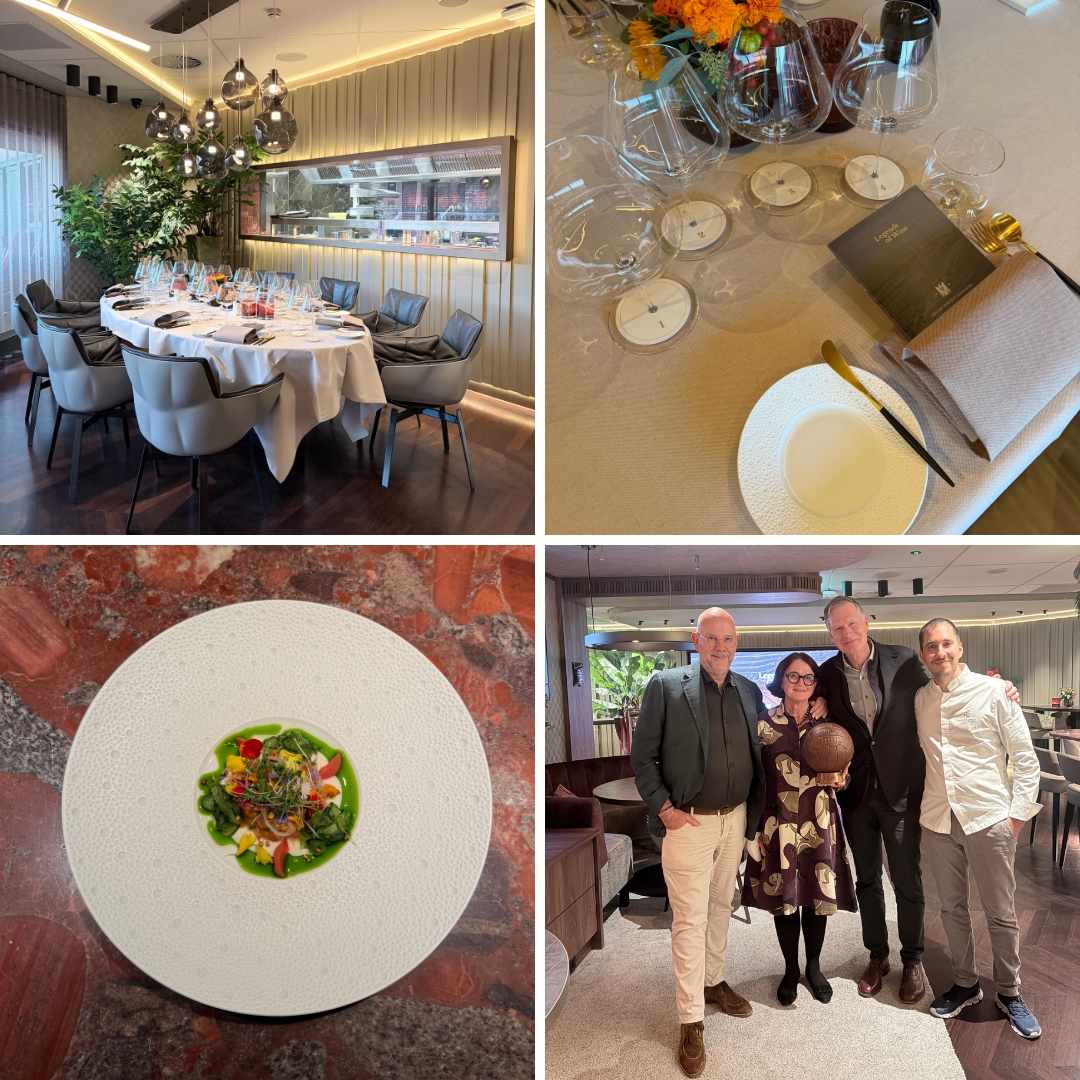
The Legends Lounge, an Amazing Venue Where Great Food, Outstanding Wines Come Together.
This is where the Legends Lounge proved its value as more than an unconventional setting. Frank van Gool had brought producers, guides and chefs into the same room, allowing the evening to unfold through exchange rather than presentation alone. From Saint-Estèphe’s gravel rises to the limestone slopes of the Santa Cruz Mountains, the wines never needed to arrive at the same answer. Their differences gave us the story.
The Next Edition of Legends of Wine
Legends of Wine consists of a series of events where the best of the best from the world of fine wine meet their equivalent in fine dining. Great wineries that work together with top Chefs. In previous editions wineries such as Liber Pater, Egon Müller, Domaine Thibault Liger-Belair, Biondi – Santi and Penfolds visited the Legends Lounge, and for this season an impressive line-up of new stars will find their way
The next Legends of Wine Dinner will take place on Thursday, 8 October 2026, turning the focus towards Germany and the VDP, the Verband Deutscher Prädikatsweingüter. Cees van Casteren MW will return to guide guests through a selection of approximately twenty wines from some of the association’s leading estates, including Wittmann, Dönnhoff and Peter Jakob Kühn and many more.
Representing different regions, vineyards and expressions of German wine, the selection will offer a broad view of the standards and philosophies that unite the VDP’s members. The wines will be accompanied by a dinner prepared by Philipp Stein, chef of the Michelin-starred Steins Traube in Mainz, bringing the cuisine of Germany’s wine country to the Legends Lounge for the next chapter of the series.
This article is written by our own Niels Aarts. We would like to thank Frank van Gool and the Legends Lounge team, as well as the representatives of Château Cos d’Estournel and Ridge Vineyards, and of course Erik van Loo and the team of Parkheuvel for the wonderful evening, wines and dinner.
Join our insiders’ list and get exclusive early access to new articles, expert tips, and fresh reviews delivered straight to your inbox. Subscribe now and be the first to discover!