Join Our Wine Journey – Sign Up for the Newsletter 🍷
A Seat at the Table: Restaurant The Millèn
Share
Deel op X (twitter)
LinkedIn
WhatsApp
A Seat at the Table: Restaurant The Millèn.
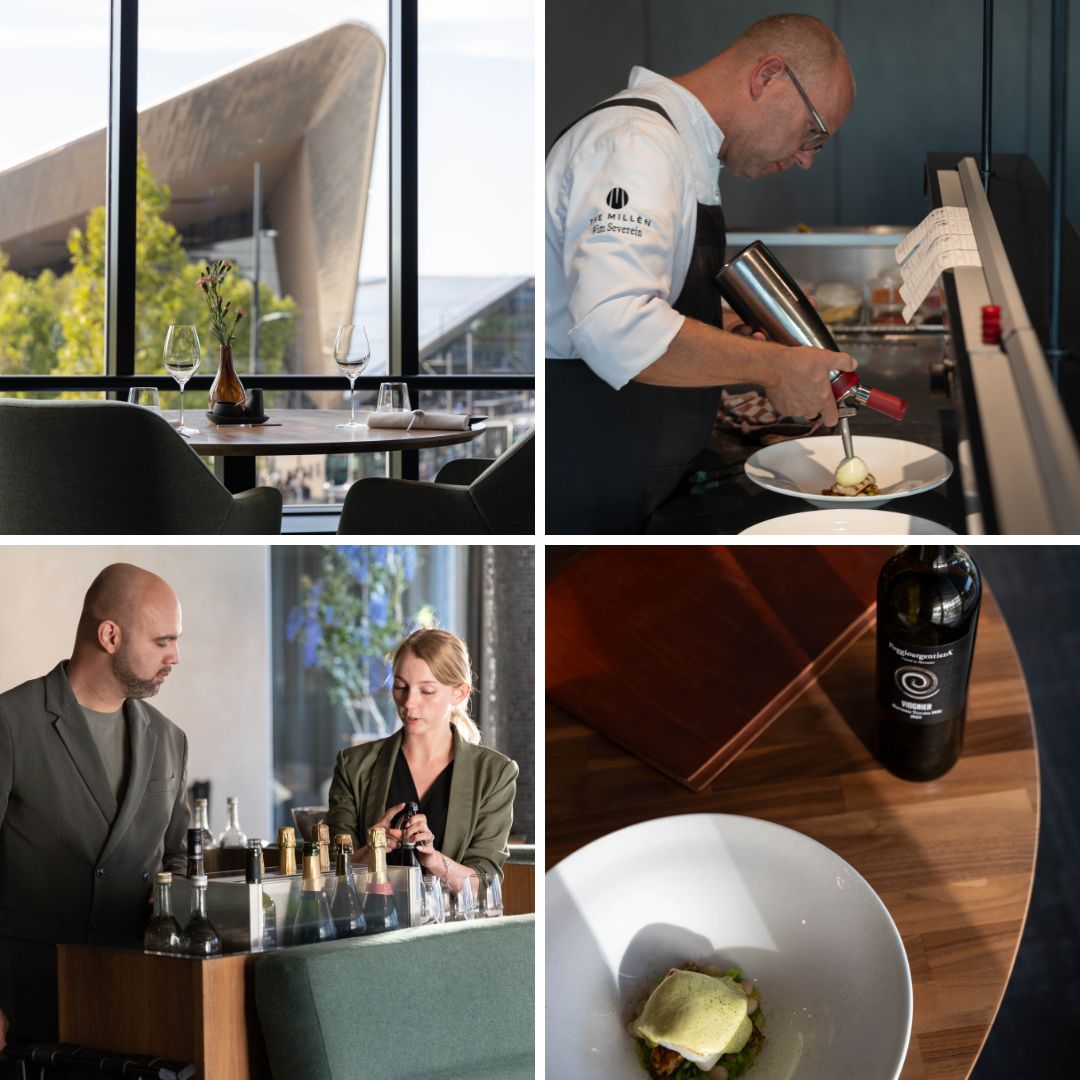
With Rotterdam unfolding beyond the windows, we join Chef and Owner Wim Severein and Maître-Sommelier Sanne Poppen for an evening in which food and wine tell two sides of the same story.
There is something almost theatrical about dining at Michelin Restaurant the Millèn. From our table, behind the large windows of the restaurant, Rotterdam seems to be playing out on a stage below us. Directly opposite stands the unmistakable architecture of Central Station. Trams glide across Stationsplein, trains arrive and depart, cyclists find their way through the evening traffic and a seemingly endless stream of travellers moves in and out of the station. The city never really stands still.
Front row seats at the Rotterdam City Theater.
The Millèn is located on the first floor of the Millennium Tower, within the Rotterdam Marriott Hotel, and there can be few dining rooms in the city where Rotterdam itself feels quite so present. As daylight slowly fades and the lights come on around the station, the view keeps changing. Inside, however, the pace is altogether different. We settle into our seats and, for the next few hours, allow Wim and Sanne to determine the rhythm of our evening.
About A Seat at the Table
Wine rarely exists in isolation. Some of its most memorable expressions are experienced around a table, alongside food and in the company of the people who chose to put a particular bottle there.
With A Seat at the Table, we want to explore that relationship. We visit restaurants where wine forms an essential part of the dining experience, joining the chef and sommelier through a lunch or dinner to understand not only what they serve, but why. We are interested in the philosophy of the kitchen and cellar, the personalities behind them and, above all, what happens when their ideas eventually meet on the table.
A Seat at the Table, our New Culinary Journey.
This is not intended as a conventional restaurant review, nor simply as an analysis of food-and-wine pairings. We want to experience these restaurants as our readers might: settling in, following the progression of the menu, discovering the wines and listening to the stories behind the choices along the way.
Sometimes the kitchen will lead the conversation; elsewhere, the cellar might. What matters to us is that there is a conversation worth having.
And for our first seat, we find ourselves above the heart of Rotterdam, at The Millèn.
Chef and Maître-Sommelier
In Wim and Sanne, The Millèn has two rather interesting people through whom to begin that conversation.
Wim’s story starts a long way from Rotterdam, in the Frisian fishing town of Harlingen. His grandfather knew the local fishermen and would sometimes return with their bycatch, which a young Wim would take into the kitchen with his grandmother to see what they could make from it. Looking back, he has connected those experiences with an instinct that remains central to his cooking today: working with what is available at a particular moment. Season and product come first.
His cooking has travelled considerably since then. Years spent at Rotterdam’s Wereldmuseum brought him into contact with flavours and combinations from around the world, influences that remain visible at The Millèn. Yet there is little interest in disguising the ingredients underneath them. Wim has described his food as pure and recognisable, while still wanting it to remain exciting. It is a philosophy we will come to recognize throughout dinner, where familiar products regularly find themselves surrounded by flavours from much further away.
Wim Severein and Sanne Poppen.
Across the dining room, Sanne approaches Wim’s food from another direction. Winner of the prestigious Nationale Hennessy Gastvrijheidsprijs, she has established herself as one of the country’s talented young sommeliers at the age of 27, while The Millèn’s wine list has also received a nomination for Star Wine List of the Year Netherlands. Yet, accolades tell us relatively little about how someone actually thinks about wine. For that, we need to start drinking.
Fortunately, Sanne already has something in mind.
Champagne, Before Anything Else
The first bottle of our evening is Rafflin-Lepitre Blanc de Blancs Premier Cru. It is a grower Champagne, made entirely from Chardonnay, and The Millèn’s house Champagne. More importantly, it is here because Sanne wanted it here.
For years, The Millèn had poured another Blanc de Blancs, but over time Sanne began seeing that Champagne appears in more and more places around Rotterdam. She wanted something different for The Millèn and started tasting alternatives from several importers. Rafflin-Lepitre was the bottle that stayed with her.
As she explains why, we get our first real sense of how she approaches wine. She likes the Champagne’s elegance and the fact that it doesn’t reveal everything at once. It has layers, but you have to give it time. That matters at the beginning of dinner, because Sanne doesn’t want to start an evening with a wine so rich or eccentric that everything afterwards has to compete with it. Her view is straightforward: the wine should support the food, never overpower it.
Rafflin-Lepitre, Sanne’s Discovery from Champagne.
It is easy to understand the appeal once it is in our glasses. Rafflin-Lepitre has the freshness and precision we hope for from Blanc de Blancs, but there is more going on underneath. We return to the glass several times and, by the time the first bites begin to arrive, it has become clear that this is more than simply a pleasant start to dinner.
In fact, it impresses us enough to leave The Millèn with another story to pursue. We will be taking a closer look at Rafflin-Lepitre and its wines in an upcoming Dutch Wine Apprentice feature, exploring the grower behind the Champagne that first caught our attention here at Sanne’s table.
For now, there is no need to hurry. The Champagne stays with us as a Selection of Amuse-Bouches from Wim’s kitchen begins to arrive. We taste, talk and occasionally find ourselves looking back through the windows as another tram passes below. The city is still demanding attention, although gradually the table begins to win.
A Wine Looking for a Dish
The first course tells us quite a lot about Wim.
Sea Bream Ceviche comes with Pika from Curaçao, Melon, Koa, Avocado and Padrón Pepper. The fish remains clearly at the center of the plate, but the flavours around it travel. There is freshness and salinity, softness from the avocado, fruit from the melon and a more exotic, spicy direction coming from the Curaçao influence and Padrón pepper.
It is easy to see the connection with the way Wim talks about his cooking. The product remains recognisable, yet the world around it has become considerably larger than the North Sea.
Sea Bream Ceviche.
Sanne pours Joh. Bapt. Schäfer Schäferstündchen 2025 from the Nahe, and when we talk about the combination she tells us something we hadn’t expected: this time, the wine actually came first.
She had tasted Schäferstündchen through an importer and simply liked it enough to buy it. There was no dish waiting for it and no carefully conceived pairing at that stage. The wine entered the cellar first; Sanne would work out where it belonged afterwards.
Eventually, Wim’s ceviche provided the answer.
Tasted on its own, Sanne finds Riesling the most dominant element of Schäferstündchen. At the table, that changes. The salinity and acidity of the ceviche calm that side of the wine, while the avocado, melon and other components draw out more roundness, fruit and body. Other parts of the blend begin to make themselves known.
Joh. Bapt. Schäfer Schäferstündchen from the Nahe.
We like the way she puts it: the dish opens the wine.
It is a lovely thought because it turns the usual conversation about pairing around. We spend so much time asking what a wine can add to food that we sometimes forget to ask what food might reveal in a wine. Another bite, followed by another sip, and we begin to understand what she means.
From the North Sea to the Tuscan Coast
The next course feels closer to home. Grilled Plaice arrives with Zeeland Mussel, Green Bean, Coco de Paimpol and Savory Hollandaise, bringing together a delicate fish with considerably richer flavours around it.
That presents Sanne with a dilemma. Pair only with the plaice and the wine could easily become too light for everything else on the plate; follow the hollandaise and beans too enthusiastically and the fish itself risks disappearing.
Grilled Plaice.
Her answer comes from Tuscany: Poggio Argentiera Viognier 2023 from Maremma.
Viognier gives her something she needs here—body—without having to find that weight through oak. The choice of Maremma rather than the Rhône is deliberate as well. Sanne finds a coastal salinity in the wine that becomes more apparent alongside the plaice and Zeeland mussel, while the natural roundness of Viognier has enough presence for the hollandaise.
Poggio Argentiera Viognier 2023 from the Maremma.
Then she points us towards a detail in Wim’s cooking that we might otherwise have missed. The coco beans have been prepared with the liquid from the mussels. Suddenly the plate looks slightly different. What initially seemed like separate components—fish, shellfish, beans, sauce—has an underlying connection running through it. With the wine alongside it, Sanne finds the plaice, mussel and beans moving towards the foreground together, while the hollandaise and green beans settle somewhat into the background.
This is one of those moments when talking about the wine actually sends us back to the food. Another forkful, another sip, and something that was already there becomes easier to see.
The Conversation Changes Direction
By the time Barbary Duck with Cherry, Beetroot, Meadowsweet, Buckwheat and Duck Jus arrives, daylight has all but disappeared outside. The menu has become deeper and warmer too, and Sanne finally reaches for red.
She pours Pepe Mendoza Casa Agrícola Tinto 2024 from Alicante, a blend of Monastrell, Giró and Alicante Bouschet.
Barbary Duck being prepared in the Kitchen.
Barbary duck is relatively mild, and Sanne doesn’t want to bury it beneath a powerful red. She is looking for warmth and roundness, but also enough freshness to leave room for everything Wim has built around the meat. She sees the ripe, generous side of Monastrell finding its way naturally towards the dried cherry and beetroot, while the fresher, spicier character she finds in Alicante Bouschet pulls the combination in another direction.
What interests her is precisely that tension.
Talking about this wine leads us somewhere more interesting than the mechanics of the pairing itself. Sanne explains that she doesn’t believe there is one way to bring wine and food together. Sometimes she wants to move in the same direction as the dish—richness alongside richness, for instance. At other times, she prefers to create contrast, using freshness against weight. What matters to her is not adherence to a formula, but whether the combination ultimately finds its balance.
Then she returns to something she said about the opening course. With Schäferstündchen, the dish opened the wine. Here she feels the direction has reversed: the wine opens the dish, bringing Wim’s different layers into sharper focus.
Pepe Mendoza Casa Agrícola Tinto 2024 from Alicante.
The observation changes the way we approach the plate. Rather than wondering whether the wine “matches” the duck, we find ourselves moving between cherry, beetroot and meadowsweet, returning to the glass in between. The wine hasn’t merely found its place beside the food; it has given us a reason to look at Wim’s dish again.
Cheese Without the Usual Answer
Wim doesn’t follow the duck with a conventional cheese plate. Instead, Lola Montez arrives with Blackcurrant, Granola, Hay Jelly and Bee-pollen Parfait, already beginning the gradual move from savoury towards sweet.
Sanne could easily have reached for one of the classic answers. She deliberately doesn’t.
She tells us that she finds it a little disappointing when cheese automatically sends sommeliers towards the same familiar fortified wines or powerful reds. Lola Montez is relatively elegant and fresh, so why overwhelm it simply because convention says cheese needs something substantial?
Her alternative is Ximénez-Spínola Exceptional Harvest 2024 from Jerez.
Pedro Ximénez may hardly sound like a rejection of conventional cheese pairing, but Exceptional Harvest is not the dark, viscous PX many of us instinctively picture when we hear the grape’s name. There is sweetness, certainly, but also freshness and a nuttier character that finds its way naturally towards the toasted granola. The blackcurrant provides another fresh counterpoint, while the wine has enough presence for the cheese without turning the course into something heavier than Wim intended.
Lola Montez with Ximénez-Spínola Exceptional Harvest
It becomes one of those courses where we stop following a fixed order. Cheese and wine, then blackcurrant; back to the wine, a little granola, another piece of cheese. Each combination shifts things slightly, and the pleasure lies as much in moving around the plate as it does in finding one supposedly perfect mouthful.
More than anything, the choice tells us something about Sanne. She is willing to question the obvious answer when she thinks another bottle might make the conversation more interesting.
Something That Sounded Like Breakfast
Then comes dessert: Blueberry, Fennel, Rye, Buttermilk and Blueberry Sorbet.
When Sanne first saw those ingredients written down, she wasn’t entirely sure what to do with them either. She jokes that blueberry, fennel, rye and buttermilk sounded almost more like breakfast than dessert. On paper she imagined something relatively substantial and initially considered a much heavier wine. Then she tasted the pâtissier’s finished dish and discovered something altogether softer, lighter and fresher.
That changed everything.
We finish in Hungary with Béres Tokaji Magita 2023. Tokaj is a region Sanne has a particular affection for, and Béres a producer she had wanted to visit for some time before eventually making the journey herself. The wine has the sweetness and roundness required for dessert, but Furmint provides the acidity she realised Wim’s dish needed.
There is also a practical consideration behind her choice. We have already eaten our way through amuse-bouches, four courses and several glasses of wine. Sanne doesn’t want the final combination to become a wall of sugar and richness. If the wine is too sweet, she feels the fresher details of the dessert disappear. Magita allows the blueberry, fennel and buttermilk to remain part of the conversation, lifting the final course rather than weighing it down.
Béres Tokaji Magita.
By now we recognize the thought behind it. From the first glass of Champagne to the last wine of dinner, Sanne has consistently left room for what is on the plate.
Dessert marks the end of the five-course menu, but nobody appears particularly interested in bringing the evening to an abrupt close. Coffee arrives with a selection of house-made friandises, and we settle back into our seats for a little longer.
Only now do we really look outside again.
A Seat Above Rotterdam
Rotterdam Central is fully illuminated by this point. Trams are still moving across Stationsplein and trains continue to arrive and depart. Cyclists weave through the intersection, taxis pull away and another stream of travellers emerges from the station. For several hours, all of this has been happening only metres away from us, yet somewhere between Champagne and Tokaj the city has slipped into the background.
Coffee and Friandises.
Over coffee, the conversation inevitably returns to the evening. What stays with us is how little the food and wine have felt like separate parts of it. There have been moments when Sanne followed Wim’s cooking and others when she deliberately moved in another direction. At times the wine drew our attention towards something on the plate; elsewhere, as with the opening Schäferstündchen, the food made us reconsider what was in the glass.
None of this has felt particularly orchestrated from our side of the table. There was no sense that every pairing needed to demonstrate how clever it was. Instead, the relationship developed quietly over dinner, one course and one bottle at a time. Perhaps that is why we find ourselves talking about the combinations afterwards rather than simply remembering them as five dishes accompanied by five wines.
There is one last pleasure in having nowhere to rush off to. We finish our coffee, take another friandise and return to watching the city through the glass.
Wim has spoken of The Millèn as a place where guests can escape the hectic pace of Rotterdam despite sitting right in the middle of it. After spending an evening here, we understand what he means. The city never disappears. We have watched it moving beneath us from the moment we arrived, but inside the restaurant dinner has followed its own rhythm: Champagne and amuse-bouches, one plate followed by another, conversations over the wines, and eventually coffee and something sweet.
Rotterdam by Night.
We take one last look across Stationsplein before leaving. Another tram slides past below, Central Station is still busy and Rotterdam carries on much as it did when we arrived several hours earlier.
Our evening has taken us considerably further—from Wim’s childhood in Harlingen and the Curaçao influences in his cooking to Champagne, the Nahe, Tuscany, Alicante, Jerez and Tokaj—but in the end, the story of The Millèn feels remarkably grounded in this room. In Wim’s cooking, in Sanne’s glasses and in everything that happened between the two over the course of dinner.
For our first A Seat at the Table, we could hardly have asked for a better place to sit.
This article is written by our own Niels Aarts. Picture credits by the talented Marianne van Velzen (MA.VE Photography). We would like to thank The Millèn, Sanne, Wim and the whole team, for a wonderful experience.
Join our insiders’ list and get exclusive early access to new articles, expert tips, and fresh reviews delivered straight to your inbox. Subscribe now and be the first to discover!