Join Our Wine Journey – Sign Up for the Newsletter 🍷
Yves Cuilleron – Crafting the Modern Identity of Northern Rhône
Share
Deel op X (twitter)
LinkedIn
WhatsApp
Yves Cuilleron – Crafting the Modern Identity of Northern Rhône.
In the steep, granite terraces of the Northern Rhône—where mechanization is often impossible and every vine demands manual care—Cave Yves Cuilleron has emerged as one of the region’s defining estates. Not through radical reinvention, but through a steady, deliberate evolution rooted in tradition, precision, and a deep understanding of place.
Few producers embody the modern revival of the Northern Rhône as clearly as Yves Cuilleron. His journey is not only personal—it mirrors the rediscovery of a region that, for much of the 20th century, seemed to have lost part of its former stature.
A Family Story, Interrupted and Reclaimed
The Cuilleron family has been part of Chavanay since the 16th century, though wine was not always its sole focus. Like many families in the region, their activities once spanned fruit growing and mixed agriculture.
It was Yves’ grandfather, Claude Cuilleron, who decisively shifted the focus toward viticulture in the early 20th century, expanding vineyard holdings and beginning to bottle wines under his own label in 1947. The domaine later passed to Yves’ uncle, Antoine, whose work preserved both quality and reputation.
By the mid-1980s, however, the estate stood at a turning point. With no clear successor, the vineyards were to be sold.
Yves Cuilleron.
Yves Cuilleron’s decision to take over in 1987 was therefore not a continuation, but a conscious step into the unknown. Starting with less than four hectares across Condrieu and Saint-Joseph, he effectively rebuilt the domaine from its foundations—guided more by instinct than by certainty.
What began as a personal decision would soon become part of something much larger: the redefinition of the Northern Rhône itself.
Growing with the Rhône Renaissance
Historically, the Northern Rhône held a position alongside Bordeaux and Burgundy, with appellations such as Côte-Rôtie and Hermitage commanding comparable prestige. Yet phylloxera, two world wars, and the extreme labour required to maintain its steep vineyards led to a dramatic decline in plantings.
By the 1980s, a new generation began to reverse that trajectory. Cuilleron was part of this movement.
At the time, land was available and relatively affordable—an opportunity that required both vision and conviction. Over the following decades, he expanded steadily into key appellations, including Côte-Rôtie, Saint-Péray, Cornas, and Crozes-Hermitage.
Today, the domaine spans around 70 hectares across six appellations—an impressive scale in a region defined by fragmentation. Yet what is most striking is not the size, but the coherence: a portfolio that feels unified despite its diversity.
A Philosophy of Precision Through Simplicity
At the core of Cuilleron’s work lies a philosophy that is both traditional and quietly radical: wine should be made as simply as possible.
His approach in the cellar reflects this. Fermentations rely on native yeasts, and the use of additives is avoided. The process is intentionally restrained, allowing the character of the fruit to remain central.
Yves working in the Cellar.
As Cuilleron himself emphasises, the real work happens in the vineyard. The objective is to harvest grapes at optimal maturity—balanced, healthy, and expressive—so that intervention in the cellar becomes unnecessary.
Strong Grape Selection in the Vineyards.
This is not minimalism for its own sake, but a disciplined pursuit of clarity. The role of the winemaker is not to shape the wine into something new, but to guide it toward an authentic expression of its origin.
Balance, Freshness, and Identity
Across both white and red wines, three elements consistently define Cuilleron’s style: balance, freshness, and a strong sense of place.
This philosophy is particularly evident in his whites, where he has established himself as one of the leading producers in the region. Unlike many Northern Rhône domaines, which focus predominantly on red wines, Cuilleron maintains an almost equal split between white and red production.
In Condrieu, based on Viognier, the differences in granite soils—biotite in the north, muscovite around Chavanay—translate into distinct stylistic expressions. The wines from Chavanay, including La Petite Côte, tend to show greater freshness and floral lift, offering a more accessible yet still precise interpretation of the appellation.
La Cote Condrieu.
Further south, in Saint-Péray and white Saint-Joseph, the interplay between Marsanne and Roussanne becomes central. Marsanne contributes structure and a more mineral, almond-driven profile, while Roussanne adds aromatic lift, freshness, and acidity—an increasingly important component in warmer vintages.
It is precisely this philosophy—balance, freshness, and clarity of origin—that becomes tangible in the glass.
In the Glass – Tasting a Selection of the Range
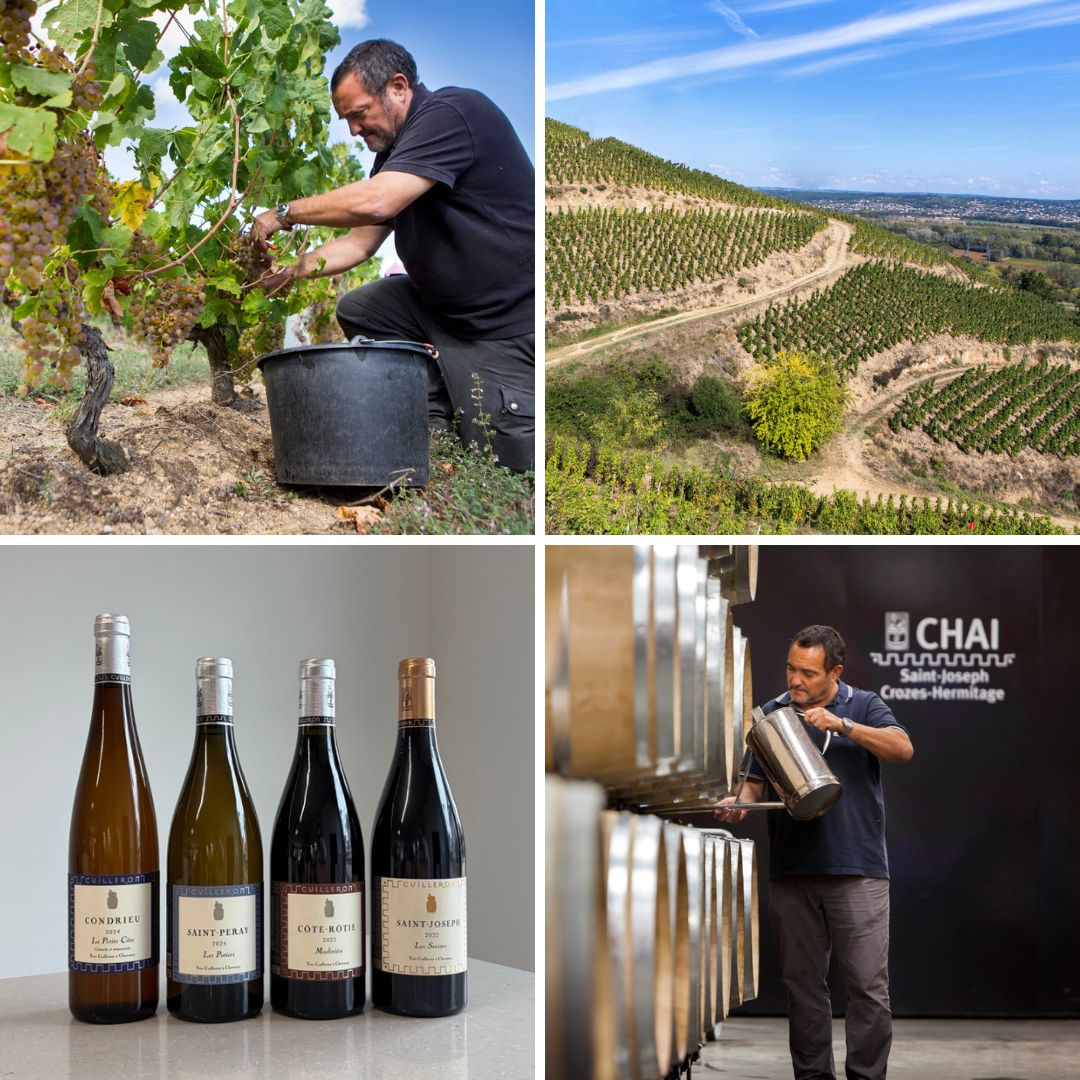
A selection of four wines illustrates how Cuilleron’s philosophy translates across appellations, varieties, and styles.
The Cuilleron Selection on our Tasting Table.
2024 Condrieu La Petite Côte – 90/100 DWA Score
An elegant and approachable introduction to Condrieu. The nose opens with white peach, apricot, and delicate floral notes, underpinned by a subtle mineral lift. On the palate, the wine is medium-bodied with a smooth texture, supported by a fresh, almost linear acidity that keeps the richness in check. The finish is clean and gently aromatic, emphasizing drinkability without sacrificing precision.
2024 Condrieu La Petite Côte.
2024 Saint-Péray Les Potiers – 93/100 DWA Score
A more layered and structured expression of Marsanne and Roussanne. Aromatically, ripe orchard fruit is complemented by almond, anise, and a faint saline nuance. The palate is textured and expansive, yet defined by vibrant acidity that provides tension and direction. The finish is long and composed, suggesting both immediate appeal and clear ageing potential.
2024 Saint-Péray Les Potiers.
2022 Côte-Rôtie Madinière – 92/100 DWA Score
A focused and refined interpretation of Northern Rhône Syrah. The nose shows dark berries, violets, and subtle notes of spice and graphite. On the palate, the wine combines depth with energy, supported by fine-grained tannins and well-integrated oak. Partial whole-cluster fermentation adds aromatic lift, contributing to a wine that is structured yet precise.
2022 Saint-Joseph Les Serines – 93/100 DWA Score
A more concentrated and age-worthy expression within the range. The nose is deeper and more brooding, with black fruit, pepper, and earthy undertones. The palate is structured, with firm yet polished tannins and a pronounced mineral backbone. The finish is long and persistent, marking this as a wine that will benefit from further ageing.
Precision Through Parcels
If the philosophy is rooted in simplicity, the execution is anything but simplistic.
Each parcel is vinified separately, reflecting differences in soil, exposure, altitude, and vine age. In appellations such as Saint-Joseph, this can mean working with dozens of individual lots.
Yves works with parcellaire vinification to do the vineyards justice.
This parcel-by-parcel approach allows for a high level of precision. Decisions regarding extraction, fermentation, and whole-cluster use are adapted to the characteristics of each plot. Only after maturation are the wines assembled, with blending serving as a tool to refine, rather than homogenize.
Over time, this has naturally led to an increased focus on single-vineyard expressions. While the Rhône lacks the formal classification system of Burgundy, the growing use of lieux-dits reflects a broader shift toward greater terroir transparency—something increasingly valued by both sommeliers and collectors.
Climate Change and the Evolution of Style
The impact of climate change is unmistakable. Where previous generations struggled to achieve full ripeness, today’s challenge lies in preserving freshness and balance in increasingly warm vintages.
Greater consistency between vintages has improved overall quality, yet maintaining the identity of each appellation requires constant adaptation.
Rediscovering the Past to Shape the Future
One of the most intriguing developments at the domaine is the reintroduction of forgotten grape varieties.
Drawing on historical research and old ampelographic records, Cuilleron has planted a selection of nearly extinct Rhône varieties—grapes that disappeared largely because they struggled to ripen under past climatic conditions.
Today, these same varieties offer compelling advantages: lower alcohol levels, higher acidity, and strong structural profiles—potentially highly relevant for the future of the region.
A Quiet Strength in the Global Market
Despite exporting to around 60 countries, the domaine remains deeply rooted in France, where the majority of production is still sold. Key export markets—including the United States, the United Kingdom, and the Benelux—reflect regions with a strong understanding of Northern Rhône wines.
In a global market increasingly shaped by scarcity and speculation, Cuilleron maintains a different approach. Allocation is managed with a long-term perspective, ensuring continuity for established partners rather than chasing short-term demand.
The Next Chapter
With the next generation already involved in the domaine, succession is no longer a distant consideration but an ongoing process. Multiple family members are preparing to take on roles across vineyard, cellar, and commercial operations.
This continuity ensures that the philosophy of the domaine—rooted in family, terroir, and precision—will carry forward.
A Defining Voice in the Northern Rhône
Cave Yves Cuilleron represents a distinctive vision of the Northern Rhône—one that prioritizes balance over power, precision over intervention, and authenticity over trend.
Built during a period of regional rediscovery and shaped by decades of thoughtful expansion, the domaine stands today as a benchmark for the modern Rhône. At its core, the philosophy remains clear: respect the vineyard, understand each parcel, and allow the wine to express its origin with honesty and clarity.
Having Shaped the Northern Rhone region for Decades Yves still is a Defining Voice to Date.
In a region defined by its extremes, that clarity is perhaps the most compelling expression of all.
This article is written by our own Niels Aarts and based on a personal interview with Yves Cuilleron. The wines are provided by their Dutch importer and distributor Vinites.
We thank Yves and Vinites for their support and time towards creating this article. Cave Yves Cuilleron and its wines are distributed in the Dutch market by Vinites.
Join our insiders’ list and get exclusive early access to new articles, expert tips, and fresh reviews delivered straight to your inbox. Subscribe now and be the first to discover!