Join Our Wine Journey – Sign Up for the Newsletter 🍷
Tenuta Monteti: Precision and Structure on the Tuscan Coast
Share
Deel op X (twitter)
LinkedIn
WhatsApp
Tenuta Monteti: Precision and Structure on the Tuscan Coast.
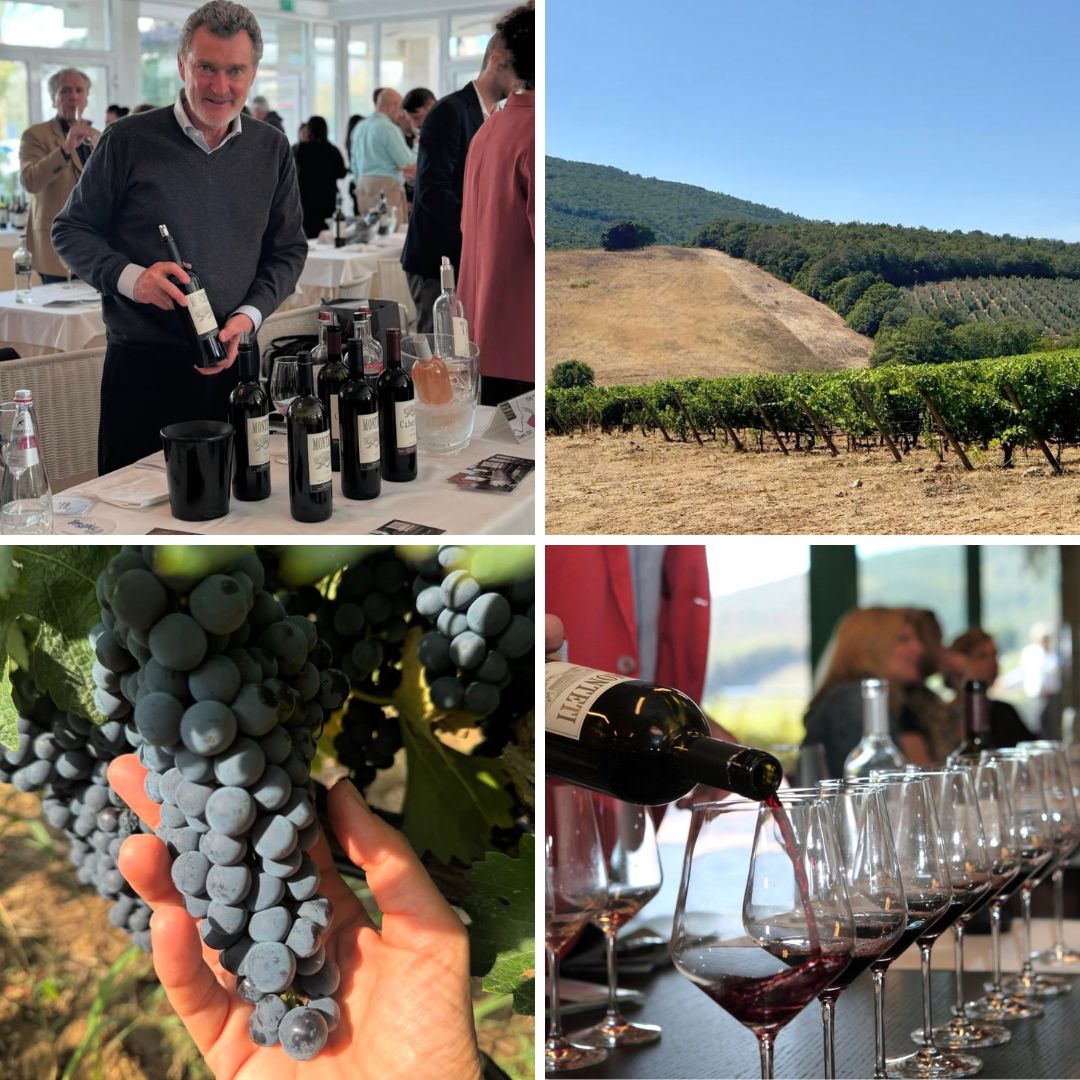
In the far south of Tuscany, close to the border with Lazio, lies Tenuta Monteti. The estate is located approximately ten kilometers from the Tyrrhenian coast, in a part of Tuscany that remains relatively isolated. Beyond the medieval village of Capalbio, human presence is sparse. The landscape is defined by Mediterranean scrub, low bush vegetation and open expanses, markedly different from the better-known inland Tuscan countryside.
A Remote Corner of Southern Tuscany
The estate takes its name from the Monteti hill that rises above the vineyards, providing natural shelter from the strongest maritime winds and forming a defining feature of the local landscape.
In the early 1990s, Gemma and Paolo Baratta acquired a small valley here with the ambition of establishing a quality-driven wine estate. There were no existing vineyards or historic structures to build upon; the project was developed entirely from scratch.
This starting point offered considerable freedom. In the absence of restrictive local wine regulations or entrenched traditions, soil composition, exposure and mesoclimate became the decisive factors guiding subsequent choices.
The Monteti Estate.
In consultation with leading oenologist Carlo Ferrini (Podere Giodo), they selected grape varieties capable of coping with warm conditions while delivering structure and ageing potential: Petit Verdot, Cabernet Sauvignon, Cabernet Franc, Merlot and Alicante Bouschet. In this part of the Maremma, these varieties achieve full phenolic ripeness, while proximity to the sea and constant ventilation help preserve freshness and balance.
The conversion of former pastureland into vineyards required several years of work. At the same time, a winery was constructed with careful integration into the surrounding landscape. Two-thirds of the building is located underground, allowing gravity flow to be used during vinification and maturation while ensuring natural thermal stability, a significant advantage in a warm climate.
Since 2010, the second generation has taken over daily management: Eva Baratta and her husband Javier Pedrazzi now lead the estate.
Javier Pedrazzi and Eva Baratta.
The founders’ original ambition was to produce no more than two flagship wines: one expressing the Mediterranean influence of the nearby sea, and one more firmly rooted in the clay-rich soils of the inland slopes. Under Eva and Javier’s leadership, this concept was expanded with a third cuvée: a rosé that deliberately emphasises freshness and tension while maintaining structural precision.
All wines are released under the Toscana IGT designation. This classification offers considerable flexibility in grape varieties and vinification choices. For Monteti, this is not convenience but philosophy: working without imposed blending rules and focusing entirely on what soil and climate permit. Javier refers to the area as the “Italian Far West”, a territory where quality is shaped less by hierarchy and more by vision and execution.
Vineyards: Clay, Wind and Balance
The 30 hectares of vineyards are situated at approximately 145 meters above sea level and are divided into five main parcels with south-eastern or south-western exposure.
The soils are stony at the surface, with a pronounced clay subsoil. This combination ensures effective drainage while also providing water retention during dry periods, a crucial factor in a warm coastal climate.
The Monteti hill shields the vineyards from the strongest maritime winds, while constant air circulation through the valley provides cooling and promotes healthy fruit. The Tyrrhenian Sea moderates temperature peaks without compromising phenolic ripeness.
During vineyard establishment, large underground rock formations were encountered. These were carefully excavated and positioned alongside the vineyard plots as a visible reminder of the estate’s respect for soil and origin.
The Vineyards of Tenuta Monteti.
From the outset, a strictly parcel-based approach was adopted. Each plot is harvested and vinified separately. Around thirty vessels in the cellar allow for the individual élevage of roughly one hectare per vessel, enabling precise selection and flexibility at blending.
Harvesting is carried out entirely by hand under close supervision of both agronomist and cellar master. Selection is rigorous: even within a single row, decisions are made as to which vines are ready and which require additional hang time.
These decisions are not based solely on ripeness parameters. Soil composition also plays a role. Sections with higher clay content tend to produce greater density and structural depth and are often key components of the flagship Monteti blend.
This labor-intensive method allows Tenuta Monteti, even in warmer vintages, to maintain balance between ripeness, acidity and tannic structure, essential in the premium segment.
Sustainability as Structural Commitment
Since 2016, Tenuta Monteti has participated in the V.I.V.A. programme of the Italian Ministry for the Environment, which measures and monitors the environmental impact of wine estates. In 2017, the estate obtained certification as a sustainable enterprise following audits covering water consumption and greenhouse gas emissions.
Since 2023, Monteti also holds SQNPI certification for integrated and sustainable production.
For the estate, environmental stewardship is not an auxiliary project but a logical extension of its long-term quality philosophy.
Winemaking: Precision Through Selection
The red wines undergo oak ageing followed by one or two years of bottle maturation prior to release. Monteti works with French oak barriques and tonneaux in varying toast levels, selected per parcel according to tannic structure, aromatic profile and texture.
Climate change has increased heterogeneity within and between vineyard plots. Separate vinification of variations in exposure, altitude and soil allows continued control over freshness, extraction and phenolic maturity.
The Barrel Cellar at Tenuta Monteti.
Selection takes place at multiple stages: in the vineyard, during manual harvest, and again at two sorting tables in the cellar. Only homogeneous, perfectly healthy fruit proceeds to fermentation.
The result is a portfolio defined by structure, precision and ageing capacity.
The Wines
During an online tasting organized by Wine+Partners, a selection of the estate’s wines was tasted in the presence of Eva Baratta and Javier Pedrazzi. The session offered insight not only into stylistic decisions and vintage characteristics, but also into the broader vision underpinning the project.
What stands out is the passion and intensity with which both winemakers speak about their work. Their commitment to this remote stretch of the Tuscan coast is palpable. They refer to a “powerful energy”: the combination of sea, wind and open landscape forms an essential part of their identity and of the character expressed in the wines produced here.
The Wines on the Tasting Table.
The tasting combined recent and mature vintages: TM Rosé 2024, Caburnio 2020 and three vintages of Monteti: 2020, 2016 and 2011.
The 2020 vintage on the Tuscan coast is considered warm yet balanced. By contrast, 2016 is widely regarded as classically structured, while 2011 was significantly warmer and more concentrated.
Tasted side by side, these wines illustrate Monteti’s consistent focus on equilibrium between phenolic ripeness, acidity and tannic architecture, regardless of climatic variation.
2024 TM Rosé IGT Toscana | 90/100 DWA score
70% Merlot, 20% Cabernet Franc, 10% Mourvèdre
Pale salmon pink. The nose is clean and floral, showing rose petal and honeysuckle alongside mandarin zest and wet-stone minerality.
The palate is slender and tension-driven, with mouthwatering grapefruit acidity leading into red berries and a subtle white-pepper nuance. The finish is precise, marked by wild strawberry and citrus zest. Despite its lightness, the wine carries sufficient substance and gastronomic focus.
Bright ruby with purple reflections. The nose combines lavender and elderflower with cassis, black cherry and Mediterranean herbs.
Fresh acidity defines the palate, carrying wild berries and red cherry through to a medium-long finish supported by finely grained tannins. The style balances Mediterranean ripeness with tension and drinkability.
2020 Monteti IGT Toscana | 93/100 DWA score
45% Petit Verdot, 35% Cabernet Sauvignon, 20% Cabernet Franc
Intense ruby. The nose is layered with black cherry, cassis, mint, eucalyptus, cedar and clove over a stony mineral core.
Juicy on entry, with compact fruit concentration and integrated tannins. Acidity remains vibrant through a long finish marked by tobacco and dark chocolate. Structured yet balanced, youthful yet already harmonious.
2016 Monteti IGT Toscana | 94/100 DWA score
45% Petit Verdot, 30% Cabernet Sauvignon, 25% Cabernet Franc
Deep garnet with minimal evolution. Aromatic layers of crushed blackberry, dark cherry and floral notes are complemented by dried fruit and subtle oak-derived spice.
Medium-bodied but firmly structured, with integrated acidity and fine tannins. The finish combines dark chocolate and floral lift beneath the ripe fruit core. The wine still has significant ageing potential.
2011 Monteti IGT Toscana | 93/100 DWA score
55% Petit Verdot, 25% Cabernet Franc, 25% Cabernet Sauvignon
Intense garnet. Balsamic herbs, leather, tobacco and forest floor mark the nose.
On the palate, ripe dark fruit is supported by lifted acidity and velvety tannins. The finish reveals cocoa and mocha. Now at its peak, combining tertiary complexity with retained freshness.
Conclusion
Tenuta Monteti demonstrates how vision, site selection and disciplined execution can shape a coherent identity in a relatively young wine region. Through parcel precision, structural clarity and a consistent focus on balance, the estate has established a recognisable style that withstands both climatic variation and bottle age.
Exciting times ahead for the wines of Tenuta Monteti.
This article has been written by our own Marc Roovers. Our sincere thanks go to Eva Baratta and Javier Pedrazzi of Tenuta Monteti for their openness and detailed insights during the tasting, and to Astrid Rauch and Arabella Maislinger of Wine+Partners for the organisation and facilitation of the session.
Join our insiders’ list and get exclusive early access to new articles, expert tips, and fresh reviews delivered straight to your inbox. Subscribe now and be the first to discover!