Join Our Wine Journey – Sign Up for the Newsletter 🍷
New updates in Germany’s VDP Classification System
Share
Deel op X (twitter)
LinkedIn
WhatsApp
New updates in Germany’s VDP Classification System.
On the 12th of July, 2023, the VDP (Verband Deutscher Prädikatsweingüter) released news regarding a significant update in their classification system. In response, we were granted a wonderful opportunity to interview Theresa Olkus, Managing Director of the VDP, to understand these changes better. What is the purpose behind this update? How might it impact our experience with wine? What plans are in place?
Based on the insights gathered from the interview, we will delve into the specifics here, aiming to comprehend the update and enhance our appreciation of German wine.
Swift Overview of VDP in German Wine
German wine labeling is often described as complicated, so we’ll provide its overview with topics about climatic conditions and their historical context.
Germany is located in the northernmost wine-growing region and used to have challenges producing fully ripened grapes. While Riesling is a synonym for Germany, balancing its naturally high acidity was frequently an important topic, and higher sugar levels in good vintages helped to balance it. Consequently, initially established in 1971, the German wine law categorized grapes based on their must weight (sugar level) at harvest rather than other factors such as terroir, yields, and harvesting methods receiving lesser consideration in the classification process, which means quality wine can be produced from all sites and no correlation between vineyards names and quality.
Germany’s Key Wine Regions.
The VDP (Verband Deutscher Prädikatsweingüter) is a private organization championing high-quality wines with around 200 members across the main wine-producing regions. Boasting a history dating back to 1910, the VDP has significantly impacted the German wine industry and consumer preferences through its classification system.
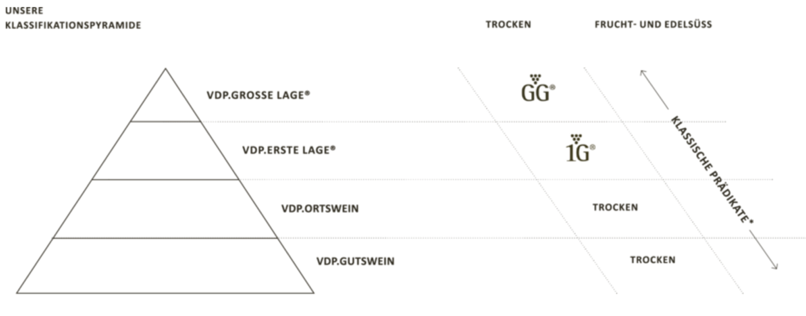
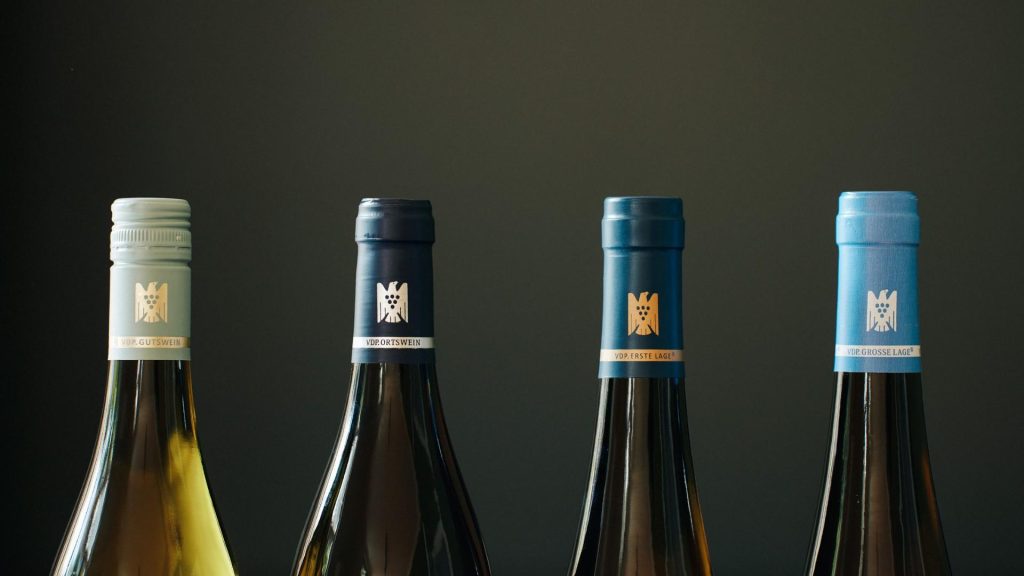
The system, akin to the one used in Burgundy, designated Grand Cru and Premier Cru vineyards and is classified with four tiers: VDP.GUTSWEIN (regional wines), VDP.ORTSWEIN (Village wines), VDP.ERSTE LAGE® (Premier Cru), and VDP.GROSSE LAGE® (Grand Cru). The idea is that the narrower the origin, the higher the quality—dry wines from VDP.GROSSE LAGE is called VDP.GROSSE GEWÄCHS® (GG logo on the bottle) and wines from VDP.ERSTE LAGE® are VDP.ERSTES GEWÄCHS® (1G logo on the bottle).
The VDP Classification Pyramid.
VDP also imposes stricter regulations on its members concerning grape growing and winemaking than those stipulated by German wine laws. These stringent standards contribute to a reputation for VDP wines as high-quality. Consequently, although VDP producers own only 5% of all vineyards in Germany, they significantly influence the wine markets. Consumers have begun selecting high-quality German wines recognizable by the VDP eagle emblem on the bottles.
The private VDP classification is different from the German wine laws. However, the German wine laws, also having undergone revision in 2021 (it takes effect in 2026), are drawing closer to the VDP labeling system. German wine law also shifted towards a province-based four-tier classification by origin. This will – if it is implemented well- positively impact consumers who discern quality levels through the four-tier system.
The Different Tiers in the VDP Classification System.
What are the Drivers for the Changes?
After celebrating two decades of the VDP.GROSSE LAGE (grand cru) and VDP.ERSTE LAGE (premier cru) classification, VDP has embarked on a progressive journey based on the existing framework by initiating re-evaluation.
The original purpose of classifying the vineyards two decades ago was to establish initial recognition of these locations, which has proven immensely successful. Those extraordinary terroirs are remarkable sources for VDP producers to craft exceptional wines. Consequently, producers and the market have shared an inherent understanding of the distinction held by their higher-graded vineyards.
Nevertheless, disparities in reputation have also become evident through producer viewpoints, wine prices, and evaluations from critics, both domestically and internationally. For instance, a certain VDP Erste Lage could potentially surpass a VDP Grosse Lage. Particularly within the context of climate change, terroir conditions for producing outstanding wines might have been shifted. Moreover, a new generation has entered the German wine industry, injecting innovative perspectives and garnering market acclaim. Therefore, the VDP has considered that the time has come to re-evaluate the standing of VDP Grosse Lage and VDP Erste Lage in light of these developments.
The evaluation leads to a more multidimensional and transparent documentation of the classification but also to a somewhat different perspective, encompassing the following aspects:
Historical relevance based on the evidence of the site’s reputation
Importance of the site and its credit rating by producers and experts
Economic relevance based on the analysis of the recognition, prices, and visibility of the wines in the national and international market
Qualitative relevance from the national and international perspective of wine critics and the wine lists of renowned restaurants
Homogeneity of geology, climate, and topography
Besides these aspects, there might be region-specific criteria. An example could be slope steepness in the Mosel or a special historical importance in Rheingau.
All the above will be calculated with numerical points that each classified site gains. Region-specific criteria will weigh a smaller portion of the overall classification, as the overarching goal is to maintain a unified system across all producing regions.
The VDP also remains open to accepting new grape varieties (e.g., Chardonnay), although this is a step for the future. Producers seeking to be newly accepted can have a pathway to getting a reputation in the market. The VDP also implies that its revised classification might eventually be incorporated into the German wine law someday after filling the gap between them. Hence, the classification criteria are moving forward with clarity. The overview of vineyards with VDP Grosse Lage and VDP Erste Large will show a different visage in three years. However, that will be a more dependable portrayal with a more multidimensional and transparent perspective.
Theresa Olkus, Managing Director of the VDP.
Conclusion
It is a democratic system as everybody can build up a reputation. In this revising process, the VDP committed to ensuring equity for producers and reliability for the market. It is undeniable that recent climate changes and the emergence of new generations have influenced this decision, aligning it with the global trend, but the primary reason of this decision is the proof and verification of what the VDP did for the past decades. To gain acceptance in the market, we firmly believe it is essential to uphold high quality, align with the prevailing global direction, and adopt an evaluation system that consumers can easily comprehend.This evolution within the VDP framework will substantially impact German wine. We will be closely monitoring the forthcoming developments.
This article is written by our own Kazumi Uejo. We would like to thank Theresa Olkus for taking the time to answer our questions open-mindedly. Picture credits: VDP and their respective rights owners.
Join our insiders’ list and get exclusive early access to new articles, expert tips, and fresh reviews delivered straight to your inbox. Subscribe now and be the first to discover!