Join Our Wine Journey – Sign Up for the Newsletter 🍷
Clos Saint Jean: Evolution and Precision in Châteauneuf-du-Pape
Share
Deel op X (twitter)
LinkedIn
WhatsApp
Clos Saint Jean: Evolution and Precision in Châteauneuf-du-Pape.
Among the many historic estates of Châteauneuf-du-Pape, Clos Saint Jean represents a particular type of Rhône story: a domaine rooted in tradition yet defined by a decisive stylistic shift in the early twenty-first century. Over the past two decades the estate has moved from producing firmly traditional wines designed for extended ageing toward a more parcel-focused and technically precise interpretation of the appellation. Today, as a new generation begins to shape the future of the estate, another phase of evolution is underway.
A Family Estate Since 1905
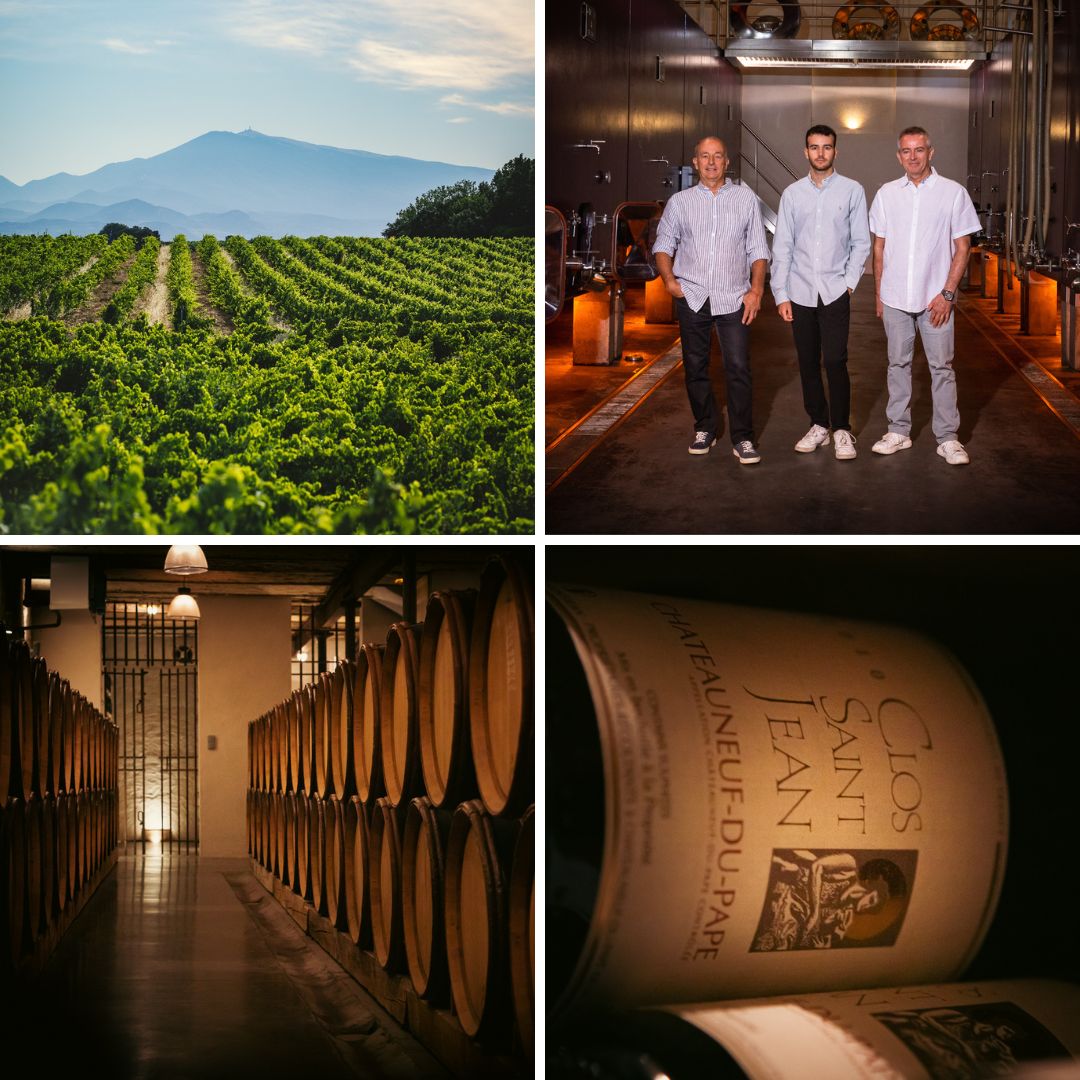
Clos Saint Jean was founded in 1905. At the time the property consisted of only two hectares. Over the following decades the vineyard holdings expanded gradually, with each generation adding parcels. Over the following decades they expanded the estate to its current size of 46 hectares, all located within Châteauneuf-du-Pape. At the same time, they strengthened the domaine’s reputation through a relentless focus on vineyard work and fruit quality.
For much of this period the wines were made in a traditional style typical of the region in the late twentieth century. Fermentation was followed by extended ageing in large oak casks for around three years, after which the wines were held in bottle for an additional two years before release. The resulting wines were powerful and structured, requiring considerable bottle age to reveal their full complexity.
The Maurel Family.
The Turning Point: 2003
The modern identity of Clos Saint Jean began to take shape around the turn of the millennium. Consumers were increasingly drawn to wines that combined power with earlier accessibility and greater fruit expression. The response was radical. In 2003 the estate rebuilt its winery from scratch, replacing the old facilities with a new cellar centered on concrete fermentation tanks. This marked a fundamental shift in both winemaking philosophy and technical approach.
The move to concrete was primarily motivated by the desire to preserve fruit purity. Concrete allows relatively stable fermentation temperatures and minimal aromatic influence, providing a neutral environment that emphasises varietal and terroir expression. For a Grenache-dominant estate such as Clos Saint Jean, this approach proved particularly effective.
The Vinification Cellar.
Equally important was the introduction of systematic parcel-by-parcel vinification. Previously the different vineyard plots had largely been blended early in the process. The new winery made it possible to ferment each plot separately in dedicated tanks, allowing the team to better understand the characteristics of individual terroirs.
Today the cellar contains 21 fermentation tanks corresponding to 21 distinct vineyard parcels. This transition laid the foundation for a series of new cuvées that highlight specific vineyard sources, including Combe des Fous and Deus Ex Machina.
The re-newed cellar allows for a more fruit forward profile and more precise vinification.
The stylistic shift coincided with growing international recognition. The estate received its first 100-point score (by Robert Parker) in 2005, a moment that dramatically increased global demand for the wines and positioned Clos Saint Jean among the leading producers of the appellation.
Vineyard Philosophy: Quality Before Volume
Despite the technological changes in the cellar, the philosophy in the vineyards has remained remarkably consistent. The estate has always placed primary emphasis on viticulture, reflecting the belief that the quality of the fruit ultimately determines the quality of the wine. Focus on vineyard work reflects a conviction that careful farming reduces the need for intervention during vinification.
Vines with age and character are crucial in Clos Saint Jean’s winemaking philosophy.
The estate currently farms vineyards with an average age of approximately 60 years, although some parcels are significantly older. In fact, the domaine deliberately avoids bottling wines from vines younger than forty years old. The rationale is straightforward: older vines develop deeper root systems that explore multiple soil horizons, allowing them to access different mineral layers and produce grapes with greater concentration and complexity.
Precision During Harvest
The estate’s focus on quality becomes particularly evident during harvest, when an unusually rigorous sorting protocol is applied.
All grapes are hand harvested by a regular team that returns every year and is well acquainted with the quality standards expected at the estate. The first selection therefore takes place directly in the vineyard, where pickers discard unripe or damaged bunches.
Precision and strong selection in the vineyard are elementary to Clos Saint Jean’s success.
A second selection occurs immediately after harvesting, when grapes are transferred into bins at the tractor. At this stage several experienced vineyard workers examine the fruit again and remove any compromised berries.
Once the grapes arrive at the winery, they pass over a sorting table where additional staff perform a third inspection. Only after this step the grapes enter the destemmer, which itself removes dried berries during the destemming process.
In challenging vintages this rigorous sorting can significantly reduce production. In one recent harvest the estate lost approximately 40% of its potential crop. For the domaine, however, such losses are considered an acceptable cost of maintaining quality.
Winemaking: Preserving Grenache
Clos Saint Jean’s winemaking approach reflects the central role of Grenache in the estate’s vineyards. Fermentation for all varieties takes place in concrete tanks and typically lasts around two weeks, followed by malolactic fermentation in the same vessels.
After fermentation the different varieties are separated for ageing according to their structural characteristics.
Grenache, which forms the backbone of most cuvées, remains in concrete tanks for approximately one year. The reasoning is that Grenache is relatively prone to oxidation and can easily lose freshness when exposed to excessive oxygen. Concrete therefore helps preserve fruit expression while allowing gentle micro-oxygenation.
Syrah and Mourvèdre, by contrast, are aged in oak barrels. These varieties are considered more reductive and benefit from controlled oxygen exposure to soften tannins and develop aromatic complexity.
The Barrel Cellar.
The estate uses relatively modest proportions of 15–20% new oak, with light toasting to avoid overwhelming the expression of terroir. The barrels are sourced from a Burgundian cooperage working with custom specifications designed to integrate oak influence as subtly as possible.
A New Generation Arrives
The next stage in the evolution of Clos Saint Jean began when Valentin Maurel, the newest generation of the family, joined the estate after completing studies in food science engineering in Lyon. Before returning to the family property, he gained experience in several wine regions abroad, including Switzerland, Oregon and South Africa.
Valentin Mourel.
These international experiences had a significant influence on his perspective. Working with Pinot Noir and Chardonnay in Oregon and South Africa exposed him to wine styles emphasizing elegance, freshness and moderate alcohol levels. The contrast with the traditionally powerful wines of Châteauneuf-du-Pape prompted him to explore ways of introducing greater finesse without abandoning the identity of the appellation.
Since joining the estate, Maurel has gradually introduced adjustments to vineyard management and harvest timing, particularly with the aim of reducing alcohol levels while preserving ripeness and tannin quality.
Sine Fine: An Experimental Cuvée
Alongside these adjustments within the main range, Valentin has introduced a personal project called Sine Fine, a small-scale cuvée intended to explore a different stylistic direction.
The wine is based primarily on Grenache grown on sandy soils, blended with Cinsault. Sandy soils are known to produce particularly elegant expressions of Grenache, with lighter tannic structure and greater aromatic lift compared with Grenache grown on clay or galets roulés.
The final blend currently consists of 70% Grenache and 30% Cinsault, fermented and aged entirely in concrete to preserve freshness and avoid oak influence.
The objective is not to replicate Burgundy but to explore whether Châteauneuf-du-Pape can express a lighter and more delicate profile while maintaining the depth and character typical of the appellation.
Continuous Evolution
More than a century after its founding, Clos Saint Jean remains a domaine defined by gradual but deliberate evolution. The transformation of the winery in 2003 reshaped the estate’s identity and brought international recognition.
Today the arrival of a new generation is prompting another phase of reflection and experimentation. The core philosophy, however, remains unchanged: careful vineyard work, rigorous fruit selection and an ongoing search for greater precision.
In a region often associated with power and warmth, Clos Saint Jean is increasingly exploring how those qualities can be balanced with freshness, elegance and a clearer expression of terroir.
For this article we got to taste a selection of Clos Saint Jean’s wines, provided by their Dutch distributor Poot Agenturen. Below our reviews, including the scores for the wines.
Ripe stone fruit and dried apricot aromas lead the nose, supported by subtle floral notes and a hint of almond. The palate is generous and textured, yet lifted by bright acidity that brings welcome freshness to the wine’s broad structure. A long finish is defined by gentle phenolic grip reminiscent of apricot kernel. Partial oak vinification of Grenache Blanc and Roussanne adds roundness and subtle complexity without dominating the fruit.
2024 Les Calades | 89/100 DWA score
Blend: 70% Grenache, 30% Caladoc
Bright red fruit aromas with notes of raspberry and red plum. Vinified entirely in concrete, the wine emphasises purity of fruit with no oak influence. The palate is juicy and approachable, with supple, sappy tannins and lively freshness.
2023 Châteauneuf-du-Pape Rouge “Sine Fine” | 89/100 DWA score
Blend: 70% Grenache, 30% Cinsault
Crunchy red cherry and wild strawberry aromas with lifted floral notes. The palate is bright and energetic with fine-grained tannins and a lighter structural frame than the domaine’s classic cuvées. The finish is clean and driven by vibrant red fruit.
Aromas of ripe black cherry, plum and raspberry reflect the generous ripeness of Grenache in this warm vintage. The palate is full-bodied and powerful yet balanced, with well-integrated tannins supporting the wine’s ample fruit concentration. Despite its 16% alcohol, the wine maintains balance thanks to its depth of fruit and structure.
The Grenache in this cuvée originates from vines planted in 1905 on a difficult parcel dominated by large galets roulés within a small combe, producing naturally low yields of around 20 hl/ha.
La Combe des Fous.
2022 | 94/100 DWA score
More Grenache-driven in character, showing juicy red and black fruit with a slightly paler colour. The wine feels open and generous, with supple tannins and immediate charm.
2020 | 96/100 DWA score
Deeper in colour and more structured aromatically, with darker fruit, peppery spice and earthy undertones suggesting a stronger Syrah imprint. Firmer tannins point toward longer ageing potential.
2022 Châteauneuf-du-Pape “Deus Ex Machina” | 96/100 DWA score
Blend: Grenache 60%, Mourvèdre 40%
Named after the Latin expression Deus Ex Machina, referring to a sudden intervention that changes the course of events, this cuvée symbolizes the stylistic transformation initiated at the estate after 2003.
The wine shows pristine and intensely ripe fruit with black cherry, plum and hints of garrigue. Mourvèdre provides structure and earthy depth on the palate, contributing firm yet finely textured tannins. Despite its power, the wine already shows impressive integration for such a young vintage.
Clos Saint Jean: Precision, Identity and the Pursuit of Balance
Clos Saint Jean today stands at an interesting intersection. The estate has already demonstrated its ability to evolve decisively when required, most notably with the transformation of its cellar and stylistic direction in the early 2000s. That shift brought greater precision, clearer fruit expression and a new level of international recognition. What is unfolding now is less abrupt, but perhaps equally significant.
Through the work of Valentin Maurel, the domaine is beginning to refine its understanding of balance within the context of Châteauneuf-du-Pape. The wines remain unmistakably rooted in the appellation, with their characteristic depth and generosity, yet there is an increasing emphasis on nuance, drinkability and textural finesse. Cuvées such as Sine Fine illustrate that this exploration is not theoretical, but already tangible in the glass.
Importantly, this evolution does not come at the expense of identity. The rigorous vineyard work, the reliance on old vines and the uncompromising approach to selection continue to define the foundation of the wines. What is changing is the interpretation: a gradual shift toward expressing not only power, but also precision and transparency.
In that sense, Clos Saint Jean reflects a broader movement within the southern Rhône, where producers are re-examining how to balance ripeness with freshness in a warming climate. The estate’s trajectory suggests that Châteauneuf-du-Pape is capable of greater stylistic range than is often assumed.
More than a century after its founding, Clos Saint Jean remains a domaine in motion. Its past is firmly anchored in tradition, its present defined by technical clarity, and its future increasingly shaped by a search for elegance within power.
Today, this evolution is supported not only by Valentin Maurel, but also by his cousin Hugo Maurel and his sister Claire Maurel, who contribute across both vineyard work and the broader business of the estate.
This article is written by our own Barbora Peterikova. The wines are provided by Poot Agenturen, who are the distributor for Clos Saint Jean in the Dutch market. We would like to thank Valentin Maurel for his team and support in writing this article, and Poot Agenturen for the wines provided.
Join our insiders’ list and get exclusive early access to new articles, expert tips, and fresh reviews delivered straight to your inbox. Subscribe now and be the first to discover!