Join Our Wine Journey – Sign Up for the Newsletter 🍷
Weingut Rudolf Fürst: Benchmark German Spätburgunder
Share
Deel op X (twitter)
LinkedIn
WhatsApp
Weingut Rudolf Fürst: Benchmark German Spätburgunder.
Weingut Rudolf Fürst stands as one of Germany’s defining addresses for Spätburgunder, shaped by the distinctive character of the red sandstone soils surrounding Bürgstadt. For centuries the Fürst family has been rooted in these landscapes, their winemaking tradition first recorded in 1638. Yet it was the determined vision of Paul and Monika Fürst from the late 1970s onward that transformed a modest family holding into a 21-hectare estate now regarded among the country’s finest. Their early conviction that Spätburgunder could excel on the warm, iron-rich sandstone slopes marked them as pioneers, long before German Pinot Noir commanded international attention.
The geological backbone of the region plays a decisive role in this success. Red sandstone absorbs and radiates heat, extending ripening in a climate where achieving full maturity for red grapes was once considered improbable. With yields intentionally kept low—on par with Burgundy’s top crus—and a focus on steep, shallow parcels, the Fürst family has elevated their vineyards into some of Germany’s most coveted sites. Names like Centgrafenberg, Hundsrück, and Schlossberg have become synonymous with precision, purity and an unmistakable mineral signature that defines the estate’s style.
Generations of experience, meticulous vineyard work, and a deep respect for the subtleties of terroir combine here to create wines of striking finesse. What began centuries ago as a local craft has grown into a benchmark for modern German winemaking—one that continues to evolve while firmly rooted in the red sandstone hills of Bürgstadt.
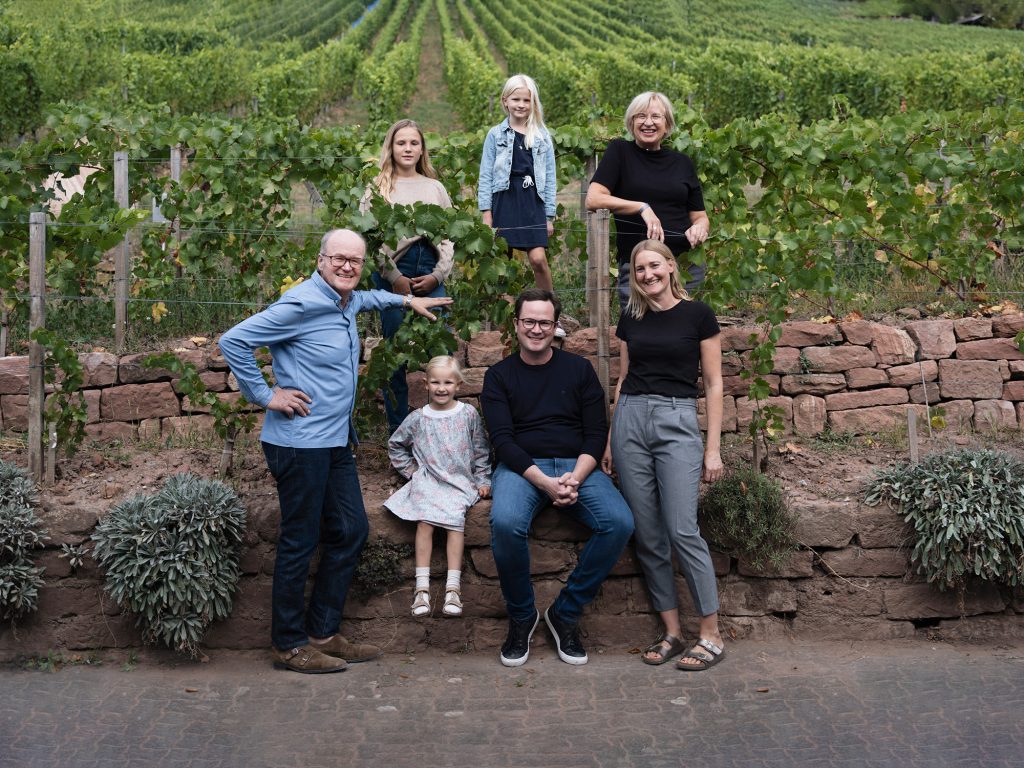
The Fürst Family.
The Origin and Strength of Weingut Rudolf Fürst
Weingut Rudolf Fürst is situated in Bürgstadt where the red sandstone soils are ideal for Spätburgunder, which makes up 60% of their 21 hectares planted. The Fürst family has been making wine around the village for centuries, with the first documentation of the family’s wines stemming from 1638. Especially since 1979, Paul Fürst and his wife Monika have made great efforts to expand the winery, expanding it from 1.5 hectares to the 21 hectares the domaine is today, with a strong focus on Spätburgunder grown on the region’s dominant red sandstone soils. In fact, they were one of Germany’s earlier pioneers of the Spätburgunder variety – proving that on these red sandstone soils it can ripen fully and produce world-class wines.
The red sandstone retains heat from the day very well and thus continues the ripening process through the night, making for fully ripe grapes in what would otherwise be too cold of an area for red wine. They also focus on reducing yields, having only an average yield of 35 hectolitres per hectare – comparable to Burgundy grand crus. Their prime parcels are the Centgrafenberg (both Spätburgunder and Riesling), Schlossberg (Spätburgunder), and Hundsrück (Spätburgunder) vineyards.
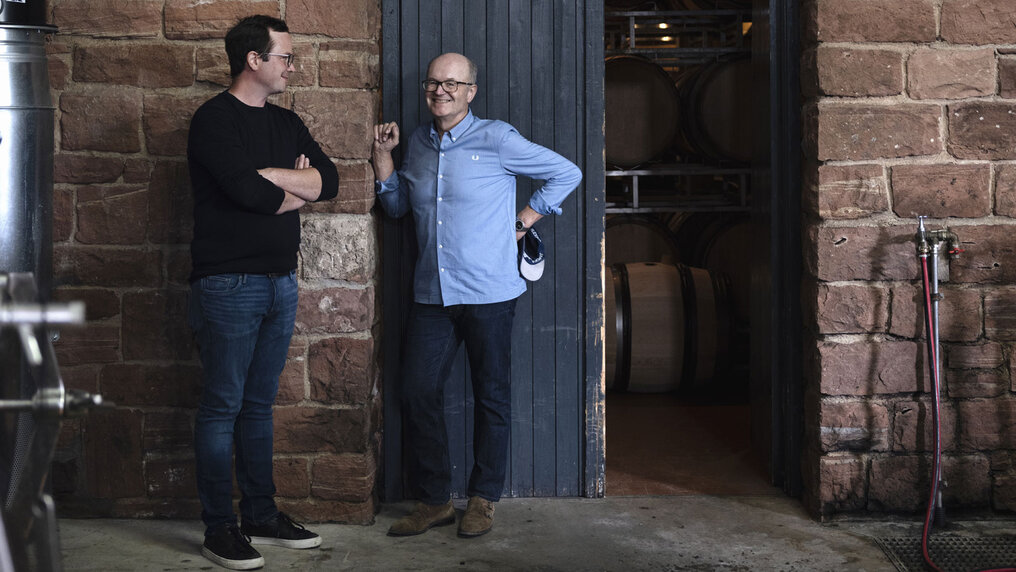
Sebastian and Paul Fürst.
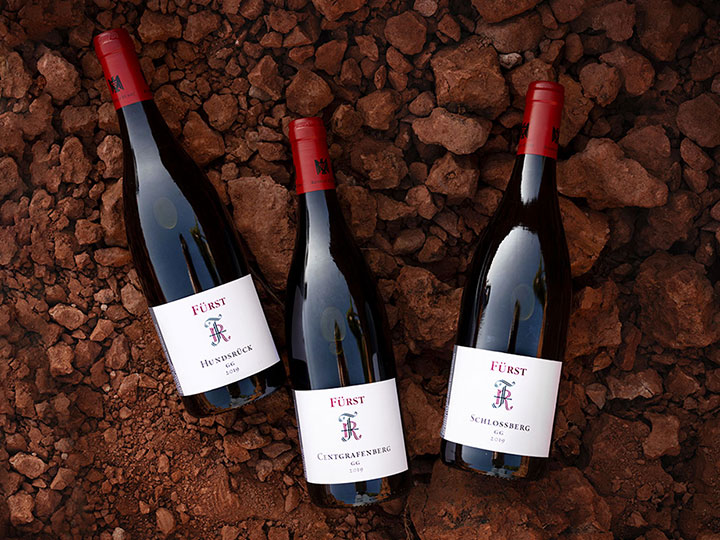
The Hundsrück in the village of Bürgstadt with its very shallow, gravelly red sandstone soil tends to produce the darkest, earthiest, most structured and concentrated wines, and is the winery’s flagship bottling. The Centgrafenberg is situated right next to the Hundsrück and has marginally deeper, loamier soils, giving a gentler expression of red and blue fruit, but still carrying the signature cool, ferrous minerality due to the red sandstone. The Schlossberg is situated in Klingenberg, a village west of Bürgstadt. This historic vineyard has unique terraces of red sandstone walls, which are protected as a historic monument and have been partly restored by Rudolf Fürst. These walls retain a lot of heat (harvest here is around 10 days earlier than in Bürgstadt), giving a very ripe, red-fruited style of wine with a lot of floral elegance and silkiness. If the Hundsrück is like a Pommard, then the Schlossberg is like a Volnay. However, both wines would probably beat many of their Burgundian counterparts in a blind tasting.
The Winemaking and Wines
For all three GG bottlings only the older vines on shallow, steep plots are used. All other vines, even those planted in the Grosse Lage vineyards, are declassified to the Ortswein or even the Gutswein bottlings. All in all, the red sandstone seems to give the wines a lot of aromatics and spice, along with ripe fruit and a certain cool ferrous minerality to them. This signature note carries all the way through to the Gutswein, and is Rudolf Fürst’s signature for the red wines that are produced.
Having studied in Burgundy at Domaine de l’Arlot, Sebastian Fürst, in charge of red winemaking of the domaine since 2008, brought the winemaking techniques over to Germany. Cold macerations, Burgundian new oak barrels, hand harvests and strict sorting of the grapes, whole bunch fermentations (up to 100% in warm years) and French clones of Spätburgunder are all commonplace at the winery, yielding incredibly polished, elegant red wines, capable of aging for a long time due to their structure and depth. His best bottlings are benchmark Spätburgunder for the whole of Germany, resulting in Sebastian being named German winemaker of the year in 2018.
The Vineyards of Weingut Rudolf Fürst.
Strict clonal selection has been in place since the 1980s, with many of the high-yielding, German Spätburgunder clones being replaced by lower-yielding French clones, with even the extremely low-yielding Pinot Fin and Pinot Très Fin being used – both being popular with some of Burgundy’s best domaines (DRC, Arnoux Lachaux). This clone produces tiny berries, curbing yields even further. In the past, green harvests were common, especially in the slightly more fertile Centgrafenberg, but due to the stricter clonal selections these have become rarer over the years. According the Sebastian, it is better for the balance of the vine to have yields naturally low instead of forcefully cutting away fruit.
Rudolf Fürst also produces world-class Riesling and Chardonnay. The Rieslings are made in a very pure, mineral style with crystalline acidity, a ripe yellow fruit profile, and very moderate alcohol. The Chardonnay sees a Burgundian vinification including a touch of reduction, showing pear, grapefruit, vanilla, butter and hazelnut. Tasting blind, one would almost guess a Burgundy premier cru or above. The rare Frühburgunder grape is also planted on just below two hectares in the Centgrafenberg vineyard, making for darker, meatier and earthier wines, with intense dark chocolate and black fruit notes. The variety only yields 22 hectoliters per hectare and is prone to many diseases, making it a true labour of love. The reserve ‘R’ bottling of the variety is not to be missed. Small amounts of Weissburgunder, Silvaner, and Zweigelt are made too, both planted around the village of Bürgstadt.
The Barrel Cellar at Weingut Rudolf Fürst.
Spätburgunder and Riesling only account for 10% of Franken’s wine production together, but as the wines of Rudolf Fürst prove, yield some outstanding results in the region. Especially in the western part of the region, where old red sandstone and clay soils give ethereal wines from these varieties. The wines of Rudolf Fürst are not cheap, but due to their elegance and regal charm the premium prices actually seem warranted, and in many cases, even worth it.
Taking a Closer Look at the Wines
In review we tasted a selection of the wines of Weingut Rudolf Fürst. Below our findings and ratings.
Rudolf Fürst 2021 Franken Spätburgunder ‘Tradition’
Entry-level Spätburgunder, younger vines and Erste Lage plots such as the Bürgstadter Berg. Aromatic red fruits, red cherry, some whole bunch spice coming through, clove, rose, earthy. Light, fine-grained tannins with fresh acidity. Lovely red-fruited elegant introduction to the house style. Our rating: 89/100 DWA score, drink 2024-29.
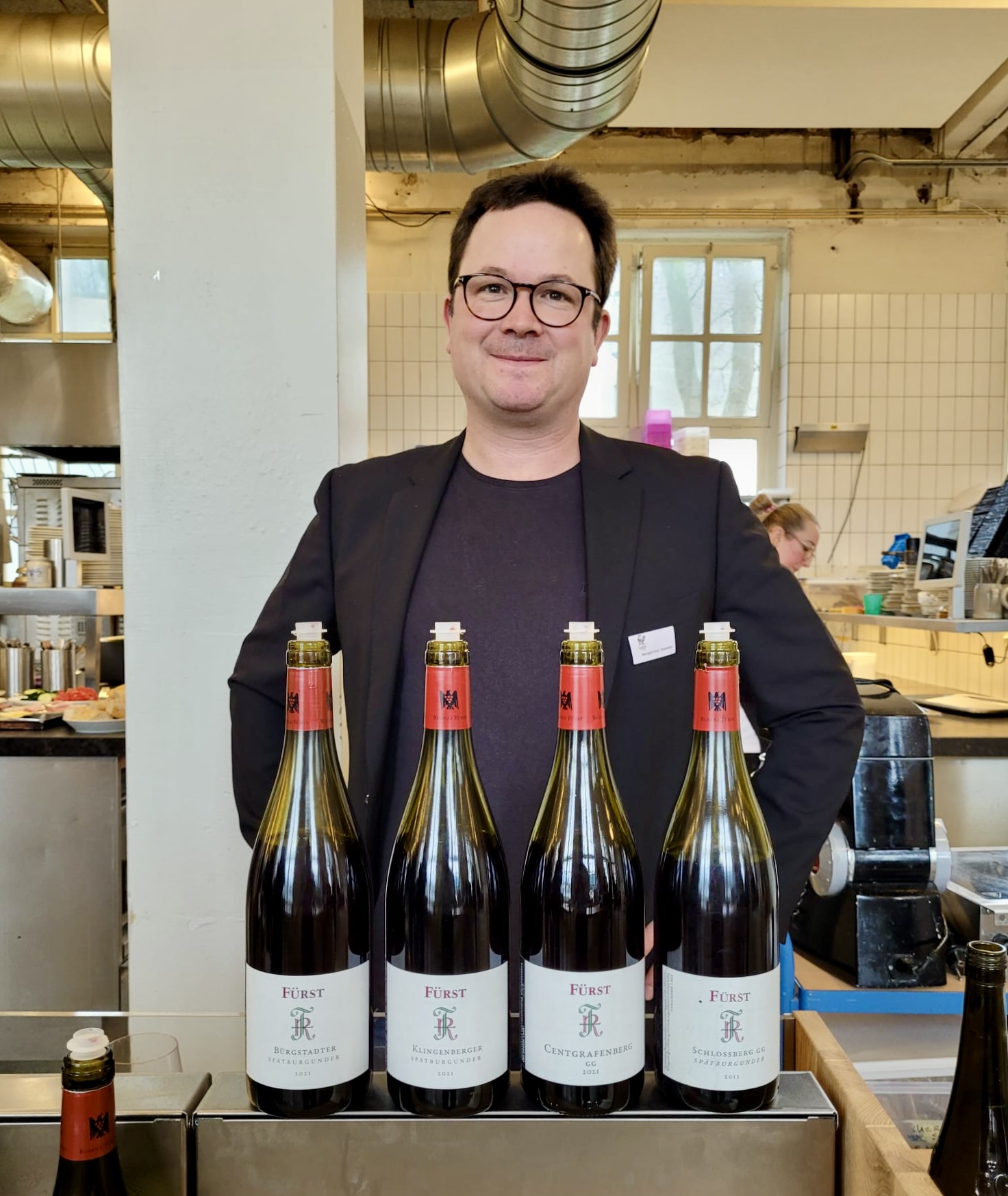
Rudolf Fürst 2021 Bürgstadter Spätburgunder
Vines from around the village of Bürgstadt. The iron-rich red sandstone soils give a distinct cool, mineral note to the wine. More cool blue fruit, blueberry, red cherry, clove, and strawberry. Some game and smoke, comparable to wines from Pommard, but not rustic at all – rather polished. Partial new oak gives vanilla and smoky notes, alongside slight oak tannins. More structure and stronger tannins than the Tradition bottling, but ripe and well-integrated. Has a certain authority to it. Step up in quality. Our rating: 93/100 DWA score, drink 2024-31.
Rudolf Fürst 2021 Klingenberger Spätburgunder
From young vines in the Schlossberg Grosse Lage in the town of Klingenberg. Detailed and elegant, interesting contrast to the darker Bürgstadter bottling. Very fine ripe red fruit profile, strawberry, ripe red cherry, rose petal, earthiness. All with a lot of freshness. Distinct whole bunch spiciness. Very layered and nuanced, with medium plus detailed ripe tannins. Gets better with time in the glass. Very long finish. Nuance and complexity over power and density. Complete. If the Bürgstadt is like Pommard, then this is like Volnay. Our rating: 94/100 DWA score, drink 2024-36.
Rudolf Fürst 2021 Centgrafenberg GG Spätburgunder
From the Centgrafenberg Grosse Lage where ferrous red sandstone soils dominate, giving wines with a certain cool mineral profile. Pronounced intensity, red and black fruit, violet, dark cherry, ripe strawberry. Spicy, Burgundian, with a note of vanilla thanks to the aging in new oak. Floral violet notes give elegance and lift. Very structured, great depth. Still needs some time to unwind in the glass, but already approachable. Full bodied, with strong, fine-grained tannins and high acidity all keeping the intense fruit profile in check. Great winemaking combined with a great vineyard yield a benchmark German Spätburgunder. Our rating: 96/100 DWA score, drink 2026-46.
Rudolf Fürst 2013 Schlossberg GG Spätburgunder
10 years old but still incredibly fresh, showing the aging potential of these wines. The detail and elegance here is unmatched, with a ripe red fruit profile and endless finish making for another outstanding Spätburgunder from the Fürst family. Dried red cherry, earthiness, rose petal, strawberry, leather, clove, vanilla, liquorice, herbs and violet. Haunting perfume which is constantly changing and unwinding in the glass. Full-bodied, with ripe strong smooth tannins. Absolute showstopper of a wine. Wines like this show why Fürst is seen as one of Germany’s best red winemakers. More focus on elegance of power, but still with an immense concentration. Could smell this for days. Our rating: 97/100 DWA score, drink 2024-43.
Rudolf Fürst’s Red Wines.
Rudolf Fürst 2021 Riesling Pur Mineral
Entry level Riesling from the Fürst family. Matured in old, large format barrels giving extra body and texture to the wine. Aged on the lees for a few months. Restrained style, showing citrus, flint, smoke, bread dough, and grapefruit. Quite intense aromatics for an entry-level wine. Very pure character, with a great acid structure. Crystalline and precise, perfectly showcasing the house style. Our rating: 89/100 DWA score, drink 2024-27.
Rudolf Fürst 2021 Centgrafenberg GG Riesling
Riesling from the Centgrafenberg Grosse Lage, planted more towards the village of Bürgstadt on slightly cooler soils compared to the Spätburgunder bottling. Very intense and nuanced, with yellow fruit, nutmeg, herbs, old oak texture, peach, orange, yellow pear, smoke, bread dough and passion fruit. House style from the Pur Mineral bottling carries through here, but with more intensity and nuance. Quite powerful but also precise, like balancing a sword. High acidity, which is no anomaly in the 2021 vintage, but of a pure, tartaric kind, instead of harsher malic acidity, giving good structure and longevity to the wine. Old-school Riesling from one of the best Riesling producers in Franken. Lightning in a bottle. Still a bit closed, will improve further over the years. Our rating: 96/100 DWA score, drink 2026-51.
Rudolf Fürst 2021 Astheimer Chardonnay
Made using grapes from the Volkacher Karthäuser Grosse Lage, right next to the Am Lumpen 1655 vineyard we will cover when discussing the wines of Rainer Sauer. Like the Am Lumpen 1655 vineyard, the soil here is primarily limestone instead of the red sandstone found in most of the Fürst holdings. However, compared to the Am Lumpen 1655 vineyard, this part is rockier and thus less suited to Silvaner, with Chardonnay thriving in these poorer soils. Chardonnay is not an allowed variety (yet) in the Karthäuser vineyard, so the wine is declassified to an Ortswein from Astheimer. Made in a slightly reductive manner, the wine needs some air to open up, with eventually aromas of peach, apricot, vanilla, toast, hazelnut, grapefruit, butter, yellow apple, dill and peach emerging. Quite restrained and pure, with a lingering finish and slight oak tannins, all with fresh acidity. Very balanced. Almost like a baby Corton-Charlemagne. Our rating: 93/100 DWA score, drink 2025-33.
Conclusion
To conclude, we look back tasting a spectacular selection of some of Germany’s best Spätburgunders, with the Rieslings and Chardonnay also being stand-out wines. The quality achieved by the unique red sandstone soils in combination with the exceptional winemaking talent of Sebastian and his Father result in pristine wines, showcasing exceptional elegance and depth. We will be following this domaine closely!
This article is written by our own Martin Bronkhorst. The wines of Weingut Rudolf Fürst are exported to a number of foreign markets and well distributed. In the Netherlands their wines can be bought through Anfors Imperial. Additionally, the wines can be bought directly at the estate.
We would like to thank the team of Anfors Imperial for providing the wines tasted. Picture credits: Weingut Rudolf Fürst, VDP and Peter Bender.
Join our insiders’ list and get exclusive early access to new articles, expert tips, and fresh reviews delivered straight to your inbox. Subscribe now and be the first to discover!