Join Our Wine Journey – Sign Up for the Newsletter 🍷
The Cape’s Dual Grammar of Winemaking
Share
Deel op X (twitter)
LinkedIn
WhatsApp
The Cape’s Dual Grammar of Winemaking.
South African wine begins in the vineyard – and understanding the Cape means first understanding how growers and winemakers interpret a landscape that is both generous and increasingly unpredictable. Heat spikes, shifting winds and compressed ripening windows are rewriting the rules of viticulture across the country. Against that backdrop, two producers rise naturally to the surface: Avondale and Jordan Wines. They represent very different philosophies, yet both stand at the frontier of how the Cape is redefining its relationship with terroir.
During a recent journey through South Africa for Dutch Wine Apprentice, it became clear to our own Onno Deumer that these two estates, despite their contrasting methods, illuminate the same central tension: how heritage and innovation can coexist – and even reinforce one another – in a region where the climate itself now demands both intuition and reinvention.
Avondale and Jordan between Classic Structure and Innovative Impulse
Avondale approaches wine from the ground up: biodynamics, biodiversity, regenerative farming and a belief that healthy soils create expressive, honest wines. Jordan, by contrast, begins with micro-parcels, clonal detail and a cellar built around precision and intentionality. One sees terroir as a living organism; the other as a system to understand, map and refine.
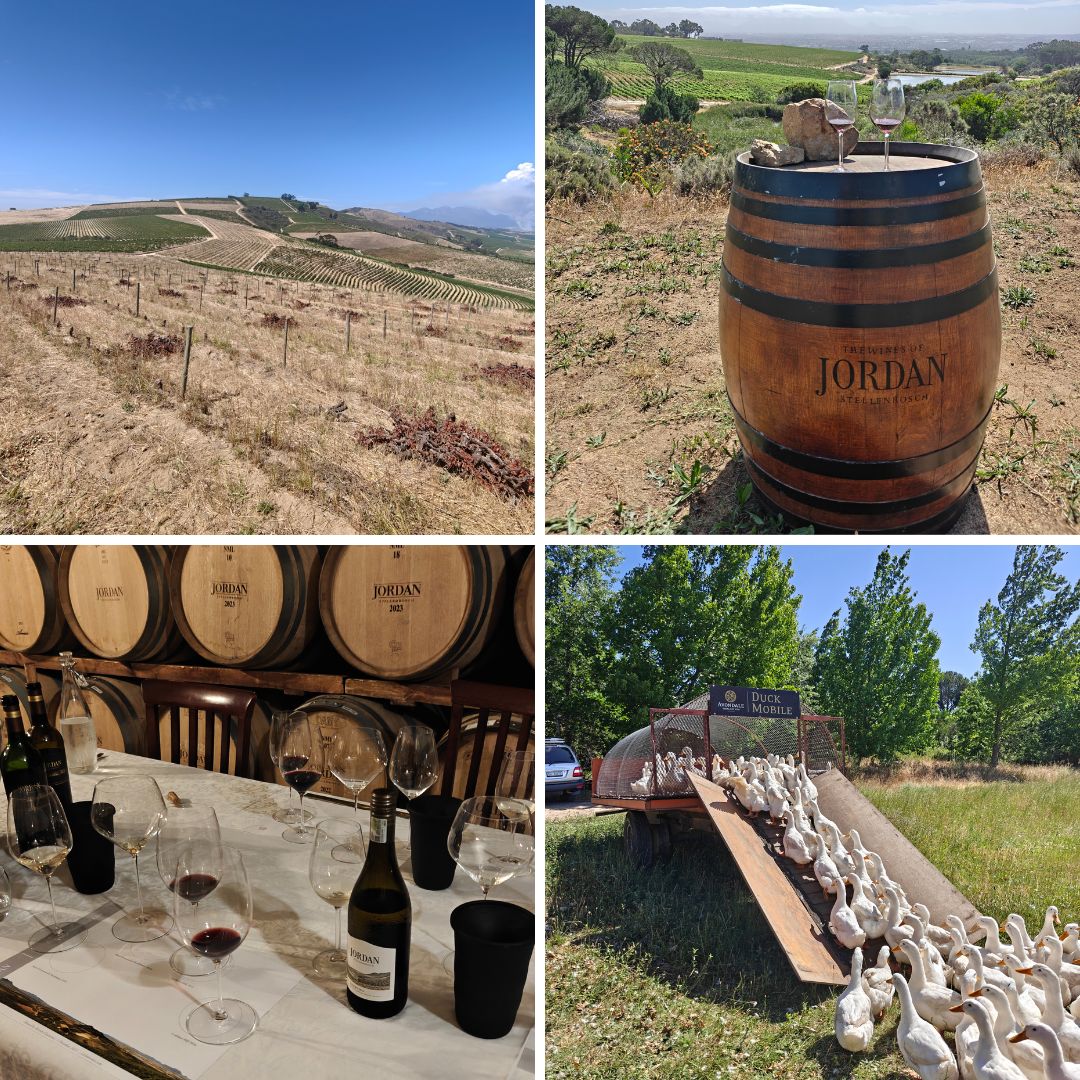
A patchwork of parcels on the slopes above Stellenbosch Kloof. At estates like Jordan, terroir is not just observed – it’s measured, mapped and translated with precision.
Together, they frame the central question of this article – and of modern South African wine more broadly: How do you evolve without losing your roots? Avondale answers through nature; Jordan through design. Their paths diverge, but their ambition is shared: to push Cape wine forward while remaining anchored in place.
This vineyard-level question rests on a wider landscape: South Africa’s evolving identity between Old World memory and New World momentum. That arc is explored in our article South Africa’s Cape as a Mirror of Europe.
Avondale – When Nature Becomes the System
South African viticulture is increasingly shaped by extremes. Heat spikes, sudden winds, hail episodes – it is no longer the averages that define a vintage, but the volatility between them. For producers committed to site expression rather than style replication, this raises a fundamental question: How do you protect a vineyard while still revealing where the wine truly comes from?
At Avondale, that question isn’t theoretical. It is the organising principle of the entire estate – and the answer involves a paradox that defines them: to innovate, they look back. Forward motion comes not from new technologies, but from recovering the rhythms and ecological intelligence on which winegrowing was originally built.
The response begins with rhythm. Avondale works according to the biodynamic calendar, aligning vineyard operations with natural cycles – including the lunar phases that dictate when soils are most receptive, when sap flow is calmest, and when the vineyard benefits from rest rather than intervention. This is not mystique; it is a disciplined framework for managing stress in a climate where timing has become a competitive edge.
From rhythm, the focus moves underground. Cover crops are selected not for uniformity but for diversity – five botanical families, each contributing different root structures, nutrients and microbial pathways. The aim is explicit: “We want the rainbow nation in our soils,” explained proprietor Johnathan Grieve. Layers of biodiversity translate into resilience: better water retention, improved structure, and a root zone capable of supporting vine health through climatic swings. Compost comes from the estate’s own cattle – a closed-loop system that deepens the microbial life on which Avondale’s philosophy depends.
Only after this foundation is built do we arrive at vineyard logistics. Pest management is handled not by synthetic sprays but by ducks – an approach that is, as Grieve put it, “more effective, less costly, and far better for the soil.” Their presence contributes not only to pest control, but also to nutrient cycling. It is a reminder that for Avondale, agriculture is ecological design.
Avondale proprietor Jonathan Grieve with part of the estate’s natural vineyard team. Ducks replace synthetic sprays, offering mobile pest control that’s effective, low-impact and fully integrated into the farm’s ecological design.
That philosophy becomes unmistakable in Cyclus, a wine that channels biodiversity and natural rhythm into a textural, energetic expression.
Avondale Cyclus 2021 – Still youthful, this five-variety blend shows ripe yellow fruit, citrus oil and gentle spice, carried by a subtle creaminess. The components knit together with precision: Chenin for drive, Chardonnay for width, Viognier for lift, Roussanne and Semillon for grip. Poised rather than opulent, with a tension that signals clear ageing potential.
DWA Score: 92/100
The cellar follows the same logic of patience and precision that governs the vineyard. More than eighty parcels are vinified separately, allowing each component to find its own rhythm rather than being blended into early uniformity. Gravity flow replaces pumping to protect texture; fermentations are spontaneous, unfolding at the pace the fruit dictates; and no filtration is used where clarity can be achieved naturally. Vessel choice broadens the expressive range: stainless steel for purity, old oak for gentle framing, amphora and qvevri for earthy tension.
Nothing is hurried, because for Avondale a wine is not simply finished when fermentation stops – it is finished when it has integrated. Parcel vinification gives every component time to find its own balance; spontaneous fermentations introduce natural variation that needs space to settle; and amphora, qvevri and old oak all shape texture slowly rather than sculpting it. The result is a maturation curve that cannot be forced into a commercial schedule. As Johnathan Grieve explained, “We want to release full-grown adults into the world.”
In practice, that means a wine leaves Avondale only when its moving parts – fruit weight, phenolic tension, acidity, and the energy that defines their style – have aligned into something stable. Release is not the end of production, but the final expression of the ecosystem they’ve cultivated. Only when the wine can stand on its own does it step into the world. Samsara, their long-elevage Syrah, shows what this patience yields in the glass – a wine shaped as much by time as by technique.
Avondale Samsara 2018 – Seven years in, this Syrah shows vivid fruit wrapped in silky, well-resolved tannins. The texture is the calling card: supple, structured, and layered, holding tension without austerity. As Jonathan Grieve notes, biodynamics shapes that clarity and gentleness – and you taste it in the wine’s composed, persistent finish.
DWA Score: 94/100
Across all of this runs a central tension shaping South African wine today: the pull between classical ambition and innovative practice. Avondale is classical in its trust in natural rhythm, soil life and patience. It is innovative in its systems thinking, data-informed ecological design and multi-material vinification. In a national landscape often associated either with technical precision or stylistic experimentation, Avondale represents a third path – one where progress comes from deepening rather than accelerating, and where the future of South African wine may depend as much on biology as on stainless steel.
Jordan – Terroir by Design
Jordan’s identity begins in Stellenbosch Kloof, a site shaped by two opposing forces: the cooling winds drawn in from both False Bay and Cape Town, and the warm uplift rolling through from the Stellenbosch valley. As estate guide Dane often noted, this gives Jordan “the best of both worlds” – a natural duality that mirrors the broader tension running through South African wine itself. And it is exactly within that tension that Jordan operates. Their landscape may be a mosaic of micro-parcels, but what distinguishes them is not the diversity alone – it is the discipline with which they translate it.
Soil samples from across the estate – quartz, granite, clay and sandstone. At Jordan, understanding terroir begins with mapping the geology, one stone at a time.
This is the classical mindset: an almost Burgundian belief that terroir reveals itself through precision, separation and patience, visible in wines like their linear, reductive Nine Yards Chardonnay or the sculpted, Bordeaux-inflected frame of Cobblers Hill. A closer look at the wine reveals how Jordan translates that classical framework into something unmistakably Cape.
Jordan Cobblers Hill 2022 – With Cabernet Franc now reserved for Sophia, Cabernet Sauvignon carries the blend alone – and the shift shows. The wine feels firmer and more linear, with dark fruit, cedar and a faint green edge still settling into place. Structure is clean and composed, the tannins fine, the acidity purposeful. It’s a vintage in formation: slightly austere today, but with the craftsmanship and balance to evolve into harmony.
DWA Score: 91/100
Yet the way Jordan pursues that ideal is unmistakably modern. Each parcel is monitored, harvested and vinified with a premeditated plan – a level of micro-vinification that goes far beyond traditional practice. Decisions about reductive handling, temperature, maceration and ageing are not reactions; they are design choices made long before the grapes reach the cellar door. What looks classical in outcome is innovative in method, and what tastes seamless in the glass is often the product of an unusually architectural approach to winemaking.
The cellar makes that duality even sharper. Jordan works with four to five coopers in multiple barrel formats – a classically European framework – but deploys them with scientific purpose, using oak, steel and concrete not for signature but for precision engineering. Gravity flow, often framed as old-world gentleness, becomes here an innovative tool for preserving parcel purity without mechanical interference. Tradition becomes technique; technique becomes philosophy.
And then comes the most forward-looking layer: Jordan’s engagement with future cultivars. Alongside their established varieties, they are planting Assyrtiko, Xinomavro, Grenache and Mencía – grapes selected not for novelty but for their structural resilience in a warming, wind-driven landscape. Their work with Riesling already hints at a new aromatic register for the Cape, while the Mediterranean and Greek varieties signal a proactive adaptation strategy rather than a reactive one. It is experimentation, yes, but never for its own sake; it is innovation undertaken to safeguard a classical ideal in a changing climate. That same dialogue between heritage and forward-thinking emerges clearly in the glass, especially in Jordan’s Timepiece Chenin Blanc – a wine that shows how a Cape classic can be reimagined through contemporary precision.
Jordan Timepiece Chenin Blanc 2024 – Cool-slope old vines give this Chenin weight and definition. Quince, citrus zest and a touch of angelica lead into a palate that balances ripe fruit with a clean, saline line. Ageing in concrete egg, amphora and old oak adds gentle texture without ornamentation. The finish is long, savoury and finely layered – a future-leaning expression of Cape Chenin.
DWA Score: 94/100
This is the irony at the heart of Jordan’s identity: what makes them classical is precisely their commitment to innovate. They do not modernise to be different – they modernise to remain precise, linear and timeworthy, even as environmental conditions evolve. In this way, Jordan stands as both heir and engineer, guardian of a tradition and architect of its future.
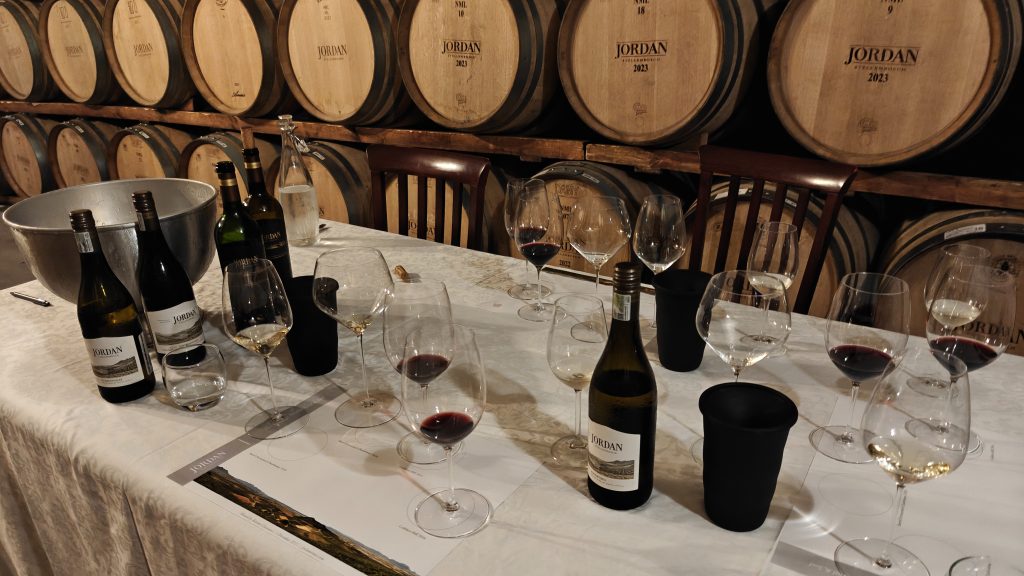
Barrel-side tasting at Jordan – where every wine is evaluated in the context of site, vintage and intent. In this cellar, precision begins not just with making, but with measuring.
Within the broader South African context, that duality is exactly what makes Jordan essential. In a country defined by diversity of terrain, cultivar and philosophy, Jordan offers a model for how classical structure and modern pragmatism can coexist without tension – or rather, how tension can be used productively. Their wines do not reject European influence, nor do they imitate it. Instead, they draw from it with fluency while charting a path that is unmistakably Cape: disciplined but not doctrinaire, expressive but not indulgent, rooted yet forward-moving. Anyone seeking to understand what South African wine can become – and how it might evolve while retaining its core identity – will inevitably find part of the answer here, on this wind-shaped ridge above the Kloof.
Where Avondale and Jordan chart this tension in the vineyard, Warwick and Spier confront it through heritage and identity – a perspective developed in our upcoming article The Cape as a Brand in Motion.
Beyond the vineyard and the cellar, the same tension unfolds at the table – where Creation and La Colombe translate it into flavour, texture and experience, explored in our upcoming article The Cape Beyond the Glass.
Bringing the Two Together – Two Paths, One Question
Seen side by side, Avondale and Jordan do not appear to be natural counterparts. One farms by lunar rhythm, compost and biodiversity; the other by micro-parcels, clonal detail and architectural precision. One leans into spontaneity, the other into design. And yet they belong together because they illuminate the same underlying tension shaping South African wine today: How does a producer balance the classical ambition for purity and structure with the innovative impulse to rethink how wine should be grown and made?
At Avondale, that balance leans toward tradition as foundation. Their innovation comes from reviving older, slower forms of agriculture – from lunar calendars to regenerative soil building – and translating them into wines that feel textural, unforced and honest. It is a classical worldview expressed through modern ecological intelligence.
At Jordan, the balance tips the other way. Their classical goal – precision, linearity, age-worthiness – remains unchanged, but the methods are unmistakably contemporary: micro-vinification, climate-resilient cultivars, multi-cooper barrel strategy, and a cellar run as a design laboratory. Innovation becomes the tool that protects the classical ideal.
And beneath these contrasting methods lies a shared pressure that increasingly defines the Cape: a climate that no longer behaves like a stable partner, but like a moving target. Heat spikes, wind shifts and compressed ripening windows force every producer to decide what to preserve – and what to reinvent.
Avondale answers by strengthening the ecosystem itself, letting biodiversity and natural rhythm absorb climatic volatility. Jordan responds by engineering precision: mapping parcels, refining canopy strategies and trialling future-fit cultivars. Each estate uses a different language, but both are translating the same challenge into opportunity. Climate, in this sense, is not a separate theme – it is the engine that pushes classical and innovative philosophies into active dialogue.
At Avondale, biodiversity isn’t just underground – it’s visible between every row. Diverse cover crops build resilience from the soil up, forming the foundation of a regenerative approach to terroir.
Together, Avondale and Jordan show that South Africa’s search for a wine identity does not hinge on choosing between old and new. Instead, it emerges from the conversation between them. Avondale proves that looking backward can be a form of moving forward; Jordan proves that innovation can be a way of safeguarding heritage. Their philosophies diverge, but their purpose aligns – and in that alignment, a distinctly South African voice begins to take shape: rooted, restless, and entirely its own.
This article is written by our own Onno Deumer.With sincere thanks to Jonathan Grieve of Avondale for his time, openness and clarity in explaining the estate’s regenerative philosophy. We are equally grateful to Bianka and Dane of Jordan Wines for their generosity, precision and insight into the estate’s unique site and winemaking approach.
Our appreciation also goes to Delta Wines, Dutch importer and distributor of Avondale and Jordan, for their continued support and for facilitating access to both estates and their wines.
Join our insiders’ list and get exclusive early access to new articles, expert tips, and fresh reviews delivered straight to your inbox. Subscribe now and be the first to discover!