Join Our Wine Journey – Sign Up for the Newsletter 🍷
South Africa’s Cape as a Mirror of Europe
Share
Deel op X (twitter)
LinkedIn
WhatsApp
South Africa’s Cape as a Mirror of Europe.
Heritage reimagined at the southern edge.
In just a few decades, South Africa has transformed from a historical wine producer into a stylistically confident player on the global stage. For a long time, Europe was the obvious reference – Burgundy, Bordeaux and the Loire set the benchmarks by which quality was measured. But today, a visit to the Cape reveals something more: familiarity, yes, but also divergence. Old World and New World don’t follow each other here – they collide, overlap, and evolve together.
That dual identity is not a limitation. It’s the very source of South Africa’s energy. As Michelle Erasmus, head sommelier at La Colombe – one of the World’s 50 Best Restaurants, situated in Cape Town – put it: “We get to enjoy the best of both worlds, as we have one foot in the Old World, and one foot in the New World”. South African wine thrives on the tension between those two poles. It feels rooted, yet unconstrained – informed by tradition, but never bound by it.
Time to explore exactly that tension. During a recent visit to the Cape, our own Onno Deumer travelled from Stellenbosch to Hemel-en-Aarde, tasting and talking with viticulturists, winemakers, and sommeliers who are shaping the country’s wine identity. To unpack how South Africa navigates the space between heritage and innovation – and why that space may be where the future of wine is being written.
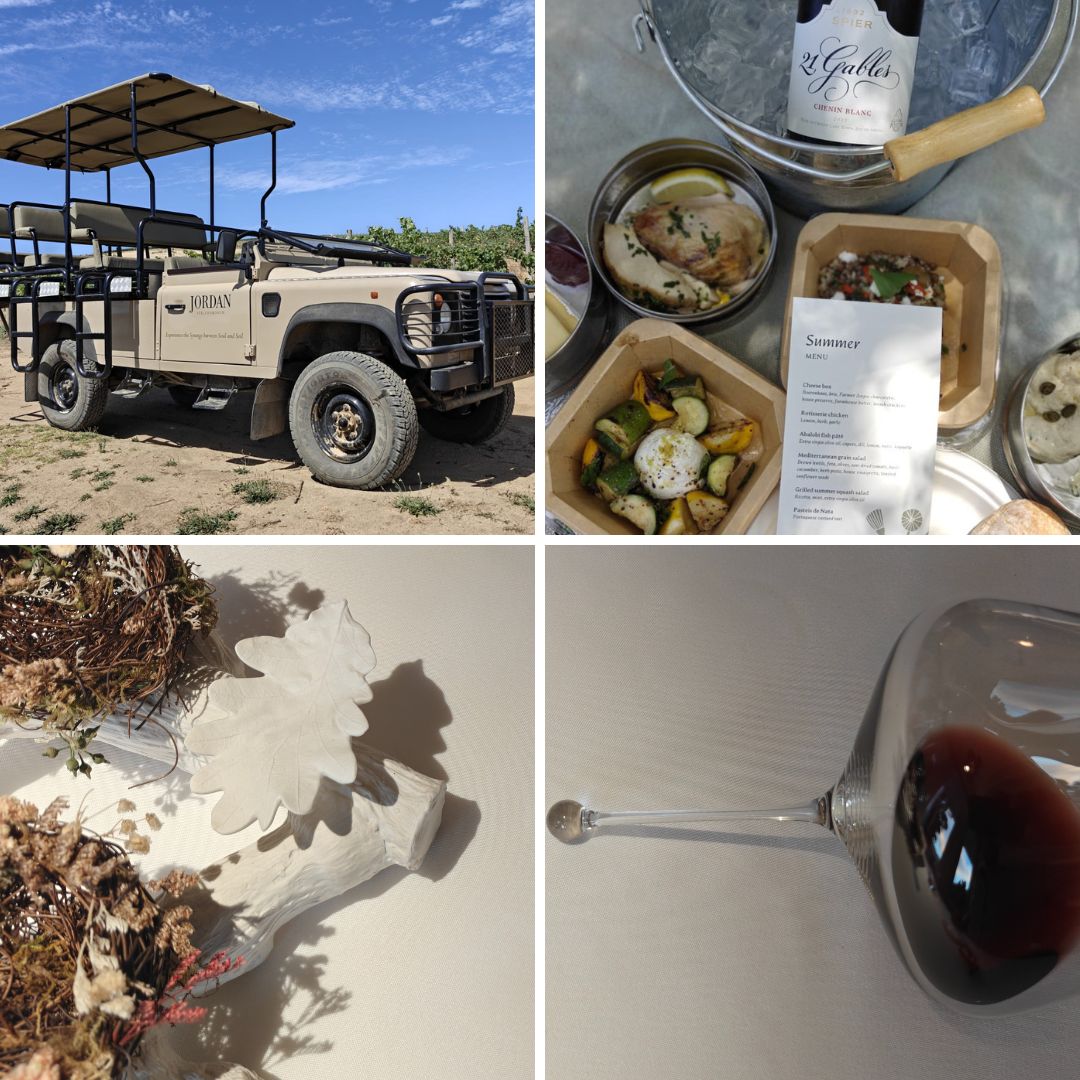
A vineyard tour vehicle – part tradition, part reinvention. In the Cape, even the way wine is introduced reflects the tension between classic roots and innovative expression.
Why ‘Classic vs. Innovative’ Still Matters
South African wine doesn’t fit into easy categories. It’s not Old World, though much of its knowledge, structure and varietal palette are clearly European in origin – from Bordeaux-style blends in Stellenbosch to Burgundy-minded Pinot Noir and Chardonnay in Hemel-en-Aarde. Nor is it fully New World, despite the freedom from appellation rules, the openness to experimentation, and a generation of winemakers unafraid to challenge convention. Instead, it operates in a space between – one that’s fluid, dynamic, and constantly evolving.
In that space, the tension between classic and innovative is more than just stylistic. It’s philosophical. It raises questions about what defines quality, how terroir is interpreted, and who gets to decide what wine should be. In South Africa, those questions aren’t abstract – they’re visible in the vineyard, the cellar, and the marketplace.
Using this tension as a lens offers clarity. It reveals how tradition is being redefined, not rejected. How winemakers are revisiting Bordeaux blends or Chenin Blanc with fresh intent. How soil studies and biodynamics, stainless steel and amphorae, heritage and disruption can all coexist – not in conflict, but in conversation.
In a wine world that often leans into sameness, this ongoing conversation is what gives the Cape its edge. It’s not about choosing sides. It’s about understanding what happens when both are allowed to speak.
Curious how this tension plays out in the vineyard and the cellar? In our article The Cape’s Dual Grammar of Winemaking, we visit Jordan Wines and Avondale – two producers who represent opposing yet equally thoughtful approaches to winemaking. One is rooted in scientific precision, the other in regenerative flow.
A Spectrum, Not a Split
To talk about South African wine is to talk about range. Not the kind measured in altitude or soil type – though there’s plenty of both – but in approach. Across the Cape, producers blend tradition and innovation in ways far more layered than a simple binary suggests.
Take the Bordeaux-style wines of Stellenbosch. Wineries like Tokara and Vergelegen produce structured, age-worthy reds with clear Old World roots, yet each pushes the category forward in its own way. Tokara does so through detailed site mapping and a sharply defined, Cabernet-led architecture; Vergelegen advances through sustainability-driven viticulture and long-term clonal work that shapes both style and structure. Kanonkop, long considered a benchmark, continues to evolve as well – refining texture, extraction and vineyard expression while remaining anchored in the classic Cape idiom.
Want to go deeper into how South African estates build on legacy to shape their future? In our upcoming article The Cape as a Brand in Motion explores how Warwick and Spier reinterpret tradition – one through family narrative, the other through scale and social impact.
Elsewhere, Chardonnay is a battleground of philosophy. Jordan channels reductive finesse and oak-driven structure; Hamilton Russell leans into restraint, altitude and natural acidity; Eikendal pushes the variety into more crystalline, almost architectural expressions. These wines are recognisably Burgundian in inspiration, yet unmistakably Cape in identity.
Then there are producers who challenge the frame entirely. Avondale uses biodynamics not as branding, but as compass – crafting wines that are both holistic and highly structured. Reyneke takes a similar approach, proving that low-intervention can still mean high precision. Creation, in Hemel-en-Aarde, designs wines for dialogue with food, not just for stand-alone typicity. Atlas Swift blends site and style across appellations, while Alheit’s work with Chenin reimagines Cape heritage through detail and restraint. Arno Smith, in turn, explores texture and tension through skin-fermented white wines that feel both ancient and sharply contemporary.
Even the sweet wines of Constantia tell a layered story. At La Colombe, Klein Constantia’s Vin de Constance is served at the end of the menu – but not in the traditional, monolithic sense. Instead, the sommelier team pours it from a solera of multiple vintages in the cellar, reframing a historic icon through the lens of movement, continuity and evolution.
This isn’t a split between old and new. It’s a continuum – with most producers moving fluidly along it. The question is no longer “Are you classic or innovative?” but “How do you make the tension between them productive?”
What Makes the Cape Distinct?
To understand South African wine is to embrace its contradictions. It doesn’t fit into easy categories – and that, precisely, is what makes it compelling. On a relatively compact piece of land, the Cape offers a spectrum of expressions that few other wine regions can match. From high-altitude Chardonnay in Elgin to old-vine Chenin on granite soils in Swartland, diversity isn’t a feature – it’s the foundation.
This diversity plays out across cultivars, climates, and cellar philosophies. Pinotage – for decades misunderstood – now reclaims its identity through a new wave of confident, site-driven bottlings. Chenin Blanc, once bulk workhorse, now serves as South Africa’s quiet ambassador, capable of everything from crystalline tension to broad, textural power. Even Bordeaux blends, a supposed echo of Europe, are now composed with unmistakably local rhythm.
The freedom to blend is not just technical – it’s cultural. South African winemakers are less bound by tradition, more open to synthesis. That openness translates to wines that feel at once rooted and creative, expressive but not chaotic. You taste it in the precision of Uva Mira, the wild energy of Avondale, the conceptual rigour of Spier’s Creative Block, and the restrained elegance of Crystallum Pinot Noir.
But the Cape’s signature doesn’t end in the vineyard. It continues on the plate – and in the space between plate and glass. Restaurants like La Colombe don’t use wine to complement food; they use wine to complete thought. Pairings are not decorative. They are essential, choreographed to reveal not just flavour, but narrative.
From tasting room to picnic table – across the Cape, wine is increasingly woven into curated experiences. Thoughtful pairings, seasonal menus and outdoor settings turn hospitality into part of the terroir.
That’s what sets South African wine apart. Not a single style or grape or region. But a mindset. A willingness to be plural. To be both familiar and unfamiliar. Both precise and intuitive. Both old and new – often within the same glass.
Want to see how South African wine plays out at the table? In our upcoming article The Cape Beyond the Glass, we visit Creation and La Colombe – two places where pairing is not a final step, but a first principle. Here, wine is not just served. It’s staged.
What We Tasted – A Glass-to-Glass Dialogue
Theory tells part of the story. But glass tells more.
Over the course of our journey, we encountered wines that didn’t just echo Europe – they responded to it. Not by copying, but by conversing. Several in particular stood out. Not because they were the most iconic, but because they made the contrast tangible. Each one mirrored a classic style – and then chose its own direction.
These aren’t benchmark wines. They’re real glasses from real moments – poured across the Cape, from Stellenbosch to Hemel-en-Aarde to Constantia. Together, they form a tasting table of tension and transformation.
Precision with Pulse
The first surprise came from Paarl, in the foothills of the Klein Drakenstein mountains. Avondale Armilla is a traditional method sparkling wine, made from Chardonnay and aged extensively on lees. At first glance, it plays to Champagne’s script: fine bead, creamy mousse, autolytic depth. But its tone is different. Biodynamic farming brings a kind of wild energy – a broader mid-palate, a touch of oxidation, and a texture that speaks of sun and soil. This isn’t sterile precision. It’s sparkling wine with pulse.
Avondale Armilla Blanc de Blanc 2018 – Clean citrus and cool apple set a taut, Blanc-de-Blancs-like frame. With air, the long lees ageing adds gentle brioche and a measured creaminess, without softening the wine’s drive. Tension and maturity sit in balance – poised, energetic, and performing above its class.
DWA-Score: 94/100
Texture Meets Tension
Few wines during the trip felt as classically poised as Jordan’s Nine Yards Chardonnay from Stellenbosch. This is a wine built with Burgundy in mind – fermented in oak, aged on lees, shaped by reduction and time. It speaks a familiar language: struck match, citrus tension, precise oak integration. But something shifts in the mid-palate. There’s more volume, more sunshine in the fruit, and a textural generosity that feels distinctly Cape-born. This isn’t Burgundy. It’s Stellenbosch with a point to make.
Jordan Nine Yards Chardonnay 2024 – Citrus and a touch of reduction give the wine its linear spine, before warmer stone-fruit notes fill the mid-palate. Oak sits neatly in the background – adding shape, not weight – and the acidity keeps everything finely drawn. Burgundy in structure, but with a distinctly Cape brightness.
DWA-Score: 93/100
Earth in Expression
Pinot Noir is often framed as a French affair – ethereal, linear, restrained. But Crystallum’s Mabalel, from the Elandskloof Valley, shows a different side. This is a wine of altitude and intention. It opens with floral lift and gentle spice, then builds into a darker, more savoury register. There’s finesse, yes, but also wildness: a tension between elegance and earth, line and weight. It doesn’t mimic Burgundy – it rewrites the rules for Pinot in the southern hemisphere.
Crystallum Mabalel Pinot Noir 2015 – Earthy at first, then steadily unfolding into lifted red fruit and fine spice. The palate gains clarity and drive with food, revealing a poised line and a long, savoury finish. Subtle in its opening, but increasingly nuanced and compelling.
DWA-Score: 94/100
A glass in dialogue with its setting. In the Cape’s top restaurants, wine is not an accessory – it’s staged with intent, where every detail reinforces the story in the glass.
A New Voice for an Old Grape
If one grape embodies South Africa’s split identity, it’s Chenin Blanc. And Alheit’s Nautical Dawn is its manifesto. Dry-farmed, naturally fermented, and drawn from old bush vines, this wine carries the DNA of the Loire but speaks with Cape clarity. Its acidity is lightning-rod sharp, its texture finely grained, but it also hums with salt, sun and stone fruit. It’s not polished, it’s alive – and in that rawness lies its strength. A wine that doesn’t reference Chenin – it redefines it.
Alheit Vineyards Nautical Dawn 2022 – Bright citrus and white peach lead, carried by a chalky snap that feels coastal and finely etched. The palate is concentrated yet lifted, moving with clean, saline precision and a long, subtly briny finish. Purity over polish – vivid, focused and intense.
DWA Score: 94/100
Structure with Soul
Stellenbosch Cabernet often invites comparison to Bordeaux – and Vergelegen V Red makes that comparison tangible. Grown on the wind-exposed slopes of the Helderberg and shaped through meticulous clonal selection, it opens with classical structure and clarity. But Cape conditions shift the register: brighter light, steeper elevation and precise cellar work lend the wine a wider mid-palate and a more sculpted, modern edge. It carries Bordeaux in its bones – yet its voice is unmistakably Cape, firm in profile but expressive in intent.
Vergelegen V Red 2022 – Dark berries lead into graphite and cedar, with an early hint of savoury development that belies the wine’s youth. The Petit Verdot adds colour and firm structure, yet the palate stays supple and layered, carried by refined tannins and steady intensity. Classical in outline, but broader and more expressive in its Cape register.
DWA Score: 96/100
History Reinterpreted
At La Colombe, Klein Constantia’s Vin de Constance is presented not as a fixed endpoint, but as a wine in motion. Drawn from a solera-like blend of multiple vintages, it shifts from a single historic reference into a living continuum – a gesture that turns heritage into evolution. In this form, the Cape’s most famous sweet wine becomes a metaphor for South Africa itself: rooted in legacy, but defined by its willingness to move.
Klein Constantia Vin de Constance N.V. – Warm citrus peel, dried apricot and soft nut tones open in gentle layers, touched by a faint oxidative lift. The sweetness feels finely draped rather than dense, carried by steady acidity and a slow, persistent glide. A living blend of vintages that shifts as it sits – poised, evolving, captivating.
DWA Score: 96/100
Together, these wines prove a simple point: South African wine doesn’t need to choose between old and new. It can reflect, respond – and then rewrite. In each of these glasses, that transformation is already underway.
A Signature Beyond the Label
South African wine is in motion. It draws from centuries of knowledge while embracing the freedoms of a younger industry. Its wines can echo Europe, challenge it, or sidestep comparison altogether. That dynamism is its strength – but also its test.
Because with so much possibility, the question becomes: what story does South Africa want to tell?
That question echoed throughout our journey. In conversations with viticulturists, winemakers, and sommeliers, a common thread emerged: South African wine has the talent, terroir, and ambition to compete with the world’s best. What it still seeks is alignment – a shared identity that goes deeper than varietals or techniques.
Michelle Erasmus, head sommelier at La Colombe, put it sharply. She celebrated the strides made with Chenin Blanc: a once-overlooked grape now leading the country’s global reputation. But she contrasted that with the ongoing struggle around Pinotage – a local icon that, after nearly a century, still divides opinion and defies definition. The challenge, she argued, lies not in quality but in coherence: a lack of education, collaboration, and narrative clarity that holds the category back.
A focused tasting of single-soil Chenin Blanc – proof of how South Africa’s signature grape is being studied, refined, and redefined. Few varieties speak the Cape’s identity with such clarity.
Her perspective wasn’t singular. Others voiced similar concerns – not as criticism, but as a call. South Africa doesn’t need to mimic anyone. But it does need to choose: not between old and new, but for a voice that weaves both into something unmistakably its own.
That voice is emerging. We tasted it in wines that respected tradition but didn’t rely on it, in vineyards where climate and soil met vision, and in pairings that told a story beyond flavour. The tools are there. The moment is now.
South African wine doesn’t need to be one thing. But it does need to mean something. Not just a style. A signature.
This article is written by our own Onno Deumer. With thanks to Michelle Erasmus of La Colombe for her openness, critical perspective and deep belief in the potential of South African wine. We are grateful to the producers whose wines shaped this article – Creation, Avondale, Spier, Warwick and Jordan – for their generosity in sharing both bottles and context.
Our appreciation also goes to Dutch importers Vinites and Delta Wines for their support and for facilitating access to a broad and representative cross-section of the Cape.
Join our insiders’ list and get exclusive early access to new articles, expert tips, and fresh reviews delivered straight to your inbox. Subscribe now and be the first to discover!