Join Our Wine Journey – Sign Up for the Newsletter 🍷
South Africa’s Cape as a Brand in Motion
Share
Deel op X (twitter)
LinkedIn
WhatsApp
South Africa’s Cape as a Brand in Motion.
How Warwick and Spier balance heritage, inclusivity and innovation.
Heritage, once a given, has become a strategic asset. Innovation, once a stylistic experiment, now shapes who gets reached – and who gets left behind. For estates with history, scale and ambition, the challenge is no longer purely viticultural. It is communicative. How do you remain credible to long-time followers while staying relevant to new generations of drinkers with different habits, expectations and reference points?
That tension – between classical authority and innovative accessibility – became increasingly tangible during a recent journey through South Africa by our own Onno Deumer. Across tastings, conversations and cellar visits, it surfaced not in the glass alone, but in how estates spoke about themselves: through labels, portfolios, formats and the audiences they chose to address.
That broader interplay between classical reference points and a more fluid, contemporary wine culture, is explored in our article South Africa’s Cape as a Mirror of Europe.
It is at that level – brand, positioning and proposition – that some of the Cape’s most consequential decisions are now being made. Warwick Wine and Spier Wines offer two compelling perspectives on this question. Both are deeply rooted in history, both operate at scale, and both are acutely aware that relevance cannot be taken for granted. Yet their responses differ. Warwick navigates renewal by expanding formats and entry points without abandoning its premium core. Spier builds breadth around a value-driven narrative, using wine as a platform for culture, education and inclusion.
Inside Spier’s tasting room, where wine meets culture. The wall displays “Creative Blocks” by South African artists – part of a long-running social programme that inspired the name of one of Spier’s most recognisable wine ranges.
Together, they show that in the modern Cape, classic versus innovative is not a stylistic argument, but a branding one – a continuous negotiation between legacy and audience, between what a winery has been and what it still needs to become.
Warwick – Renewing Relevance Without Abandoning Heritage
Few estates in Stellenbosch carry the weight of history quite like Warwick. For many professionals, the name is inseparable from the legacy of Norma Ratcliffe, whose tenure shaped not only the estate’s wines but its identity: Cabernet-led, structured, and firmly positioned within the classical Cape canon. These were wines built for longevity and recognition – and they earned it, through critical acclaim, cellar presence and a clear sense of authority.
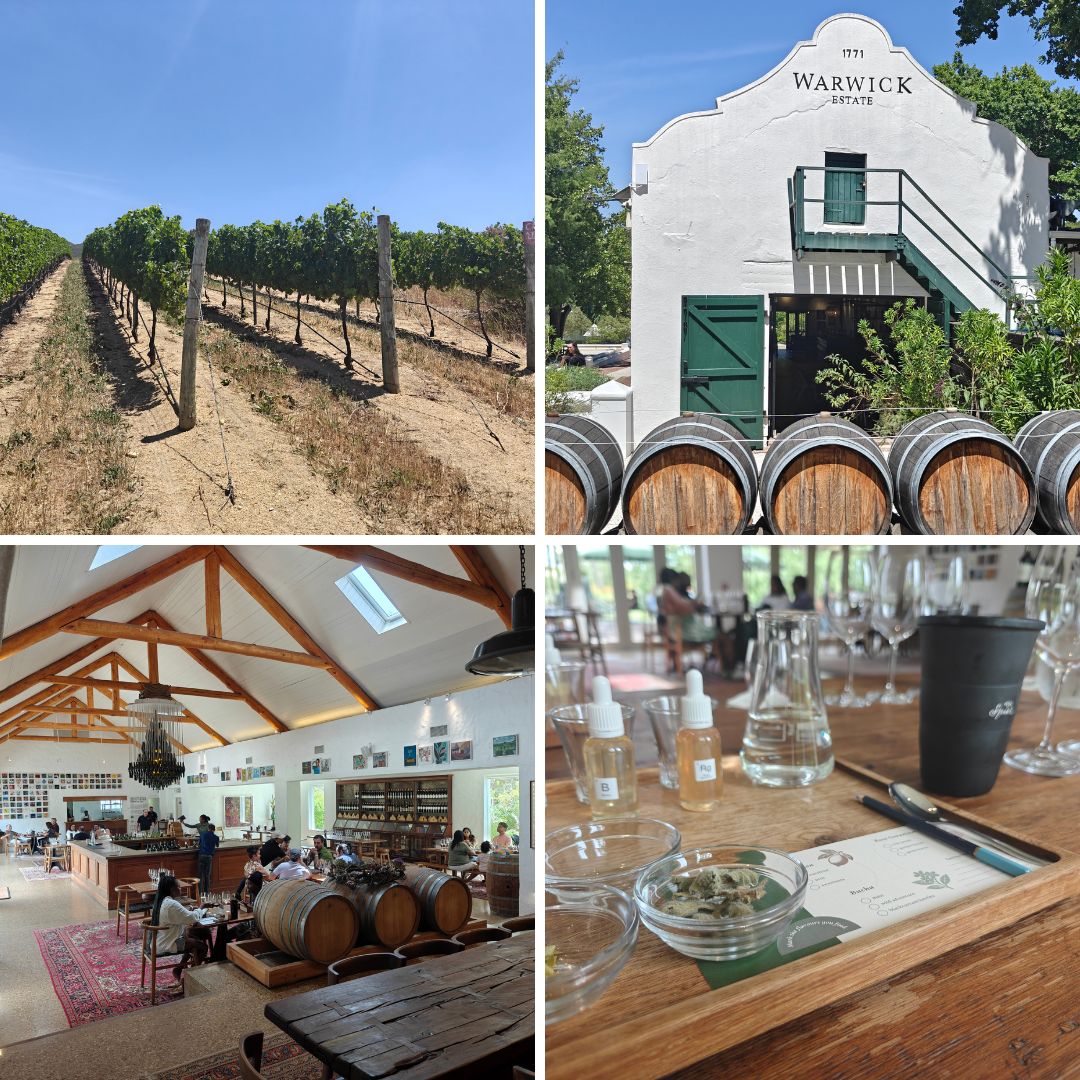
Warwick’s historic cellar building, dating back to 1771, anchors the estate’s classical identity – a reminder that heritage here is more than narrative; it’s built into the landscape.
That legacy remains a source of strength. It is the reason Warwick is trusted. But it is also where a contemporary tension begins to surface. For a new generation of drinkers – often younger, less brand-loyal, and less anchored to appellations or critics – that same story can feel distant. The cues that once signalled quality with ease no longer translate automatically. Heritage, once a shared language, increasingly requires mediation.
This is the challenge Warwick faces today: not a loss of identity, but a narrowing of resonance. How do you remain recognisably Warwick for those who know the story – while becoming legible to those who don’t?
For Berenice Barker, Global Sales & Marketing Executive at Warwick, the answer begins with a refusal to see tradition and change as opposing forces. As she puts it: “Don’t get me wrong about our heritage – we certainly do not want to kick it in the teeth.”The point is not caution, but continuity. Innovation, in this view, is not about distancing the brand from its past, but about ensuring that past remains encountered – and understood – in the present.
Seen through that lens, Warwick’s recent moves fall into place. Low-alcohol wines, alternative packaging formats such as cans and bag-in-box, and more casual entry points are not attempts to dilute the brand, but to reposition its points of contact. They recognise that relevance today is situational: different moments, different price sensitivities, different expectations of formality. These wines are not designed to replace the estate’s premium expressions; they are designed to meet new drinkers where they are.
The same philosophy informs how Warwick now structures and communicates its range. Rather than relying on standalone, evocative cuvée names that assume prior knowledge, the portfolio increasingly speaks in a clearer internal logic – making it easier for a new audience to understand what a wine represents within the whole. The notable exception is Trilogy: a name so deeply woven into Warwick’s identity that it functions less as a label than as a landmark, bridging generations rather than belonging to one.
Warwick Trilogy 2020 – Still youthful, this Stellenbosch blend opens with cassis, blackcurrant and cedar, accented by dark chocolate and savoury spice. The palate is firm and structured, driven by Cabernet fruit and tightly knit tannins. Restrained rather than generous at this stage, with depth and focus pointing clearly toward further complexity with bottle age.
DWA-Score: 91/100
Warwick’s shift toward single-varietal labelling, like this Cabernet Franc, reflects a move away from abstract names – making it easier for drinkers to understand what’s in the bottle, and what to expect from it.
What emerges is a brand operating on two temporal planes at once. On one side, the classical markers of success remain intact: a flagship wine on the cover of Decanter, validated through longevity, scores and reputation. On the other, a different measure of relevance comes into play: an activation that travels organically, sells out within weeks, and reaches drinkers untouched by traditional wine media – not through amplification, but through resonance.
Warwick Cabernet Franc 2023 – Varietally precise, with red berry fruit and a graphite edge typical of Cabernet Franc from weathered granite soils. The palate is focused and composed, showing fine, supple tannins and controlled mid-palate weight. Fresh, mineral and quietly persistent, with site expression clearly leading the style.
DWA-Score: 93/100
Neither path negates the other. Both are necessary. And both stem from the same conviction articulated by Barker: that heritage is not something to be protected from change, but something that survives precisely because it continues to be entered in new ways.
In Warwick’s case, innovation is not about rewriting the story, but about keeping it open. The wines remain recognisably Warwick. What evolves is the invitation – ensuring that a new generation can step inside without being asked to inherit the entire past first.
That same balance between tradition and innovation plays out earlier in the wine’s life cycle as well – in the vineyard and cellar – as seen at estates like Avondale and Jordan in The Cape’s Dual Grammar of Winemaking.
Spier – Meaning at Scale
While Warwick negotiates relevance by widening access around a tightly defined core, Spier approaches the same challenge from the opposite direction: not by narrowing focus, but by structuring meaning across scale. Where Warwick asks how heritage can remain visible while evolving, Spier asks how heritage can be lived – socially, culturally and viticulturally – without becoming abstract.
Spier’s story is often read through size. One of the Cape’s oldest wine farms, visually expansive and historically layered, it has long been present in South African wine – but not always defined by it. For much of the twentieth century, grapes grown on the estate were vinified externally and bottled under the Spier name, leaving wine as one element among agriculture, hospitality and heritage, rather than the organising principle. That began to change decisively in 1993, when the Enthoven family acquired the farm, initially driven by a desire to preserve its architectural and cultural fabric.
Historic Spier bottles on display. For much of the 20th century, the estate’s name appeared on labels, even as winemaking happened off-site – a brand present in wine, but not yet defined by it.
Wine followed that decision, but never in isolation. From the outset, Spier’s modern identity was shaped around a broader belief: that good wine cannot exist without good soil and good people – a philosophy later distilled into its pay-off, where good soil, good people and good wine grow. That framing still defines how Spier balances the classical and the innovative today, not by resolving the tension stylistically, but by embedding it in how the portfolio is conceived.
The Creative Block range is the clearest expression of that approach. Its name originates in Spier’s long-running art programme, coordinated through the Spier Arts Trust, where South African artists create original works on small wooden blocks. The initiative provides income, exposure and development, making art accessible while supporting creative careers. The wines adopt that same logic. Creative Block blends are deliberately composite: different grape varieties, parcels and vinification approaches combined into wines that prioritise balance, drinkability and inclusivity over single-site or single-varietal expression. Innovation here is not technical bravado, but intent – wines designed to bring people in, without flattening complexity.
Spier Creative Block 3 2021 – A Rhône-inspired blend led by Shiraz, opening with violet lift, black cherry and mulberry, edged by black pepper and subtle spice. The palate is supple yet structured, with polished tannins giving shape without weight. Ripe and generous, but held in balance by fresh acidity and a savoury finish. Designed for the table rather than the pedestal.
DWA-Score: 92/100
21 Gables occupies a contrasting but equally intentional position. Formerly known as the Private Collection, the range was renamed to reconnect it explicitly with the estate’s architectural heart. The twenty-one Cape Dutch gables that define Spier’s historic buildings were central to the farm’s acquisition in 1993, making architecture a founding motivation rather than an afterthought. The wines reflect that sense of structure and continuity. Drawn from selected sites and built for composure rather than immediacy, 21 Gables represents Spier’s classical voice: measured, layered and oriented toward longevity, but articulated with modern clarity rather than nostalgia.
Spier 21 Gables Chenin Blanc 2023 – A precise, layered Chenin drawn from old vines, opening with baked quince, chamomile and toasted cashew. The palate is full yet tightly framed, with vivid acidity giving line and control. Oak is present but discreet, shaping texture rather than flavour. Concentrated without excess, this is restraint used as a tool for depth and finesse.
DWA-Score: 94/100
One of Spier’s twenty-one Cape Dutch gables – the architectural legacy that inspired the name of the estate’s flagship wine range. Preserving these historic buildings was a founding motivation behind the farm’s modern revival.
What matters is not which range is “higher” in hierarchy, but how clearly their roles are defined. Creative Block and 21 Gables are not stylistic opposites; they are complementary expressions of the same philosophy. One opens the conversation, the other deepens it. Both are supported by a wider portfolio that includes alternative formats and accessible styles, reinforcing Spier’s belief that innovation is as much about inclusion as it is about technique.
In the context of South African wine, Spier demonstrates a different answer to the classic-versus-innovative question. Where some estates resolve the tension through stylistic positioning, Spier resolves it through structure. Heritage is not reduced to a single flagship, nor innovation confined to novelty. Instead, meaning is distributed – across people, culture, architecture and wine. Scale, here, is not dilution. It is the medium through which Spier makes heritage active rather than static.
Bringing the Two Together – Positioning as Identity
Seen together, Warwick and Spier illustrate two distinct but complementary answers to the same question: how does a historic South African wine estate remain relevant without hollowing out what made it matter in the first place?
At Warwick, the tension is managed through focus. Heritage is concentrated, protected and clearly articulated – while innovation operates around it, widening access without disturbing the core. The strategy is surgical: preserve the authority of the flagship, but allow new formats, styles and naming logic to speak to audiences who might otherwise never encounter the brand. Innovation here is not a stylistic pivot, but a recalibration of entry points.
Spier approaches the same challenge through distribution. Rather than concentrating heritage in a single pinnacle, it embeds meaning across the estate – in people, architecture, art and wine ranges with clearly differentiated roles. Creative Block and 21 Gables do not dilute identity; they articulate it from different angles. Innovation becomes inclusive, heritage becomes lived, and scale turns into an asset rather than a liability.
What unites both estates is a shared refusal to treat innovation as disruption. In both cases, renewal is framed as continuity – not by freezing the past, but by ensuring it continues to be encountered. The wines change, the formats evolve, the audiences broaden. But the underlying question remains constant: how do you make legacy legible to the present?
That question extends beyond the bottle. In places like La Colombe, and through producers such as Creation, this dialogue between classic and innovative is translated into pairing, hospitality and guest experience – explored further in our upcoming article The Cape Beyond the Glass
In that sense, Warwick and Spier offer more than contrasting brand strategies. They reveal a broader truth about South African wine today. The future does not belong exclusively to those who chase novelty, nor to those who retreat into tradition. It belongs to those who understand that identity is not something you defend by standing still – but something you maintain by choosing, again and again, how to be seen.
This article is written by our own Onno Deumer and part of a series of articles on the current state of the South African wine industry.
Our thanks go to Berenice Barker of Warwick Wine for her candour and strategic insight into the estate’s evolving brand narrative, and to Henriette Jacobs of Spier Wines for articulating how scale, culture and wine intersect within one of the Cape’s most influential estates. We also thank Elise Thijm of Dutch importer Vinites for her guidance and support, and for helping to connect producers, context and conversation throughout this journey.
Join our insiders’ list and get exclusive early access to new articles, expert tips, and fresh reviews delivered straight to your inbox. Subscribe now and be the first to discover!