Join Our Wine Journey – Sign Up for the Newsletter 🍷
Serralunga Day: Exploring Barolo’s Identity
Share
Deel op X (twitter)
LinkedIn
WhatsApp
Serralunga Day: Exploring Barolo’s Identity.
Just days after most producers had bottled their 2022 vintage — in some cases still unlabeled — we travelled to Piedmont for an event that occupies a distinctive place on the Barolo calendar.
For the first time, Dutch Wine Apprentice attended Serralunga Day — not simply a tasting, but a carefully structured, multi-part gathering dedicated to one single commune. Through a blind tasting, a walk-around session, and an evening gala, the identity of Serralunga d’Alba came into focus — not through isolated highlights, but through a shared sense of purpose.
Our own Onno Deumer was present from morning until night. Not to rate or rank, but to understand: what makes Serralunga Day so unique, and why have 42 producers chosen to present themselves not as competitors, but as a united terroir?
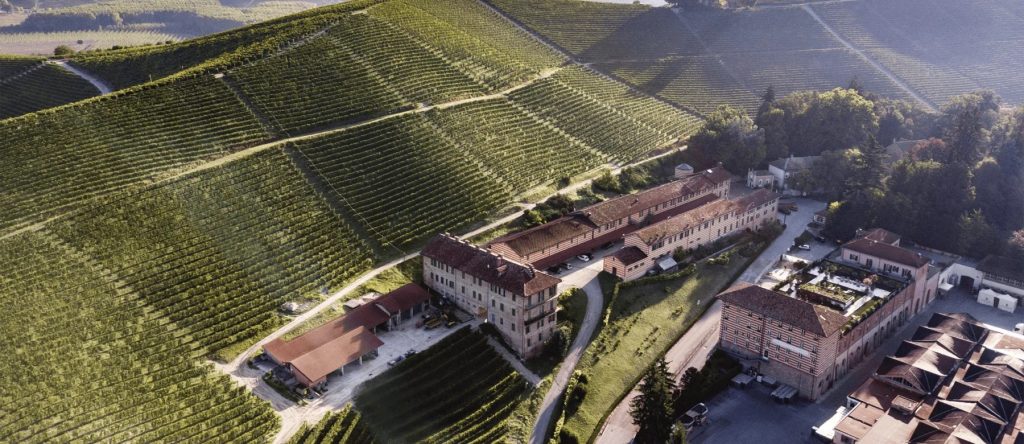
The Villaggio Narrante at Fontanafredda.
The Birth of a Barolo Day
Serralunga Day began as a bold initiative from the producers of this eastern Barolo commune. Unlike in other villages across the appellation, every single winery — large or small, progressive or traditional — agreed to present their wines under a shared identity: Barolo del Comune di Serralunga d’Alba. It was the first commune in Barolo to achieve full participation across its producer base.
What sets this effort apart is not just its organisation — it’s the philosophy behind it. The goal of Serralunga Day is not to spotlight stylistic differences between producers or MGA (Menzioni Geografiche Aggiuntive) sites, but to identify the common ground: what defines the sensory signature of Serralunga d’Alba Barolo, regardless of who makes it?
That question may seem simple, but in Barolo, it’s anything but. For decades, the region was a patchwork of personal visions — labels often reflected individual ambition more than origin. Rivalries between traditionalists and the so-called Barolo Boys fuelled intense debates about authenticity, aging, and terroir. Even the current MGA system, now central to regional classification, only came into effect in 2010.
Against that backdrop, the collective spirit of Serralunga d’Alba feels quietly radical. By developing a shared Manifesto — such as this year’s interpretation of the newly bottled 2022 vintage — the commune is forging a common language. Not dictated, but debated. Not unified in style, but in intent.
Other communes like La Morra or Barolo may follow, but for now, Serralunga d’Alba stands alone: a commune not just defined by its terroir, but by its willingness to speak with one voice.
Serralunga as a Barolo Benchmark
If one were to distill the essence of Serralunga d’Alba into a single concept, it would be structure. This commune, located on the eastern side of the Barolo zone, is known for producing wines of depth, density, and longevity. But the reasons for this lie not just in winemaking choices — they begin beneath the surface.
Serralunga d’Alba is defined by its soils. Unlike communes such as La Morra or Verduno, where sandier topsoils often lead to more aromatic and accessible wines, Serralunga d’Alba is dominated by compact, calcareous marl. This heavier, less porous soil type slows down vegetative growth and contributes to wines with greater tannic grip and vertical structure. Add to this the commune’s elevation and predominantly eastern exposures — which allow for slower, more measured ripening — and the result is a style marked by tension, not immediacy.
But if the structural character of Serralunga d’Alba is widely recognised, the nuance within it is just as remarkable. The commune counts no fewer than 39 officially recognised MGAs, each shaped by subtle variations in slope, exposition, and soil composition. Alessandro Masnaghetti, whose detailed maps have helped define how Barolo is understood today, describes it best: “Serralunga d’Alba is a universe on its own.”
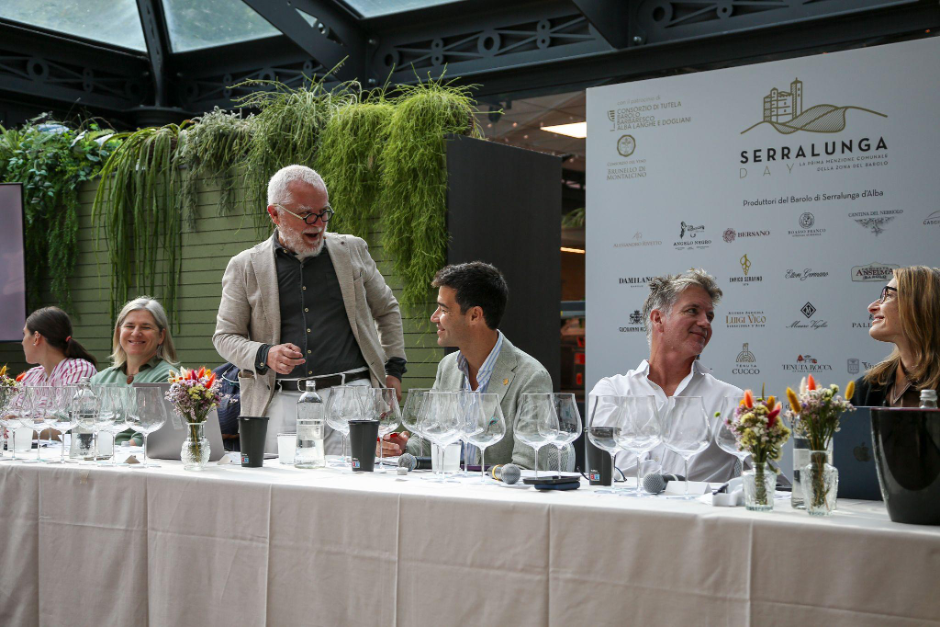
Alessandro Masnaghetti – revered cartographer of Barolo – and Gabriele Gorelli MW discuss Serralunga d’Alba’s terroir and its 39 MGA sites.
This complexity, however, is not the focus of Serralunga Day. The event is not built around exploring difference, but coherence. And in that sense, it challenges the conventional narrative of Barolo, which has long prized producer individuality and vineyard specificity. Serralunga d’Alba offers a counterpoint: that even in a region famed for nuance, there is value in speaking collectively — not to flatten identity, but to give it shape.
The Event in Three Movements
Serralunga Day unfolds in three distinct acts — each with its own tone, tempo, and purpose. The setting is the historic Villaggio Narrante on the Fontanafredda estate: a place where the region’s past and present coexist in quiet grandeur. From the Michelin-starred Guido Ristorante to the sun-dappled courtyards and expansive greenhouse pavilion, the venue serves not just as a backdrop, but as a physical reflection of the event’s ambition.
More than a setting, Fontanafredda is part of the story — a historic estate in transformation. Explore it from the inside in Fontanafredda – Icon with a Pulse.
Act I: The Blind Tasting (Morning)
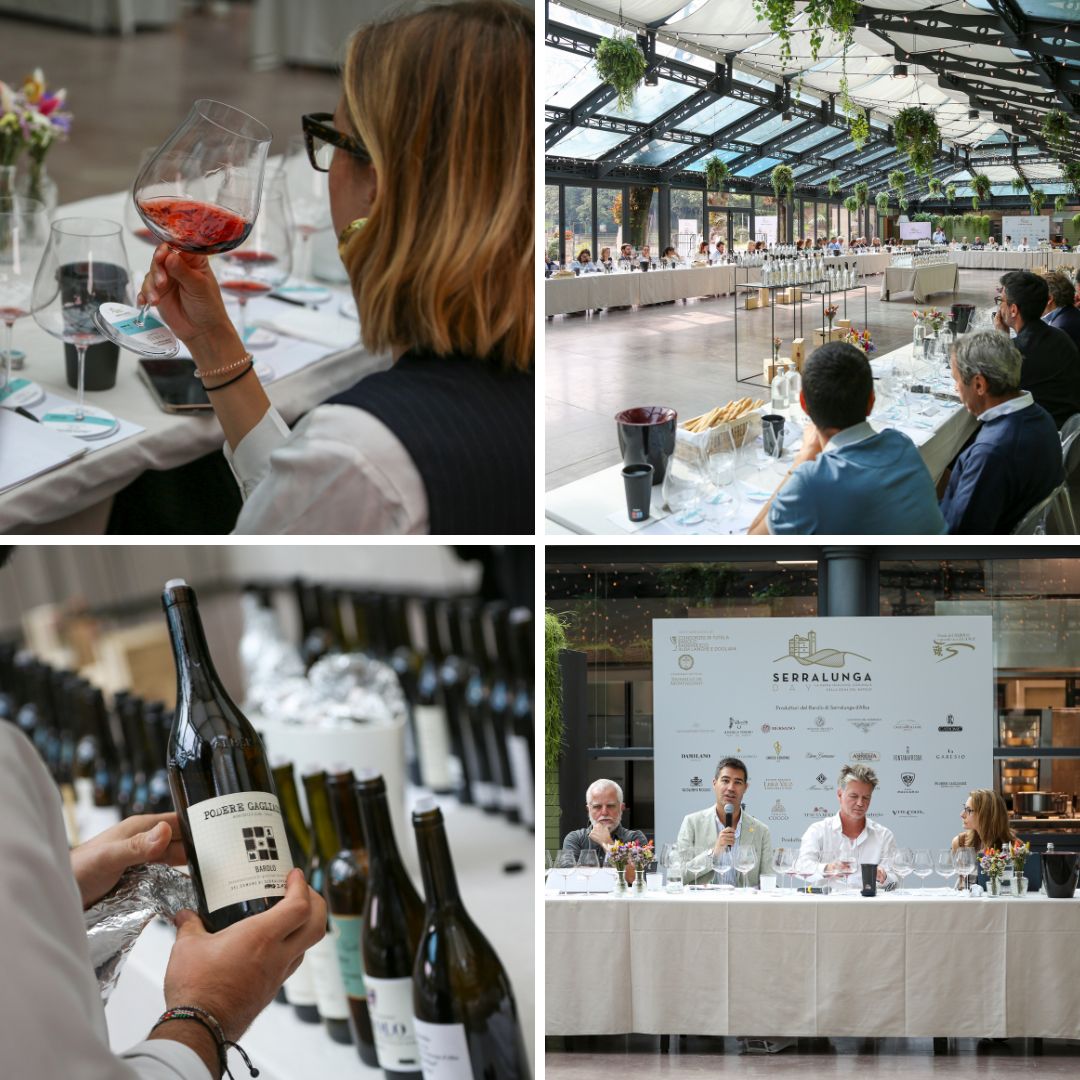
The day begins with a seated blind tasting of the 2022 vintage — an academic, highly structured exercise designed not for critique, but for collective insight. Around 100 guests take their seats: producers, Masters of Wine, international journalists and educators from across Italy, Europe, and North America. The sense of purpose is unmistakable — this is not a casual walk-through, but a focused examination of terroir.
The tasting is expertly led by Gabriele Gorelli MW — one of Italy’s first Masters of Wine — who moderates the session with clarity and authority. Alongside him, fellow Master of Wine Justin Knock and Italian Wine Expert Michaela Morris — certified by the Vinitaly International Academy — contribute detailed commentary throughout the flights, offering both technical perspective and stylistic interpretation. Their role is not to judge, but to guide — helping frame a discussion that seeks coherence over critique.
The format is rigorous. Each guest receives 26 glasses, marked and arranged not by producer name, but by geography: from north to south, reflecting shifts in soil; then from west to east, following changes in exposition. It’s a tasting designed for pattern recognition — and for listening, as much as for tasting.
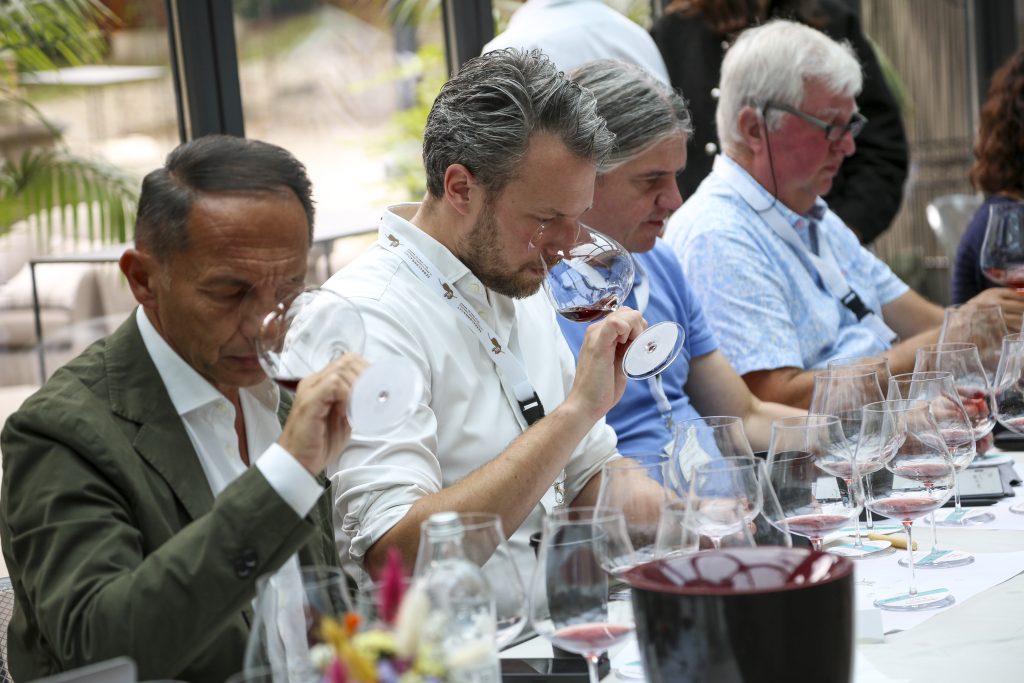
The blind tasting of Barolo del Comune Serralunga d’Alba 2022: wines arranged by terroir rather than producer, guided by MWs and Masnaghetti.
Supporting the session with geological context is Alessandro Masnaghetti, whose influence on the modern understanding of Barolo cannot be overstated. His detailed maps and terroir analyses have shaped the way both professionals and collectors interpret the region. Here, with characteristic precision, he frames the 2022 vintage within its climatic and topographic context — illuminating not just differences, but the threads that connect. As one attendee puts it: “He doesn’t show you vineyards. He shows you logic.”
This year’s vintage — 2022 — had just been bottled, offering a rare opportunity to assess it in its infancy. For a deeper exploration of how Barolo del Commune Serralunga d’Alba 2022 is shaping up, see our companion piece The 2022 Barolo Vintage Uncovered.
Act II: The Walk-Around Tasting (Afternoon)
In the afternoon, the tempo softens as the courtyard opens for a walk-around tasting — this time, exclusively featuring Barolo from Serralunga d’Alba’s 2021 vintage. Unlike the blind tasting, these wines are poured by the producers themselves, offering a more personal, open-ended format.
What makes this session particularly valuable is its depth. Alongside the commune-level wines (Barolo del Comune di Serralunga d’Alba), producers also present bottlings from specific MGA sites — and in some cases, even individual vineyards or clos. For those present in the morning, it’s an opportunity to compare vintages, explore detail within the broader identity, and engage directly with the people behind the wines.
Brunello di Montalcino is also present — not in competition, but in dialogue. The shared tasting space underscores a shared audience: one that values age-worthy, site-specific expressions of Nebbiolo and Sangiovese alike.
Act III: The Gala Dinner (Evening)
As evening falls, the glass pavilion at Fontanafredda takes on a different rhythm — soft light, long tables, the gentle hum of conversation rising between courses. Around 250 guests — producers, journalists, importers, and international guests — gather for a dinner that is both festive and reflective.
While the day has centred on the newly bottled 2022 vintage, the wines served tonight are primarily from 2021 — poured from magnum, chosen for their readiness to accompany food and conversation. Dishes from the estate’s Michelin-starred Guido Ristoranteare served with measured elegance, each pairing reinforcing the region’s connection between land, culture, and cuisine.
Midway through the evening, the tone shifts momentarily. The 2022 Manifesto — the outcome of the morning’s blind tasting and collective discussion — is formally presented. It is a quiet but meaningful moment: not a declaration of superiority, but a shared interpretation, authored together and affirmed in public.
The dinner also serves as a moment of recognition — to celebrate the producers who continue to invest not only in their vineyards, but in each other. It is here, in the mingling of personalities and perspectives, that the soul of Serralunga d’Alba reveals itself most vividly.
Serralunga Day is more than a tasting. It is a model — of cooperation, of intentionality, of what it means to communicate a terroir with one voice. In a region historically defined by contrast and competition, the producers of Serralunga d’Alba are charting a different path: one that embraces diversity, but speaks in unison.
What makes this approach so compelling is its clarity of purpose. Rather than spotlighting individual excellence or stylistic eccentricity, the event is built around shared understanding. The blind tasting seeks not standout wines, but a common thread. The walk-around session invites dialogue, not performance. The gala celebrates not opulence, but cohesion.
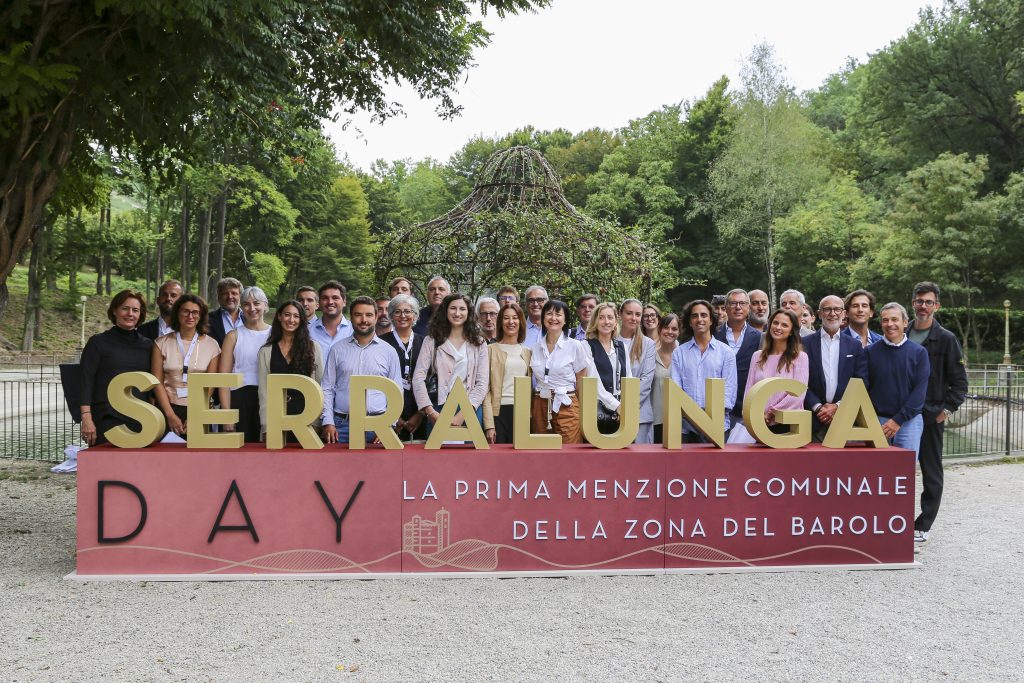
The group behind the Manifesto — producers, journalists, and Masters of Wine — shaping a collective voice for Serralunga d’Alba.
This is not to say that Serralunga d’Alba erases difference — far from it. Within the commune, the range of expression is vast, shaped by its 39 MGA sites and their interplay of soil, slope, and sun. But by seeking out what unites rather than divides, Serralunga d’Alba offers something rare: a communal identity built not on branding, but on substance.
That identity is now codified each year through a shared Manifesto — a document agreed upon by producers, critics, and Masters of Wine alike. It is not a marketing tool, but a declaration of intent: here is what we believe our vintage represents, and here is why it matters.
In doing so, Serralunga d’Alba sets a precedent — not just for Barolo, but for how fine wine regions might evolve. Not by flattening complexity, but by framing it. Not by speaking louder, but by speaking together.
This article is part of a four-part series on Serralunga Day 2025. Read more:
This article is written by our own Onno Deumer. With sincere thanks to the producers of Serralunga d’Alba for their openness and collaboration; to Alessandro Masnaghetti for his enduring cartographic clarity; to Gabriele Gorelli MW and Justin Knock MW for their guidance and insight, and to Michaela Morris — Italian Wine Expert (Vinitaly International Academy) — for her thoughtful contributions; and to the team at Fontanafredda (and their Dutch importer Vinites) for hosting with generosity and precision.
Join our insiders’ list and get exclusive early access to new articles, expert tips, and fresh reviews delivered straight to your inbox. Subscribe now and be the first to discover!