Join Our Wine Journey – Sign Up for the Newsletter 🍷
Sassotondo: A Different Face of Maremma
Share
Deel op X (twitter)
LinkedIn
WhatsApp
Sassotondo: A Different Face of Maremma.
How a family winery is shaping a different vision of Southern Tuscany.
In the early 1990s, the Tuscan region of Maremma began to attract a wave of ambitious wine projects. Drawn by its Mediterranean climate and vast stretches of undeveloped land, producers saw the area as a new frontier for modern Tuscan wine, often planting international varieties such as Cabernet Sauvignon and Merlot along the coast. Yet further inland, among the volcanic hills around Pitigliano in southern Maremma, a different story took shape. Here lies Sassotondo, a small family estate founded in 1990 that chose a markedly different path.
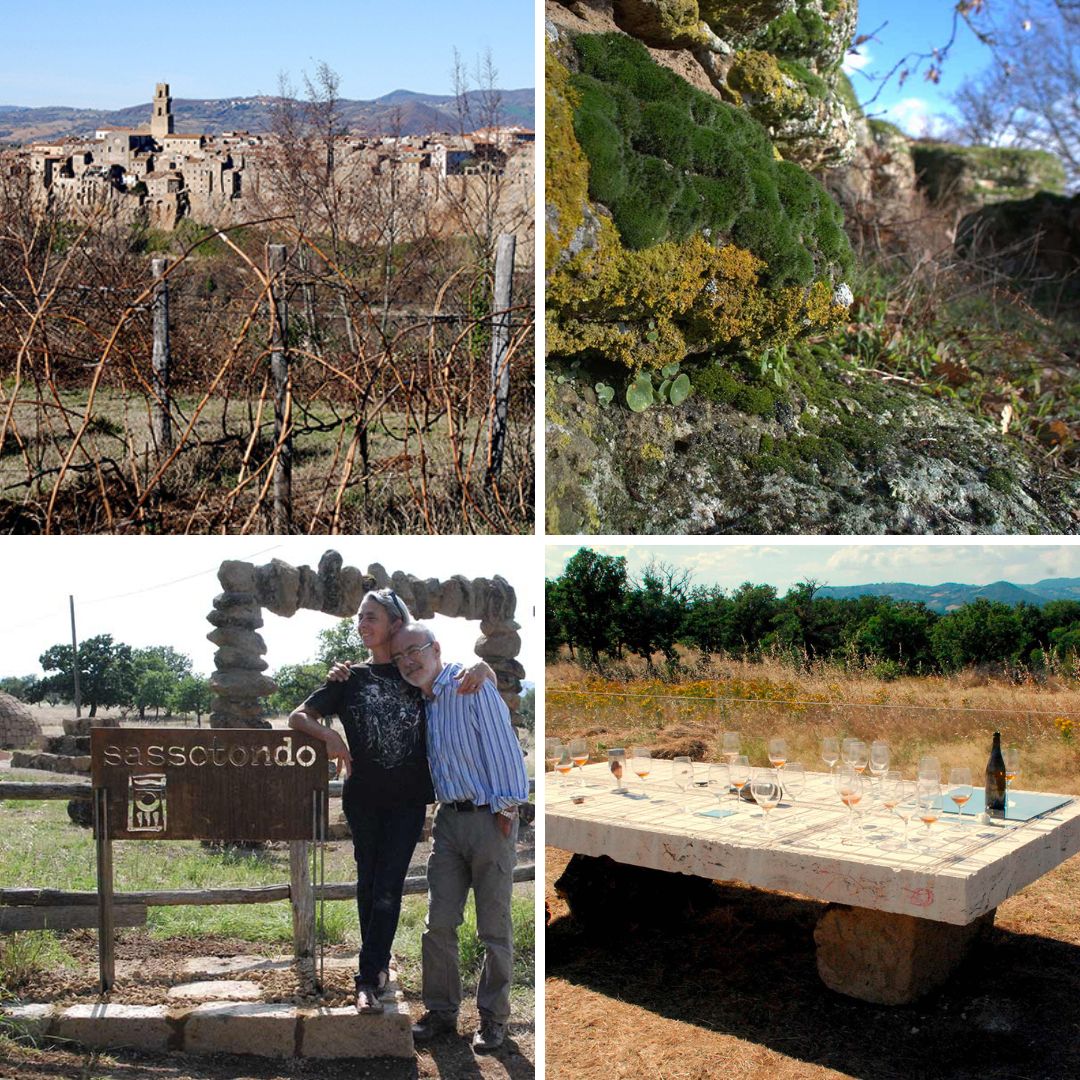
The rolling landscape of southern Maremma, where new wine projects began to emerge in the early 1990s.
During a recent conversation with founder Carla Benini and her daughter Francesca Ventimiglia, our own Onno Deumer learned how that story began with a surprisingly simple decision. At the time, Benini and her partner Edoardo Ventimiglia were living in a modest 42-square-metre apartment in central Rome. With the same amount of money, they could either buy twenty additional square metres in the city – or purchase 65 hectares of rural land in a little-known corner of southern Tuscany. They chose the land. What began as a search for space and a different way of life gradually evolved into one of the region’s most distinctive wineries, built around volcanic soils, organic farming, and an unwavering belief in the potential of a once-overlooked local grape: Ciliegiolo. Their path, however, would diverge from what many would soon come to regard as the typical model for wine production in Maremma.
Beyond the Coastal Image of Maremma
Over the past three decades, the image of Maremma has largely been shaped by its coastal landscapes. Sun-drenched vineyards stretch toward the Tyrrhenian Sea, agriturismi welcome a growing stream of visitors, and wines inspired by nearby Bolgheri have brought the region international recognition. Cabernet Sauvignon and Merlot became central to this modern identity, producing polished wines that quickly gained attention beyond Italy.
Yet this coastal narrative tells only part of the story. Travel inland and the character of Maremma begins to change. The terrain rises, the soils turn volcanic, and the vineyards become smaller and more scattered. Around Pitigliano, winegrowing follows a quieter logic – one rooted less in international varieties and more in the region’s own indigenous grapes. It is within this lesser-known corner of southern Tuscany that Sassotondo found its direction.
The Volcanic Hills of Pitigliano
Around Pitigliano and nearby Sovana, the landscape of southern Maremma takes on a distinctly volcanic character. Vineyards are rooted in tufo, a porous volcanic tuff formed by ancient eruptions linked to the volcanic basin of Lake Bolsena.
Tufo – the porous volcanic rock that defines the vineyards around Pitigliano and shapes the character of the wines of Sassotondo.
These soils drain easily yet retain moisture deep within the rock, encouraging vines to send roots far into the ground. Combined with elevations of around 300 metres and cooler nights than the coastal plains, the conditions favour wines with freshness and aromatic precision.
It was precisely this landscape that shaped the direction of Sassotondo. For Carla Benini and Edoardo Ventimiglia, the volcanic plateau surrounding the estate suggested a different approach to winegrowing – one rooted in local varieties and the character of the soil. Among those grapes, one stood out in particular: Ciliegiolo, a variety long used mainly for blending, yet here showing an affinity for the volcanic terrain that would eventually define Sassotondo’s identity.
Choosing a Different Path
At Sassotondo, many of the defining choices emerged directly from the vineyards themselves. Shortly after establishing the estate in the early 1990s, the family acquired an old farm just outside Pitigliano. Among its vineyards was a parcel planted largely with Ciliegiolo vines dating back to the 1960s. At the time, this was hardly seen as a promising discovery. Across central Italy, Ciliegiolo was typically used as a blending partner for Sangiovese – valued for adding fragrance and softness but rarely considered capable of producing a serious wine on its own. Its naturally generous yields and large clusters often reinforced that perception. Yet this old vineyard would soon prove far more significant than anyone initially expected. Few producers in Italy had attempted to build an entire estate identity around Ciliegiolo, making Sassotondo one of the earliest wineries to explore the grape as a serious monovarietal wine.
The turning point came with the arrival of consultant winemaker Attilio Pagli. Known for his work with indigenous varieties across central Italy, Pagli encouraged the estate to take the old vineyard seriously and to explore what Ciliegiolo might express in these volcanic soils. For Carla Benini, an agronomist by training and still relatively new to winemaking at the time, this guidance proved decisive. Rather than replacing the vineyard with more fashionable varieties, the decision was made to understand the grape that was already there. As Benini recalls, the context of the time made that decision almost inevitable: “At that time everybody was planting Cabernet and Merlot. We thought: if everybody does the same thing, you must find something different.” What began as an experiment would soon evolve into a defining choice for the estate.
San Lorenzo vineyard below the tuff-stone town of Pitigliano, where volcanic soils shape Sassotondo’s interpretation of Ciliegiolo.
The results of that decision first became visible in San Lorenzo, the wine that would become one of the defining bottlings of the estate. First produced in 1997, it was conceived as a pure expression of Ciliegiolo from the old vineyard that had inspired the project. In this parcel, however, the vines behaved differently from what the variety was generally known for. Decades of age had naturally reduced their yields, producing smaller bunches and more concentrated fruit. Combined with the volcanic soils around Pitigliano, the result was a wine with unexpected depth, colour, and structure. When the wine began to attract attention, many tasters assumed it must be Syrah when tasting it blind – a grape more commonly associated with the kind of intensity and spice they encountered in the glass. In reality, it was simply Ciliegiolo revealing a side of its character that few had previously recognised.
Alongside these early experiments with Ciliegiolo, the vineyards at Sassotondo were farmed organically from the beginning. At the time, however, this was not something the estate felt the need to highlight on the label. For Carla Benini, it was simply the most natural way to work with the land they had chosen. Walking through the vineyards today, the landscape appears almost wild: grasses grow between the rows, animals move through the fields, and the vines are part of a wider ecosystem rather than an isolated crop. As Benini explains, the aim has never been strict control, but balance – allowing the vineyard to develop its own equilibrium so that the soil, plants and surrounding life support each other.
Wildflowers growing between the vineyard rows at Sassotondo — part of the living ecosystem that supports organic farming in the estate’s volcanic soils.
Within this landscape, Ciliegiolo gradually became more than just a grape variety for Sassotondo. It became the natural language through which the estate could interpret its surroundings. The vitality of the grape in the vineyard demanded careful management, yet when yields were controlled it revealed an expressive character capable of reflecting subtle differences in soil, exposure and winemaking approach. Rather than seeking a single definitive style, the winery began to explore the many faces the variety could show across its vineyards and in the cellar. Over time, this exploration evolved into a range of wines that interpret Ciliegiolo from different angles – each offering a slightly different perspective on the estate’s volcanic terroir. Two of the clearest examples are San Lorenzo and Monte Calvo, wines that reveal how differently the same grape can speak within a single landscape.
When Terroir Becomes Wine
Entering the cellar at Sassotondo means stepping directly into the volcanic landscape that defines the estate. The winery itself is carved into tufo, the porous volcanic rock that dominates the hills around Pitigliano. These underground spaces – long used in the region since Etruscan times – provide naturally stable conditions for fermentation and aging. In many ways, the cellar feels like a continuation of the vineyards above, where the same rock that shapes the roots of the vines also surrounds the wines as they mature.
Barrels ageing in the tufo-carved cellar of Sassotondo, where the volcanic rock provides naturally stable conditions for maturation.
Within this setting, the estate explores different expressions of Ciliegiolo, shaped both by vineyard characteristics and by decisions taken in the cellar. Two wines illustrate this approach particularly well: San Lorenzo and Monte Calvo.
San Lorenzo originates from the old vineyard that first revealed the potential of Ciliegiolo at the estate. Planted largely in the 1960s, the site produces naturally low yields and small, concentrated berries. The volcanic soils here tend to give wines with structure and depth, and the winemaking reflects that character. Fermentation focuses on careful extraction to build texture and backbone, allowing the concentration from the old vines to translate into a wine with both intensity and aging potential. In this sense, San Lorenzo represents the more classical expression of Ciliegiolo at the estate – a wine where the power of the vineyard is allowed to speak clearly.
Sassotondo San Lorenzo Ciliegiolo 2021 – Black cherry and dark fruit lead the nose, layered with dried herbs, light earth and a touch of spice. Old vines and firmer extraction give the wine depth and structure, while vibrant acidity keeps the palate focused and energetic. The finish lingers on cherry, savoury earth and gentle spice – a concentrated, powerful expression of Ciliegiolo.
DWA-Score: 93/100
If San Lorenzo reveals the depth that old vines can give to Ciliegiolo, Monte Calvo shows how differently the same grape can speak when vineyard and winemaking shift the balance. While the variety remains the same, both the vineyard and the cellar approach change the character of the wine. The fruit comes from a parcel with a more pronounced volcanic composition, where vines grow in soils rich in tufo and other volcanic deposits typical of the Pitigliano plateau. These soils tend to produce wines with greater tension and aromatic lift, giving the fruit a naturally brighter and more energetic profile. Rather than emphasising extraction and structure, the winemaking is designed to preserve this character. Fermentation therefore favours infusion rather than extraction, often including a proportion of whole clusters. This gentler approach slowly releases colour, aroma and tannin, resulting in a wine that is more lifted and perfumed.
Sassotondo Monte Calvo Ciliegiolo 2023 – Red cherry, wild strawberry and subtle florals define the aromatics, lifted by a distinct mineral edge shaped by the estate’s volcanic soils. The infusion-style extraction keeps the texture light and finely structured, allowing freshness and aromatic precision to take centre stage. Bright acidity carries the fruit through a poised, mineral finish.
DWA-Score: 92/100
This openness to experimentation also reflects the gradual involvement of a new generation at Sassotondo. Francesca Ventimiglia, who grew up among the vineyards and has increasingly taken part in the work of the estate, represents a slightly different perspective on the wines. Having travelled widely and encountered wine cultures far beyond southern Tuscany, she approaches the estate’s wines with both familiarity and curiosity. For Francesca, the exploration of Ciliegiolo is not a finished project, but an ongoing process. While the foundations of the project remain firmly rooted in the vineyards and philosophy established by her parents, some of the more recent interpretations of Ciliegiolo – including wines such as Monte Calvo – explore lighter extraction and greater aromatic nuance. In this way, the evolution of the wines mirrors the evolution of the family itself.
Bottlings from Sassotondo – including San Lorenzo and Monte Calvo – illustrating the different expressions of Ciliegiolo explored by the estate.
A Small Winery in a Big Wine World
For all the attention its wines increasingly receive, Sassotondo remains, at heart, a deliberately small estate. The project that began with the purchase of 65 hectares of rural land was never intended to grow into a large commercial winery. From the beginning, the ambition was simpler: to live and work with the land in a way that remained coherent with the landscape and with the ideas behind the wines.
Three decades later, that philosophy still defines the scale of the estate. Remaining small allows close attention to the vineyards and to the delicate balance that organic farming requires. Yet it also means accepting certain limitations. One of the most persistent challenges is not the vineyard itself, but the people needed to care for it. Like many rural areas of southern Tuscany, the region around Pitigliano does not always offer an easy pool of skilled vineyard workers. Finding people who understand the land and are willing to work closely with it over time is therefore one of the quiet challenges of running a small estate.
At Sassotondo, the work continues slowly – shaped by a small team, the rhythm of the land, and the passing of generations.
The same dynamic applies to the market. As a small producer working with an unconventional grape variety, Sassotondo does not fit easily into the familiar narratives through which wine regions are often presented abroad. Instead of relying on scale, the estate has gradually built relationships with importers and sommeliers who are specifically interested in distinctive wines. As Benini puts it with a smile: “We are small fish in a big sea. But being small also gives us freedom”.Over time, this has led to a presence in markets where curiosity for indigenous varieties is particularly strong. Countries such as South Korea and Canada, for example, have become important destinations for the wines, where specialised importers actively seek out producers like Sassotondo.
Within the estate itself, a new phase is gradually taking shape. Francesca Ventimiglia has become increasingly involved in the work of the winery, bringing a perspective shaped both by growing up among the vineyards and by observing the wider wine world. Her involvement does not signal a break with the philosophy established by her parents, but rather an evolution of it – continuing to explore the possibilities of Ciliegiolo while remaining attentive to the character of the land.
For both generations, the guiding question remains remarkably consistent: how to remain faithful to the place that inspired the project in the first place. The answer, it seems, lies not in expansion but in coherence – maintaining a scale that allows the vineyards, the grape and the philosophy of the estate to remain closely connected.
A Different Face of Maremma
In many ways, the story of Sassotondo reflects a quieter side of Maremma that is often overshadowed by the region’s more visible successes. While the coastal estates have helped define the international image of the territory, places like Pitigliano reveal a landscape where wine evolves more slowly, shaped by local varieties and by people willing to work closely with the land.
Looking back, the choice between twenty extra square metres in Rome and sixty-five hectares of countryside seems almost symbolic. What began as a search for space – both literal and figurative – gradually evolved into something more enduring: a long conversation between a family, a grape variety and a volcanic landscape. Through Ciliegiolo, Sassotondo has simply given that landscape the room to speak.
Across the vineyards of Sassotondo, where the next chapter of the estate is already taking root.
This article is written by our own Onno Deumer. With thanks to Carla Benini and Francesca Ventimiglia of Sassotondo for their openness, time and thoughtful reflections on the history and philosophy of the estate. We are grateful for the opportunity to taste and discuss a range of their wines, and for the insights that helped bring the story of Sassotondo and its volcanic Ciliegiolo to life.
A thank you to their and our partner Wine Lister as well, for facilitating the interview and tasting.
Join our insiders’ list and get exclusive early access to new articles, expert tips, and fresh reviews delivered straight to your inbox. Subscribe now and be the first to discover!