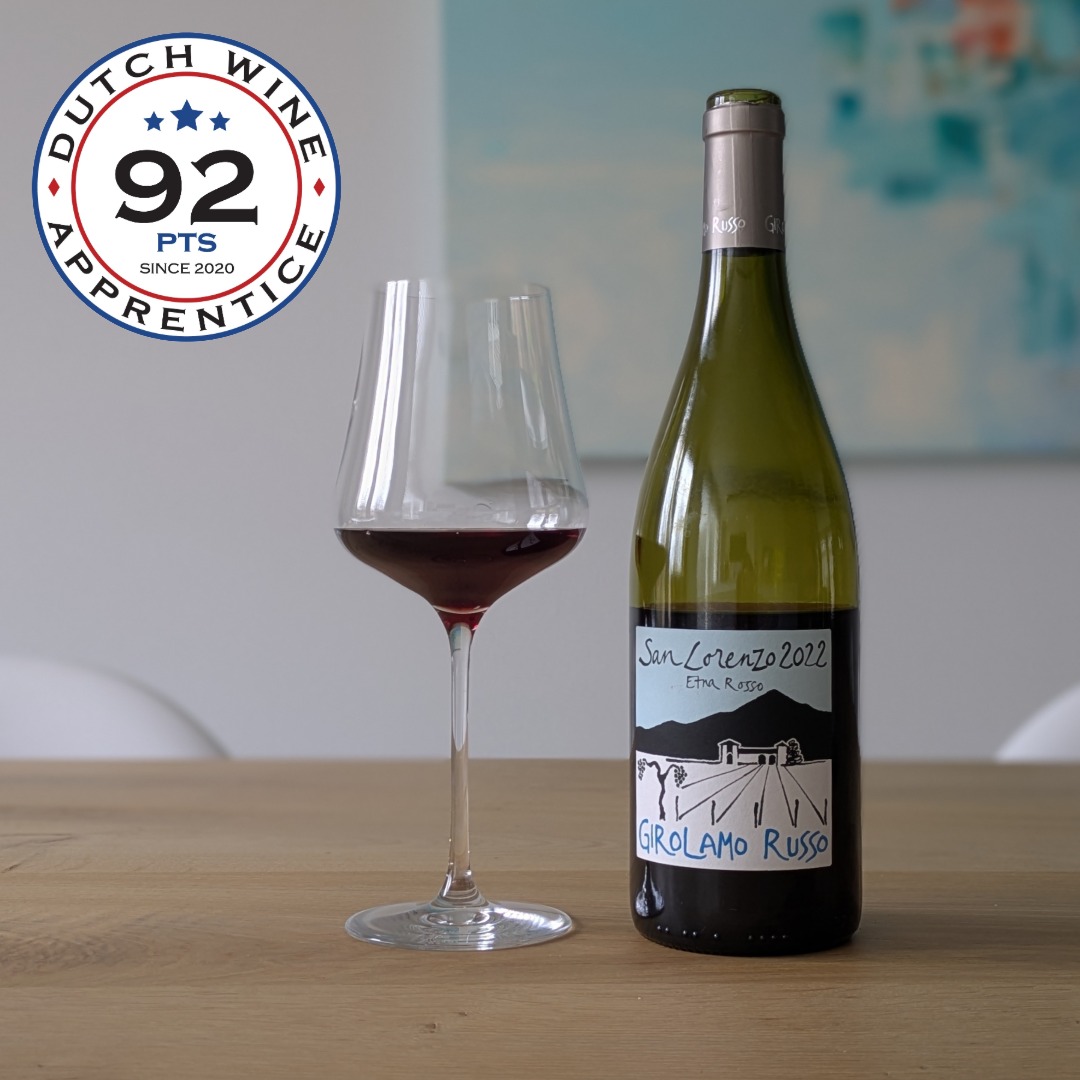
Girolamo Russo – 2021 San Lorenzo Etna Rosso
Red
Italy
Etna
Nerello Mascalese
Spiegelau Definition Universal
74 EURO


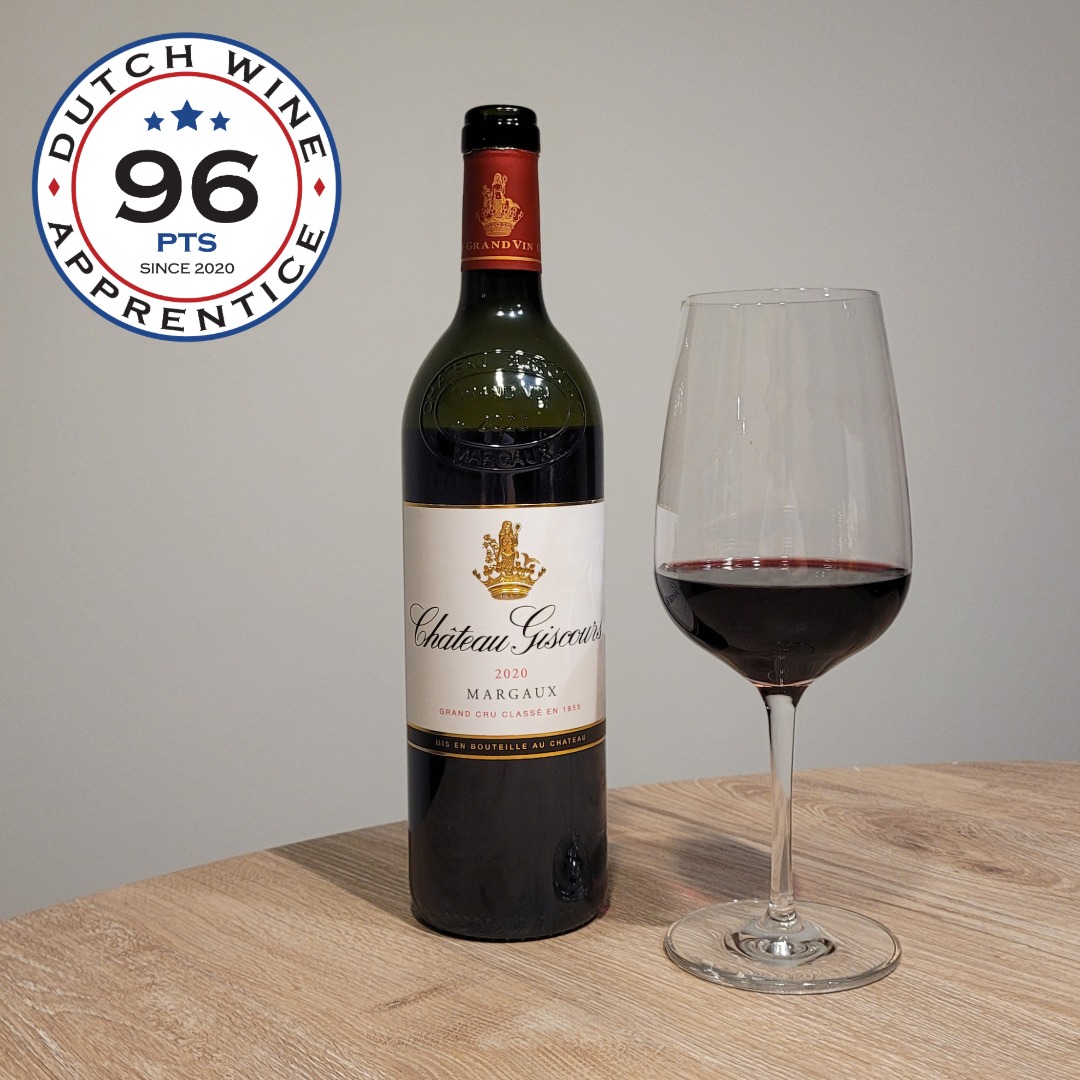
Château Giscours is among the most popular classified Bordeaux estates in the Netherlands, thanks to its Dutch ownership and strong price-to-quality ratio — a key factor in the Dutch market. With its roots in wine production going back to the 16th century, it is one of the longest established Châteaux of the Médoc. Join us as we explore one of its recent vintages and the impressive streak of success the estate has achieved in recent years.
Château Giscours is at Troisième Grand Cru Classé in the 1855 Classification of Bordeaux, with its wine production going back over 450 years. At over 400 hectares it is one of the largest Châteaux in Bordeaux, with roughly 100 hectares in total dedicated to their grand vin and second wine (La Sirène de Giscours), and a further 60 hectares just outside of the appellation of Margaux dedicated to their Haut-Médoc de Giscours bottling. All in all, quite an impressive amount considering that after the Second World War only seven hectares of Giscours were in production due to economic downfall and general neglect of the Château.
Fortunately, this neglect was also noticed by Nicolas Tari. From 1947 onwards, he gradually increased his shares and fully acquired the Château in 1952. This paved the way for significant investment, and when he was succeeded by his son Pierre Tari – one of the judges at the Judgement of Paris in 1976, and at the time the President of the Union des Grands Crus de Bordeaux – quality was back at its original height once again. However, during the 1980s quality took a slight downfall once more after many Cabernet Sauvignon vines were grafted over to Merlot, which was a fashionable (but perhaps short-sighted) choice at the time. The resulting wines, while softer and more approachable in their youth, lacked the longevity and complexity that had once defined the profile of Giscours.
With the Albada Jelgersma family in charge of the Château since 1995, and Alexander van Beek serving as managing director since 1998, the wines have luckily once again returned to their roots. Recent vintages have repeatedly achieved scores of 95 points or higher from most wine critics, us included. This is largely due to a replanting program in the late 1990s focusing on both restoring the vineyard densities and swapping Merlot vines for Cabernet Sauvignon vines. This shift back to Cabernet Sauvignon turned out to be the correct choice, as terroir studies carried out by Kees van Leeuwen in 2008 exposed extremely homogenous gravel soils. The reason for this is two-fold: Cabernet Sauvignon thrives in stony, warm soils, which help it reach optimal ripeness in Bordeaux’s moderate climate, and the gravels allow for fast drainage of the soils after rain, further enhancing the ripening of Cabernet Sauvignon. Merlot on the other hand ripens earlier and is more prone to developing high alcohol and losing acidity in these warm, well-drained gravel soils – hence why it is more often found on the right bank of Bordeaux, on clay-limestone soils. In 1995, around 60% of the vineyard was planted with Merlot at Giscours. By 2025, that figure has reversed, with approximately 65% now devoted to Cabernet Sauvignon complemented by 30% Merlot, and a dash of Cabernet Franc (3%) and Petit Verdot (2%).
Château Giscours is situated in Labarde, within the appellation of Margaux. As with its more northerly peers Saint-Estèphe, Pauillac, and Saint-Julien, it is considered to be one of the most famous and prestigious communes of the Médoc. This is in part due to the many 1855-classified Châteaux present in these communes, but perhaps even more so due to their classic gravelly soils, which tend to produce some of the finest Cabernet Sauvignon in the world. In Margaux, and especially at Giscours, these gravel terroirs are some of the most homogenous across the whole of Bordeaux.
These pure gravels, often mixed with a bit of sand, yield more elegant and perfumed wines than those from Pauillac, where additional clay in the gravelly soils lends more power to the wines. While these differences are subtle, and also producer-dependent, they do tend to stand out in blind tastings and offer unique personalities to these communes. A comparison with an iron fist in a velvet glove is often drawn for the wines of Margaux, whereas the wines of Pauillac are more commonly associated with power, the wines of Saint-Estèphe with slightly more rustic tannins, and the wines of Saint-Julien with balance. While the communes have different identities, a trait they all share is their uncompromising quality, with strict rules regarding vine densities and yields being applicable – all aptly reflected in the prices of the wines produced.
The vineyards of Château Giscours are split in 43 distinctive plots, each treated separately, and set across three large gravel mounds called Petit Poujeau, Grand Poujeau, and Cantelaude. Petit and Grand Poujeau lie to the west of the Château on very pure gravels and tend to be the warmest soils of the Château. It is no surprise that the single block of Petit Verdot Giscours farms is found here. Right in front of the Château lies the mound of Cantelaude, holding the vast majority of Giscours’ vines, being a bit cooler than Petit and Grand Poujeau. A distinct microclimate within Cantelaude can be found in the Belair plots, located north of the D2 road. This area often produces the most elegant expressions of Cabernet Sauvignon, thanks to its relatively cooler conditions.
This diversity of plots provides the ideal palette for crafting the Château’s blend for the grand vin. In colder years, more focus will be on the Petit and Grand Poujeau due to their warmer soils, and warm years see the Belair plots come to greatness. In certain years, Petit Verdot and Cabernet Franc are also added to the grand vin to further enhance its structure and complexity. In this context, Petit Verdot adds floral lift and tannic grip, and Cabernet Franc spice and freshness. Taken together, all the ingredients for greatness are present at Giscours, allowing them to create a masterful grand vin in each year – truly deserving of its third growth classification. More recently, the team has focused on harvesting their vines in several picking rounds: younger vines slightly earlier for freshness and liveliness, and older vines a bit later for depth, complexity, and the quality of the tannins. While costly to do so, the quality of the wine warrants the effort.
In the winery, roughly 40-50% of new oak is used for the grand vin as to not overpower its elegance, with the wine staying for roughly 14 months in barrel. For the 2020, due to the powerful character of the vintage, 50% new oak was used, and the wine was aged for 17 months in oak. Recent trends in the winery have been to opt for a more reductive approach to capture all of the elegance of the Margaux terroir. Furthermore, for the Merlot, a one-week cold maceration has also been used for this reason, to extract colour and aroma without adding excessive tannin.
According to Managing Director Alexander van Beek, the 2020 vintage was one of the most successful of the decade. The year started off with a relatively early budburst followed by a wet spring. The pure gravel soils of Giscours greatly helped in this regard to reduce humidity and mildew. Luckily a dry and warm period followed, with uniform flowering and moderate heat. The summer however was hot and dry, with some vines even shutting down. Some relieving rain fell in August, after which a gentle late summer allowed for a long picking window for the Merlot. The Cabernet Sauvignon was harvested shortly after and in any case before the 2nd of October due to a storm being forecasted. All in all, for the grand vin 56% Cabernet Sauvignon and 44% Merlot was used – with the Cabernet Franc and Petit Verdot blended into the La Sirène de Giscours.
After decanting for an hour, the wine fully confirms Alexander’s confidence in the vintage’s success. The wine has a classic Margaux perfume with an interplay of red and black fruits of cassis, cherry, blackcurrant, and ripe bramble. The oak is present but perfectly integrated and not standing out at all, with a subtle vanilla and clove note accompanying the lifted perfume. Quite mineral too, with subtle pencil lead and tomato leaf nuances minding us that we are indeed in the Médoc. Gorgeous tannins – elegant and pixelated, yet undeniably powerful. Wonderful balance, intensity and length, with classic Margaux silkiness. Great depth. Moderate alcohol at only 13.5%. Deep, composed, and complete – this is another superb Giscours, combining its signature freshness and finesse with a firm, structured core of red and dark fruits.
Enjoyable now but will give many more decades of drinking pleasure. We award this excellent Margaux red with a 96-point DWA score. Drink 2028-55.
This article was written by our own Martin Bronkhorst. Château Giscours is distributed in the Netherlands through De Bruijn in Wijnen, and sold through various retailers.
Join our insiders’ list and get exclusive early access to new articles, expert tips, and fresh reviews delivered straight to your inbox. Subscribe now and be the first to discover!
Subscribe for curated content, podcast alerts and honest wine reviews.