Join Our Wine Journey – Sign Up for the Newsletter 🍷
Philippe Castéja: A Steward of Bordeaux in a Changing Wine World
Share
Deel op X (twitter)
LinkedIn
WhatsApp
Philippe Castéja: A Steward of Bordeaux in a Changing Wine World.
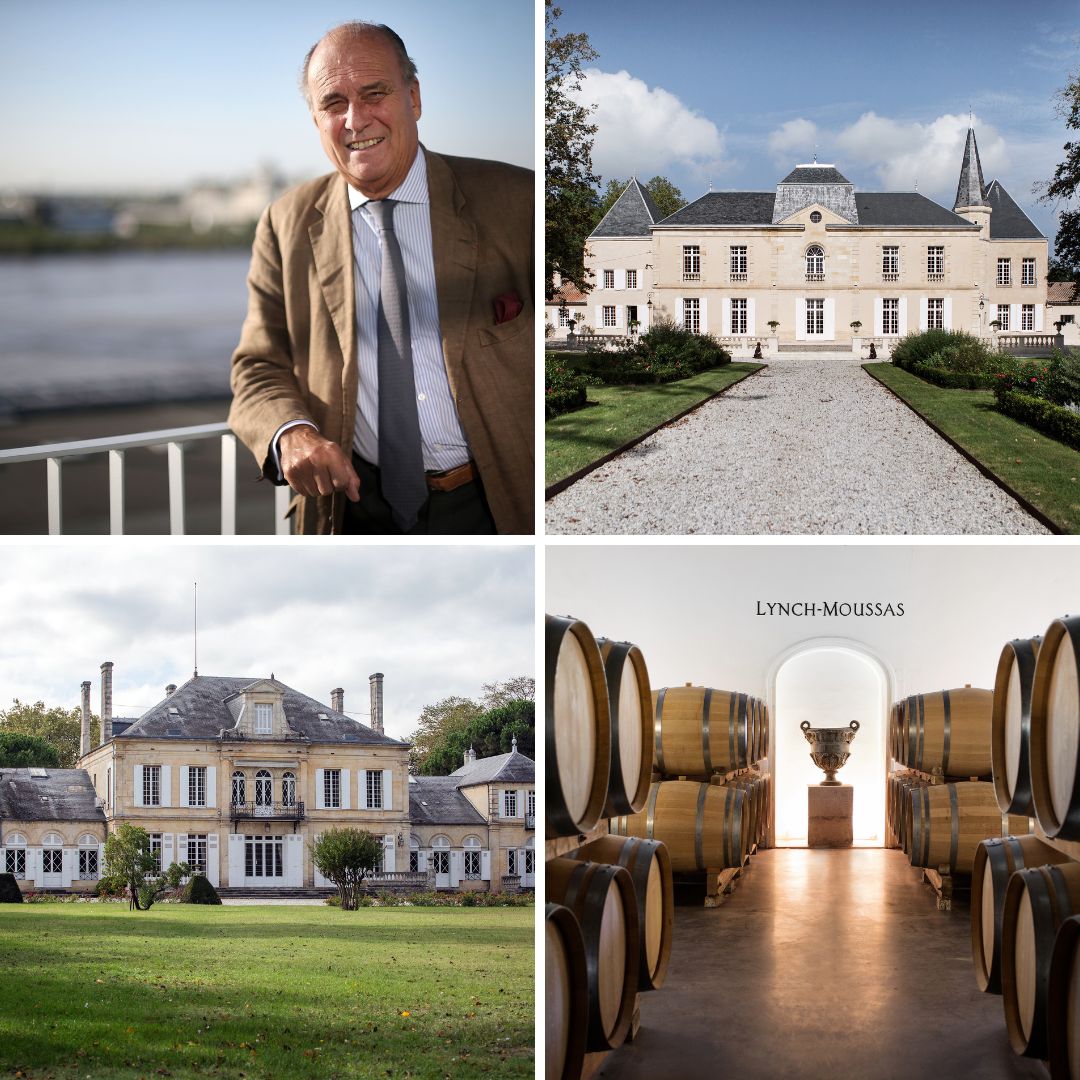
The gravel drive leading up to Château Batailley carries the quiet confidence characteristic of Pauillac. Broad lawns, ancient trees and the stately façade of a Grand Cru Classé create a setting that reflects both heritage and calm certainty. It was here, in one of the Médoc’s most emblematic estates, that we met Mr. Philippe Castéja—a figure whose influence stretches across generations, continents and the intertwined worlds of viticulture and commerce.
Mr. Castéja belongs to the fifth generation of a family deeply rooted in Bordeaux. Although he later studied economics, his earliest education came from growing up in the countryside, where vineyard work was not an obligation but simply part of daily life. As a child he pruned vines, harvested grapes, racked wines, even tended farm animals. These early experiences created an instinctive understanding of land and craft—an understanding that would later shape the decisions he makes as one of Bordeaux’s most prominent leaders.
Chateau Batailley.
Today, as chairman of Borie-Manoux, he oversees nine estates across the region, including Château Batailley and Château Lynch-Moussas in Pauillac and Château TrotteVieille in Saint-Émilion. His dual identity—at once producer and négociant—gives him a panoramic view of how Bordeaux works both internally and within the global fine wine market.
The Uniqueness of La Place
When Mr. Castéja speaks about La Place de Bordeaux, he does so with clarity earned through lived experience. Outside France, many wine lovers recognize the term, yet few fully understand its mechanics. The system emerged because Bordeaux’s production scale made it impossible for individual estates to distribute globally on their own. Specialized wine merchants filled that role, developing expertise in specific markets such as Asia, the US, the UK or the Benelux. Over generations, this evolved into a finely tuned network that moves Bordeaux’s top wines around the world with unmatched reach.
Borie-Manoux’s head office in Bordeaux for its Negociant business.
Nearly all classified growths now work with several of these merchants, but Château Batailley remains a singular exception. It continues its long-standing exclusive partnership with Borie-Manoux, an unusual continuity in a system where most estates rely on multiple distributors.
This coexistence of tradition and adaptation reveals much about Bordeaux’s identity—an interplay between heritage and pragmatism rather than a tension between old and new.
A Broader Meaning of Terroir
When asked about terroir, Mr. Castéja does not restrict the definition to soil or geographical markers. Instead, he describes terroir as a triad: earth, climate and culture. It is only through the alignment of all three that a wine expresses a true sense of place.
Bordeaux’s climate plays a unique role in this identity. The Atlantic influences, the warming ocean current and the vast Gironde estuary create an environment where the days allow full ripening while the cool nights preserve freshness. This natural balance forms the foundation for Bordeaux’s longevity—the reason its wines can mature gracefully over decades.
The profile of Bordeaux wines might be changing, but their culture remains firmly as a differentiator.
Yet it is culture—generational knowledge, ingrained philosophies, and long-standing practices—that Mr. Castéja emphasizes most. Bordeaux’s wines are shaped by a collective memory, a continuity that cannot be fabricated or imitated quickly.
A Moment in the Glass
As we explored these subjects, a bottle of Château Batailley’s Grand Vin was opened between us—not as a conclusion, but as a natural part of the conversation. In Bordeaux, wine is rarely an afterthought; it is often present throughout a discussion and adds context to what is being said.
The wine we tasted reflected several of the themes Mr. Castéja raised. Its clarity and structure matched the evolution he described: a style grounded in history, but shaped by greater precision and control in both vineyard and cellar. The freshness in the glass also connected directly to his point about Bordeaux’s climate, where cool Atlantic-influenced nights help preserve balance and lift.
Mr. Philippe Castéja.
Taking time to taste while speaking with someone whose family has been connected to these vineyards for generations made his definition of terroir—earth, climate and culture—feel more concrete. The wine helped translate broader ideas into something immediately understandable, linking what we discussed in the room to the place outside the window.
Evolution Without Abruptness
Climate inevitably entered the conversation, though not in alarmist terms. Mr. Castéja recognizes the challenges: shifting weather patterns, mildew pressure, increased environmental awareness compared with three decades ago. But he resists the narrative that climate alone has shaped Bordeaux’s stylistic evolution.
For him, Bordeaux’s transformation is equally cultural. The 1970s were defined by the need for volume, the 1980s and 1990s by the influence of the Parker era, when ripeness, power and oak dominated. Today, Bordeaux has embraced a more precise, balanced style—one that privileges purity, freshness and tension.
This refinement has been made possible by major investments in cellars and vineyard mapping. Many estates rebuilt their vat rooms to vinify individual parcels separately—a practice now considered essential for expressing terroir with greater clarity.
The vineyards at Château Batailley.
Castéja himself adopted such an approach early. When he took over Lynch-Moussas in 2001, he initiated a seven-year evaluation of every plot with Denis Dubourdieu, tasting berries, assessing yields and tracking performance across vintages. Only after that period did they determine which parcels truly belonged in the Grand Vin. “If a plot never reaches the Grand Vin,” he said, “you are producing for nothing.”
This long-term view is not a luxury in Bordeaux—it is the foundation of quality.
Château Lynch Moussas.
A New Generation of Drinkers
Although La Place remains essential for distribution, Mr. Castéja has observed significant changes in how producers engage with consumers. Estate visits are increasing; e-commerce has become a central pillar of sales; and younger drinkers approach wine with curiosity rather than tradition. They want to understand stories, methods, landscapes and people.
Wine dinners, tastings and brand ambassador programs resonate strongly with this generation. Their interest lies not only in drinking wine but in discovering it. This shift makes storytelling indispensable—and Bordeaux, rich with narrative and heritage, is well positioned to meet that demand.
The World Beyond Bordeaux
Mr. Castéja acknowledges that the global fine wine landscape has expanded dramatically. California, Australia, New Zealand, China and other regions have emerged as serious players, each with distinct identities and loyal followings. Spirits now occupy growing attention at major trade shows, reflecting shifting consumer patterns.
Yet Bordeaux holds two enduring advantages: its proven capacity to age, and its deep cultural identity. Newer regions can produce exceptional wines, but few can demonstrate, as Bordeaux can, how their wines evolve over half a century.
Foreign producers joining La Place often underestimate the patience required. Some succeed—Opus One being the iconic example—while others quietly withdraw. “There is no miracle,” Castéja notes. “It takes time.”
Guardian of a Classification
Beyond his estates, Mr. Castéja has long dedicated time to Bordeaux’s professional organizations, including his role as President of the Conseil des Grands Crus Classés 1855. He speaks of this responsibility with conviction. The classification, he believes, is not only a historical artifact but a navigational tool—a way for consumers to understand Bordeaux’s structure and hierarchy. Its preservation benefits the entire region.
History in Bordeaux’s cellars, a big part of today’s relevance.
A Region Moving Forward, One Step at a Time
Leaving Château Batailley, our conversation stayed with us as a clear reminder of how Bordeaux continues to evolve. The region is adapting step by step, refining its approach without abandoning the foundations that built its reputation.
Mr. Castéja’s message was consistent throughout: progress in Bordeaux is rarely driven by sudden change, but by long-term decisions in both vineyard and cellar. “Everything takes time,” he said—and that patience remains one of Bordeaux’s defining strengths.
Bordeaux has an exciting future ahead, but there is no discussion about its relevance in fine wine.
Bordeaux and its Future in the World of Fine Wine- The Series
This article is written by our own Niels Aarts. It is based on our visit in December 2024, as part of our interview series ‘Bordeaux, and its future in the World of Fine Wine’. Stay tuned as we will publish more articles and interviews in this series, featuring leaders of the Bordeaux wine region.
We would like to thank Mr. Philippe Castéja and the team at Château Batailley, especially Marie-Laure Decroux and Hugues Mathieufor their warm welcome, time and support in the creation of this article.Additionally we thank their Dutch partner Poot Agenturen, who import and distribute the wines of the Castéja family in the Netherlands, for their collaboration on this article.
Join our insiders’ list and get exclusive early access to new articles, expert tips, and fresh reviews delivered straight to your inbox. Subscribe now and be the first to discover!