Join Our Wine Journey – Sign Up for the Newsletter 🍷
Macán: A Modern Rioja Built on Patience and Precision
Share
Deel op X (twitter)
LinkedIn
WhatsApp
Macán: A Modern Rioja Built on Patience and Precision.
Macán is not a winery that exists because Rioja needed another luxury label. It exists because two of Europe’s most established wine families (the Rothschild and Alvarez families) believed the region still had room for something new—something built with time, discipline, and a very specific idea of what modern Rioja could become.
Speaking with Ignacio Calvo de Mora, General Manager of Macán, the impression is immediate: this is a project shaped less by marketing ambition than by long-term conviction. Rioja, in his view, is not simply a historic region with prestige. It is a place where wine is inseparable from culture, landscape and identity. “Wine is the DNA of Rioja,” he says, and it is exactly that deep-rooted connection—between people and vineyards—that made the region the right home for Macán.
Two Families, One Long Horizon
Bodegas Benjamin de Rothschild & Vega Sicilia, Macán, is a joint venture between TEMPOS Vega Sicilia, owned by the Álvarez family, and Edmond de Rothschild Heritage. On paper, it is a powerful combination: one partner representing Spain’s most iconic fine wine legacy, the other carrying the weight of one of the world’s most recognized names in wine and luxury. But Ignacio is quick to steer the conversation away from the obvious prestige. What mattered from the start was not status, but alignment. The two families shared the same obsession: quality, and the willingness to wait for it.
When the first serious conversations began in 2004, the question was not whether Rioja could deliver excellence—it clearly could—but how long it would take to reach the level they were aiming for. Vega Sicilia’s perspective was grounded in experience: if you want to create one of Spain’s great wines, you are not talking about a five-year plan. You are talking about decades. Ignacio recalls the response from the Rothschild side with a smile, because it captures their philosophy perfectly: “Our history is centuries, not decades.” That kind of time horizon is rare, and it explains why Macán was never designed as a fast-moving project. It was designed as a legacy.
Rioja, where the Alvarez and Rothschild families found common ground.
The Vineyard Puzzle of Rioja
From that moment, everything began in the vineyard. Rioja is a region where land is deeply personal. Old vines are not commodities; they are family heritage. That makes acquisition difficult, especially when the goal is not simply to buy hectares, but to secure the right sites.
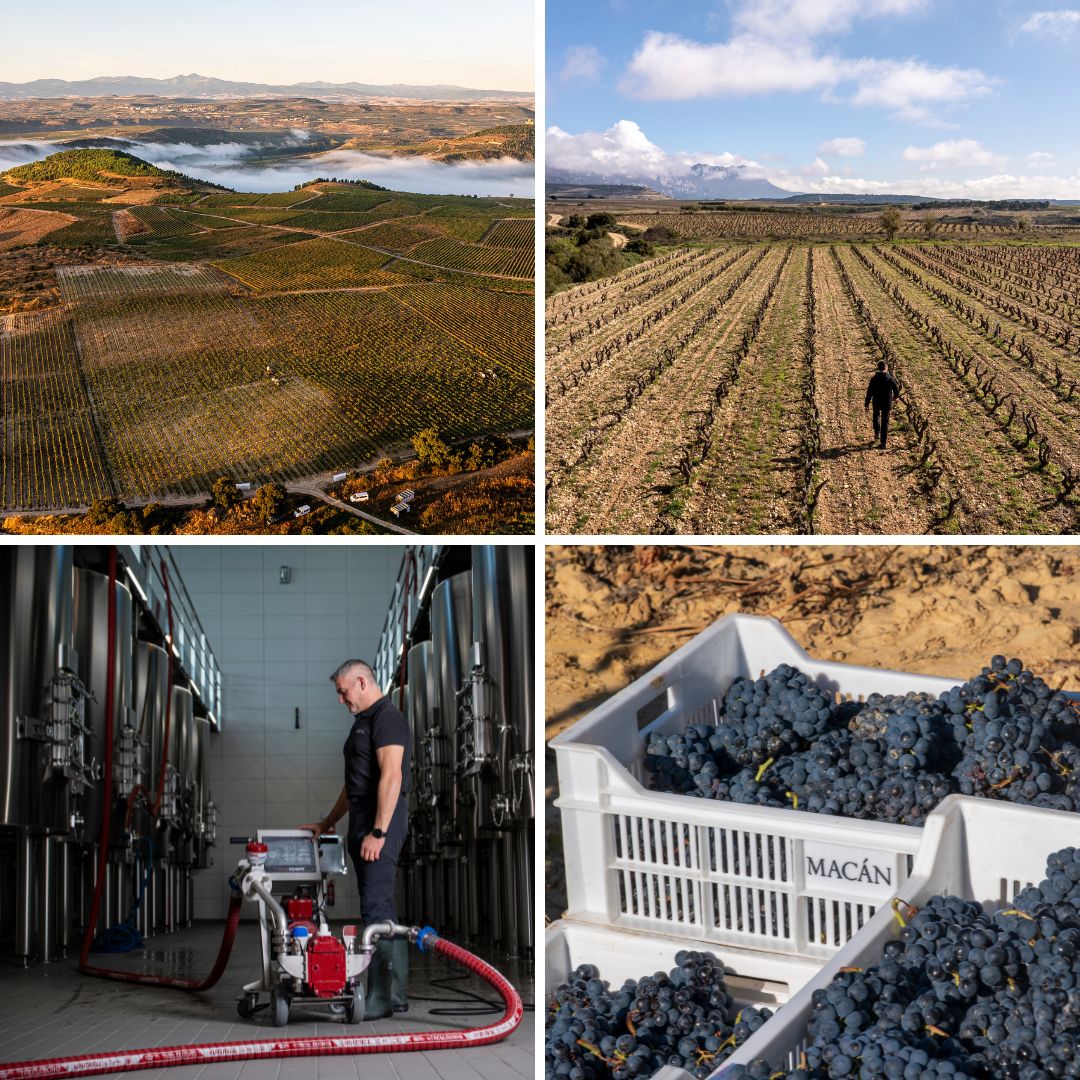
Over the years, Macán managed to build an impressive mosaic: around 100 hectares, spread across roughly 176 different plots across Rioja Alta and Rioja Alavesa. It is not a single estate in the romantic sense, but rather a carefully assembled patchwork of terroirs, each contributing something specific to the final wines.
San Vicente de la Sonsierra on its hilltop in Rioja.
The heart of that patchwork lies around San Vicente de la Sonsierra, a village that has become increasingly synonymous with top-level Rioja. It is not just picturesque, with its castle and church watching over the landscape, but viticulturally privileged. Ignacio speaks about the area with admiration: altitude, orientation, and the presence of limestone create a framework for wines with structure and finesse.
Rioja in Autumn, when the patchwork of vineyards becomes very clear.
It is also the place that gave Macán its name. The people of San Vicente are known locally as the “Macanes,” and choosing that word was more than branding. It was a tribute, and also a way of anchoring the project to a community that, in many ways, represents the soul of Rioja.
A Winery Built Under Pressure
There is an irony in that story, Ignacio admits. The winery itself is not in San Vicente, but in nearby Samaniego, close to the Sierra Cantabria. When the opportunity came to build there, the location was simply too compelling to ignore.
Still, it wasn’t immediately welcomed by everyone. Ignacio jokes that some locals felt the project had taken “the beautiful girl” out of the village. Over time, that tension faded, and today the connection is deeply practical as well as symbolic. Much of the workforce comes from San Vicente, and the relationship between the winery and the village has become strong again—built on trust, shared work, and the reality that Macán’s identity remains inseparable from its vineyard origins.
For Ignacio personally, Macán has also been a journey into wine from the outside. He did not grow up in the sector, having worked in banking, tourism and consulting before joining the project more than a decade ago. He describes his move into wine as arriving “from the desert” into something unexpectedly beautiful. The winery, the vineyards, the two families behind it—everything about the project felt like a gift.
A-Grade facilities in the newly built Macan winery.
Yet that gift came with responsibility. One of the most demanding chapters was the construction of the winery itself, built between 2015 and 2016 and needing to be ready for harvest. Ignacio calls it one of the toughest periods of his career. It was a race against time, and failure was not an option.
The facilities are built in service to the winery’s vineyards and their terroir.
The result is a modern facility designed around precision. It is not a showpiece built to impress visitors first, but a tool built to understand terroir and translate it into wine. The ability to vinify by plot, to isolate vineyard expression, and to manage the smallest details of élevage is central to how Macán has evolved.
From First Vintages to a Turning Point
Macán’s first commercial vintage was 2009, produced in rented facilities in Leza. The early years were experimental, full of learning, and inevitably shaped by limitations. But 2014 marked a shift. An exhaustive terroir study gave the team a deeper understanding of what they actually had in their hands.
Both Macan wines took shape in the vineyards at first.
Then 2016 became the real turning point. With the winery finished, the tools in place, and the vineyard knowledge growing, Macán could finally start becoming what it was always meant to be: a Rioja defined by precision rather than assumption, and by identity rather than reputation alone.
Two Wines, Two Personalities
From the beginning, the project produced two wines: Macán and Macán Clásico. The original concept was influenced by Bordeaux, with the idea of a first and second wine. But Ignacio explains that this framing gradually became less useful. The names themselves don’t suggest hierarchy, and the wines are no longer treated that way. Today, the estate speaks of two identities—two different styles rather than one wine and its understudy.
Macán, the flagship, is designed for structural complexity and elegance. The best grapes for this style come from higher terraces and poorer, limestone-rich soils, often from older vines that naturally deliver concentration without excess weight.
Different vineyard selections are followed by strong quality inspections at the winery.
Macán Clásico, by contrast, is built around freshness and fruit, with what Ignacio calls a “rock and roll” personality. Its ideal parcels are found in lower areas, closer to the Ebro River, where vineyard conditions can be more generous and the fruit expression more immediate.
Even the release strategy supports this identity. Clásico is generally released earlier, roughly a year ahead of Macán, not because it is “lesser,” but because it is meant to show its energy and freshness sooner. In Ignacio’s view, it was an important decision not only for the wine itself, but also for helping people understand the difference between the two bottles.
The Search for Soul
A key figure in Macán’s refinement is winemaker Gonzalo Iturriaga, who joined the project and made his first vintage in 2015. Ignacio speaks about him with a mixture of admiration and honesty. The early wines were undeniably good, but something was missing. They lacked what he calls “soul”—a sense of identity beyond quality.
Gonzalo’s challenge was not to make Macán more powerful, but to make it more itself. Rioja tannins, Ignacio explains, are extremely sensitive. If you extract too hard, you lose finesse and the wine becomes heavy. Gonzalo pushed the team away from aggressive extraction and toward something closer to infusion—less force, more patience. The idea was not to build muscle, but to build structure that feels natural.
Both Macan wines consequently follow their own path when it comes to vinification and ageing.
As the wines evolved, so did the details of élevage. In the early years, the wines leaned heavily on new French oak. Today, that percentage has been reduced significantly, allowing fruit and site to take a more natural role. Large-format oak has become increasingly important too, bringing a different kind of integration—less obvious oak imprint, more texture, more finesse. Ignacio describes the effect almost poetically, as velvet-like smoothness, a kind of sweetness and polish that feels structural rather than aromatic.
Small Changes, Big Results
Macán’s progress has not come from one dramatic revolution, but from many small decisions that add up over time.
One of the most important changes in recent vintages of Macán has been the introduction of Graciano. Macán Classico in turn now sees some Garnacha added. In 2020 this began as a subtle addition—just enough to bring lift and freshness without challenging Tempranillo’s dominance. In 2021 the proportion increased slightly, and Ignacio suggests it is now part of the long-term direction. Both are classic Rioja grapes, historically important, and in the context of warming seasons, they offer exactly what Macán is chasing: tension, energy and a sense of line.
The same mindset applies to experimentation. Ignacio describes Macán as a place where Gonzalo has room to explore, to test, and even to invest years into a single idea. One example is the development of their own yeast, a project that took seven years and was only implemented from 2020 onwards. Ignacio admits he is not a technical winemaker, but he could taste the difference immediately: more fineness, more freshness, more control.
The vineyard side has evolved too, not only through ownership but also through sourcing. While Macán initially focused exclusively on estate fruit, the reality of Rioja is that access to the best plots is not always achieved through purchase. Over time, the winery began working with external growers, testing, rejecting, learning, and gradually building relationships. Ignacio is open about it now, and proud of it. The key, he insists, is respect: if you want great grapes, you must pay for them.
From Context to Glass: Macán on the Tasting Table
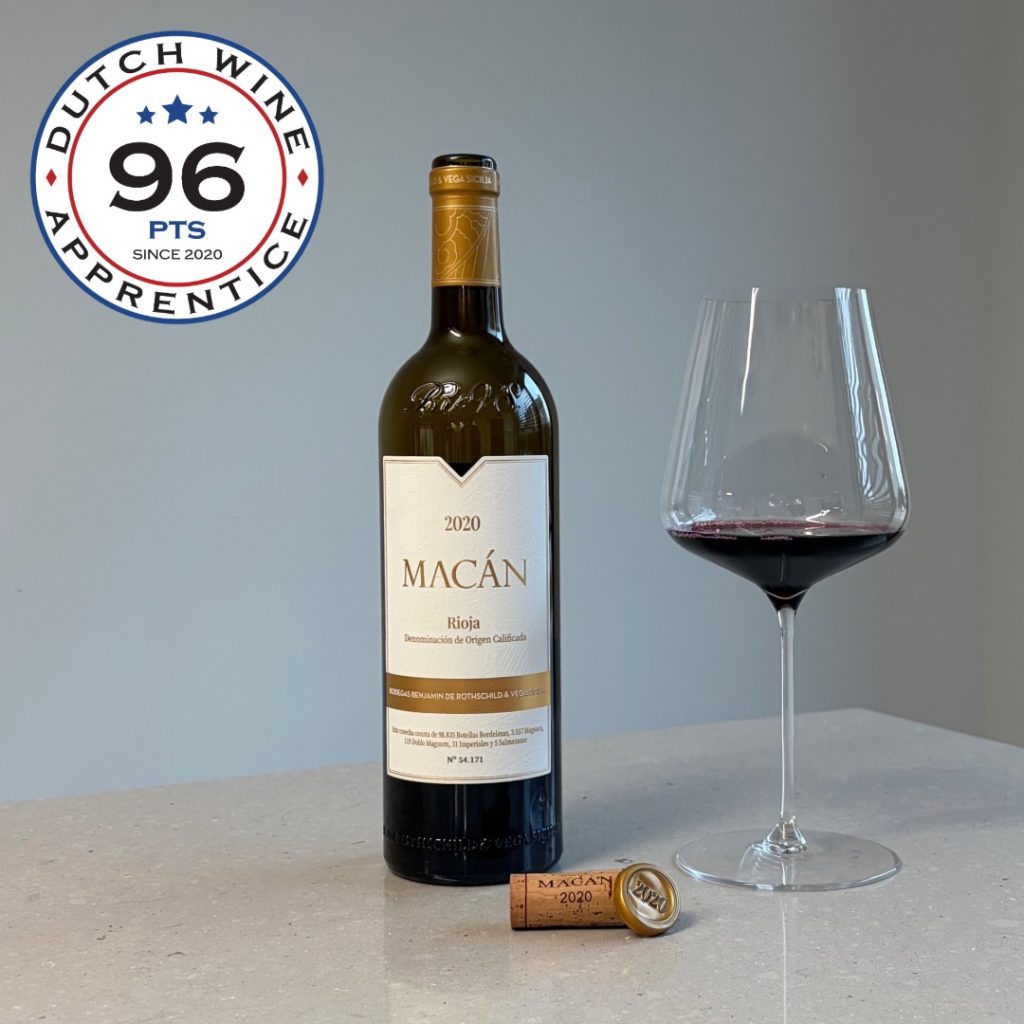
Macán 2020 | Rating: 96/100 DWA score
Macán 2020 is a wine that speaks in measured tones rather than dramatic gestures. Aromatically, it opens with dark berries, plum skin and a refined savoury edge, moving into graphite, cedar, tobacco leaf and finely integrated spice. There is no sense of excess here. Everything feels composed, layered and deliberate.
On the palate, the wine is structured and architectural, with tannins that are present but polished, shaping the fruit rather than overpowering it. The mid-palate shows depth and calm authority, while freshness keeps the wine agile and precise. The finish is long, savoury and increasingly mineral, suggesting that the wine’s best years remain ahead.
Macán 2020 feels like a clear statement of intent: modern Rioja built on restraint, proportion and longevity.
2020 Macan – 96 point DWA score.
Macán Clásico 2021 | Rating: 94/100 DWA score
Macán Clásico 2021 immediately leans into a more energetic and fruit-driven personality. The nose shows bright cherry, blackberry and juicy plum, supported by gentle vanilla, sweet spice and a subtle herbal lift.
The palate is vibrant and fluid, prioritizing freshness and momentum. Fruit remains the center of gravity, yet the wine retains seriousness through its underlying structure and finely managed tannins. Oak is present but well judged, adding shape and texture without distracting from the wine’s youthful, “rock and roll” expression.
Clásico 2021 delivers exactly what its identity promises: a modern Rioja that is approachable earlier, without sacrificing precision.
2021 Macan Clásico – 94 point DWA score.
Conclusion – Rioja’s Future, Written in Real Time
Macán is still young by Rioja’s standards, yet it already carries the clarity of a project that knows exactly what it wants to become. What makes it compelling is not simply the weight of the names behind it, but the discipline of its evolution: vineyard by vineyard, decision by decision, vintage by vintage.
The partnership between Vega Sicilia and Benjamin de Rothschild brought resources, experience and global presence, but Ignacio’s story makes it clear that none of that replaces the hard part: earning identity. Macán’s progress has been defined by the willingness to question early assumptions, to refine technique without losing regional character, and to accept that greatness is built slowly—never declared quickly.
Respect for Heritage and Openness to Innovation make a Bright Future for Macan.
In a region that often balances tradition with reinvention, Macán feels like a modern Rioja written in real time: rooted in San Vicente’s limestone and culture, shaped by precision in the cellar, and driven by a long horizon that most wineries can only talk about.
This is not a finished story. But it is already a serious one.
This article is written by our own Niels Aarts. We would like to thank Bodegas Benjamin de Rothschild & Vega Sicilia, in particular Ignacio Calvo de Mora, for their time and the opportunity to write this article. The wines are imported and distributed in the Netherlands by Colaris, and available for professionals and direct sale. Picture credits: Bodegas Benjamin de Rothschild & Vega Sicilia.
Join our insiders’ list and get exclusive early access to new articles, expert tips, and fresh reviews delivered straight to your inbox. Subscribe now and be the first to discover!