Join Our Wine Journey – Sign Up for the Newsletter 🍷
Gut Hermannsberg: Time as a Quality Decision
Share
Deel op X (twitter)
LinkedIn
WhatsApp
Gut Hermannsberg: Time as a Quality Decision.
The story of Weingut Gut Hermannsberg, in Germany’s Nahe region, is closely intertwined with the history of German wine. At the beginning of the twentieth century, the Prussian state launched an initiative to revitalize viticulture. The aim was to restore the production of quality wine in the aftermath of the Phylloxera crisis that had devastated European vineyards, while also addressing the broader economic difficulties facing the wine sector.
Remarkably, the chosen site had never been planted with vines. The south-facing slopes around the villages of Niederhausen and Schlossböckelheim in the Nahe region consisted largely of rocky hillsides with scattered oak trees and the remains of an abandoned copper mine. Establishing vineyards here required extraordinary effort. Without modern machinery, rock had to be broken and removed by hand, while explosives were used to shift hundreds of cubic metres of stone. Only after years of labour were the first vines planted, around 1903.
Turning into a Wine Business
The estate was first established as the Domäne Niederhausen-Thalböckelheim and soon entered a period of prosperity. German Rieslings ranked among the most sought-after wines in the world during the 1920s, which certainly contributed to the estate’s reputation. The following decades, however, brought difficult times, with the two World Wars marking the lowest point.
In 1998 the state estate was privatized, partly reflecting the political question of whether a government should remain involved in wine production. The first private owner renamed it “Ehemalige Staatsweingut” (“Former State Winery”), but the wines failed to restore the historical reputation of the property.
A new chapter began in 2009, when the entrepreneurial Reidel family acquired the estate and relaunched it as Gut Hermannsberg following substantial investment.
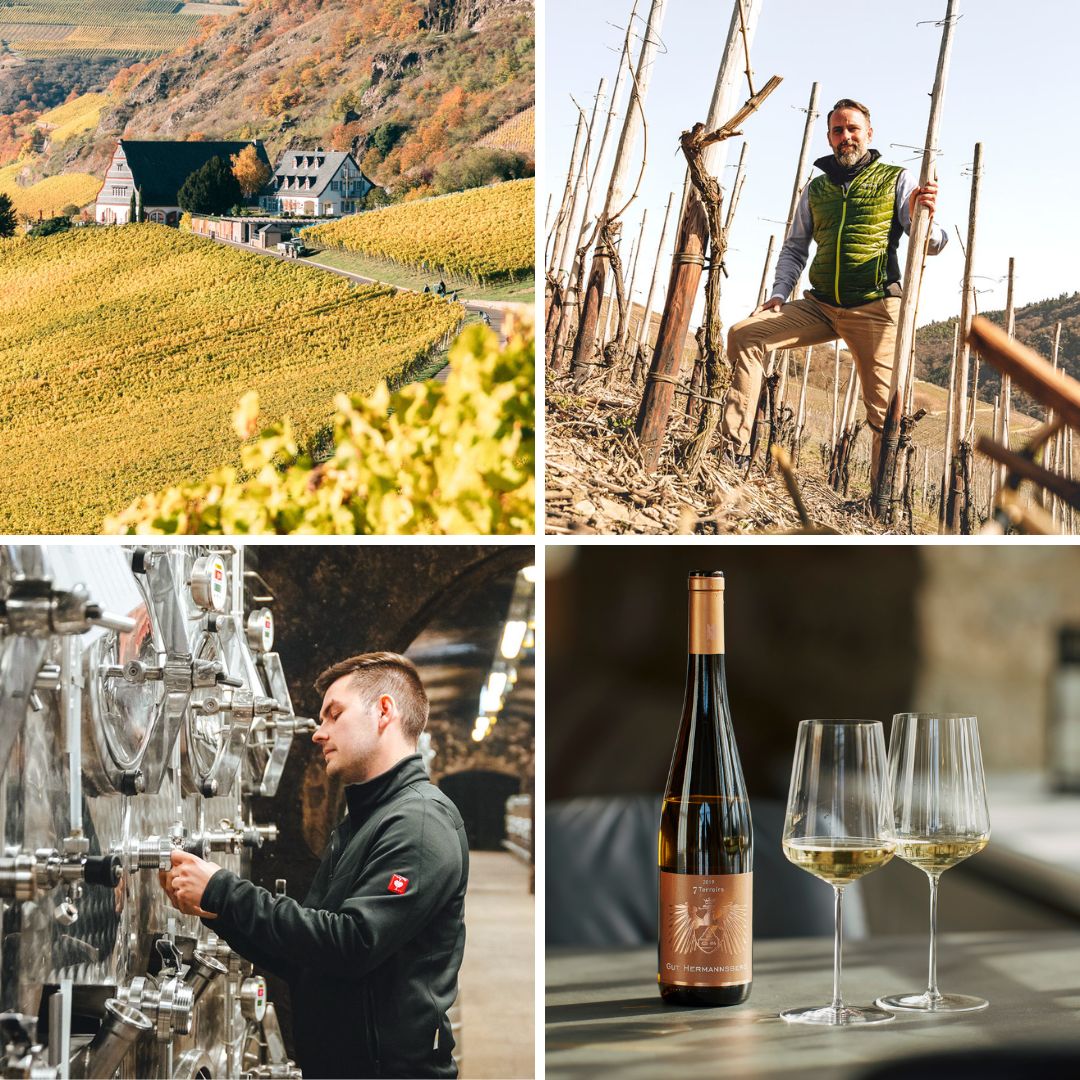
Weingut Gut Hermannsberg.
Seven ‘Grosse Lagen’ Around the Estate
During an online tasting with managing director Achim Kirchner it became clear which decision now defines the estate’s position within the German wine landscape.
Before addressing that choice, however, it is worth considering the vineyards themselves.
Gut Hermannsberg cultivates around 30 hectares of vines, all classified as VDP.GROSSE LAGE. The VDP, Verband Deutscher Prädikatsweingüter (today VDP.Die Prädikatsweingüter), is Germany’s association of leading wine estates, whose members adhere to a strict vineyard and wine classification system that complements national wine law. VDP.GROSSE LAGE represents the highest vineyard classification, broadly comparable to Grand Cru.
Gut Hermannsberg on the slope, amidst its vineyards.
Gut Hermannsberg owns seven of these ‘Grand Cru’ sites of which five lie directly around the estate. From the terrace, the surrounding vineyards define the landscape: Hermannsberg rises behind the estate, Felsenberg lies further west, and Steinberg to the east. Directly in front stands the imposing Kupfergrube, while In der Rossel remains hidden behind the Steinberg. Two additional sites, Bastei and Rotenberg, are located a few kilometers away.
The Decision to Wait
Winemaker Karsten Peter and Managing Director Achim Kirchner believe that their top wines are often released too early to fully express their quality. In particular, the VDP.Grosse Gewächse (dry wines from VDP.Grosse Lage vineyards) require time to fully express their structure and site character.
Managing Director Achim Kirchner and Winemaker Karsten Peter.
The estate therefore began experimenting with delayed releases. In 2015, a small portion of the Kupfergrube GG was held back for two additional years before release. Even that proved insufficient to show the wine’s full potential. Today several GGs are released only after five years. By then the wines have begun to open and display greater clarity of site expression while still retaining youthful energy.
To support this approach, the estate constructed a new underground cellar that allows the wines to mature under stable, cool conditions. The decision was not without risk. Holding back flagship wines requires both financial patience and confidence that the market will understand the intention. Over time, however, this policy has become one of the defining elements of Gut Hermannsberg’s identity.
The Online Tasting with Achim Kirchner
A year ago, a visit to the estate offered the opportunity to experience first-hand the estate’s remarkable setting above the Nahe. This year’s online tasting, organized by Wine+Partners, provided a continuation of that experience.
Achim Kirchner selected a representative line-up of wines to illustrate the current style and philosophy of the estate. Across the entire range, from Gutswein to Grosses Gewächs, the wines follow the same fundamental approach in the cellar: manual harvest, spontaneous fermentation and ageing on the fine lees. Depending on vineyard, fruit quality and vintage conditions, the wines may be matured in neutral oak casks.
Within each vineyard, grapes are harvested parcel by parcel, and vinification is also carried out separately. For this purpose, Karsten Peter has more than 120 oak casks of varying sizes at his disposal.
A Frost Night in April 2024
The 2024 vintage was dramatically shaped by a single night. Between 23 and 24 April, an unexpected frost hit the region. An unusually early budbreak meant that the young shoots were already exposed when temperatures dropped sharply.
By the following morning the damage was evident. The shoots had turned brown and withered. At Gut Hermannsberg roughly eighty percent of the crop was lost in a single night. Vineyards throughout the Nahe and several other German wine regions were similarly affected.
The Tasting Table
Now let’s take a closer look at the wines that featured our tasting.
Gut Hermannsberg 2024 7 Terroirs Riesling trocken | VDP.Gutswein | 91/100 DWA score
Because Gut Hermannsberg owns exclusively VDP.Grosse Lage vineyards, even the estate wine originates from grand cru sites. Normally younger vines or barrels not selected for GG are used for this cuvée. In 2024, however, the severe frost reduced yields so dramatically that the estate decided to declassify the harvest from all vineyards and assemble it into this wine.
Bright pale lemon in the glass. The nose is expressive and inviting, offering summer blossom, ripe peach and a hint of passion fruit, supported by subtle creaminess and a stony freshness.
The palate is generous yet remarkably poised. Juicy stone fruit and ripe citrus unfold over a rounded texture, while lively acidity provides freshness and precision. Despite the wine’s concentration, it remains fluid and effortless.
The finish lingers on lemon zest, citrus pith and a saline mineral note. Remarkable depth for an estate Riesling.
7 Terroirs and Vom Vulkan.
Gut Hermannsberg 2023 Vom Vulkan Schlossböckelheim Riesling trocken | VDP.Ortswein| 91/100 DWA score
The grapes for this Ortswein originate entirely from the volcanic soils of the VDP.Grosse Lage Kupfergrube in Schlossböckelheim. The terroir here is defined by melaphyre, a volcanic rock that gives the wines their characteristic smoky and mineral edge. After maceration, the wine fermented spontaneously and matured partly in stainless steel and partly in old large oak Stückfass (1000 – 1200 liter).
Bright lemon-yellow in the glass. The nose is pure and lively, initially marked by a crackling flinty reduction that gradually reveals preserved lemon, lemongrass, ripe grapefruit and verbena. Subtle smoky mineral notes underline the volcanic origin of the site.
The palate is taut, vibrant and extremely juicy. Ripe lemon and pink grapefruit are joined by peach skin and delicate stone fruit, framed by lively medium-plus acidity. A saline, stony core runs through the wine, giving it both tension and precision while keeping the profile lean and focused.
The finish is long, mouthwatering and distinctly mineral, lingering on citrus zest, saltiness and crushed stone.
Gut Hermannsberg 2023 Schlossböckelheim Felsenberg Riesling GG | VDP.Grosses Gewächs | 93/100 DWA score
The imposing Felsenberg vineyard is one of the warmer sites in Schlossböckelheim, with soils dominated by volcanic melaphyre and porphyry. The wine matured for almost a year on the fine lees in used oak Halbstück casks (600 liter).
The nose initially shows a reductive character, giving the wine tension and energy before gradually opening with aromas of lemon and lime zest, rhubarb, green apple and blossom honey. With air, subtle smoky and flinty notes emerge, alongside a gentle creaminess that adds further depth.
On the palate, ripe citrus takes center stage. Amalfi lemon and grapefruit are framed by precise acidity, creating a vivid, energetic structure. The texture is both juicy and rounded, combining freshness with a subtle creamy dimension. Notes of green apple, citrus segments and delicate green herbs contribute additional complexity.
The finish is long and finely saline, with lingering citrus zest and a pronounced mineral tension. Even in its youth the wine is remarkably animated and seductive, yet its structure clearly suggests that a few years of cellaring will allow its full depth to unfold.
Felsenberg and Hermannsberg.
Gut Hermannsberg 2020 Niederhausen Hermannsberg Riesling GG Reserve | VDP.Grosses Gewächs | 94/100 DWA score
The monopole Hermannsberg vineyard lies only a short distance from the Kupfergrube, yet differs markedly in soil composition. Here dark slate and loess dominate, complemented by volcanic material introduced during historical mining activity.
After spontaneous fermentation the wine matured for two years in cask and was subsequently aged in bottle before being released as a GG Reserve.
Pale yellow in the glass with a subtle green hue, indicating remarkable youthful freshness. The nose is initially restrained, gradually unfolding with aromas of green apple, grapefruit and almond, followed by blossom honey and delicate notes of warm stone. With aeration, further layers appear, including Mirabelle plum, lemon zest and hints of dried citrus peel, alongside subtle nuances of tobacco and dried fruit.
On the palate the wine is precise and linear, defined by a stony mineral core. Juicy Mirabelle and vineyard peach are framed by citrus freshness, while the texture gains a gentle roundness with air, revealing faint herbal nuances reminiscent of a delicate tisane. Despite the warmth of the vintage, the structure remains focused and finely chiselled.
The finish is long, elegant and finely textured, with lingering citrus zest, mineral salinity and a subtle tingling persistence. A wine that balances ripeness with clarity, expressing the Hermannsberg site through finesse rather than power.
Kupfergrube.
Gut Hermannsberg 2019 Schlossböckelheim Kupfergrube Riesling GG Reserve | VDP.Grosses Gewächs | 95/100 DWA score
The south-facing Kupfergrube vineyard was established on the site of a former copper mine. Its soils are dominated by volcanic melaphyre, partly covered by dark slate brought to the surface during historical mining activity.
The wine matured partly in stainless steel and partly in large oak casks and was released as a GG Reserve after extended bottle ageing.
Bright light gold in colour. The nose is expansive yet precise, opening with ripe stone fruit and citrus-driven aromatics. Notes of lemon tart, orange peel and ripe peach unfold alongside red currant, quince and a distinct smoky minerality. With air, the aromatic profile becomes increasingly lifted, revealing dried citrus peel and a stony, almost saline freshness that reflects the volcanic site.
The palate is broad on entry, showing both concentration and depth. Flavours of peach, quince and citrus are supported by subtle hints of honey and tropical fruit, while vibrant acidity keeps the wine tightly focused. Despite the wine’s evident power and density, the structure remains remarkably precise, with the mineral core lending a chiselled firmness to the texture.
The finish is saline and persistent, with juicy peach and citrus zest returning alongside a pronounced mineral drive. A wine of considerable substance and site expression, combining power with clarity and elegance, and promising further development in bottle.
Conclusion
This tasting highlighted not only the distinct personalities of the individual vineyards, but also the estate’s commitment to clarity and balance across the range. The decision taken at Gut Hermannsberg to hold back the top wines for around five years prior to release is an approach that remains rare and adds considerable value, allowing the wines to enter the market with greater composure, while preserving their capacity for further development. In this respect, Gut Hermannsberg continues to position itself as one of the reference points for dry Riesling in the Nahe.
The winery surrounded by vines.
This article is written by our own Marc Roovers. Picture credits: Gut Hermannsberg and Peter Bender. Many thanks to Henrike Heinicke of Wine+Partners for organizing the online tasting, and to Achim Kirchner of Gut Hermannsberg for the generous presentation and thoughtful selection of wines, which provided a coherent and insightful overview of the current range.
Join our insiders’ list and get exclusive early access to new articles, expert tips, and fresh reviews delivered straight to your inbox. Subscribe now and be the first to discover!