Join Our Wine Journey – Sign Up for the Newsletter 🍷
Fontanafredda, Icon with a Pulse
Share
Deel op X (twitter)
LinkedIn
WhatsApp
Fontanafredda, Icon with a Pulse.
Reporting for Dutch Wine Apprentice, Onno Deumer travelled to Serralunga d’Alba for a three-day residency at Fontanafredda: host to the 2025 edition of Serralunga Day, and more than a footnote in Barolo’s history. This visit was not limited to a single tasting or event. It unfolded across multiple sites, conversations and shared moments — all curated by the estate itself. The result: a deeper encounter with a place that continues to shape not only its region, but the conversation around what it means to be a Barolo institution in motion.
The experience began at Cascina Galarej, one of several accommodations on the Fontanafredda estate. Waiting at the table was Roberto Bruno, CEO of Fontanafredda and an unmistakable presence across the next few days. From that first meeting — a lunch shared with fellow international press — it was clear this was not going to be a standard press trip. Fontanafredda was not just welcoming us. It was inviting us in.
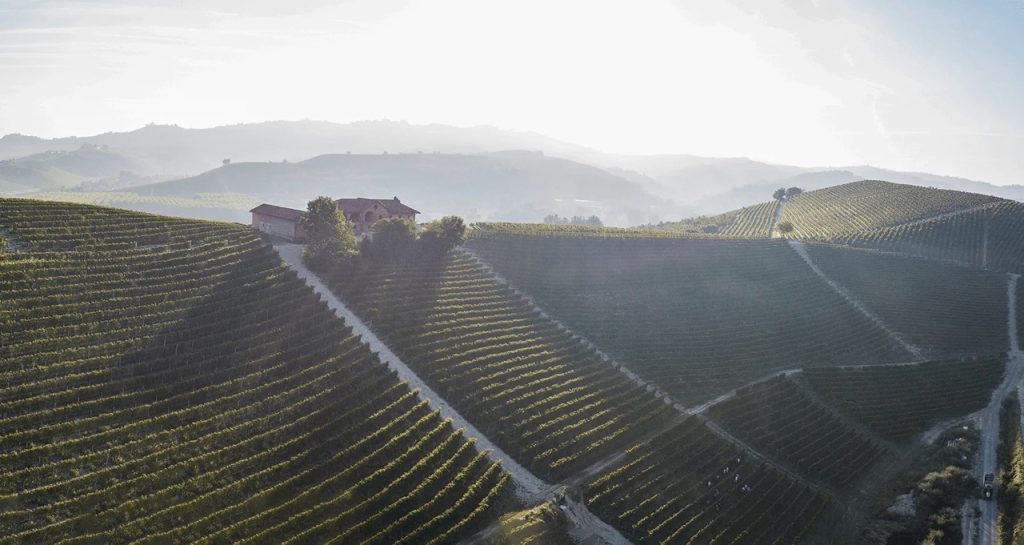
Cascina Galarej, perched above the morning mist — the starting point of a deeper encounter with Fontanafredda.
This article is not a producer profile. It is a report from inside: Fontanafredda as a living estate, observed up close over the course of three days. A place where history and ambition converge — and where the wine continues to speak for itself.
From Royal Gift to Modern Player
Fontanafredda is, by all accounts, one of the most historically significant estates in Barolo. Its story begins in 1858, when Victor Emmanuel II — then King of Sardinia, later the first king of unified Italy — acquired the land as a gift for his mistress, later wife, Rosa Vercellana. A decade later, their son Emanuele Guerrieri di Mirafiori — often referred to as Emanuele Alberto — took charge of what had already become a functioning wine estate. From the very beginning, Fontanafredda’s identity was shaped by scale, vision and political symbolism. The expression “wine of kings, king of wines” was no empty phrase: here, it was literal.
The estate grew quickly under Emanuele Alberto’s guidance, expanding both vineyard holdings and cellar capacity while also investing in people: housing for workers, a church, administrative buildings. Fontanafredda became a kind of rural village organised around wine. Technical milestones soon followed — from one of the first uses of concrete fermentation tanks in Europe (1887) to early international distribution across Europe and the Americas. At its peak, Fontanafredda was producing over a million bottles per year. Barolo, here, was both an agricultural product and an expression of national identity.
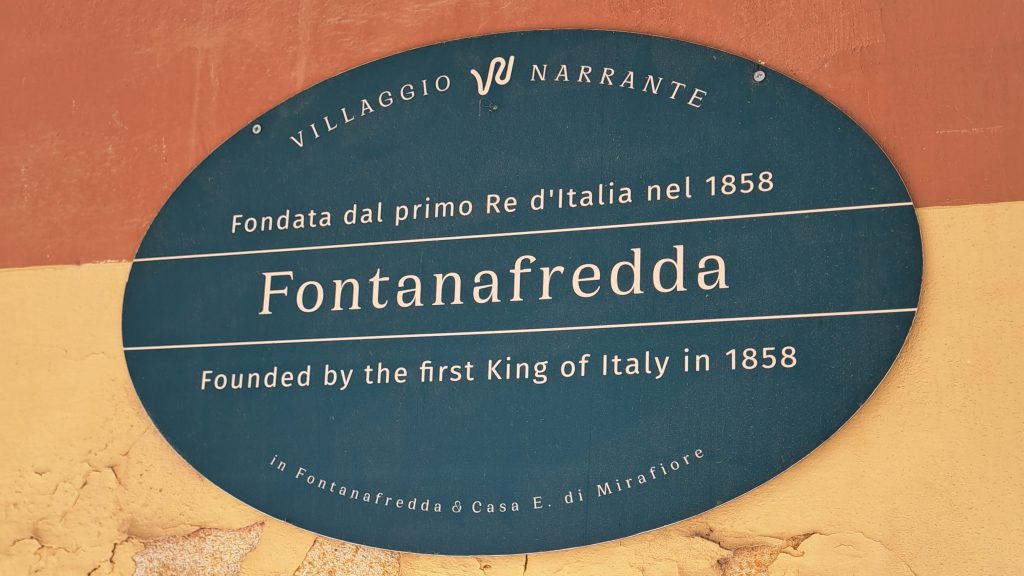
Founded as a royal gift, Fontanafredda still carries the legacy of Victor Emmanuel II — the first King of unified Italy.
What followed was a period of turbulence: phylloxera, two world wars, and a long transition from private to institutional ownership. In 1931, Fontanafredda was acquired by Monte dei Paschi di Siena, a Tuscan bank with historical roots, marking the estate’s shift from family stewardship to financial management. Some chapters from this period are rarely told. But what matters more is the continuity of presence: Fontanafredda remained in production throughout the 20th century, one of the few Barolo estates to never fully pause its output.
The modern turning point came in 2008, when Oscar Farinetti — founder of the global Eataly food and wine marketplace — led a consortium to acquire the estate and bring it back under Piedmontese ownership. With that came a new era: one defined not by a single oenologist or stylistic manifesto, but by long-term investment in people, vineyards, communication, and sustainability.
Under Roberto Bruno’s leadership, Fontanafredda has repositioned itself not simply as a historic estate, but as a relevant one. Its voice in the Barolo landscape is firm, but not dominant. Its production is large, but quality-focused. And its values — biodiversity, organic viticulture, accessible hospitality — are aligned with a more contemporary idea of what it means to be a wine institution today.
The past is still present at Fontanafredda. But it no longer defines the estate. It supports it — quietly, structurally — as new chapters are written above.
Scale Without Distance
Fontanafredda is the largest contiguous estate in the Langhe, with over 120 hectares of certified organic vineyards under its direct management. That fact alone sets it apart. But what becomes clear during a visit — and even more so over the course of three full days — is that scale here does not translate into detachment. It expresses itself through diversity, integration, and a careful sense of balance.
The estate is, quite literally, a village. Winding footpaths connect accommodation sites, restaurants, cellars, offices and woodland. Each space has its own function and personality. Cascina Galarej, where we stayed, overlooks the vineyards and houses a modern tasting room and pool; the more classical Hotel Le Case dei Conti Mirafiore lies lower on the hill, surrounded by history; a third building, the Vigna Magica, is geared towards weddings and events. Add to that three dining concepts, including the Michelin-starred Guido Ristorante, and the picture becomes clear: Fontanafredda is built to host, receive, and operate — at a scale few other producers in the region could sustain.
Yet none of it feels corporate or over-engineered. Even the walk through the tunnel that connects cellar to tasting room — a dim, winding passage carved under the estate — speaks more of continuity than showmanship. The large-format botti, the neat stacks of barriques, the long cellar corridors: they’re functional, but also serve as quiet reminders that wine here is not made in haste. Every space, from the production halls to the forest trails, feels integrated. The estate lives at multiple speeds.
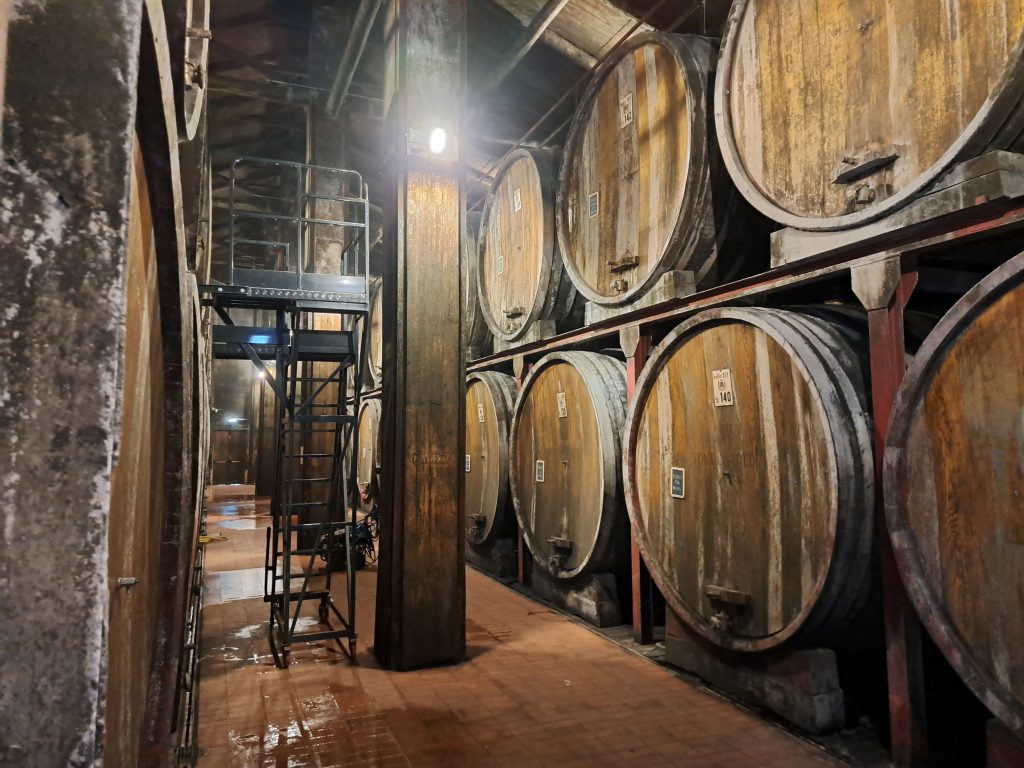
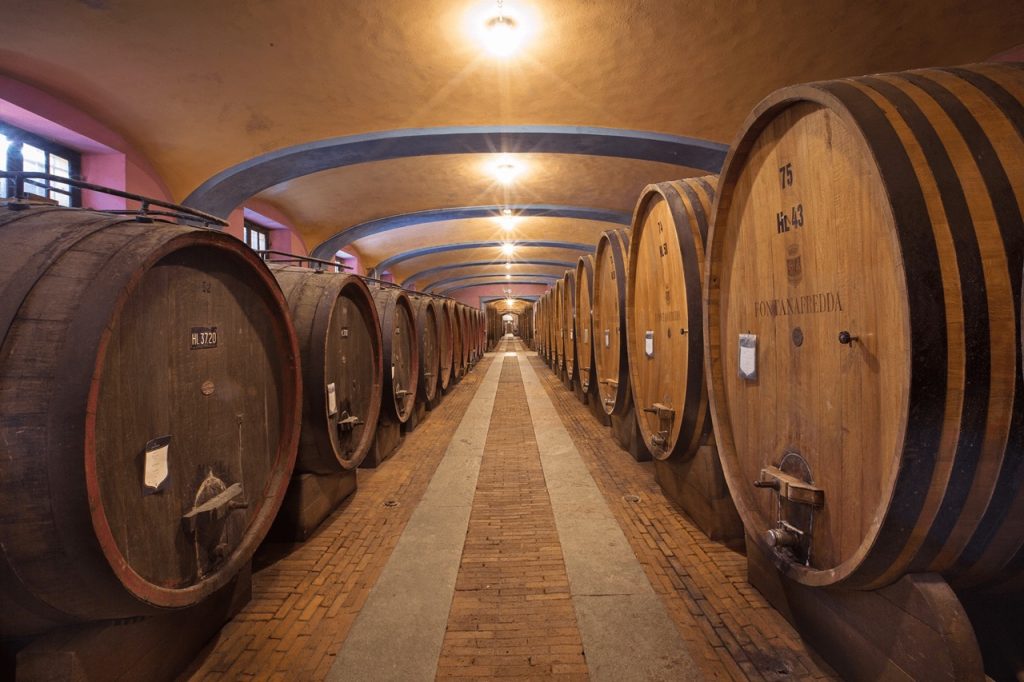
In Fontanafredda’s historic cellar, traditional botti rest in quiet rhythm — shaping Barolo not for today, but for time.
That idea — of managing complexity without losing focus — runs through the entire Fontanafredda approach. In the vineyard, multiple MGAs (Menzione Geografica Aggiuntiva) are farmed, each with different exposition, soil type and altitude. In the winery, there’s room for large-scale bottlings as well as cru-level micro-vinifications. In hospitality, Fontanafredda serves everyone from wedding guests to wine collectors to walking tourists. But the unifying thread is attention. Attention to environment, to experience, and above all, to identity.
What could easily feel like an empire, or a theme park, instead feels like a landscape with intent. The sum is large — but the parts remain human.
Conversations at the Core
In any estate of scale, you look for the people who embody the place — who carry its history forward while shaping its direction. At Fontanafredda, those roles are clearly defined: Roberto Bruno and Giorgio Lavagna.
Roberto, the CEO, greeted us at the first lunch and remained a consistent presence throughout the visit. Tall, composed, and engaging, he brings a mix of strategic clarity and human warmth to the role. He moves with ease across settings — lunch with journalists, a technical walkthrough of the cellars, a quiet aside during a tasting. He speaks of Fontanafredda not as a brand, but as something layered: a working estate, a cultural symbol, a source of pride.
That perspective came through not just in conversation, but in how he guided us. Every part of the estate tour had intention. In the cellar, we paused at the large-format botti used for Barolo maturation — some decades old, still in active use. In the underground tunnels that connect the core buildings, the quiet and cool air spoke for itself. When we reached the archive room — a vault containing a bottle from every vintage since 1961 — the point was made without needing explanation: this estate is built on continuity.
Roberto’s leadership style is visible not only in infrastructure, but in people. His team moved confidently, yet with a sense of shared purpose. The agenda across the three days was full, but never rushed. Nothing felt overly orchestrated. Instead, it felt like Fontanafredda letting us into its rhythm — from soil to glass, from boardroom to bottling line.
Then came Giorgio Lavagna — winemaker, technical lead, and in many ways the other half of the estate’s voice. Giorgio is not the kind of winemaker who speaks in headlines. He stays mostly in the background, offering observations through a translator, choosing words carefully and with precision. But when he talks, you listen.
Lavagna’s reflective style is just one of the approaches shaping Serralunga d’Alba today. For a broader view on the personalities defining the village’s wine scene, read Serralunga d’Alba, One Village, Four Archetypes.
We met during a focused tasting session, where Giorgio presented several wines across different MGAs. His style is reserved, but not cold. He avoids sweeping statements, preferring to frame choices in terms of site, timing, and balance. Cold maceration, large-format oak, extended fermentations — for Giorgio, these are not trends or signatures. They are tools, adjusted per vintage, per cru. His language is practical, but his thinking is philosophical.
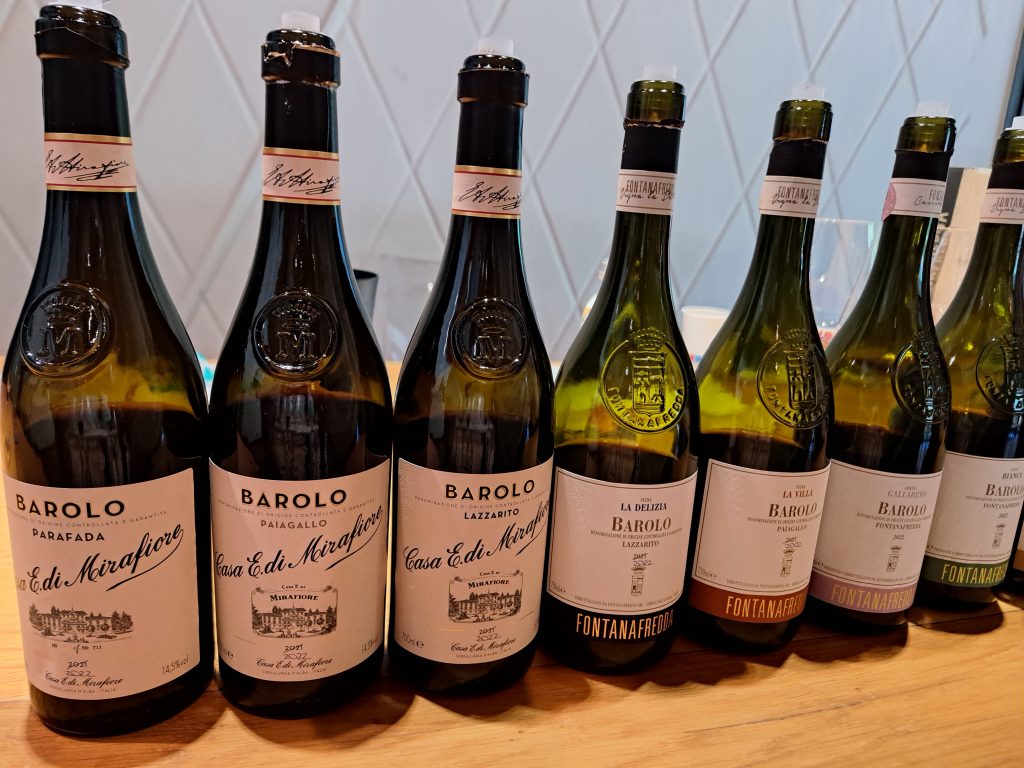
During a focused tasting, Giorgio Lavagna presented Barolos from across the estate’s MGAs — not to showcase variety, but to show intent.
What became apparent through both men was a shared orientation: Fontanafredda is not here to make noise. It is here to make continuity possible. To take the scale it has, the history it holds, and render both legible through the lens of wine.
Roberto gives Fontanafredda its voice. Giorgio gives it form. And together, they animate the institution from the inside.
Thinking in Decades – Wine as a Narrative
Fontanafredda occupies a distinctive space in the Barolo landscape. While not typically included in the traditionalist-modernist dichotomy, it carries traits from both. The estate has long maintained a stylistic consistency: long macerations, restrained oak influence, and a preference for expressing vineyard identity over cellar imprint. Yet it has also embraced modern tools and adapted where needed — not to follow trends, but to serve its scale and philosophy.
Unlike the Barolo Boys of the 1990s, Fontanafredda never abandoned tradition in pursuit of immediacy. But neither does it claim purity for its own sake. Its winemaking choices are shaped by context: site, vintage, intended drinking window. This pragmatic ethos has enabled the estate to occupy a bridging role — between past and present, structure and finesse, regional heritage and global relevance.
That ethos was especially visible in the challenging but promising 2022 vintage. For detailed tasting notes and vineyard context, see The 2022 Barolo Vintage Uncovered.
At the core of this philosophy is Nebbiolo. While the estate produces other varieties — including Dolcetto, Barbera and international grapes — Nebbiolo remains the narrative thread. With vineyard holdings across multiple MGAs, Fontanafredda is uniquely positioned to express the varietal through different altitudes, expositions and soil types. Rather than fixate on a single identity, the house builds a mosaic: Serralunga d’Alba power here, the elegance of Vigna La Rosa — a historic single vineyard on the estate known for its finesse and aromatic clarity — there, and everything in between.
In the winery, the process is measured but not rigid. Cold maceration is often used to preserve aromatic detail. Fermentation times vary, but always aim to balance tannic extraction with freshness. Wood use is careful: large-format botti dominate, but barriques are used in certain cuvées where structure or site demands it. Giorgio Lavagna’s approach is not to impose a house style, but to enable each vineyard to speak. His language during our tasting was pragmatic, yet layered. Rather than declare a signature style, he spoke of adjustments: site by site, vintage by vintage. Winemaking here is not about asserting control — it’s about guiding expression.
This philosophy becomes especially clear in the estate’s single vineyard wines, where site, season and cellar align into something more reflective than declarative.
Vigna La Delizia Barolo 2022 – From La Delizia within Lazzarito, marl close to the surface and less clay define a wine of balance rather than brawn. Aromas of red fruit mingle with balsamic lift and gentle spice. The palate shows measured grip from tannins, acidity providing clarity, and a finish of notable length. In contrast to more forceful MGAs, this stands out for poise and layered elegance. Its complexity deepens with time in the glass, making it arguably the most articulate voice of the estate.
DWA-Score: 93/100
Vigna La Villa Paiagallo Barolo 2022 – The wine suggests heavier tannins, yet the texture is more about firm grip than raw power, driving body and length rather than austerity. Aromatically it leans floral, with roses and violets layered over the clay soils typical of its Barolo hillside, contributing both complexity and poise. The palate feels energetic, its activity high, carrying fullness without weight. Round, assured, and structured, it speaks of maturity while retaining freshness, a convincing expression of site expression.
DWA-Score: 92/100
Gallaretto Barolo 2022 – From a higher vineyard in the Fontanafredda MGA, acidity naturally elevated. Freshness allows extended maceration, building tannic depth, reinforced by the thicker-skinned clone. Automatically more savory than fruity: licorice, subtle herbs, anise and bay leaf rising over clay-driven structure. The palate feels layered, tannins firm yet integrated, acidity lending length and poise. It’s a thoughtful expression – discipline and softness in rare coexistence, echoing both soil and meticulous winemaking.
DWA-Score: 92/100
If there is one element that truly sets Fontanafredda apart, it may be their thinking around time. In the centre of the estate lies a modest, climate-controlled archive room. Inside are bottles from every vintage since 1961, methodically stored, referenced, and occasionally revisited. These are not museum pieces. They are part of the estate’s working knowledge: a way to taste decisions, observe evolution, and remind the team that their work is not made for today.
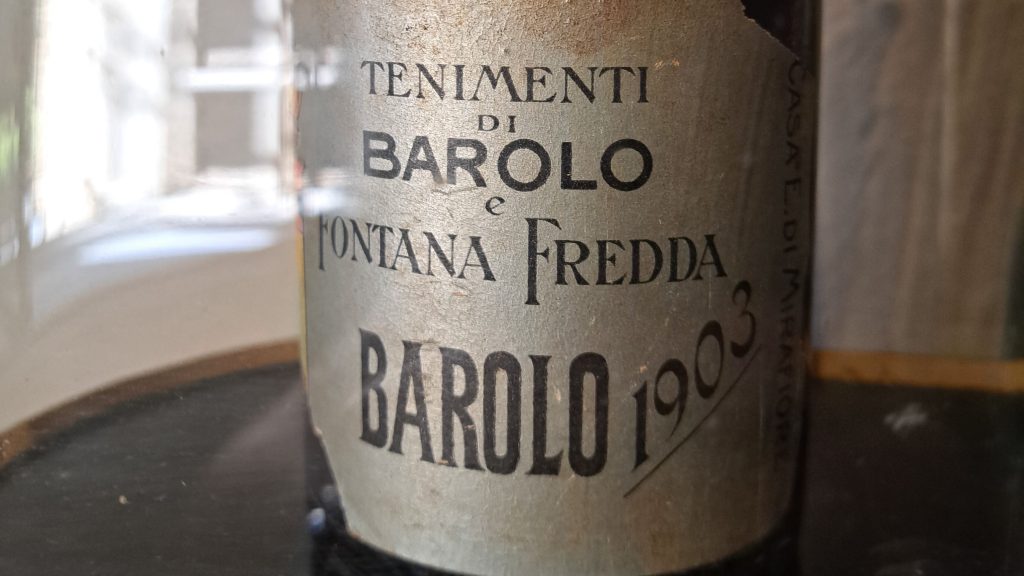
Stored in Fontanafredda’s archive room, bottles like this 1903 Barolo embody the estate’s philosophy: wine as a record, not just a product.
Fontanafredda’s long-view approach is not limited to the cellar. A fixed share of each vintage is held back and released gradually over fifty years — a rare practice, and one that signals just how seriously the estate treats the idea of wine as a cultural record.
That same mentality guides the production and ageing policy. Many wines are released only after years of bottle rest. Some special releases — such as the Barolo Riserva – Vigna La Rosa — are held back for a decade or more. Even the use of older botti is intentional: not because they’re romantic, but because they work. At Fontanafredda, the passage of time is not a risk to manage. It is a collaborator. A necessary partner in a style that is built to endure, not impress.
In a region increasingly shaped by immediacy — in winemaking, in media, in markets — Fontanafredda holds to a longer view. It is not nostalgic. But it is patient. And in wine, that may be the most radical position of all.
Present Without Overstating
At Serralunga Day 2025, Fontanafredda was the official host — a natural choice, given its position, resources and centrality within the commune. But what stood out was not their prominence. It was their restraint. There was no domination of the stage, no overt branding or scripted messaging. Instead, Fontanafredda made space: for other producers, for the narrative of the village, for the wines themselves. It was coordination, not choreography.
That attitude mirrors how the estate operates more broadly. Fontanafredda is not small, and it doesn’t pretend to be. But its scale is rarely wielded for display. Rather, it is used to facilitate — infrastructure, events, hospitality, long-term planning. The estate hosts without overshadowing, leads without loudness.
This is not to suggest modesty. Fontanafredda knows its place in the Barolo world, and it has the means to act accordingly. It maintains a production volume others can only dream of. It runs a hospitality network that includes hotels, restaurants, guided tastings and site visits — many of them operating at high standard, some at exceptional level. And it engages internationally, speaking across borders while staying rooted in Serralunga d’Alba.
Here, tradition holds its weight — but the path ahead remains open. At Fontanafredda, leadership means leaving room for others to walk alongside.
What prevents this from turning into spectacle is the guiding sense of coherence. There’s no attempt to be all things to all people. Instead, Fontanafredda presents itself as a complete thought — historically aware, operationally mature, and stylistically focused. Its institutional presence is not cold. It’s connective. And that may be why it continues to matter: not because it demands attention, but because it earns relevance over time.
In Serralunga d’Alba, where steep slopes and strong wines often define the discourse, Fontanafredda adds something else — something architectural. It provides the structure in which others can move, speak, and grow. And that, too, is a form of leadership.
This article is part of a four-part series on Serralunga Day 2025. Read more:
With sincere thanks to the team at Fontanafredda and their Dutch importer Vinites, for their openness, precision, and generosity throughout our three-day visit. Special thanks to Roberto Bruno, for his vision, clarity and hospitality; to Giorgio Lavagna, for guiding us through the wines with quiet depth and thoughtful intent; to Emilia, for coordinating every detail with warmth and grace; and to Livia, for bringing a personal, welcoming spirit to the experience. Their commitment made this portrait possible.
Join our insiders’ list and get exclusive early access to new articles, expert tips, and fresh reviews delivered straight to your inbox. Subscribe now and be the first to discover!