Join Our Wine Journey – Sign Up for the Newsletter 🍷
Finca La Emperatriz: A Single‑Estate Vision in the Heart of Rioja Alta
Share
Deel op X (twitter)
LinkedIn
WhatsApp
Finca La Emperatriz: A Single‑Estate Vision in the Heart of Rioja Alta.
In a region long defined by volume, blending and powerful brand identities, Finca La Emperatriz (part of Hermanos Hernáiz) deliberately positions itself at the opposite end of the spectrum. In conversation with Eduardo Hernáiz, a clear and coherent philosophy emerges: Rioja understood as a place of origin and identity, expressed through estate-grown wines and a single-estate approach that remains rare within the denomination.
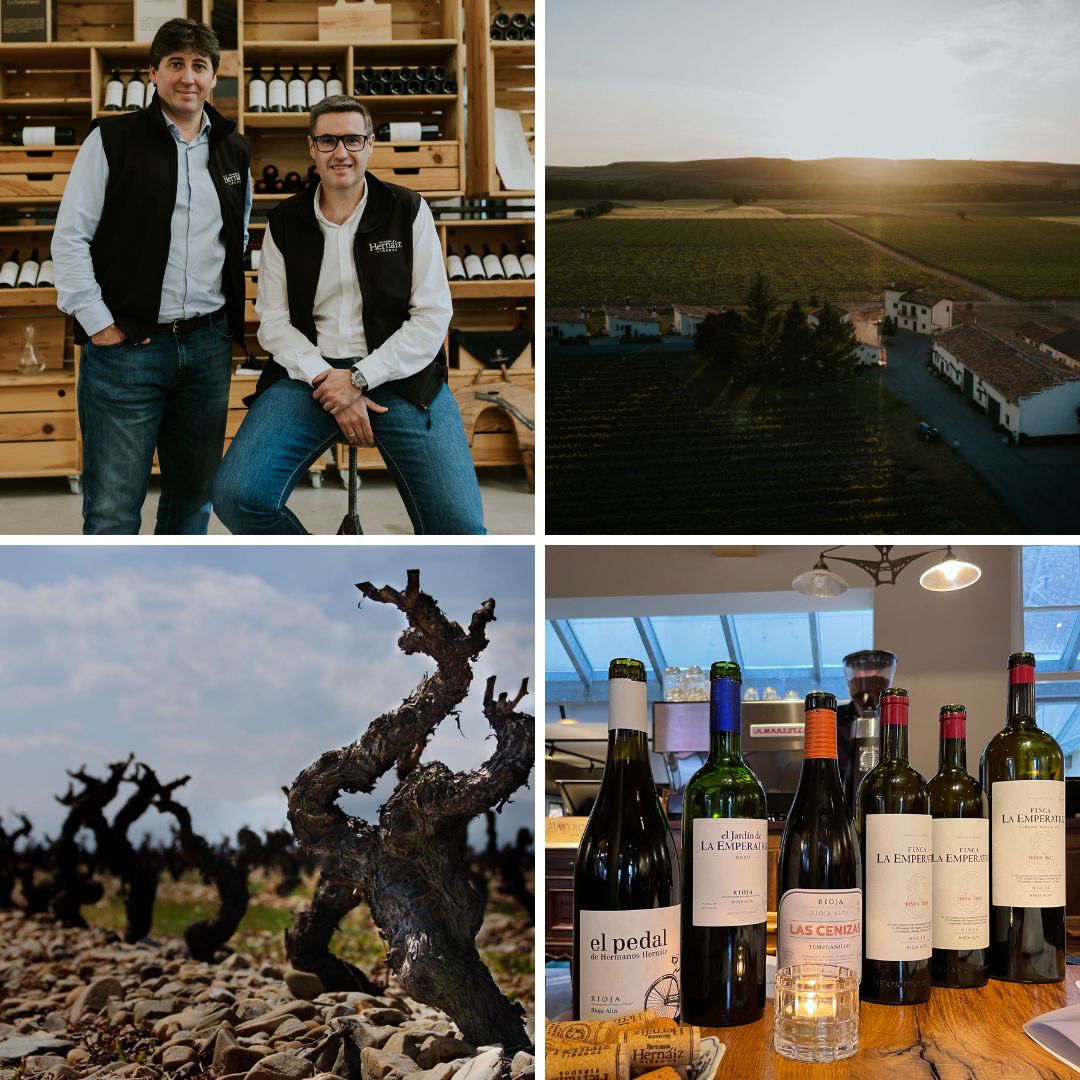
Our Inma Muñoz and Eduardo Hernáiz at the tasting.
Alongside our discussion with Eduardo, we also had the opportunity to taste a selection of his wines during a lunch hosted by their importer, Icarius, allowing the estate’s vision to be evaluated directly in the glass.
Two Realities within Rioja
According to Hernáiz, Rioja has effectively developed into two parallel worlds. On the one hand are the large industrial players, sourcing fruit from cooperatives and growers across the region and accounting for the majority of production. On the other are smaller, artisan producers working exclusively with their own vineyards. Finca La Emperatriz, as part of Hermanos Hernáiz, firmly belongs to the latter group.
All wines are made solely from estate-grown grapes. No fruit is purchased, and no bulk wine is brought in. This decision, while limiting in volume, is fundamental to the estate’s identity and its ability to communicate terroir.
The property lies in Rioja Alta, between Haro and Ezcaray, roughly ten kilometers from the Ebro River. This western location places the vineyards under a predominantly Atlantic–continental influence, making it one of the coolest areas of Rioja. Hernáiz describes it as the most classical expression of the region, particularly suited to Tempranillo: wines with freshness, firm structure and the capacity to evolve slowly over time.
The Oja Valley and a Historic Estate
Finca La Emperatriz is located in the Oja Valley – the valley that gave Rioja its name. Today, the estate covers around 70 hectares of vineyards, more than half of which are old vines averaging around sixty years of age and farmed organically.
Thirty‑two hectares of these old vineyards are classified as Viñedo Singular, making Finca La Emperatriz the largest producer within this category. In a region where single‑vineyard bottlings are typically small and fragmented, this scale is highly unusual.
The estate and its old vines take a unique position in the Rioja wine scene.
The historical roots of the estate are equally distinctive. The land once belonged to Eugénie de Montijo, the last Empress of France and wife of Napoleon III. In the 19th century she oversaw wine production on the property, before her death brought winemaking to an end. The Hernáiz family acquired the estate in 1986, and in 2000 resumed vinification, reconnecting the vineyards with their original purpose.
From Grape Growing to Estate Bottling
For many years, as was common practice in Rioja, the family sold its grapes to established bodegas. Only with the construction of their own winery at the turn of the millennium did the possibility arise to express the estate’s terroir directly in bottle.
Finca La Emperatriz.
The early years were marked by experimentation: different parcels, single varieties, and stylistic explorations. With experience, travel and exposure to international benchmarks, the estate’s vision gradually crystalized. Rather than isolating plots or varieties, the focus shifted towards coherence – blending Tempranillo, Garnacha and Viura as historically done in Rioja, but with modern precision and strict selection.
This evolution led to a deliberate simplification of the portfolio: two white wines and two red wines, each clearly positioned within a defined hierarchy.
Grand Vin and Second Wines
At the top sit the wines labelled Finca La Emperatriz, produced only in the best vintages and sourced from the oldest vineyards. Both the red and white wines carry the Viñedo Singular designation and represent the purest expression of the estate. Production is highly selective: typically, no more than 15% of total output qualifies for these wines.
Below them are El Jardín de la Emperatriz, named after the garden located at the heart of the vineyards where tastings are held. These wines are designed to be more approachable, earlier‑drinking and more accessible in price, while retaining a clear link to the estate’s character. The model is consciously reminiscent of the Bordeaux concept of grand vin and second wine.
Alongside these sits El Pedal, sourced from a different valley (Iregua), characterized by red clay soils and a slightly warmer microclimate. Here, the emphasis is on fruit purity, freshness and minimal oak influence. Conceived as a wine for immediate enjoyment, El Pedal has nonetheless surprised the estate with consistently strong critical reception.
Returning to Old Vines and Estate Genetics
A central element of the current philosophy is the return to traditional bush vines (en vaso). Younger vineyards previously planted on trellising systems are being reassessed, with some removed and replanted using massal selections taken from the estate’s oldest vines.
Hernáiz argues that these old genetic materials offer not only greater complexity, but also improved resilience in the face of climate change. Bush vines, in his view, cope better with heat and hydric stress, while naturally limiting yields.
Old vines at the Finca.
Average production across the estate is deliberately kept low, around 40 hectolitres per hectare, prioritizing concentration, freshness and site expression over volume.
Winemaking: Restraint and Integration
In the cellar, the approach is notably restrained. Fermentations rely on indigenous yeasts, with concrete tanks playing a central role. The flagship red wine is a field blend dominated by Tempranillo, complemented by Garnacha and a small proportion of Viura. After fermentation and malolactic conversion, the wine undergoes extended ageing in French oak, followed by several years of bottle ageing before release.
The barrel cellar at the winery.
The white wines follow a similarly measured path. Fermentation takes place partly in oak, followed by ageing on the lees in concrete. The aim is not to build overt richness, but to integrate oak and fruit while preserving tension and freshness. Lees are used as a protective and structural element rather than a tool for overt texture.
Wines are only released once they are considered internally balanced, a philosophy that translates into notable ageing potential and a sense of composure even at release.
In the Glass: Interpreting Finca La Emperatriz
The range from Finca La Emperatriz clearly reflects the estate’s layered approach to Rioja: from wines designed for immediate pleasure to more structured bottlings built on old vines and extended ageing. Tasted side by side, the wines underline a consistent stylistic thread — freshness, balance and restraint — while each cuvée expresses its specific origin, intent and position within the portfolio.
2023 El Pedal Blanco | 100% Viura | 90/100 DWA score (IM)
El Pedal Blanco is conceived as a pure, uncomplicated expression of Viura, placing freshness and drinkability at the forefront. The nose is clean and inviting, with aromas of fresh white fruit, citrus zest and a subtle mineral touch. On the palate, the wine is light, fresh and tasty, supported by well-integrated acidity that keeps it crisp and lively. Its straightforward, fruit-driven style makes it particularly well suited to light meals, appetisers or as an aperitif.
2023 El Pedal | 100% Tempranillo (from different vineyards) | 90/100 DWA score (IM)
Production: Aged in large, used barrels. Before bottling, 10% of wine from the previous harvest is blended in, having spent one year in oak to add complexity.
El Pedal Tinto is all about charm and immediate pleasure, without losing its Rioja identity. The nose offers red berries and cherries, layered with subtle toasted notes and a touch of liquorice. The palate is fruity, aromatic and fresh, with a lively, easy-flowing character. Oak influence is deliberately restrained, adding gentle complexity rather than structure. A natural and very enjoyable pairing with Iberian ham.
The wines at the tasting.
2023 El Jardín de la Emperatriz Blanco | 100% Viura | 91/100 DWA score (IM)
Production: Hand-harvested grapes, mostly from vineyards over 60 years old. After fermentation, the wine remains on its fine lees for two months.
This wine marks a clear step up in depth and texture. The nose combines fresh white fruit with white flowers, aromatic herbs and lifted citrus notes. On the palate, it is flavorful and more full-bodied, showing almost ripe white fruit, balanced by a fresh and persistent acidity that brings precision and length. A gastronomic style of Viura that reflects both old vines and careful élevage.
2020 El Jardín de la Emperatriz Tinto | 95% Tempranillo, 4% Garnacha, 1% Viura | 91/100 DWA score (IM)
An elegant and accessible Crianza-style Rioja, combining fruit purity with well-judged oak influence. The nose reveals ripe red fruit such as cherry and raspberry, supported by notes of vanilla, coconut and sweet spices, with light toasted nuances in the background. The palate is balanced and silky, with fine tannins and refreshing acidity. The wood is seamlessly integrated, adding depth without masking the fruit. Medium-long, very pleasant finish.
Elegant, fresh and approachable.
2023 Finca La Emperatriz Blanco | 100% Viura | 92/100 DWA score (IM)
Production: Aged for 4 months on its lees, followed by 8 months in concrete tanks and 9 months in barrels.
The flagship white of the estate shows composure and quiet complexity. The nose is clean and precise, with aromas of white fruit, pear, citrus and delicate white flowers such as jasmine. On the palate, it is smooth yet vibrant, with well-integrated acidity providing structure and flow. A subtle savoury note adds depth and tension to the finish, underlining its serious, age-worthy profile.
2018 Finca La Emperatriz Tinto| 76% Tempranillo, 20% Garnacha, 4% Viura | 93/100 DWA score (IM)
Vineyard: 50–65-year-old bush vines at 570 metres altitude
Bright cherry red in colour, the 2018 of the estate’s flagship red appears slightly more youthful than the 2017, with good intensity and clarity. Aromas of fresh red and black fruit are complemented by vanilla, soft coconut and a touch of sweet spice, giving a direct and expressive profile. On the palate, the wine is balanced and silky, with gentle tannins and lively acidity bringing freshness and lift. Oak supports the wine without dominating. Medium-long finish and highly drinkable.
Elegant, accessible and harmonious – a finely judged Rioja.
Rioja, identity and positioning
Although the introduction of the Viñedo Singular classification coincided with the estate’s repositioning, Hernáiz stresses that it was not a regulatory-driven decision. The focus on origin and identity predated the classification, which nonetheless provides a useful framework to communicate quality distinctions within Rioja.
In a region where the same appellation name appears on entry‑level supermarket wines and top‑tier terroir expressions alike, Hernáiz sees the future in clearer differentiation – and in producers willing to articulate a precise, uncompromising vision.
Estate grown and estate bottled wines at Finca La Emperatriz.
This article is written by our own Inma Munoz and Niels Aarts. We would like to thank Eduardo Hernáiz and their importer Icarius for their time and opportunity to taste the wines. Finca La Emperatriz is distributed in the Netherlands by Icarius, and available for direct sale and sold through selected partners.
Join our insiders’ list and get exclusive early access to new articles, expert tips, and fresh reviews delivered straight to your inbox. Subscribe now and be the first to discover!