Join Our Wine Journey – Sign Up for the Newsletter 🍷
Dr. Crusius: Historic Vineyards, Contemporary Nahe Wines
Share
Deel op X (twitter)
LinkedIn
WhatsApp
Dr. Crusius: Historic Vineyards, Contemporary Nahe Wines.
On a cold Monday morning at the start of the year, we first drove to Rheinhessen to visit the majestic Weingut Rappenhof (read our report here). After a great tasting, we thought it wise to conclude the visit to our neighbors in the east with another special winery in the tiny Nahe region. Weingut Dr. Crusius, located in Traisen, was only 45 minutes away and we thought it obligatory to visit, as we were highly impressed by their wines at the annual POOT Agenturen tasting.
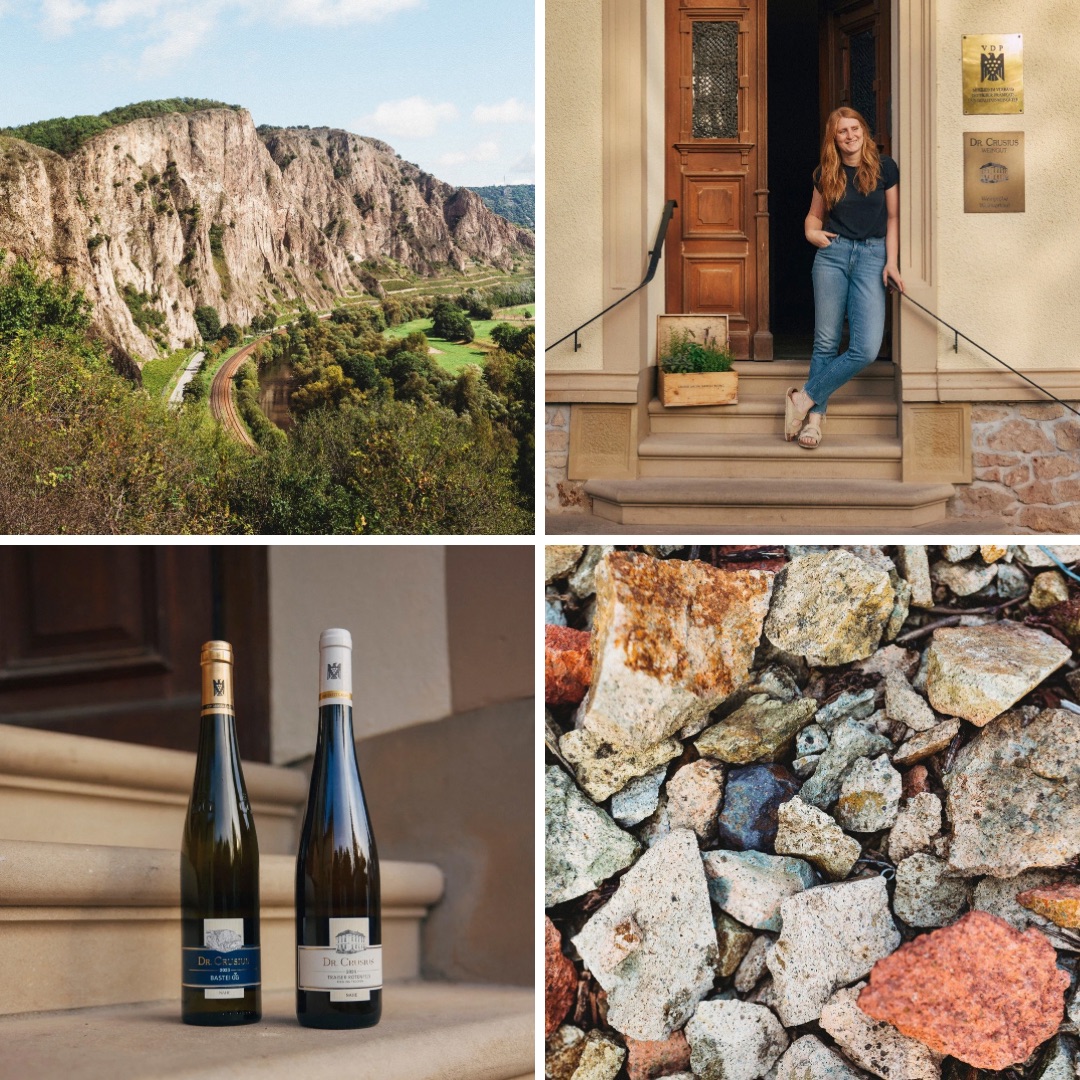
We were welcomed by Rebecca Crusius, the fourth child of the fourteenth generation, into the old house which was erected in 1888. After walking past the office through a narrow corridor, we entered their beautiful tasting room, with a view of their courtyard, and a large stone wall consisting of the iron rich rocks that can be found in their Treisen vineyards. A great start to what would be an even greater tasting.
Past, Present, Pouring Forward
Weingut Dr. Crusius can trace its roots all the way to 1576, as the agricultural establishment was already mentioned in church archives. From the 16th century halfway through the 20th, the Crusius family would engage in mixed agriculture, including viticultural practices. During the fifties of the past century, Hans Crusius (Rebecca’s grandfather), took the wheel after his father passed away and turned the agricultural establishment into a full-fledged Weingut, with 7.5ha to their name. Back then, the winery still bore the name of Peter Crusius (third of his name) from the 11th generation.
The Beautiful Nahe Region and the Vineyards of Dr. Crusius.
Flash forward twenty years or so, and Rebecca’s father, Peter Crusius IV, commences his career at Weingut Peter Crusius and would ultimately replace his grandfather’s name with Dr. after his own academic title in the nineties. Peter expanded the winery to 20ha and was part of the first generation in the Nahe officially allowed to label their wines as part of the Nahe region from 1971 onwards, although they did so a long time before the initiation of new German wine law. In 1984, Weingut Peter Crusius would join the VDP during Peter’s leadership that lasted until 2019. In that year, Rebecca took the helm, freshly graduated from Geisenheim University and with plenty experience under her belt from internships in Franken, Rheinhessen, Okanagan and Rheingau at George Breuer.
Rebecca Crusius at Weingut Dr. Crusius.
Initially, the transition of power from Peter to Rebecca took place at a slow pace. Peter was still heavily involved in decision making, but was forced to abdicate entirely after a knee surgery in 2022. Rebecca’s reign had taken off and the vintage of 2021 was her first subject. One of the most noticeable applications by Rebecca for long-term fans of the winery, might be found in the decline of residual sugar of the wines in comparison to her father’s. Nowadays, the Weingut spans over 30 ha in the beautiful Nahe region.
Unique Soils Shape the Heart of the Crusius Vineyards.
From Bastei to Barrel: The Crusius Craft
With regards to viticulture, location plays a key role to the Crusius family. Over 70% of their vineyards are classified as Erste Lage or Grosse Lagen. Their plots lie in some of the most famous in the Nahe, such as Felsenberg, Kupfergrube in Schlossböckelheim and the breath-takingly beautiful Bastei, alongside Steinberg, Mühlberg in Traisen. Approximately 55% of all plantings accounts for Riesling, 25% Weissburgunder and the rest consists of some Auxerrois, Grauburgunder, Spätburgunder, Frühburgunder and Schwarzriesling; the latter three gaining popularity in the last few years, as the climate is getting warmer. Though Spätburgunder and Schwarzriesling do not seem problematic in any way, Frühburgunder has invited unwelcome guests in the vineyards, for its early ripening attracts wasps, fruit flies and even deer.
The Vines in their Vineyards.
Besides location, passion is another main factor enabling the Crusius family in making their top level Nahe wines. Rebecca does not necessarily work the vineyards organically. However, she does so with the utmost respect for the vines, tending to their every need during the entire year. The Crusius family do not comply with dogmatic beliefs in the vineyards, nor the cellar. They prefer working flexibly and applying whatever method seems necessary to deliver absolute sublimity.
The Wines of Dr. Crusius.
Vinification includes both the usage of indigenous as commercial yeasts, vinification and aging vessels used are stainless steel vats and oak barrels, depending on the specific cuvees. Rebecca forgoes the use of French oak, as cooperage Hösch is only a fifteen-minute drive away from Traisen and supplies Dr. Crusius with their German oak barrels. 300L barrels are the smallest vessels used in the entire range.
The Grand Cru Lineup
In full German style, Dr. Crusius makes many different cuvees (mostly Riesling based, as the grape variety naturally allows for different stylistic choices in wines). Out of all cuvees, we tasted a few, among which were some Erste Lagen wines as well. For the sake of brevity, we will only highlight the GG wines here, although we do highly recommend tasting their premier crus as well.
2023 Steinberg GG
The grapes for the Steinberg GG grow in the eponymous vineyard in two different plots, west from Traisen, hometown to Dr. Crusius. The vineyards enjoy a south-eastern to south-western exposition and the vines are located between 250 to 300 meters above sea level with inclinations up to a whopping 50%. Soil composition consists of clay and porphyre – iron rich, volcanic rocks.
Vinification was done on stainless steel vats, after which a part of the wine is transferred into large oak barrels and the other part is aged in stainless steel vats.
The wine shows leesy aromas, quickly followed by white peach, lemon zest, yellow apples and honey. A whiff of petrol already shines through at this young age and adds to the harmonious nose. Intensely bright acidity with a slightly creamy mouthfeel. Wonderfully fresh with tons of complexity.
We reward this wine with a 92-point DWA score (MC)
Mühlberg GG 2023
Mühlberg is a fillet in the once famous (and now declassified from GG to Erste Lage) Rotenfels, another extremely steep slope with lots of porphyr in the soils, alongside more clay than in Steinberg, and a full southern exposition. Mühlberg is a testament to the great quality once made on this steep slope, and is the only piece that was not declassified to an Erste Lage.
The nose on this wine is not as shy as the Steinberg initially was, quickly introducing itself with a honeyed aroma, alongside yellow apple, leesiness, ripe peach and petrol. Slightly creamier than Steinberg and Felsenberg GG, with a preference for intensity over complexity compared to both aforementioned wines. Nevertheless, a classy wine and a force to be reckoned with.
We reward this wine with a 90-point DWA score (MC)
2023 Felsenberg GG
The Felsenberg vineyard is even steeper than Mühlberg and Steinberg, with inclinations up to 60%. Average age of the vines is 25 years, about ten years older than the vines in Mühlberg. Soil composition is akin to Mühlberg.
Felsenberg combines both freshness and ripeness with a floral tone of elderflower, yellow apple, ripe peach and grapefruit, besides a whiff of honey, petrol and brioche. Wonderful acidity forms the backbone of this wine and complements its fresh fruit.
We reward this wine with a 93-point DWA score (MC)
Our tasting with Rebecca Crusius.
2023 Kupfergrube GG
A vineyard close to a former copper mine, after which it was named. Some copper can still be found in the vineyards to this date, alongside rose quartz and melaphyre – black, weathered volcanic soils. Inclinations vary between 30% and 70% in the vineyard, with a full southern exposition at an altitude between 120 and 250 meters. The wine was fully vinified and aged in stainless steel vats.
Kupfergrube isn’t deemed fan favorite for nothing, as it gracefully shows on both the palate and the nose. The smell of flint and smoke beautifully transitions into lime, white peach, tangerine and a hint of honey. The leesy aromas complement the slightly creamy texture, and are contrasted by the bracing acidity. A gorgeous wine that can consider itself among the best of Germany.
We reward this wine with a 94-point DWA score (MC)
2023 Bastei GG
From the famous Bastei vineyard – at the foot of the Rotenfels massif – that will leave any spectator in awe of its beauty. The cliff forms a barrier to the wind and provides the vines with extra warmth during the growing season. The vineyard enjoys a full southern exposition at an altitude of 120 to 140 meters, inclinations up to 40% and a loam and porphyr rich soil composition. About a third of the wine is vinified and aged in ten- to fifteen-year-old barrels of 300L. The other part is vinified and aged in stainless steel.
This wine exhibits what peak performance entails in the Nahe; with aromas of ripe peach, yellow apple, honeysuckle, flint, grapefruit and petrol, walking the fine line between ripeness and freshness. Bastei is one for those who like to indulge in the most exciting complexity.
We reward this wine with a 95-point DWA score (MC)
Next Gen, Equal Greatness
Dr. Crusius has gained another name in a line of great winemakers and with Rebecca as its forewoman, their future is bright. With less than half a decade spent as its leader, Rebecca has taken Dr. Crusius to the next level and puts forth crisp, clean and nearly clinical wines. With her ability to think critically and fast, and to remain flexible in this ever changing, vinous world, Rebecca shows great skill and competence, which will aid in her becoming one of the best in the region in the coming years. We will be watching from the sidelines, whilst indulging in the delectable wines of Dr. Crusius.
Rebecca Crusius, one of Germany’s Most Talented Young Winemakers.
This article is written by our own Miquel Claase. Picture credits Weingut Dr. Crusius and Peter Bender. We thank Rebecca Crusius for her warm welcome and the tasting, as well as their importer and distributor in the Dutch market Poot Agenturen. The wines of Weingut Dr. Crusius are available in the Dutch market through select partners of Poot Agenturen.
Join our insiders’ list and get exclusive early access to new articles, expert tips, and fresh reviews delivered straight to your inbox. Subscribe now and be the first to discover!