Join Our Wine Journey – Sign Up for the Newsletter 🍷
Château Les Carmes Haut-Brion – Bordeaux Reimagined from Within
Share
Deel op X (twitter)
LinkedIn
WhatsApp
Château Les Carmes Haut-Brion – Bordeaux Reimagined from Within.
There are very few places in Bordeaux where the past and the present collide as directly as they do at Château Les Carmes Haut-Brion. Hidden behind walls in the heart of the city, this historic estate is both a living reminder of Bordeaux’s earliest viticultural history and one of its most contemporary voices. It is an estate that challenges assumptions – about location, classification, style, and even about how Bordeaux should be experienced and consumed today.
During our visit, which combined an in-depth interview with Commercial Director Thibaut Richard and a detailed vineyard and cellar tour, it became clear that Les Carmes Haut-Brion is not attempting to modernize Bordeaux by rejecting its heritage. Instead, it offers a carefully considered reinterpretation of what Bordeaux can be in a changing world, driven by people, place, and a very clear philosophical vision.
A Vineyard Inside the City
Château Les Carmes Haut-Brion occupies a truly unique position in Bordeaux: it is the only working vineyard located entirely within the city itself, complete with a Bordeaux postal code. The estate is enclosed by walls, forming a genuine ‘clos’ known as Le Clos des Carmes. Once inside, the urban surroundings seem to disappear. The sound of traffic is replaced by birds and flowing water, creating an almost surreal sense of isolation in the middle of a major city.
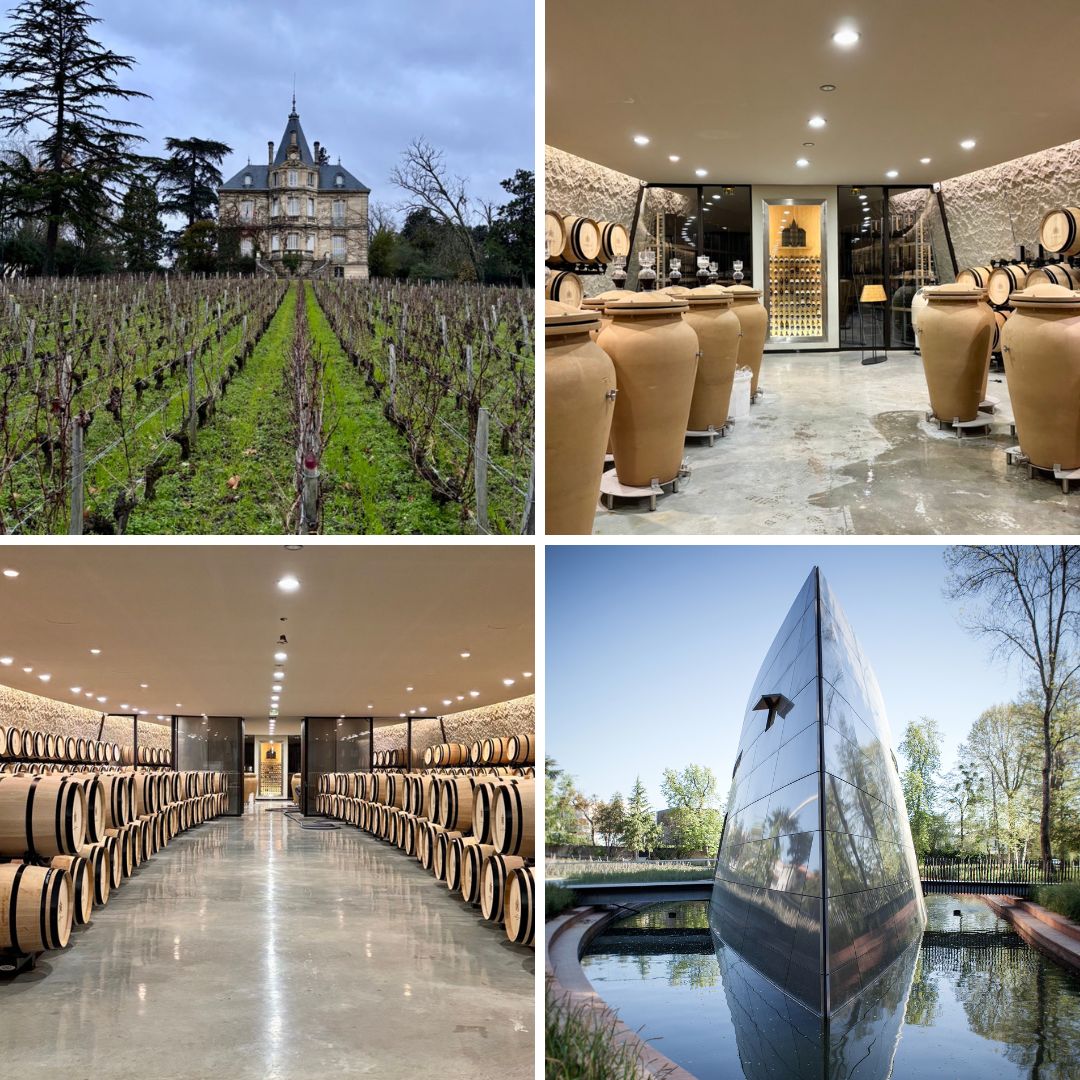
Château les Carmes Haut Brion, an idyllic oasis in the city of Bordeaux.
The vineyard’s history stretches back more than four centuries. Originally part of the broader Haut-Brion holdings, the land was gifted in 1584 by Jean de Pontac to the Carmelite monks, from whom the estate takes its name. The monks cultivated vines alongside their religious duties, embedding viticulture deeply into the identity of the place. Over time, the property passed through various owners, most notably the Chantecaille family, Bordelais négociants who shaped the estate for roughly 150 years and firmly anchored its name in Bordeaux’s wine landscape.
Despite its pedigree, Les Carmes Haut-Brion long remained somewhat under the radar internationally. Among professionals, it was often referred to as a “Sleeping Beauty”: a property with exceptional terroir, history, and potential, but one that had yet to fully express itself on the global stage.
Waking the Sleeping Beauty
That perception began to change in 2010, when the Pichet family acquired the estate. Long-time neighbors of the château, they had looked out on the vineyard for years, fully aware of its latent potential. When the opportunity arose, they purchased Les Carmes Haut-Brion with a clear ambition: to reveal the true quality and identity of this remarkable site.
The transformation began with a deliberate and disciplined approach. Rather than starting with architecture or branding, the first major investment was in people. A new management and technical team, led by Guillaume Pouthier, was assembled around the 2012 harvest, making 2013 the first vintage fully shaped by this renewed vision.
A key element of this strategy was the conscious decision to bring in people from outside Bordeaux. The region is defined by tradition and deeply ingrained codes, and challenging those conventions often requires an external perspective. The Pichet family embraced this, granting the team both trust and autonomy.
For Thibaut Richard, who joined after more than a decade working as a Bordeaux négociant, Les Carmes Haut-Brion represented a rare convergence of heritage and innovation. His commercial background gives him a deep understanding of both market expectations and their limitations, insight that now plays an important role in how the estate positions itself globally.
Guillaume Pouthier (Managing Director) and Thibaut Richard (Commercial Director).
Terroir Defined by Precision
Le Clos des Carmes covers just over seven hectares and has always remained this size. Unlike many historic Bordeaux estates that expanded significantly after classification, Les Carmes Haut-Brion has preserved its original footprint. This continuity is central to its identity and sense of place.
Detailed soil studies revealed extraordinary complexity: no fewer than eighteen distinct soil types within the clos. Clay and limestone dominate, naturally favoring Cabernet Franc, which has become the backbone of the wine. Rather than planting by uniform blocks, the vineyard is treated as a mosaic. Varieties are matched to individual micro-parcels, and co-plantation is used to respect soil diversity and enhance complexity.
The cellar, designed by Philippe Starck and Luc Arsène-Henry.
Vineyard work is carried out with an unusually high level of care. Horses are used instead of tractors to avoid soil compaction and preserve soil life. Replanting is minimal and highly targeted, focusing only on individual vines that require replacement. The guiding principle is respect for the site – not just as an agricultural resource, but as a living historical landscape.
The urban setting also plays a critical role. Surrounded by buildings, the vineyard benefits from a warmer mesoclimate, earlier ripening, and near-complete protection from frost. These conditions allow for consistent maturity while preserving freshness, an important factor in shaping the estate’s distinctive style.
A Cellar Built for Expression, Not Power
The new cellar, first used with the 2015 vintage, reflects the estate’s philosophy perfectly. Designed to provide flexibility rather than impose a fixed winemaking formula, it allows the team to work with a wide range of vessels, including stainless steel, wood, and concrete for fermentation, followed by ageing in barriques, large foudres, and amphorae.
The cellar, impressive on a functional as well as visual level.
Ageing typically lasts between 22 and 24 months. Oak is used not to dominate the wine aromatically, but to facilitate gentle oxygen exchange and tannin integration. The aim is not to imprint flavour, but to refine structure and texture.
Two winemaking techniques are central to the modern identity of Les Carmes Haut-Brion. The first is a high proportion of whole-cluster fermentation, often between 40 and 70 percent. The second is an infusion-style fermentation using submerged caps. Together, these methods allow for precise extraction, prioritizing finesse, balance, and aromatic clarity over sheer power.
The barrel and ageing cellar.
Throughout the visit, one phrase was repeated with conviction: ‘a great wine should be born great, not become great’. This philosophy underpins every decision at Les Carmes Haut-Brion.
Redefining Drinkability in Bordeaux
Perhaps the most striking aspect of Les Carmes Haut-Brion is not technical, but conceptual. The estate actively challenges the long-standing belief that great Bordeaux must be endured in its youth and only enjoyed after decades of ageing.
While the wines undoubtedly possess the structure to age for many years, they are crafted to offer genuine pleasure far earlier. Alcohol levels are modest, acidity is vibrant, and tannins are abundant yet rendered almost imperceptible through texture. The result is a wine that delivers energy, precision, and length without fatigue.
Strategical choices in the vineyard and cellar (such as the use of amphorae) make a distinctly different Bordeaux red.
This approach resonates strongly with today’s consumers, sommeliers, and collectors who value immediacy without sacrificing depth. It is Bordeaux adapted to modern drinking habits, without losing its soul.
Tasting the 2017 Château Les Carmes Haut-Brion
The 2017 vintage was tasted during our visit and offers a clear insight into the estate’s philosophy. Often remembered in Bordeaux as a challenging year due to frost, 2017 proved far more favorable at Les Carmes Haut-Brion thanks to its protected urban location and a warm, well-balanced growing season.
On the nose, the wine is refined and expressive, showing floral notes, graphite, red berries, subtle herbal tones, and gentle spice. There is clarity rather than opulence, and a sense of freshness that defines the wine from the outset.
The palate is driven by energy and length. The wine is saline, vibrant, and layered, with tannins that are structurally present yet seamlessly integrated. Acidity carries the finish effortlessly, creating a mouth-watering persistence that invites another sip rather than overwhelming the palate.
The 2017 Château Les Carmes Haut-Brion | 94/100 DWA score.
This is a wine that feels precise and alive, offering immediate enjoyment while clearly possessing the capacity for long-term ageing.
Score: 94/100 DWA points
A Contemporary Expression of Bordeaux
Château Les Carmes Haut-Brion is neither a rejection of Bordeaux’s past nor an exercise in trend-driven modernity. It represents a thoughtful evolution – one that respects history, embraces terroir, and responds intelligently to how fine wine is experienced today.
It stands as a reminder that Bordeaux’s future does not lie in uniformity or nostalgia, but in individuality, conviction, and the courage to reinterpret tradition from within.
We have an extended review of the 2018 Château Les Carmes Haut-Brion (awarded a 97/100 score by us) available in our review library. You can find it here.
Bordeaux and its Future in the World of Fine Wine – The Series
This article is written by our own Niels Aarts. It is based on our visit in December 2024, as part of our interview series ‘Bordeaux, and its Future in the World of Fine Wine’. Stay tuned as we will publish more articles and interviews in this series, featuring leaders of the Bordeaux wine region.
We would like to thank Thibaut Richard of Château Les Carmes Haut-Brion and their Dutch distributor Colaris for their warm welcome, time, and support in the creation of this article. Picture credits: Château Les Carmes Haut-Brion.
Join our insiders’ list and get exclusive early access to new articles, expert tips, and fresh reviews delivered straight to your inbox. Subscribe now and be the first to discover!