Join Our Wine Journey – Sign Up for the Newsletter 🍷
Château Haut-Bailly – Custodians of Style Beyond Fashion
Share
Deel op X (twitter)
LinkedIn
WhatsApp
Château Haut-Bailly – Custodians of Style Beyond Fashion.
In Pessac-Léognan, where gravel rises gently from the forest floor and history feels measured in centuries rather than decades, Château Haut-Bailly occupies a singular place. Not only for the finesse of its wines, but for the clarity of its convictions. During our in-depth conversation with Véronique Sanders – van Beek, General Manager of the estate for more than 25 years, one theme returned again and again: Haut-Bailly is not about following fashion, but about safeguarding style.
It is a philosophy expressed not through slogans, but through decisions — repeated across generations, reinforced through difficult years, and carried forward today with the quiet confidence of an estate that knows exactly what it is.
Eight Centuries of Continuity, Shaped by People
The story of Haut-Bailly stretches back more than 800 years, with early records of vines on the estate dating to the medieval period. Long before appellations or classifications existed, wine was already being shaped here, on one of the highest points of what is now Pessac-Léognan — modest in elevation, yet significant in a region where drainage and exposition define quality.
The name Haut-Bailly itself originates in the 17th century, when Parisian banker Firmin Bailly acquired the estate and gave it his name. Another defining chapter followed in the 19th century under Alcide Bellot des Minières, famously known as le Roi des Vignerons. For seven decades he elevated Haut-Bailly to a level comparable with the First Growths of Bordeaux. Contemporary documents even list Haut-Bailly among the elite estates of the time, alongside Lafite, Latour, Margaux, Haut-Brion and Yquem — a historical positioning that still resonates deeply today.
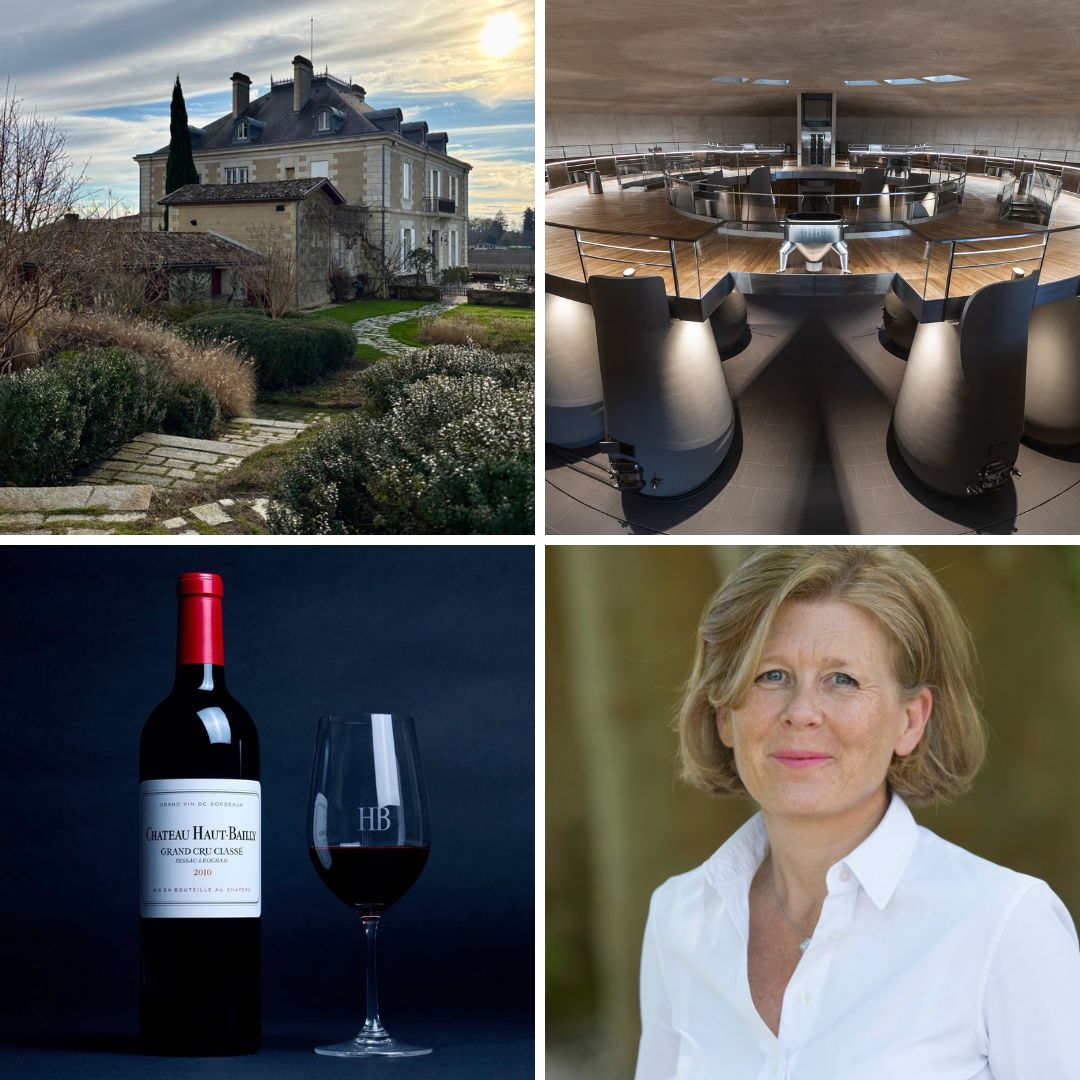
Château Haut-Bailly.
History, however, is never linear. Wars, economic crises and the general decline of Bordeaux in the mid-20th century took their toll. In 1955, Sanders’s great-grandfather, Daniel Sanders, acquired the estate at a time when Bordeaux vineyards were changing hands for very little. A devastating frost in 1956 tested the resilience of both vines and family, but the foundations for revival were laid.
That long arc of continuity matters because Haut-Bailly has never been shaped by one single moment of glory, but by the slow accumulation of intent — and by the people willing to hold the line through changing times.
Custodianship as a Philosophy: From Family Legacy to Transatlantic Partnership
The Sanders family guided Haut-Bailly through renewed investment and strong vintages in the 1960s, 70s and 80s. Yet in 1998, inheritance and fiscal realities forced the sale of the estate. Enter Robert Wilmers, an American banker, passionate about Bordeaux and its Grand Crus, with a long-held dream of owning a vineyard in the region.
Véronique Sanders – Van Beek.
Crucially, Wilmers did not arrive to rewrite history. Instead, he placed his trust in Véronique Sanders, then still a young woman in a deeply traditional environment. Her appointment as General Manager was bold at the time, but it proved decisive. Built on mutual respect and high expectations, the partnership allowed Haut-Bailly to evolve without losing its soul.
Chris Wilmers and Véronique Sanders – Van Beek.
Since Robert Wilmers passed away in 2017, Sanders – van Beek continues to run the estate in close collaboration with the second generation of the Wilmers family and more specifically with his son Chris Wilmers. “We are not owners in the absolute sense,” she explains. “We are custodians. Our duty is to pass on something in better condition than we received it.”
That mindset — stewardship rather than possession — is not abstract. It influences everything: selection decisions that sacrifice volume for purity, long-term investments that may only show their full value decades later, and a refusal to chase trends even when they appear commercially irresistible.
Haut-Bailly in Motion: Progress Without Disruption
For an estate so deeply anchored in history, Château Haut-Bailly is remarkably dynamic. One of the most striking impressions from our visit was not only how much has changed in recent years, but how naturally those changes feel — never disruptive, never cosmetic, always aligned with the château’s long-term identity.
A key milestone in this evolution was the acquisition of La Chartreuse in 2012, located just 800 metres away. Formerly known as Château Le Pape, it was not simply absorbed overnight into the Haut-Bailly universe. Instead, it was approached with the same quiet discipline that defines the estate’s winemaking: restore what is essential, refine what is needed, and only then allow it to carry the Haut-Bailly identity.
La Chartreuse was renovated over several years and developed into a guesthouse, reinforcing a broader shift in Bordeaux: the growing importance of hospitality as part of a château’s modern expression. Yet the more revealing part is how the vineyard integration was handled. For nearly a decade, the team walked the parcels, learned their nuances, and progressively raised the quality before the fruit was finally incorporated into the Haut-Bailly blend. The final vintage released under the Château Le Pape name was 2021 — the end of a chapter that now feels less like a brand decision and more like the completion of a long transition.
La Chartreuse Haut-Bailly.
This same philosophy of progress without rupture is embodied in Haut-Bailly’s new cellar, inaugurated in 2020. Architecturally, it is modern yet discreet, half-buried and seamlessly integrated into the landscape so it feels like a continuation of the estate rather than an interruption of it. Beneath the surface, it is a cellar designed around precision, flow and the practical realities of harvest.
Haut Bailly’s Cellar, which is largely built underground.
Grapes arrive under cover, preserving integrity in heat or rain. Logistics are designed so tractors never cross paths, creating calm efficiency at the busiest moment of the year. After sorting, fruit is transported in small-volume carts to avoid crushing and oxidation, then moved by gravity into a network of stainless-steel and concrete vats arranged in circular form. Everything is monitored in real time, giving the team absolute control over fermentation and extraction.
Château Haut-Bailly boosts one of Bordeaux’s most beautiful cellars.
What emerges from these developments is not a château reinventing itself, but an estate refining its ability to express what it has always been. Haut-Bailly evolves like its wines do — slowly, deliberately, and with an unshakable sense of proportion.
Haut-Bailly’s Marvelous Barrel Cellar.
Style Over Fashion: The Haut-Bailly Signature and the Role of Selection
Few estates articulate their philosophy as clearly as Haut-Bailly. The château has consistently resisted short-term trends, even when doing so was financially tempting. The guiding principle is simple: la mode change, le style reste — fashion changes, style remains.
For Haut-Bailly, style is defined by elegance, silkiness and depth, with power expressed through harmony rather than force. It is a tactile wine, often described by Sanders – van Beek as a caress rather than a statement. Chasing trends, she argues, inevitably leads to a loss of identity.
That identity begins in the vineyard. Haut-Bailly’s core estate consists of 30 hectares in one single block around the château, planted exclusively to red varieties. Cabernet Sauvignon dominates, supported by Merlot, with small amounts of Petit Verdot and Cabernet Franc. At the heart of the estate lies an extraordinary four-hectare parcel of century-old vines, co-planted with multiple varieties — a rare survivor of older Bordeaux viticulture. Rather than isolating this parcel into a special cuvée, the château uses it as a structural anchor in the Grand Vin, believing that the strength of blending is fundamental to the estate’s consistency.
Harvesting in the Vineyards surrounding the Château.
Selection is where philosophy becomes reality. Haut-Bailly was among the pioneers of second wines, producing one as early as 1967: La Parde de Haut-Bailly. Long before the trend accelerated in the 1980s, the estate already understood that precision begins with what you choose not to include.
Since 2018, the former La Parde de Haut-Bailly has been renamed Haut-Bailly•II — a deliberate statement of pride and clarity. The second wine is not an afterthought, nor merely a home for lesser parcels. It is crafted with the same attention as the Grand Vin, offering a different interpretation of the terroir, often with a slightly more immediately charming profile.
Declassification levels underline this commitment to quality. Where previous generations might have diverted 30% of production away from the Grand Vin, today that figure can reach 50%, spread across second and third wines. The result is that Haut-Bailly II frequently represents what would have been considered Grand Vin quality a generation ago — an important lens through which to view both value and accessibility.
The Hinge Moment: Tasting Haut-Bailly 2022 and Seeing the Philosophy in the Glass
All of these ideas — style, restraint, precision, and the long view of time — are convincing in conversation. But at Haut-Bailly, they become undeniable in the glass.
During our interview we tasted the 2022 Grand Vin, poured early and revisited repeatedly as themes of climate, selection and identity unfolded. That context matters. The wine did not simply accompany the conversation — it became part of it, opening gradually as the discussion deepened.
In its youth, the wine already conveys a striking sense of balance and calm authority, despite being shaped by one of the driest growing seasons in recent memory. The nose opens with classic Pessac-Léognan markers: graphite, finely crushed gravel and cedar, layered with dark berries, blackcurrant leaf and subtle floral tones. There is ripeness, but no excess.
On the palate, 2022 Haut-Bailly is remarkably tactile — a description Véronique herself often returns to. The tannins are fine-grained, silky and persistent, creating a sensation closer to texture than structure. Freshness is the defining counterpoint, lending lift and precision to what is, beneath the surface, a concentrated wine born of very small berries and low yields.
What stands out most, tasted slowly over time, is harmony. Despite the extreme conditions of the vintage — barely 350 mm of rainfall during the growing season, compared to an average of around 800 mm — the wine never feels forced or heavy. Instead, it expresses restraint, poise and an almost effortless drinkability at this early stage, while clearly retaining the depth and architectural framework required for long ageing.
We award this Pessac-Léognan masterpiece with a 97+/100 DWA score.
Château Haut-Bailly 2022.
If 2022 proves anything, it is that Haut-Bailly’s style is not a nostalgic ideal. It is a working discipline — one that holds under pressure, and perhaps shines most when conditions become extreme.
A Compact Flight After the Tour: Three Wines, One Signature
After the tour and interview, we tasted three further wines that sharpened the picture of Haut-Bailly’s identity: how the Grand Vin matures with grace, and how Haut-Bailly II has become a serious expression in its own right rather than a simple secondary label.
Château Haut-Bailly 2015 – 94/100 DWA score
A beautifully resolved expression of the vintage, balancing generosity with the château’s signature restraint. Dark fruit, cedar, tobacco leaf and a Graves-like mineral edge come together with a supple, suede-textured tannin profile. The wine carries breadth and warmth, but never loses its composure — polished, harmonious, and confidently evolving.
Haut-Bailly•II 2019 – 91/100 DWA score
Proof that the second wine is crafted with real intent. Bright fruit, graphite and gentle spice meet a clean, finely shaped palate. It offers early accessibility without sacrificing precision, and carries a distinctly Haut-Bailly sense of balance.
Haut-Bailly•II 2022.
Haut-Bailly•II 2022 – 93/100 DWA score
A standout second wine in a year of extremes. Ripe black cherry, cassis and floral lift meet gravelly freshness and impressive clarity. Tannins are smooth and tactile, and the wine flows effortlessly — charming now, yet structured enough to develop.
Conclusion – Style as a Long-Term Commitment
Château Haut-Bailly is not defined by a single vintage, a single owner or a single moment of acclaim. Its strength lies in continuity — of place, of people and of intent. From its medieval origins to its present-day stewardship, the estate has consistently chosen patience over haste and style over fashion.
The conversation with Véronique Sanders – van Beek makes clear that Haut-Bailly’s wines are shaped by a long view of time: wines made to be enjoyed today, but conceived for a future the current custodians may never see. In an era increasingly driven by immediacy, that perspective feels both rare and quietly powerful.
Château Haut-Bailly. Always Refining, but true to its Identity.
At Haut-Bailly, greatness is not pursued through excess or reinvention, but through fidelity to terroir and an unwavering belief that the most enduring wines are those that remain true to themselves.
Bordeaux and its Future in the World of Fine Wine- The Series
This article is written by our own Niels Aarts. It is based on our visit in December 2024, as part of our interview series ‘Bordeaux, and its future in the World of Fine Wine’. Stay tuned as we will publish more articles and interviews in this series, featuring leaders of the Bordeaux wine region.
We would like to thank Véronique Sanders – Van Beek, Manon Drougard and the Haut-Bailly team for their warm welcome, time and support in the creation of this article. Picture credits: Château Haut-Bailly.
Join our insiders’ list and get exclusive early access to new articles, expert tips, and fresh reviews delivered straight to your inbox. Subscribe now and be the first to discover!