Join Our Wine Journey – Sign Up for the Newsletter 🍷
Caiarossa – Biodynamic Precision on the Tuscan Coast
Share
Deel op X (twitter)
LinkedIn
WhatsApp
Caiarossa – Biodynamic Precision on the Tuscan Coast.
Where Mediterranean energy meets a Bordeaux-driven pursuit of balance
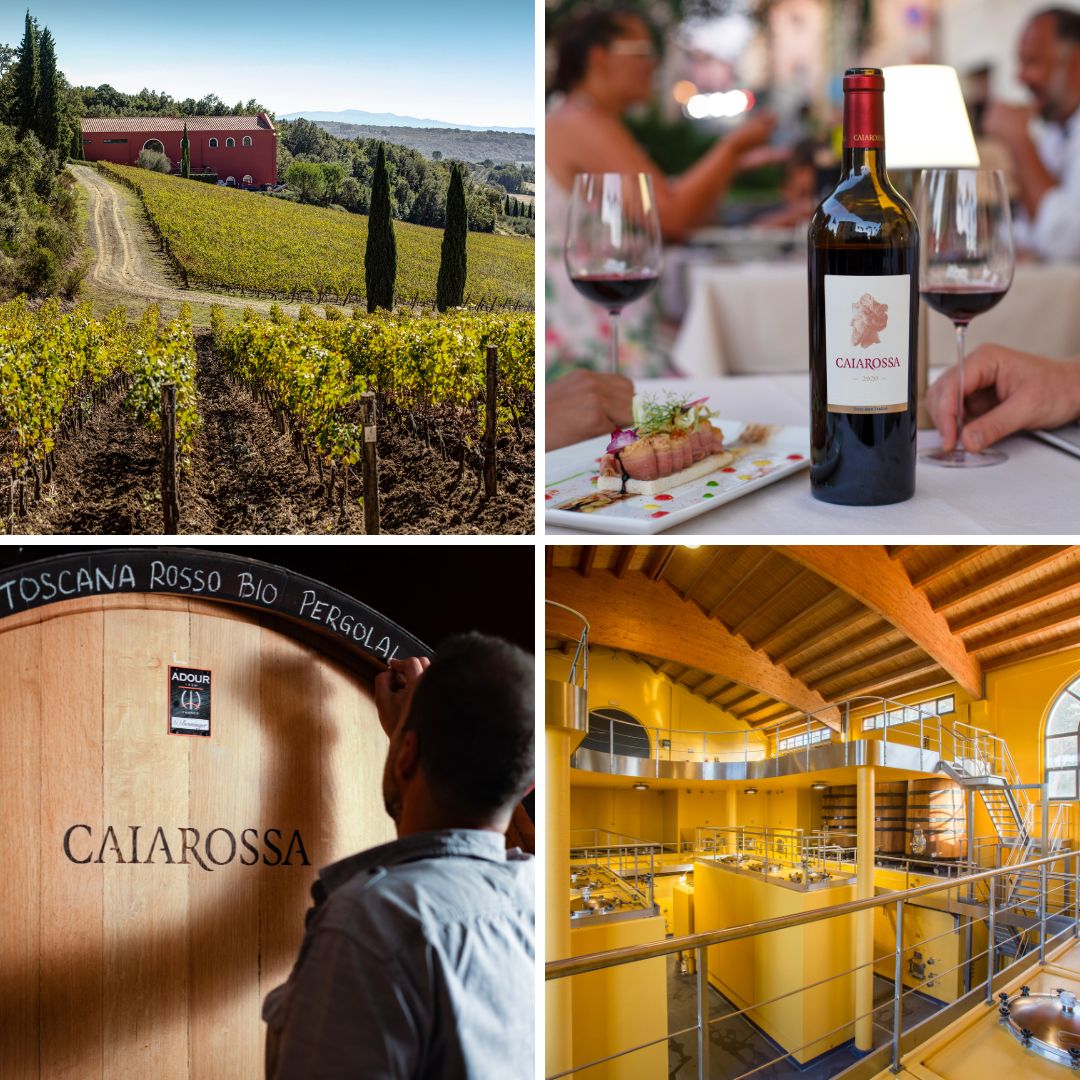
Placed high above the Tyrrhenian coastline, just inland from the village of Riparbella, Caiarossa stands as one of the most distinctive voices in modern coastal Tuscany. It occupies a singular space: geographically close to Bolgheri, yet worlds apart in expression; rooted in Bordeaux heritage, yet fundamentally Tuscan; fully biodynamic, yet guided by scientific precision rather than romantic idealism.
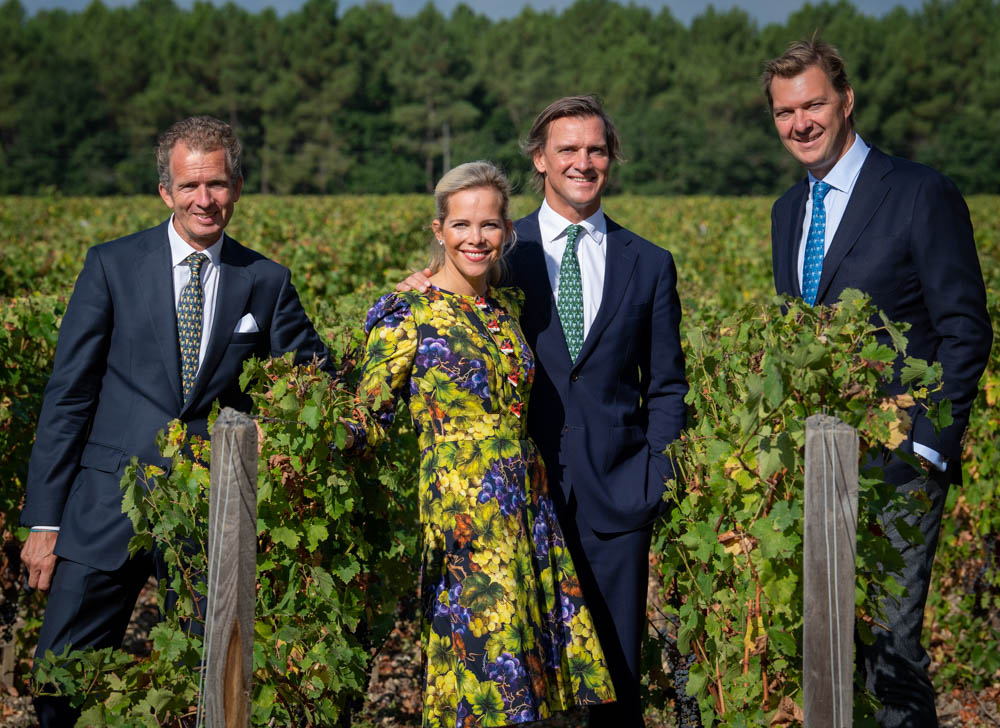
Since its acquisition by the Albada Jelgersma family (owners of Château Giscours) in 2004, the estate has developed from a promising outlier into a confident, articulate winery whose identity is now fully formed. Under the direction of Alexander van Beek, Caiarossa has entered a decisive phase of maturity—one propelled by deep vine development, refined viticultural insight, and a philosophy centered around harmony, authenticity, and expressive detail.
The Albeda Jelgersma Family.
From Etruscan Hills to Modern Vision
Caiarossa was not born from inherited tradition, but from intention. For the Albada Jelgersma family, the search in Italy was driven by a desire for creative freedom and a long-term vision—an opportunity to shape a winery from the soil upward rather than adapt to a legacy already written. That search led them to a rugged, untouched hillside known as Podere Serra All’Olio: a site of striking natural beauty, geological diversity, and untapped potential.
What captivated them immediately was the land’s singular character. Rising to 500 metres above sea level and exposed to both Mediterranean sunlight and cooling maritime winds, the vineyards benefit from a climatic tension that preserves freshness even in warm vintages. Beneath this modern expression lies a deep historical pulse. The region carries Etruscan roots, with archaeological evidence of winemaking dating back some 2,700 years.
The surroundings of Caiarossa.
This lineage finds its echo in the estate’s iconic label, depicting a sculpted head of Dionysus discovered near Volterra and later acquired by Eric Albada Jelgersma—an artefact that unexpectedly reunited the family’s passions for art, history, and wine.
The recovered sculpted head of Dionysus, God of Winemaking.
In Tuscany, Caiarossa remains a rarity: a winery conceived on ancient winemaking soils, yet liberated from the weight of precedent—free to design its vineyards, select its varieties, and define its own philosophy from a blank canvas.
A Landscape of Mosaic Terroirs
One of Caiarossa’s defining attributes is its extraordinary geological diversity. Across 40 hectares of vineyards, soil types alternate in rapid succession:
Ancient volcanic ash
Schist and flint
Compact red clay
Sandstone and loam
Gravelly marine deposits
Caiarossa consists of a mosaic of vineyards.
Rather than impose uniformity, the estate embraces this complexity. Extensive soil studies allowed the team to pair each parcel with the variety best suited to it. As a result, Caiarossa is planted to a broad yet purposeful palette of grape varieties—including Sangiovese, Syrah, Cabernet Franc, Cabernet Sauvignon, Merlot, Petit Verdot, and Grenache, as well as white varieties Chardonnay, Viognier, and Vermentino.
This “mosaic viticulture” is central to the estate’s character. Each wine reflects a different facet of the property, and together they form a complete portrait of the land.
Biodynamics: A Framework for Energy, Not Dogma
Caiarossa was one of the first estates on the Tuscan coast to adopt biodynamic farming. Yet Van Beek insists that biodynamics is not a belief system—it is a framework for observation. By tuning work in the vineyard to natural cycles, soil vitality and vine energy are strengthened, resulting in fruit with greater purity and precision.
Biodynamic work in the vineyards at Caiarossa.
Importantly, Caiarossa’s biodynamics are supported by scientific rigor:
continuous soil and microclimate monitoring
canopy refinements to protect acidity
clonal and rootstock trials
thoughtful water management
and, in recent years, the adoption of estate-selected indigenous yeasts for more controlled, terroir-driven fermentations
This blend of biodynamic philosophy and scientific clarity produces wines that are vibrant, balanced, and naturally expressive.
The Caiarossa Team: Precision Through People
Behind the estate’s technical coherence stands a remarkably stable and committed team. Caiarossa is not driven by individual stardom, but by collective continuity — a group of vineyard and cellar specialists who have grown alongside the vines and now operate with an almost instinctive understanding of the land.
Many members of the team have been part of the project for over a decade, creating a working environment that feels closer to family than hierarchy. Decisions in the vineyard are shaped by constant observation, shared tasting, and daily dialogue between agronomists and cellar staff. This tight feedback loop ensures that biodynamic principles are never abstract, but translated into concrete action — row by row, parcel by parcel.
The Caiarossa team.
The result is a rare alignment between philosophy and execution. Passion is evident, but so is discipline: every pruning cut, every harvest decision, every fermentation adjustment reflects not only knowledge, but collective responsibility. It is this human precision — invisible on the label yet unmistakable in the glass — that allows Caiarossa to transform complexity into clarity.
Winemaking Philosophy: The Pursuit of Juiciness
If one word captures Caiarossa’s identity, it is juiciness. For the estate, juiciness represents the internal “life” of a wine—the pulse of energy that carries freshness through richness and creates drinkability even in youth.
Achieving this relies on:
Precise harvest timing (never overripe)
Gentle extraction
Low to moderate fermentation temperatures
Early blending to encourage harmony
And an emphasis on noble tannins rather than power
Caiarossa’s winery, with views towards the sea.
In a region where heat can easily push wines into heaviness, Caiarossa stands firmly apart. Its wines are generous yet always balanced, expressive yet never overbuilt.
Winery Architecture: Harmony in Form and Function
Caiarossa’s cellar is designed around the principles of feng shui, aimed not at symbolism but at architectural balance. The building is organized vertically, allowing for gravity-flow movement—gentler on the fruit and more aligned with the estate’s philosophy of subtlety.
Natural light fills key spaces, fermentation tanks are positioned for clarity and efficiency, and the barrel cellars maintain ideal conditions with minimal intervention.
The beautiful and state-of-the-art cellar of the winery.
A new hospitality and vinification building is currently in development, designed to enhance the estate’s ability to welcome visitors and share its philosophy in an immersive, educational way.
Four Voices, One Estate
The wines of Caiarossa each speak with their own distinct voice, yet together they form a complete expression of the estate’s identity — one articulated through a single white wine and three reds.
Caiarossa Bianco — A Coastal White with Lift
A rare white from this corner of Tuscany, originally centered around Chardonnay and Viognier, now invigorated by Vermentino. Production is very limited—between 3,500 and 6,000 bottles—yet demand remains high. Textured, aromatic, and fresh, it mirrors the estate’s blending philosophy from a different angle.
Pergolaia — The Sangiovese Expression
Pergolaia is the gateway to Caiarossa’s style: fragrant, juicy, and inherently Tuscan. Driven by Sangiovese, with small Bordeaux-variety components adding softness, it is energetic, saline, and shaped by fine yet vibrant tannins.
Aria di Caiarossa — The Volcanic Voice
From the estate’s highest and stoniest slopes, Aria is defined by its volcanic soils. Graphite-tinged aromatics, mineral tension, and structural finesse give it a personality entirely its own. Increasingly, Aria is recognized as a wine on equal footing with the flagship.
Caiarossa — The Grand Assemblage
The estate’s flagship brings together multiple varieties from its most expressive parcels. It embodies the totality of the estate’s mosaic terroir—aromatic lift from Cabernet Franc, depth from Merlot and Syrah, structure from Cabernet Sauvignon, nuance from Petit Verdot and Grenache. It is the most complete, architectural expression of Caiarossa.
The 2021 Caiarossa, awarded 95-points in our review.
Tasting Notes & Reviews
For this article, Caiarossa’s distributor De Bruijn in Wijnen provided the current vintages of all four wines. Below are our impressions and the ratings from our tasting panel.
2023 Caiarossa Bianco | 93/100 DWA score
A radiant coastal white with tension and texture. Aromas of white peach, citrus peel, jasmine, and crushed stone. The palate is sleek yet layered, combining orchard fruit, salinity, and a gentle phenolic touch. Vermentino adds definition, while Chardonnay and Viognier provide aromatic depth. Long, mineral finish. A beautifully balanced blend.
2020 Pergolaia | 92/100 DWA score
A vibrant expression of Sangiovese from Riparbella. Bright cherry, raspberry, dried flowers, and blood orange define the nose. Juicy and medium-bodied on the palate, with the signature saline kick that characterizes the cuvée. Fine tannins and subtle herbal tones make this both approachable and nuanced. Charming and precise.
2020 Aria di Caiarossa | 93/100 DWA score
A wine shaped by volcanic soils. Aromatics of blackberry, blueberry, graphite, violets, and flint. Focused and refined on the palate, with taut tannins, dark fruit, spice, and crushed-rock minerality. The acidity gives clarity and lift, balancing depth with tension. Distinctive, structured, and full of personality.
2021 Caiarossa | 95/100 DWA score
A poised, expressive and beautifully refined blend that captures the estate’s growing maturity. Deep ruby with lifted aromatics of blackcurrant, plum, wild herbs, exotic spice, and subtle mineral tones. The palate is generous yet vibrant—silky dark fruit framed by noble tannins and a bright core of acidity. Harmonious, balanced, and built for graceful aging.
Caiarossa’s flagship wine and its red stone soil it represents.
We have an extended review of the 2021 Caiarossa available in our review library. You can find it here.
A Future Driven by Experience
With new parcels coming into production and a major investment in hospitality underway, Caiarossa is entering a new phase. The estate’s approach to R&D—shared between Tuscany and Bordeaux—continues to refine canopy management, soil vitality, and phenolic balance. Cross-regional learnings flow both ways: what works in Tuscany helps shape Giscours, and vice versa.
For the estate, the ultimate goal is not expansion, but deepening identity. Each year, the vines grow more rooted, the blends more precise, and the wines more nuanced. Caiarossa’s story is not about chasing prestige; it is about building authenticity through detail, harmony, and respect for place.
Alexander van Beek, the experienced MD of Caiarossa and Giscours.
Conclusion
Caiarossa today stands among the most compelling estates on the Tuscan coast. It occupies a rare intersection: Mediterranean warmth with structural clarity; biodynamic vitality with scientific precision; youthful energy with growing maturity.
Its wines—whether the coastal brightness of the Bianco, the volcanic tension of Aria, the energetic charm of Pergolaia, or the architectural refinement of the flagship—share one unmistakable thread: the pursuit of harmony through balance and detail.
As the estate continues to evolve, Caiarossa is no longer simply part of the conversation about coastal Tuscany. It is helping define where the region is headed.
This article is written by our own Niels Aarts. We would like to thank Caiarossa, in particular Alexander van Beek, and their Dutch distributor De Bruijn in Wijnen for their support and the wines provided. Picture credits: Caiarossa.
Caiarossa’s wines are sold by De Bruijn in Wijnen to retailers and hospitality partners, and to consumers through their webshop.
Join our insiders’ list and get exclusive early access to new articles, expert tips, and fresh reviews delivered straight to your inbox. Subscribe now and be the first to discover!